Rocket Pipe Connect Review: Turn Pipes, Launch Rockets
Fire runs from flame posts to rockets on a 5-by-8 pipe grid, and one branching run can launch two: a Rocket Pipe Connect review.
Game at a glance
Rocket Pipe Connect
6.5/ 10
Our score
Pipe turning plus chain clears: a pairing that makes you look twice.
In this article6 sections
The LIMIT counter at the top of Level 3 in Rocket Pipe Connect shows rotate arrows instead of a flame and reads 80. By the time it has slipped to 78, GOAL, the count of rockets still to launch, has already dropped from 10 to 4.
This is a pipe-linking connect the dots game for mobile, played in portrait. Pipe pieces are turned until a run links a flame post on the left of the grid to a rocket on the right. The linked pipe then burns away, the rocket launches and new pieces fill the gap.
We played Levels 1 to 4, picking up the first near its end and stopping partway through the last. The game blends the pipe rotation of plumber puzzles with the chain clears of connect-and-clear games, and the mix is very enjoyable.
Turning pipes to link flame posts with rockets
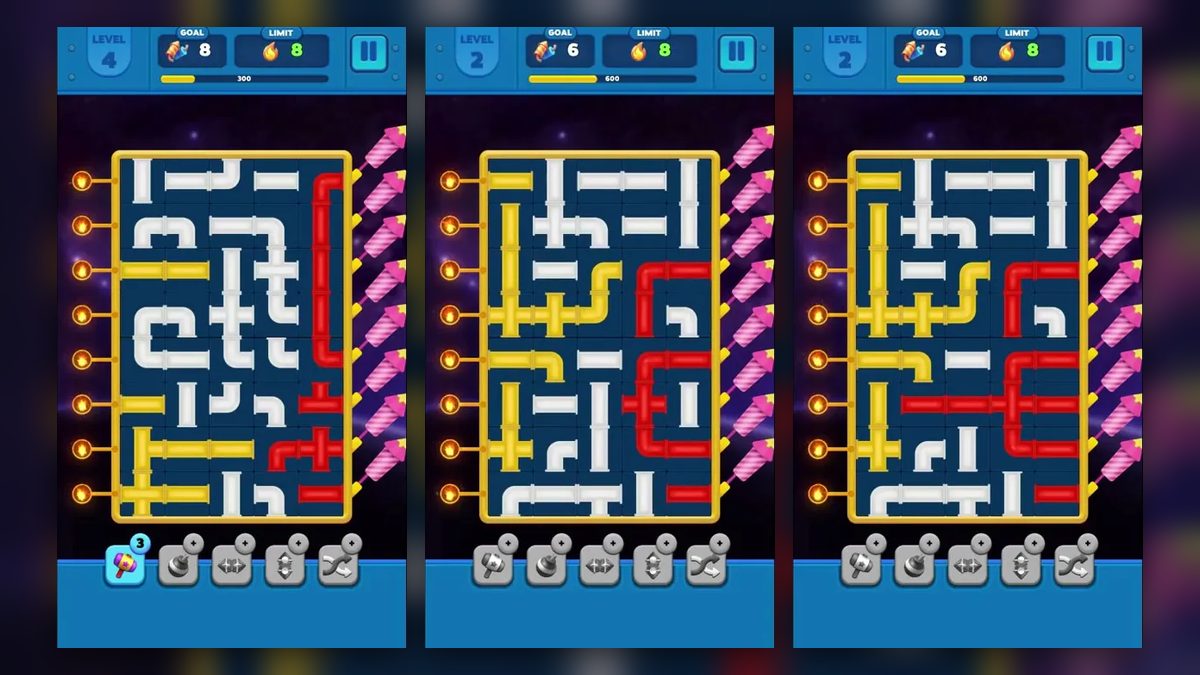
The board is a grid 5 columns wide and 8 rows high, framed in gold against a purple, starry backdrop. Eight glowing flame posts line its left edge and eight pink striped rockets line its right, one of each per row. Above the board, a blue bar shows the level number next to a GOAL panel and a LIMIT panel, with a pause button at the far right. The aim of each level is to launch as many rockets as GOAL asks for, while LIMIT counts down beside it.
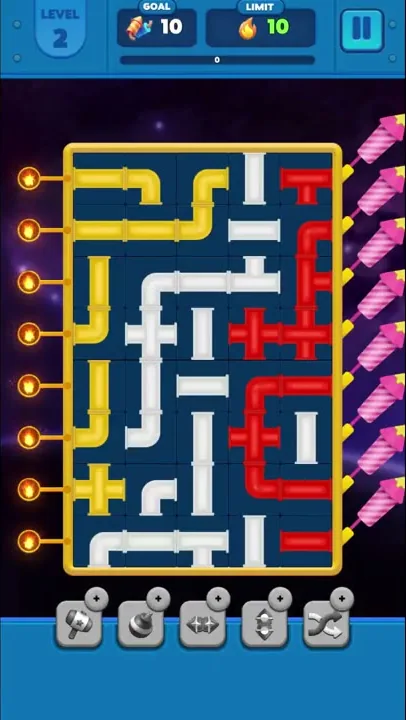
Every cell holds one pipe piece in one of four shapes: straight, elbow, T or cross. The T and the cross are where a run can split, so one run can reach more than one rocket.
Color shows what each piece is connected to. Pipe joined to a flame post is yellow and pipe joined to a rocket is red, while anything joined to neither stays white.
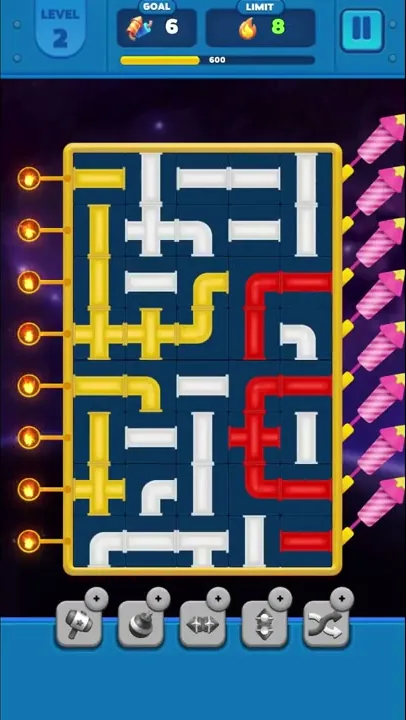
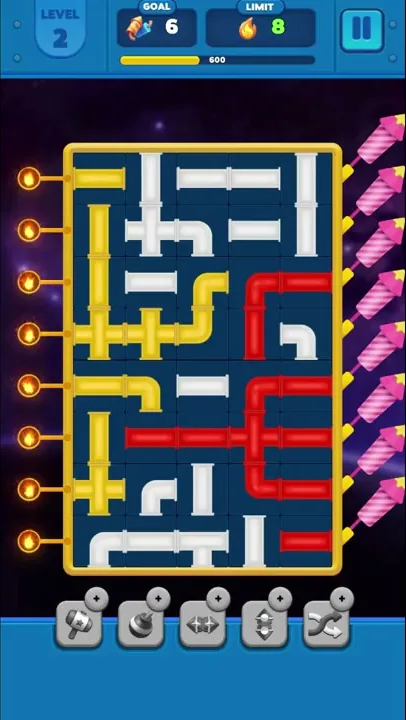
Pieces turn in place on the grid. In the middle of Level 2, two upright pieces in the sixth row were turned to lie flat, and the row went red from the second column across to its rocket as it joined the red network. Turning them cost nothing from the flame LIMIT, which stood at 8 before and after.
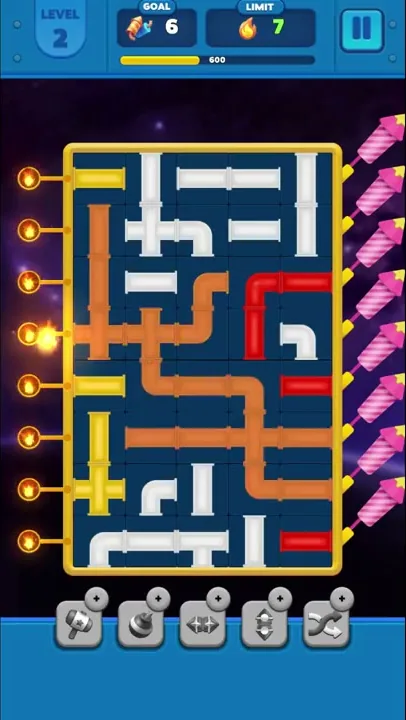
Once a run links a flame post to a rocket, the whole run turns orange. A bright flame then travels along it from the flame-post end, and the pipe it has passed turns gray.
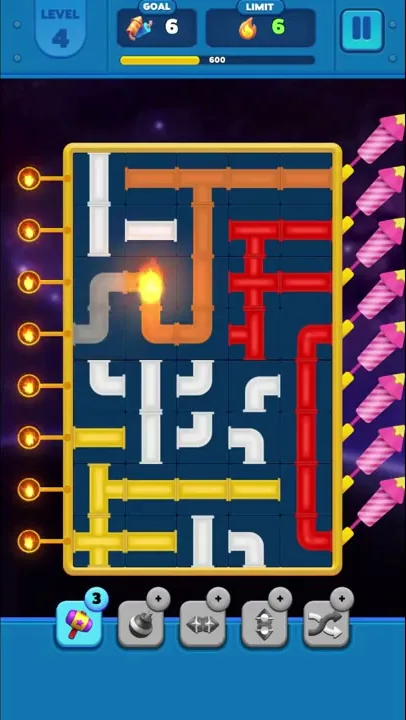
When the fire reaches a rocket, that rocket shoots off the right edge of the board and GOAL drops. Points such as “+100” pop up beside it while sparks and bits of burnt pipe scatter across the grid, and fireworks then burst in the space above the board.
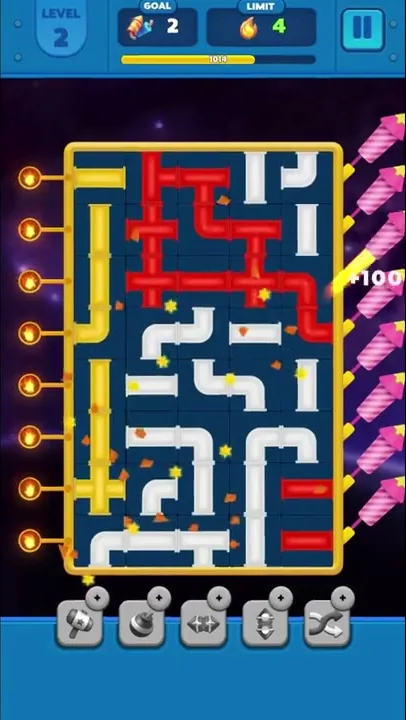
The target in Level 2 is 10 rockets, and its LIMIT of 10 flames falls as fires burn: it was already down to 9 while the first fire was still running. Later, with GOAL at 6, one orange run from the fourth-row flame post branched through T and cross pieces until it touched the right edge in both rows 6 and 7. That single fire took GOAL from 6 to 4.
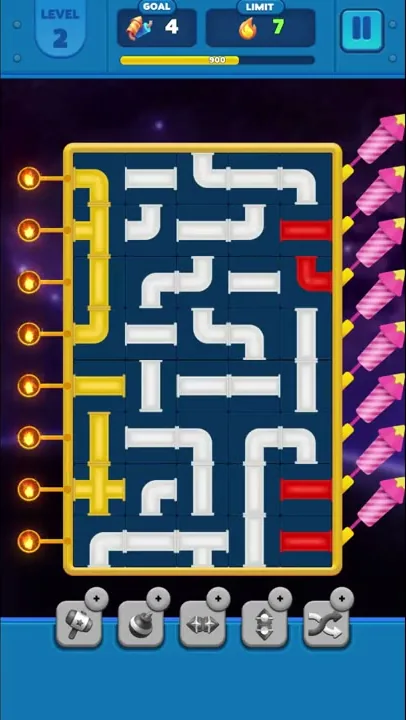
After the fire, the burnt pipe is gone and every emptied cell holds a new piece, most of them white. The next run is built from that refilled board.
From flame counts to a rotation limit
The rocket target holds steady, with GOAL starting at 10 in each of Levels 2, 3 and 4. Near its end, Level 1 sits at GOAL 2 with a flame LIMIT of 7. An orange run crosses its whole second row there, with a branch rising up the fourth column into the top row.
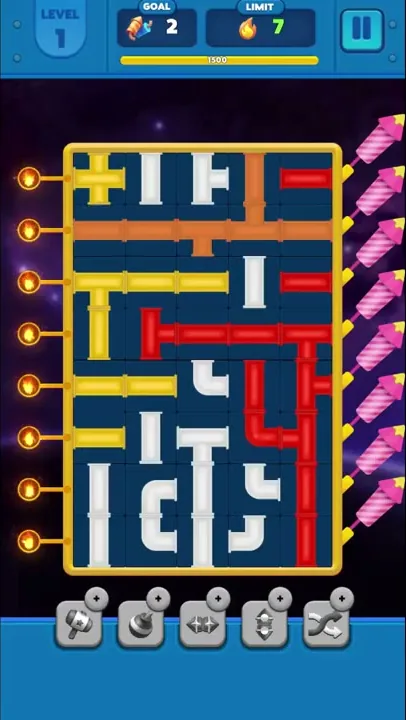
Each level after the first opens on a dimmed board with the limit type shown in the center. For Level 2 that is a large flame icon, and the levels after it show a “LIMIT” banner with an icon beside it.
The rotate arrows on the Level 3 banner mark the one rule change in these levels. LIMIT no longer falls as fires burn; it falls as pieces turn instead, starting at 80, while the target is again 10 rockets.
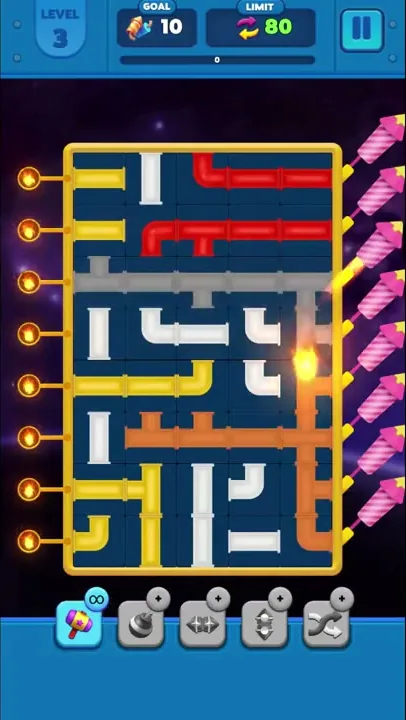
Flames come back in Level 4. Its banner shows a flame icon, and the level starts at 10 flames against a GOAL of 10.
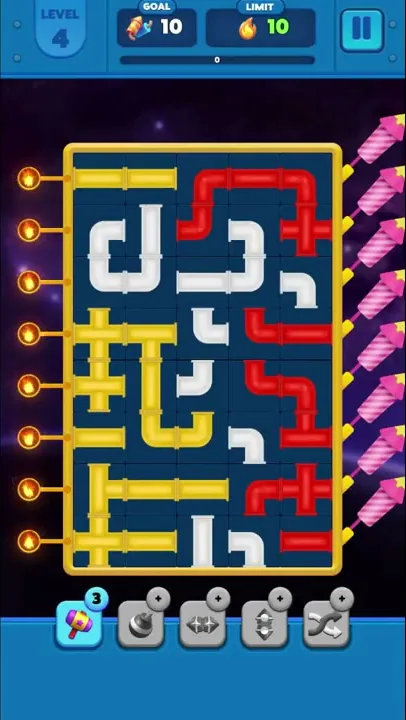
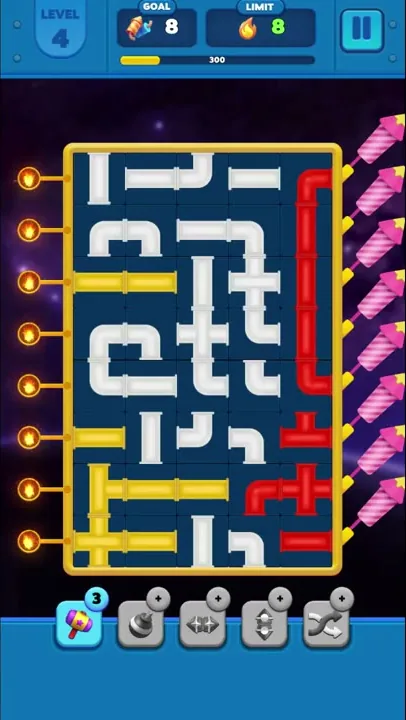
The pieces stay the same from level to level, with all four shapes and a flame post and rocket on every row. What changes is where the colors start. Level 2 opens with yellow pipe down the left column and into the top two rows, and red pipe through most of the two right columns, where two red crosses sit in the fourth row and a red loop spans rows 5 to 7. When Level 4 begins, a yellow pair fills the first two cells of the top row and more yellow fills most of the left two columns from row 4 down, while red sits in the top-right corner and runs down the right side.
Below the board, a blue bar holds five booster buttons: a hammer, a round dark object, a pipe piece with left-right arrows, a pipe piece with up-down arrows and a pair of crossed arrows. All five are gray with “+” badges through Levels 1 and 2, and none of them is seen in use.
Only the hammer changes. At the start of Level 3 a pointing hand marks its button, and through Level 3 it is colored and carries an infinity badge while the other four stay gray. The badge reads 3 once Level 4 begins.
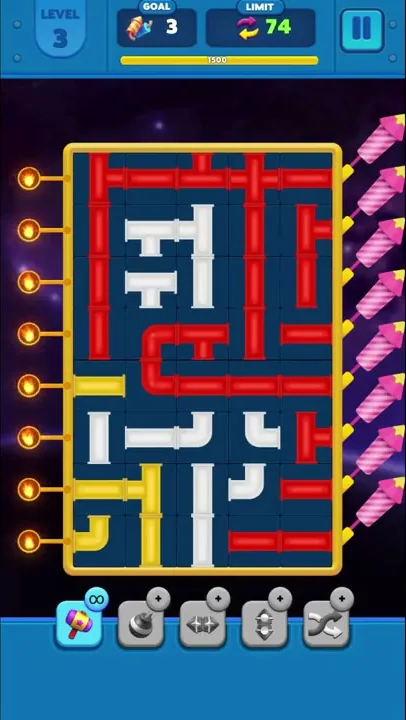
A score bar sits under the GOAL and LIMIT panels. It starts empty when a level begins and fills as rockets launch and their points come in.
Pipe rotation and rocket clears on one board
The pairing of the two halves is very enjoyable, and each one feeds the other. Turning comes first: in Level 2, two turned pieces in the sixth row pulled that row into the red network. Clearing follows, as when one burning run branched through T and cross pieces and launched the rockets in rows 6 and 7 in a single fire, and the refill then hands the turning a fresh board.
It is also a very clever experiment and a very original new spin on casual puzzle games. Seeing pipe turning and chain clears share one board made us sit up.
We still believe in building casual puzzle games by fusing mechanics that complement each other, and casual game studios could put more work into this approach.
Boosters that stay on the bar
We had no criticism of Rocket Pipe Connect, so the points below are only things these levels left unanswered.
None of the five boosters is seen in use. The hammer carries an infinity badge in Level 3 and a 3 in Level 4, but it never appears in action, so its effect remains unknown. The same goes for the other four buttons and what their “+” badges mean.
LIMIT never ran out, so what happens at zero is not shown. No fail screen or continue offer appeared, and neither did a results screen.
Branching runs that reach more than one rocket
The Rocket Pipe Connect gameplay comes down to two jobs: turning pieces until a yellow network meets a red one, and shaping runs that branch through T and cross pieces so a single fire reaches more than one rocket.
The turning draws on a taste for rotating pieces until a path closes. The branching and burning fit a liking for clear-the-board puzzling, where a whole run vanishes and the grid fills back up.
Level 3 sets a budget of 80 turns instead, so every rotation is spent from a fixed pool, which matches a taste for keeping moves few. In the flame levels, LIMIT falls as fires burn rather than as pieces turn.
Verdict
Rocket Pipe Connect rests on a single pairing: rotate pipes into place, then burn them away to send rockets up. Those two halves work hand in hand, and together they make a very enjoyable and very inventive take on casual puzzling. The thinking behind it, building a game from mechanics that fit together, still looks like a good bet.