Screw Puzzle: Nuts and Bolts, a Twist on Chain Puzzles
Screw Puzzle: Nuts and Bolts reached No. 8 on the free chart by having you move screws into empty holes until every bolt falls free.
In this article4 sections
Last week a new game called Screw Puzzle: Nuts and Bolts showed up on the free charts and has been climbing fast. You play by moving screws to new positions to free the bolts, and in our view it is a small twist on chain puzzles, the free-the-linked-pieces games that were a big hit not long before it.
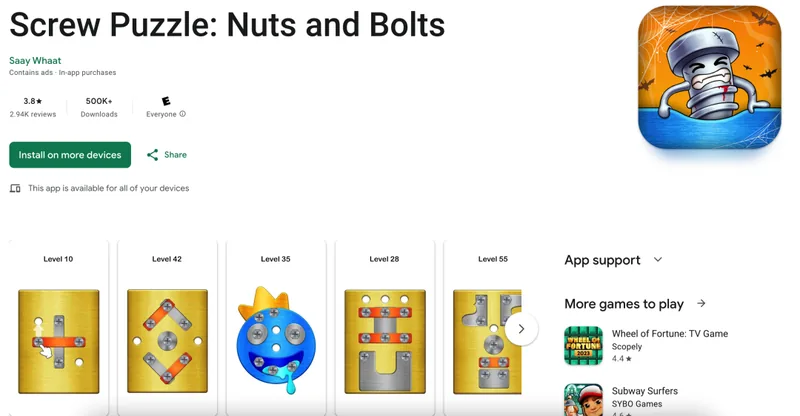
Its ranking tells the story. The game launched on October 2, spent a few days being tuned, then started a heavy ad push to bring in players on October 5. It now sits at No. 8 on the free games chart, which shows how strongly this kind of play draws people in.
Here is a closer look at the game from a few angles.
How the puzzle works
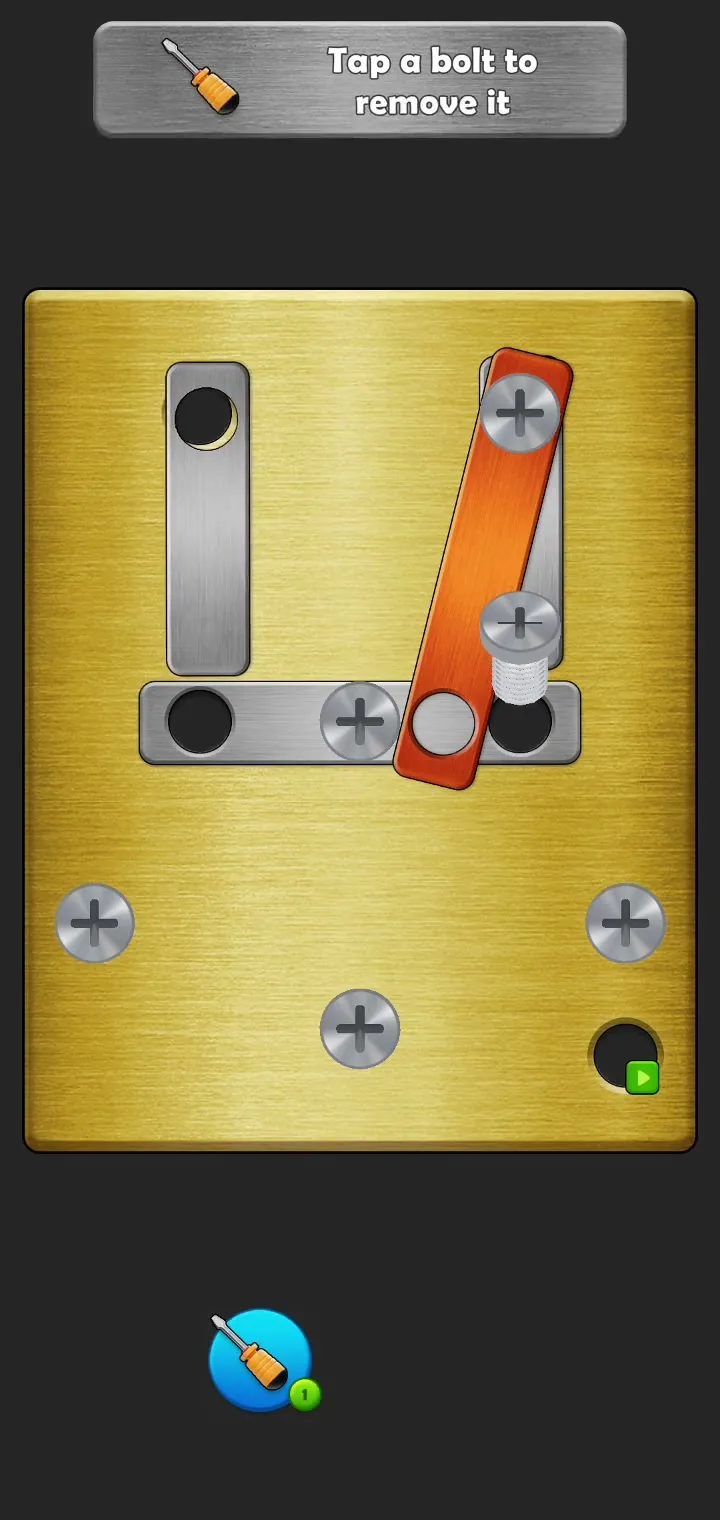
Here is a level in play:
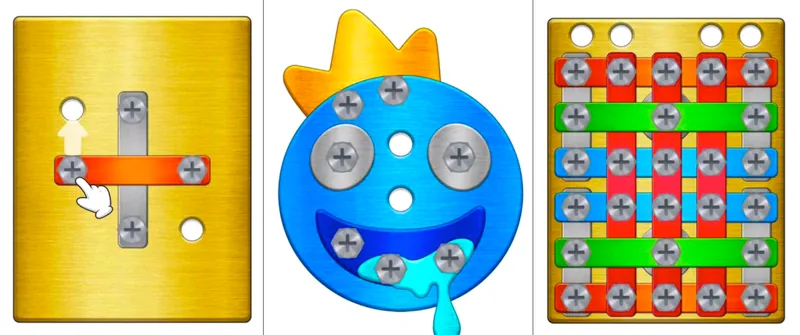
How it works in detail:
- Each level starts with bolts held to a wooden board by screws. Tap a screw to unscrew it, but it doesn’t come off the board: it can only move to another empty screw hole.
- Once a screw is out, the bolt drops a little under gravity. A bolt only truly comes free once all of its screws are out, though, and bolts can overlap one another or get caught on a screw below them, which keeps them from falling.
- The goal of each level is to free every bolt.
In practice, every move comes down to which screw to pull and which empty hole to put it in.
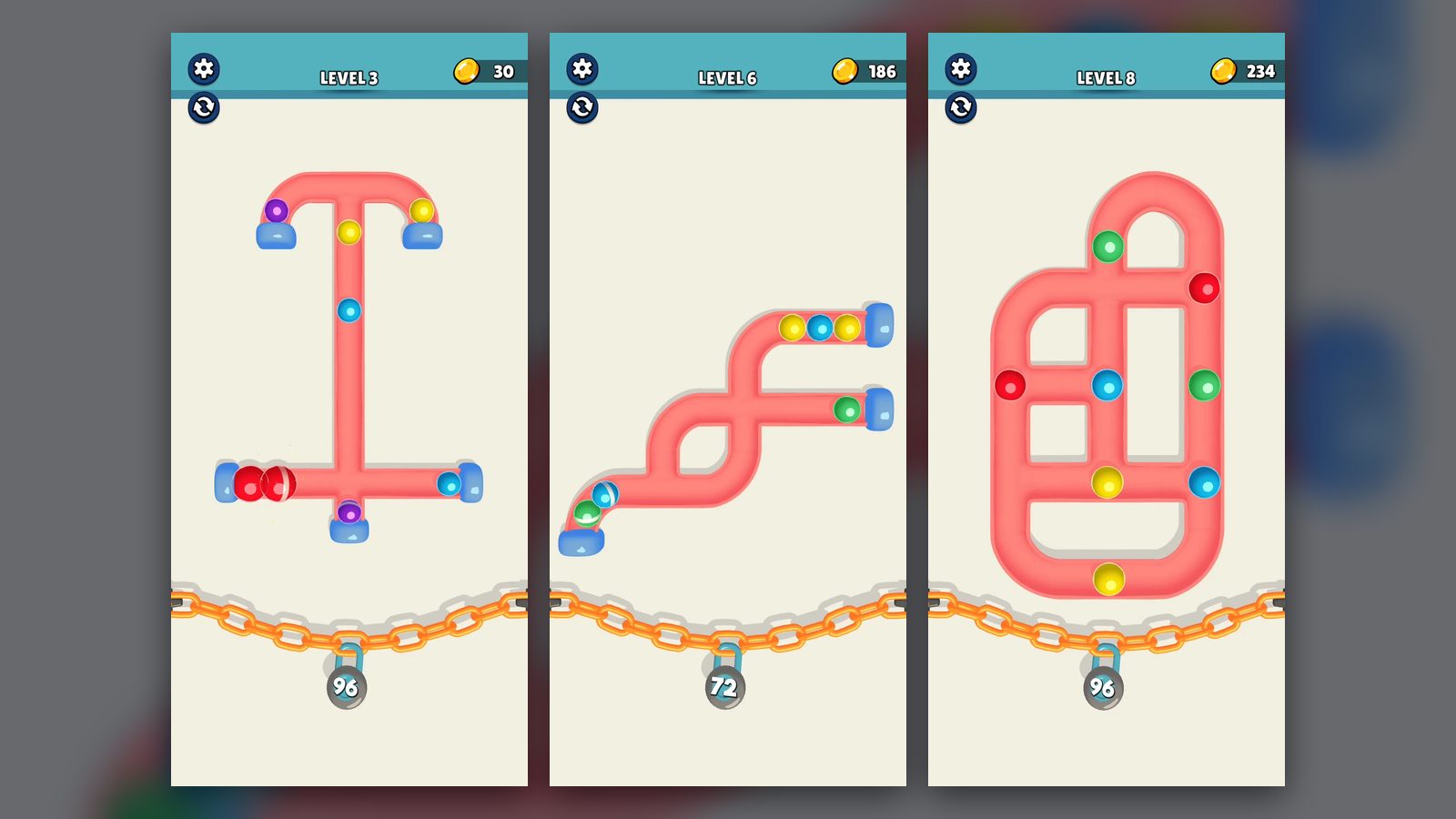
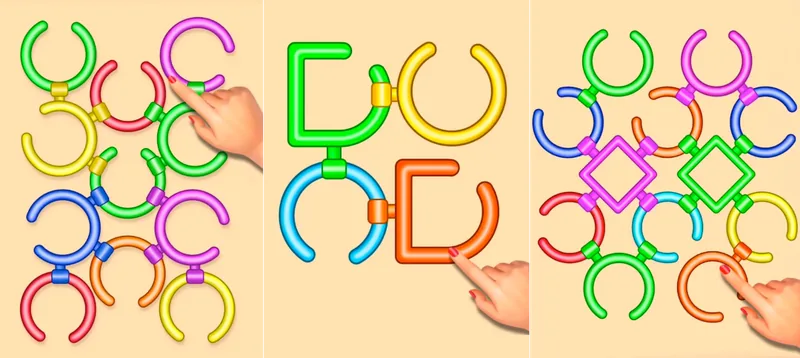
It reads as a modest variation on chain puzzles: both ask you to free a set of objects, and in both, those objects are tied to one another. Here is what a chain puzzle looks like:
Moving Screws Until the Board Is Empty
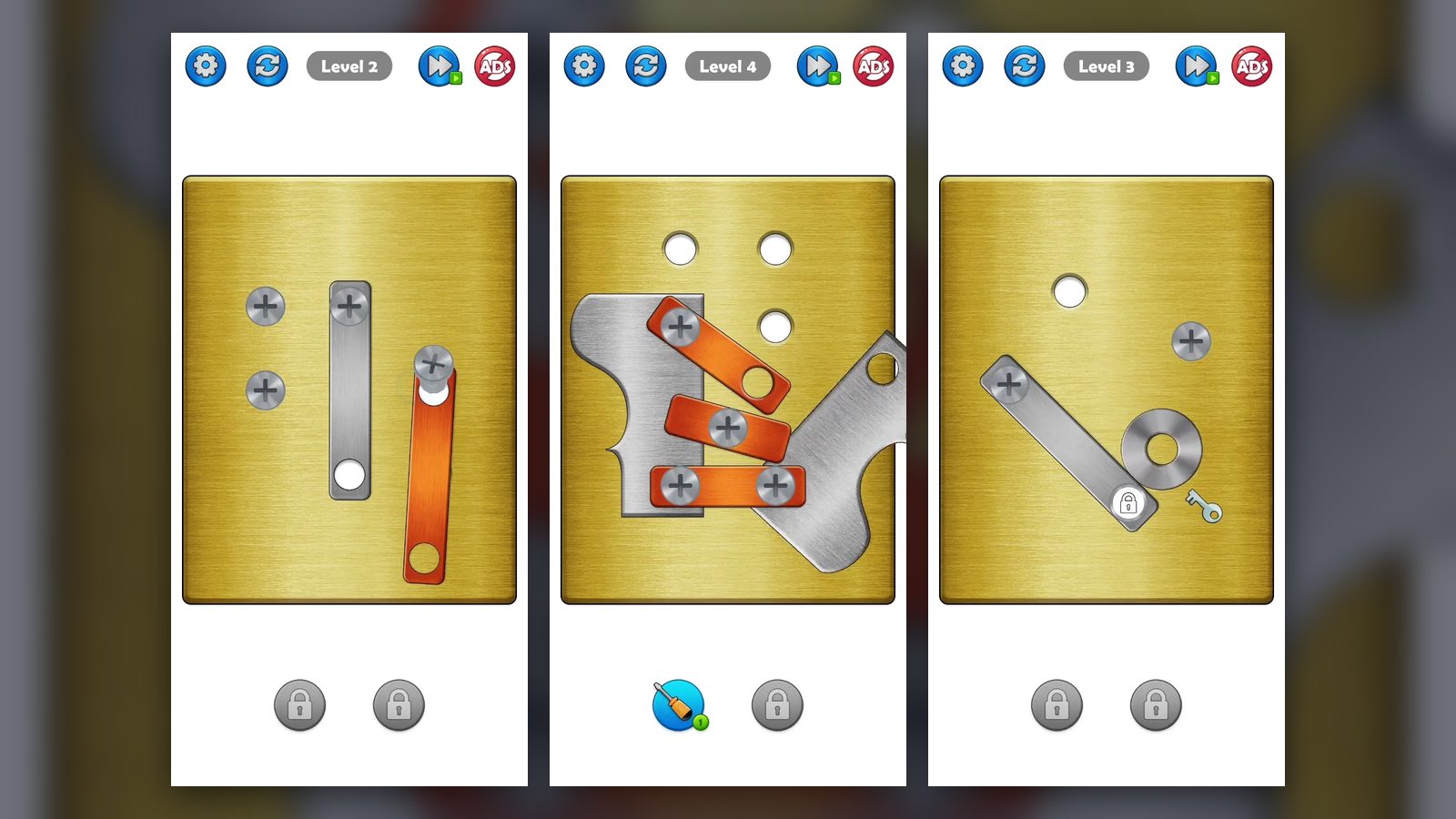
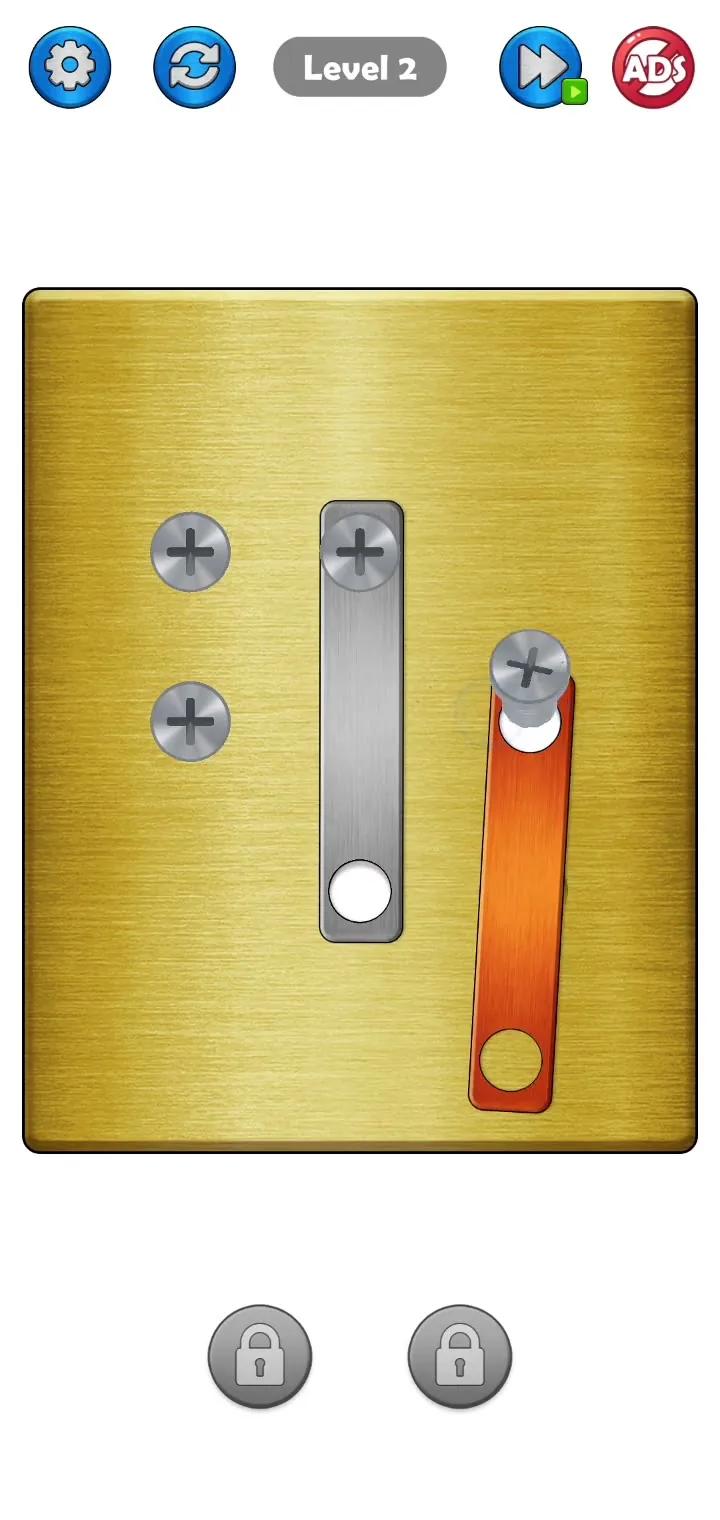
The board is a brushed-gold metal plate, seen straight on against a plain white screen. It carries gray steel bars, orange bars and cross-head screws. A lifted screw stands up out of its hole with its thread showing, and moments later it sits in a hole that was empty before. Early in Level 2, for example, the gray bar’s lower screw moves over to the empty hole on the left.
A piece held by a single screw swings down around it, and a piece with no screw left drops through the board and slides off the bottom of the screen. In Level 2 the orange bar hangs straight down from its one screw while that screw is lifted.
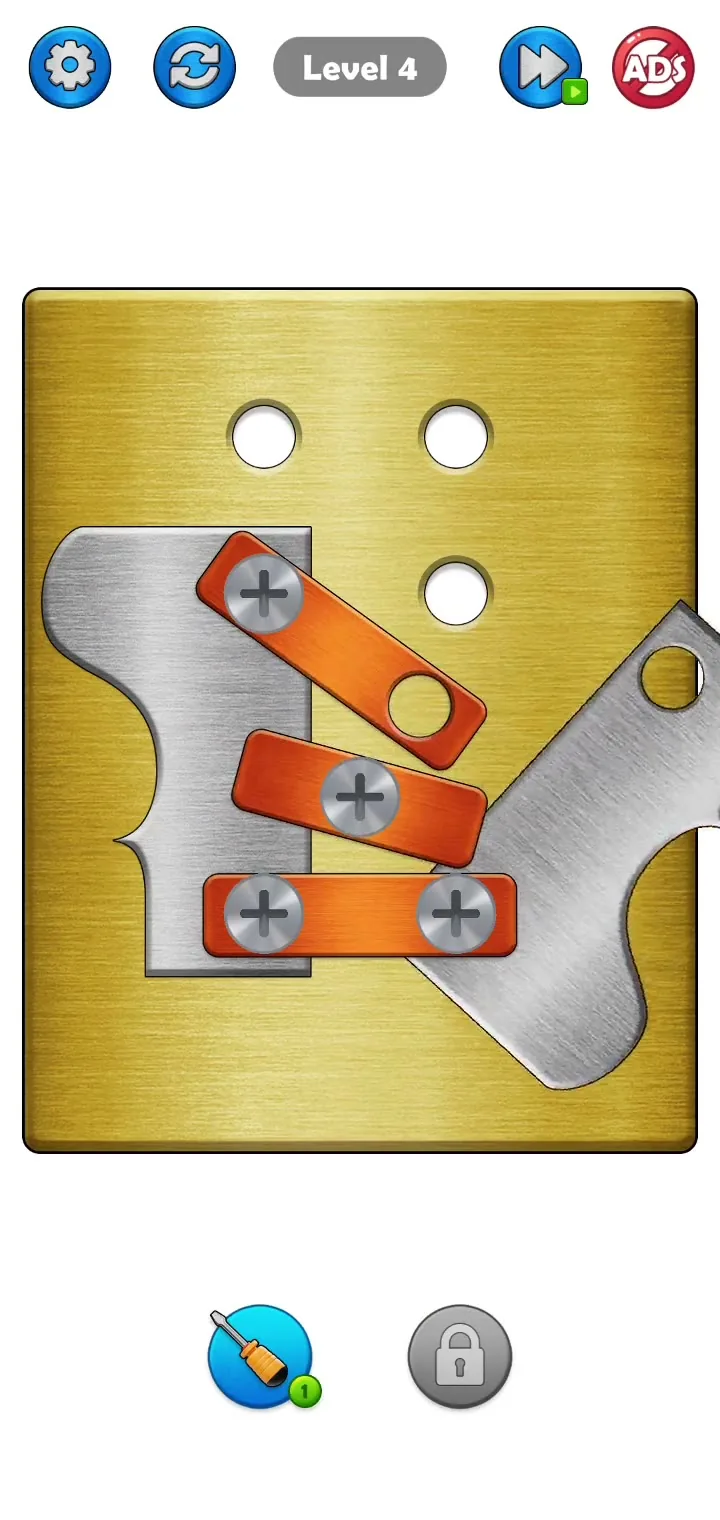
A lifted screw has to go into an empty hole, and each board has only a few free ones. Level 4, for instance, has three, sitting above its pieces.
A level is won once every bar and plate has left the board. At the end of Level 9, confetti falls over a board that holds only screws and empty holes. After Level 7, a results screen dims the board and shows the label “Level 7,” a large green “GOOD!” and a “+110” coin reward, with a coin total at the top right.
The pieces to clear are bars, shaped plates and round discs. Most gray and orange bars have a hole at each end (the Level 1 bar has one hole in its middle), and some longer bars carry three screws. Plates come cut into shapes, from curved cutouts in Level 4 to a T in Level 8 and a wide notched plate and a U in Level 9, while the round silver discs in Levels 5, 7 and 8 each have a screw through the center.
These pieces lie in layers. Early in Level 4, three orange bars lie over a gray plate with curved cutouts while a second cutout plate tips off the right edge. A few seconds later the board is clear of pieces, with the last of them falling below it, leaving four screws in a 2-by-2 group and three empty holes.
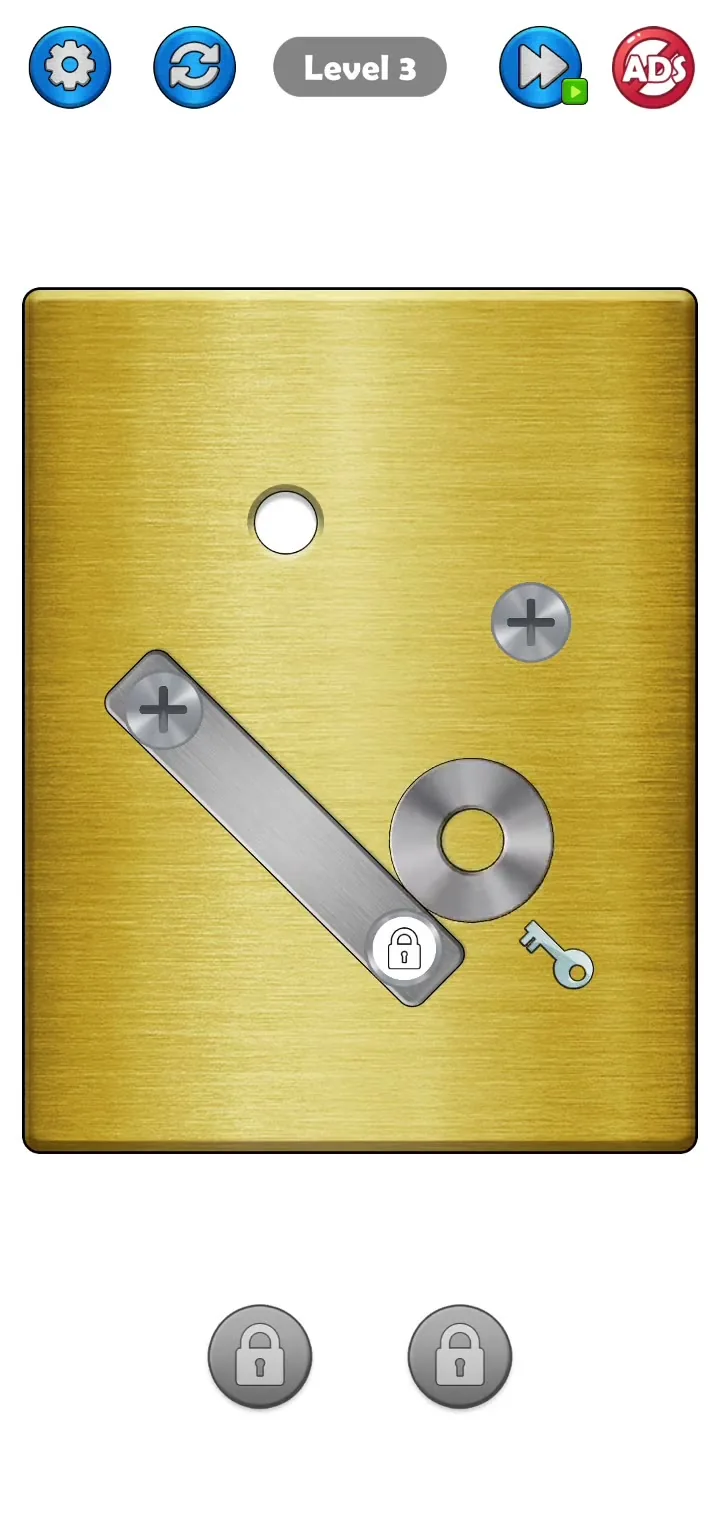
Level 3 brings in a padlock and a key. A white padlock icon sits in a hole-sized white circle at the lower-right end of a diagonal gray bar, and next to the bar are a round silver disc with an empty center and a small key icon. Shortly after, the key, the padlock and the disc are gone, and the spot where the padlock sat is an open hole.
The pair returns in Levels 6 and 7. In Level 6 the padlock marks a hole above a rectangle of two gray bars and two orange uprights, with the key lying below the frame. In Level 7 it sits at the end of a diagonal gray bar again, and in both levels, once the padlock and key are gone, a screw sits in the spot that was locked.
Level 5 swaps the gold rectangle for a blue, furry cartoon face. Its two round silver eye discs each hold a screw, and a red curved mouth plate is held by two. Once one of the mouth’s screws is moved, the plate swings down around the right-hand screw, and a few seconds later it is gone.
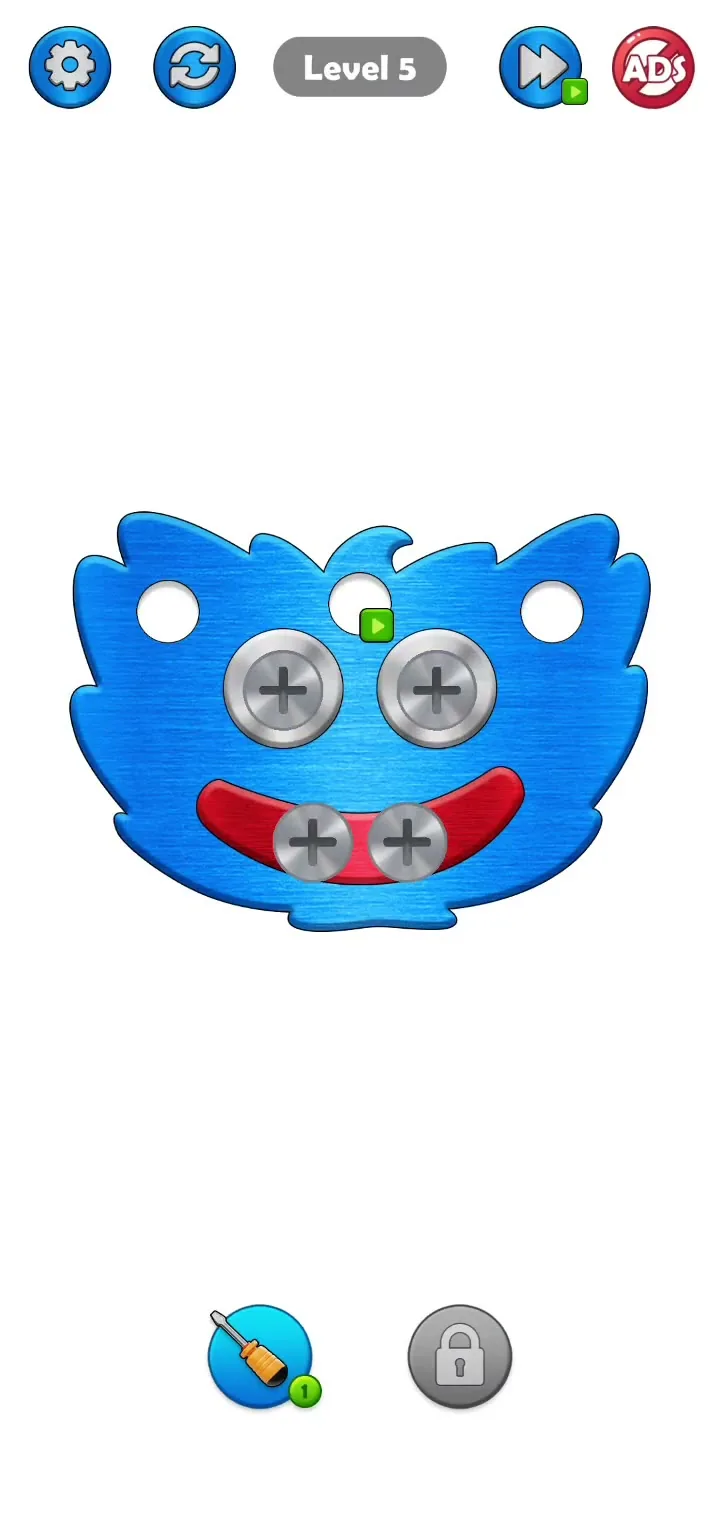
Level 5 also has the first hole marked with a small green play badge: the middle one of three empty holes across the top. Badged holes turn up again in Levels 6 through 10. A similar green play badge sits on the fast-forward button in the top bar and on the “CLAIM x2” button of the Daily Bonus panel.
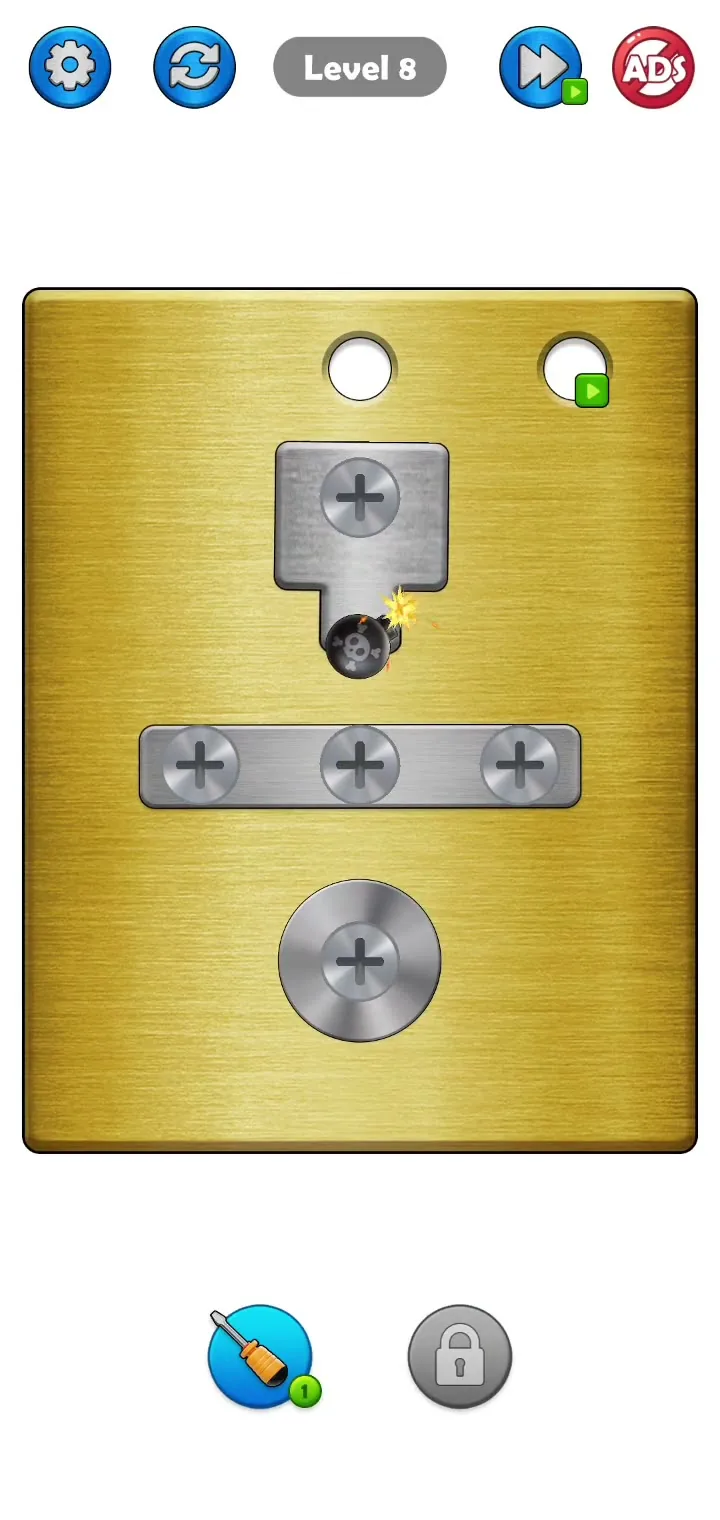
Level 8 adds a black bomb with a skull and a sparking lit fuse, sitting on the lower tab of a T-shaped plate held by one screw. Below the plate are a long gray bar with three screws and a large round disc with a screw of its own. A few seconds later the bomb is gone and the T-plate is falling.
In Level 1 a single gray bar drops off the board, leaving one screw and one empty hole; Level 2 crosses two bars; and Level 3 pairs a bar with a disc. Early in Level 9, a wide notched gray plate tilts across the top of the board with two silver discs on its lower arms, above a row of three empty holes and a U-shaped plate held by one screw in its middle tab.
Early in Level 10, orange and gray bars are stacked into a frame. An orange bar with two screws runs across the top of two gray uprights, a gray crossbar holds three screws, an orange upright runs through the crossbar’s center screw and a short gray bar sits at the bottom. The top orange bar later ends up hanging from its right screw, and at the last moment we saw, two gray bars were still on the board and the orange bar was dropping.
Two round booster slots sit under the board. Both show padlocks in Levels 1 to 3; from Level 4 the left one shows a screwdriver with a green “1” badge, while the right one stays padlocked through Level 8 and opens in Level 9 with a bomb icon and a green “1” badge. When the screwdriver is used in Level 10, everything outside the board turns dark gray and a metal banner reading “Tap a bolt to remove it” replaces the top bar. Afterward its badge shows a green “+” in place of the “1.”
Along the top of the screen sit a gear button, a circular-arrows button, the level label, a blue fast-forward button with its green play badge and a red round button labeled “ADS.” Between several levels, the game’s logo fills the screen on a blue background.
Coins also arrive through a “DAILY BONUS” panel with a seven-day calendar: 100 coins on Day 1, then 200, 300, 400, 500 and 700, up to 1000 on Day 7. Day 1 carries a green check mark, and the panel has a blue “CLAIM” button and the green “CLAIM x2” button, with coins flying to a counter at the top right.
Rough numbers
Average ad rates across the industry (US). eCPM is what an app earns per 1,000 ad views:
| Metric | Value | Note |
|---|---|---|
| Interstitial (full-screen) ad eCPM | $7 | Recent industry average |
| Rewarded video ad eCPM | $10 | Recent industry average |
| Banner ad eCPM | $0.2 | Recent industry average |
These figures are estimates from playing the game:
| Metric | Value | Note |
|---|---|---|
| Play time per player | 20 minutes | Estimated from the 20-minute baseline for hyper-casual (ultra-simple, pick-up-and-play) games, adjusted for this game |
| Interstitials shown per player | 6 | From playing the game |
| Rewarded videos watched per player | 1 | From playing the game |
| Banners shown per player | 40 | A new banner every 30 seconds, 2 a minute, over 20 minutes = 40 |
| ARPU (average revenue per player) | $0.06 | Calculated from the figures above:; ARPU=(6*$7+1*$10+40*$0.2)/1000 |
There is no way to know the game’s retention (how many players come back), but a hyper-casual baseline gives a rough guess: 45% return the next day and 15% on day 7. The game’s eCPI (what it pays for each install) should be fairly low, or it could not have grown this big this fast, so the estimate assumes an eCPI of $0.2.
From those retention numbers, the game’s 30-day LT (the average number of days a player keeps playing) works out to 3.61, derived with a power-law curve. With LTV = LT × ARPU, the 30-day LTV (what an average player earns the game) comes to $0.216, already above the assumed eCPI, so the game will certainly earn back its ad spend within 30 days. That figure is still on the cautious side: going by the usual pattern for hyper-casual games, adding the players who find it on their own should bring the payback time under 14 days, and the game’s expected size looks very large.
Looking ahead
The idea probably isn’t original. A game with the same play already appeared back in August, but unfortunately it peaked at only No. 18 on the overall free chart, and it is already sliding.
Our time with it pointed to one main problem: the levels are far too hard, and the difficulty doesn’t build up step by step, so too few players stick around and the game’s growth is badly limited.
In effect, this game improves on that August release in three ways:
- Difficulty that ramps up gradually from level to level
- Levels that are more fun
- Better performance
So polishing a game that is already on the charts and giving it a small twist still offers some opportunity; the key is the thinking behind it. Going by how it plays, this game still has room to get better, and its developers could try more polish and a few more new wrinkles.