Box Smash Review: Jelly Blocks That Stick by Color
Box Smash review: one block slides per move, same colors stick into bars, and boards range from a cross to a spiral with arrow tiles at its turns.
Game at a glance
Box Smash:Hit the Colors
6/ 10
Our score
A familiar slide-and-clear formula in new packaging, with a sticky rule built on top.
In this article6 sections
Box Smash is a familiar puzzle formula in new clothes, and it sits in the middle for us. Its slide-and-clear play is well known from ultra-simple pick-up-and-play games. On top of that it has a sticking rule of its own and strong, vivid colors.
It belongs with merge games and does its merging with colors. One block moves at a time and slides until a wall or another block stops it. Same-colored blocks that end up touching join into one bigger piece, and groups of a single color disappear from the board. We played 14 levels, spread across anything from one to four boards at a time.
Sliding jelly blocks until colors stick
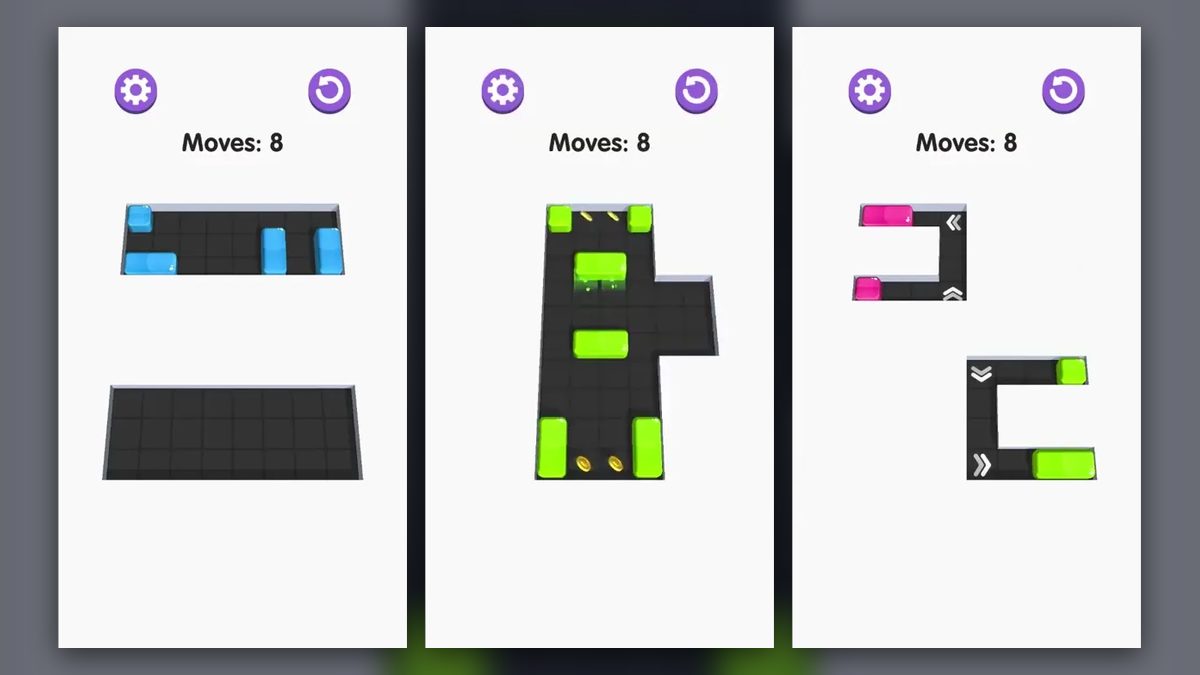
A move shifts a single block rather than the whole board, and the rest stay put. In one level with three stacked boards, the top two are already empty when a lone pink block in the bottom board’s second row runs all the way to the left wall. Its neighbors hold still, and the Moves counter drops by one. A sliding block leaves a short, faded trail, like the blue one streaking up the right leg of the H-shaped board toward the blue bar at its top.
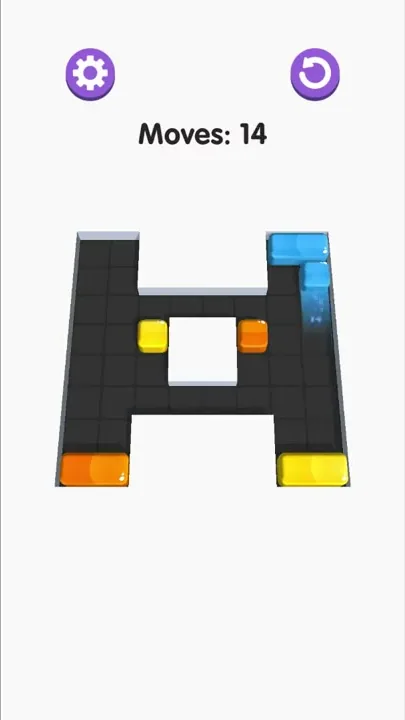
A bold “Moves:” counter sits above the board and counts down as blocks are moved. Four of the larger levels, the H-shaped board among them, come up with 20 moves to spend.
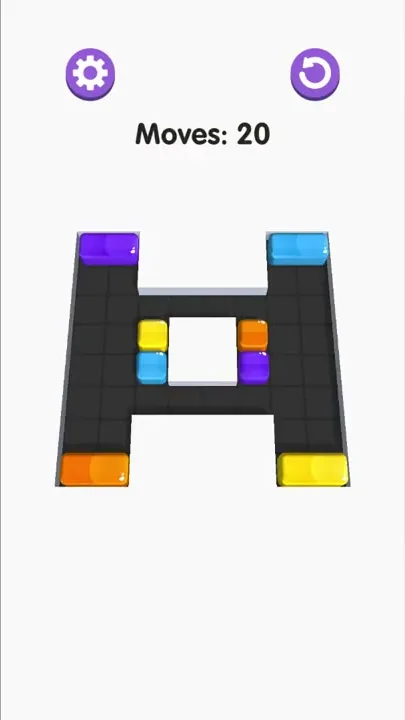
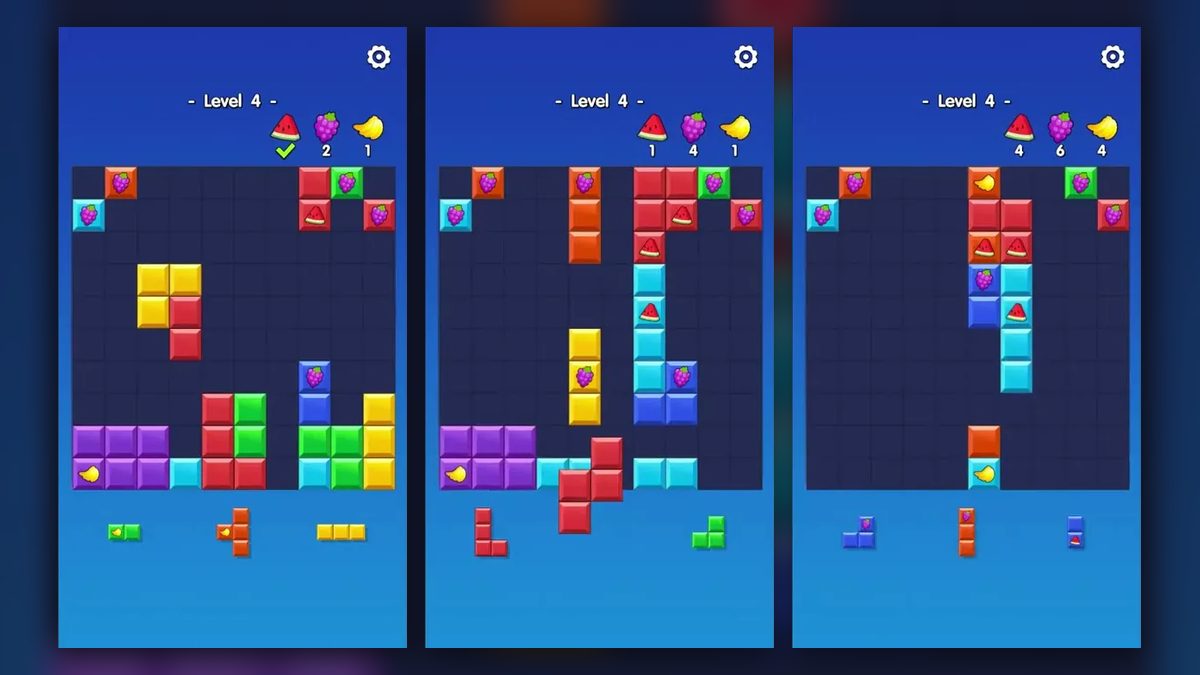
The pieces are glossy, jelly-like blocks with a small white highlight, in six colors: pink, orange, yellow, lime green, light blue and purple. Each is either a 1-cell square or a 2-cell bar, and bars lie flat or stand upright. The boards are dark gray grids with light gray rims. They are seen from slightly above at an angle, so the blocks show their sides.
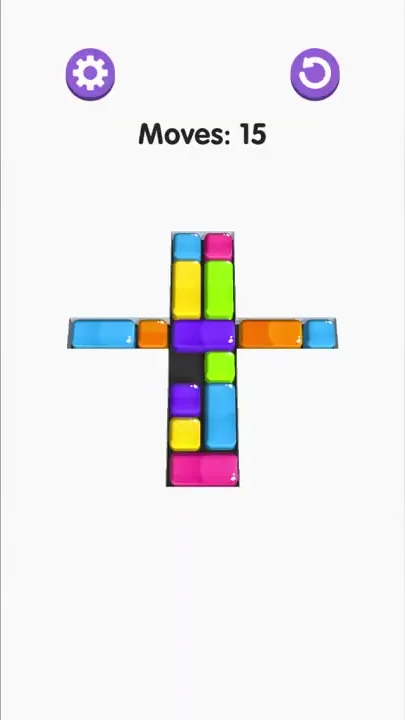
One level puts two small boards side by side with all six colors on screen at once. Both are three cells wide. The left one has an extra cell on top and holds four colors, each as one bar plus one single block. The right one has an extra cell at the bottom and holds pink, blue and purple in the same pairs, plus three single orange blocks.
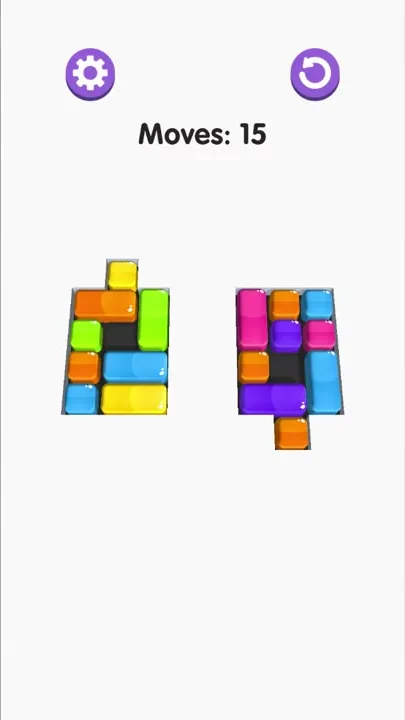
Both boards are packed with 15 moves still to spend. Two moves later, pink and purple are gone from the right board. After two more, blue has gone from that board too, and two orange singles have stuck together into an upright bar. Five moves after that, the right board is empty and only blue and yellow remain on the left.
That orange pair is the sticking rule at work: blocks of one color that end up side by side merge into a single piece. On a wide board, single blue blocks sat at the top and bottom of two columns on the right. A couple of moves later, each of those columns held one unbroken blue 2-cell bar.
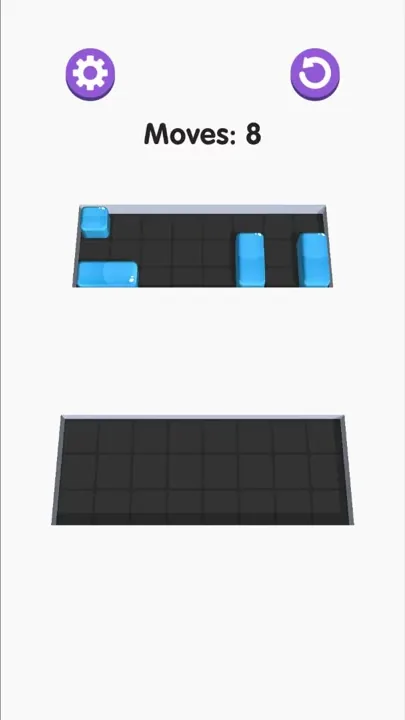
Same-colored groups then vanish. On the cross board, four of the six colors disappear over four moves, leaving only blue and pink behind. Cleared pieces shrink in place as they go: on the spiral, a yellow bar and a single yellow block dwindle away in the inner track. The two blue bars formed on the wide board, on the other hand, are still in place right after they join.
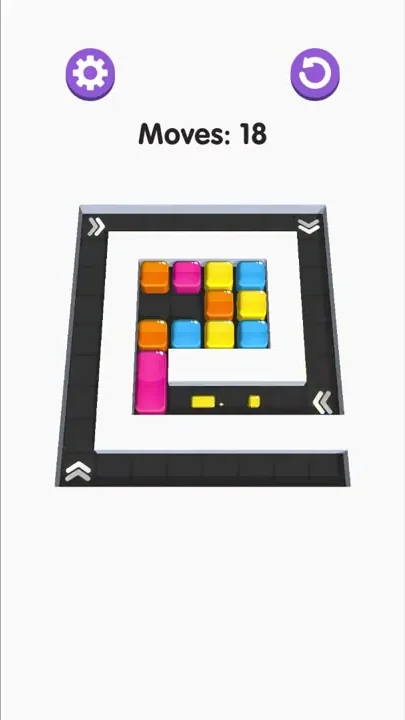
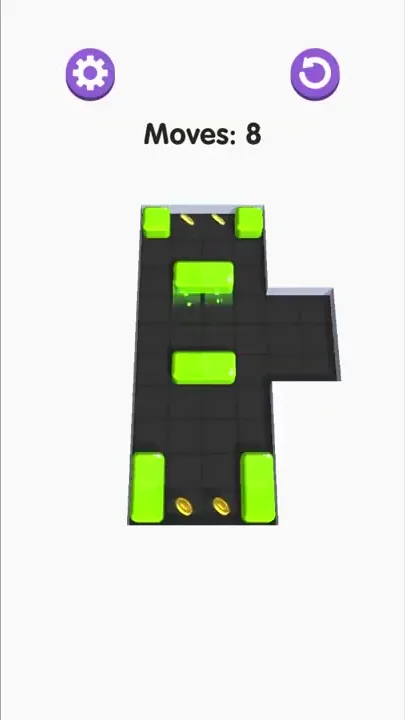
Flat, coin-like gold discs lie on board cells in two early levels. In one, two of them sit in the bottom row between a pair of yellow blocks. An all-green level has two in its top row and two in its bottom row, each pair between green blocks.
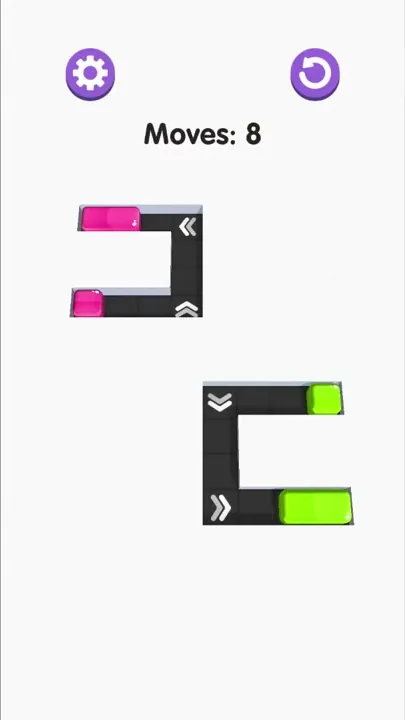
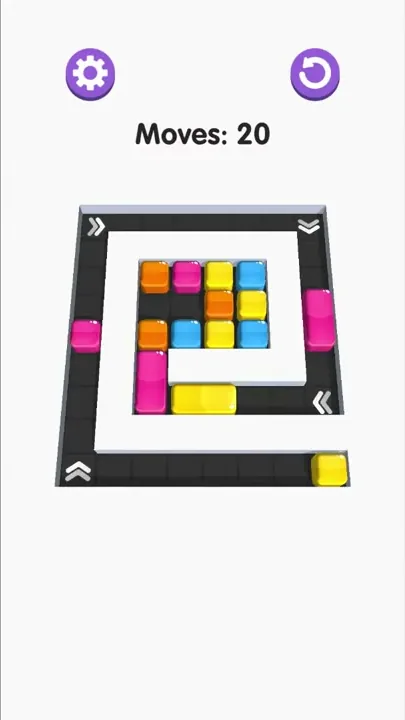
Arrow tiles are board cells marked with white double chevrons, each pointing one way, and they sit at the turns of narrow tracks. Two U-shaped tracks, one opening left and one opening right, carry them at all four inner corners. As the spiral comes up, a yellow block waits at the right end of its outermost bottom track; two moves later it has left that spot, and yellow pieces are shrinking in the inner track at the far end of the spiral. No block is seen turning on an arrow, so what the tiles do is not confirmed.
A level can use one board or several separate ones, and board shapes vary. Narrow tracks bend into L and U shapes or end in a T. Larger boards form a cross or an H with a square hole in its crossbar, and one coils into a spiral. The cross is a column two cells wide crossed by an arm one cell tall, packed with blocks in all six colors.
From one straight bar to a spiral of arrows
The early boards are small. One is a single straight bar one row deep, and the others around it are narrow tracks or compact boards with one to three colors each. The Moves counter reads between 3 and 9 in these levels. Several boards share the screen early on: one level spreads over four separate boards, with pink and blue blocks on two of them.
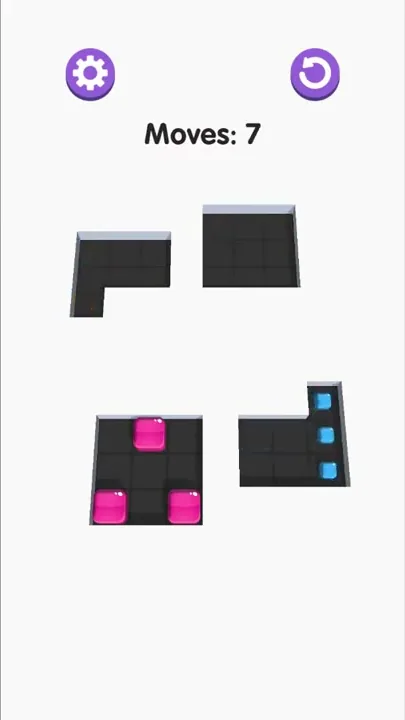
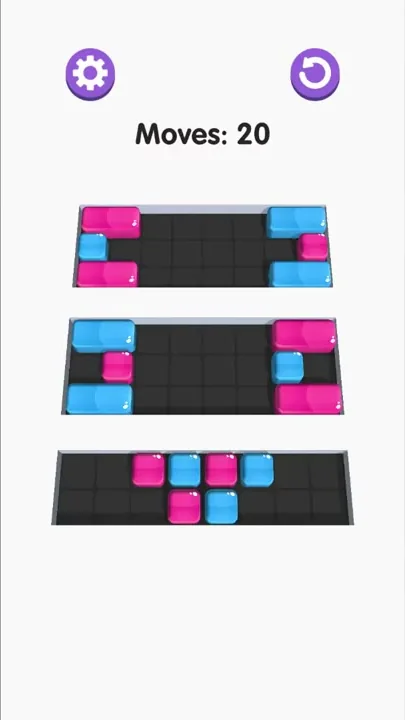
In the middle stretch the boards are packed tightly with up to six colors, spread over as many as three boards, and each of those levels comes up with 15 or 20 moves to spend. Three wide boards stacked on top of each other hold only pink and blue: at each end of the top two, two bars of one color frame a single block of the other. The top board is empty by the second move and the middle one by the fifth.
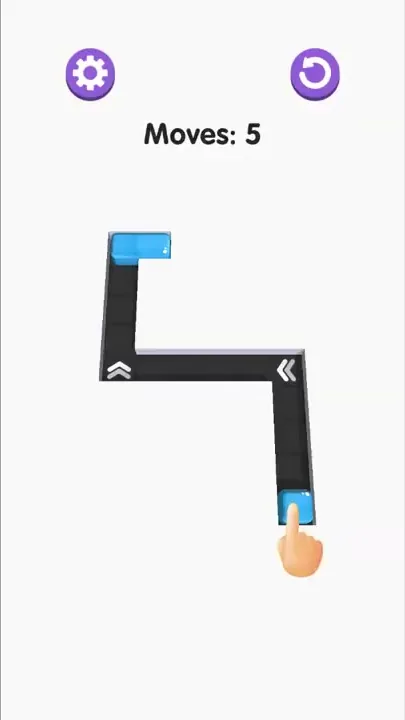
Arrow tiles are the new piece after that. They first appear on a stepped track holding just two blue blocks, a bar at the top of the left end and a single block at the bottom of the right end. A hand pointer rests on the lower one, and the Moves counter starts at 5.
The arrows return at the corners of the two U-shaped tracks. Next comes an H-shaped board with a hole in its crossbar. Early on it holds a bar at the end of each leg and four single blocks beside the hole, and later only yellow is left, a single block resting just above the yellow bar. After it comes a spiral that comes up with 20 moves to spend. Its outer track has arrow tiles at four turns and wraps around a box of single blocks in four colors.
Outside the boards, the screen has two round purple buttons, a gear at the top left and a circular arrow at the top right. The bold Moves label sits centered just below them.
A sticking rule in saturated color
Box Smash plays a bit like a color version of 2048, with colors standing in for numbers and each move shifting one block instead of the whole board. It also has a sticking rule of its own. Single blue blocks pair up into upright bars on the wide board, and two orange singles fuse in the six-color level.
The core will look familiar from ultra-simple pick-up-and-play games: slide colored blocks so they piece together, then clear them. Box Smash puts a new premise and new packaging on that mechanic and builds new play and a new experience on top of it.
The color work is bold. Six saturated jelly shades sit on dark gray grids against a plain white background, and the screen around them holds just two purple buttons and the Moves label. Overall the game feels very fresh, clean and simple.
The gold discs and the two purple buttons
We have no specific complaint about Box Smash. Progress inside a level shows on the boards themselves as they empty color by color, with the Moves counter ticking down above them. The levels here do not show what the gold discs do, or what the gear and circular-arrow buttons open.
Choosing which block to slide next
The Box Smash game comes down to one decision made over and over: which single block to send along its row or column so that same colors meet, knowing it will run until a wall or another block stops it. That fits a taste for small grid puzzles played against a move counter, and for 2048-style merging done with colors instead of numbers. The boards keep changing shape, from narrow L-shaped tracks to the cross and the spiral, so the one rule keeps meeting new layouts.
Verdict
Under its jelly blocks, Box Smash runs on a mechanic that fans of ultra-simple games will recognize, retold with a new premise and a new wrapper. From that base it grows new play and a new experience, and it has a sticking rule of its own that fuses same-colored blocks into one. Paired with its bold colors, the whole game comes across as very fresh and simple. Taken together, our opinion of it is a moderate one.