Ammo Sort Review: Sorted Bullets Feed the Gunner
An Ammo Sort review: five tray columns of red- and blue-banded bullets, sorted by color, keep a lone gunner firing at red crowds.
Game at a glance
Ammo Sort
7/ 10
Our score
Still bite-sized. Imagine only what's already on screen and all you get is copies.
In this article6 sections
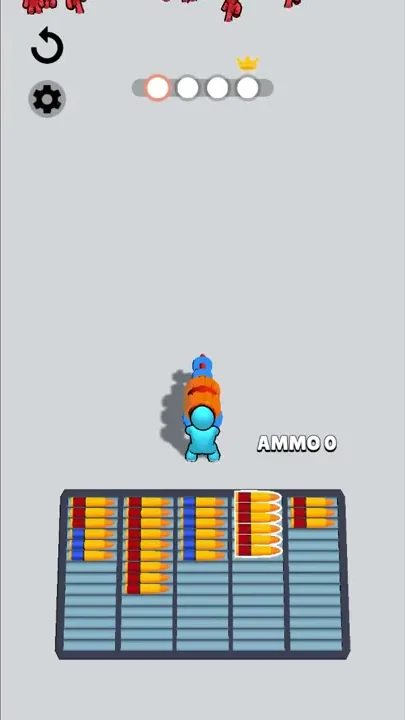
Five columns of yellow bullets, each banded red or blue, sit in a tray at the bottom of the screen in Ammo Sort. This color sort game pairs that tray with a light-blue gunner standing just above it. The gun’s ammo comes from the bullets sorted below, while crowds of red figures walk down from the top edge.
We played Stage 1, the two stages after it and the first two waves of a fourth. Sorting your own ammunition makes for a good pairing with plenty of room to grow, even though the game, as it stands, still looks bite-sized.
Red and blue bullets in a five-column tray
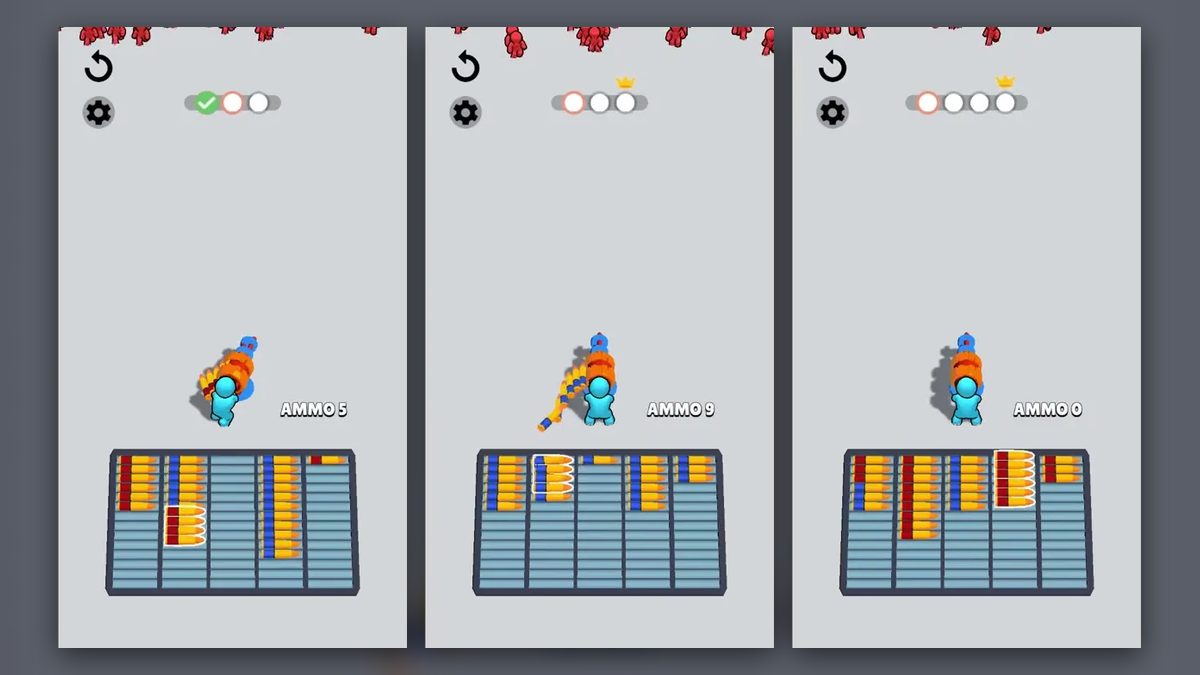
Each stage is a set of waves, and clearing all of them wins it. A row of circles at the top center keeps count, one circle per wave. The current wave’s circle wears an orange ring, and a cleared wave’s circle turns into a green check. The gun fires only while the AMMO counter beside the gunner is above 0.
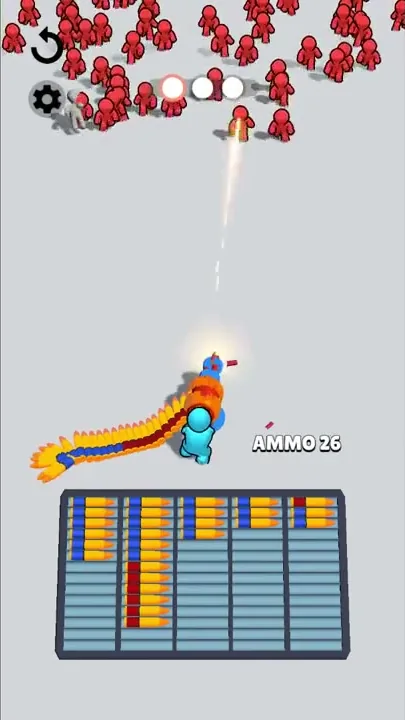
The loop runs from the bottom of the screen to the top. Bullets are sorted by color in the tray, and the sorted bullets move up onto an ammo belt that feeds the gun. The gun sends white tracers into the red crowds coming down the screen, thinning each wave until the tracker moves on to the next.
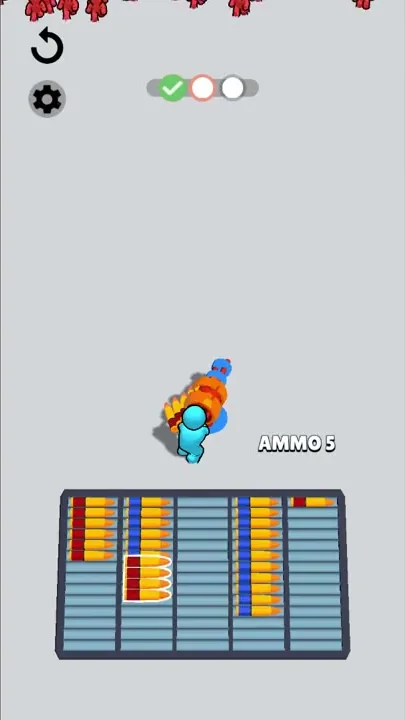
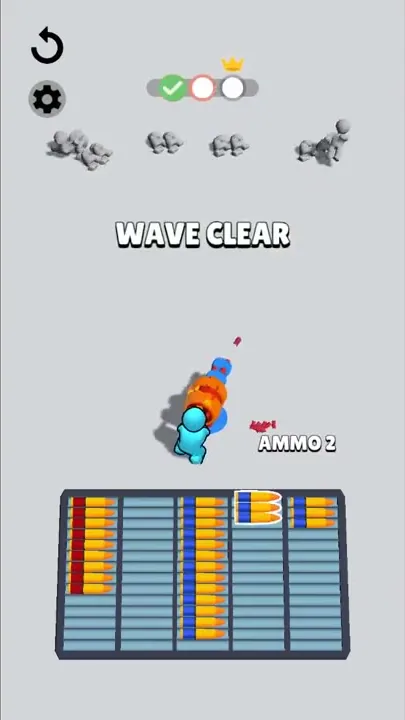
The tray is a dark-gray block with five columns of light-blue slots. Each yellow bullet has a red or blue band at its left end, and the bullets hang from the top of each column in mixed runs. In Stage 1 the second column held a long red run that reached almost to the bottom and the fourth a long blue one, while the first column stood empty.
Moves are made in the tray. The run that gets picked up is the lowest group of one color in a column, or the whole stack when a column holds only one run; it gains a white outline and then slides across to another column. In the second stage, that meant a red run under blue bullets in the second column at one point, and a lone blue bullet under a long red run in the fourth column at another. Whether stacks move by tap or by drag isn’t clear, and neither is whether the gunner’s aim is ever left to the player.
Columns filled to the bottom with one color were outlined along their full length, and their bullets left the tray for the belt. In the third stage the second column filled with red this way while a row of red bullets lay on the belt just above the tray.
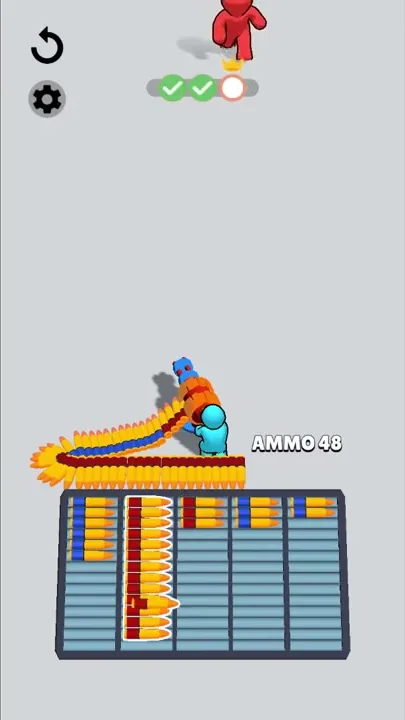
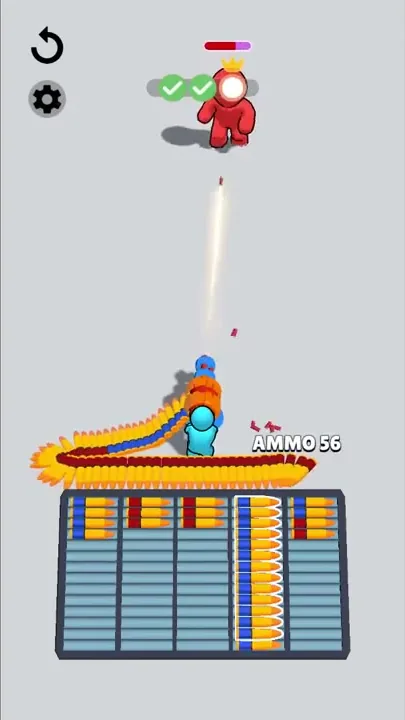
The belt is a long chain of bullets trailing to the left of the gun and fanning out at its far end. Once it grows long enough, it also runs along the top edge of the tray, as it did in the fourth stage with the counter at AMMO 63. That AMMO number climbs as bullets join the belt and drops while the gun fires.
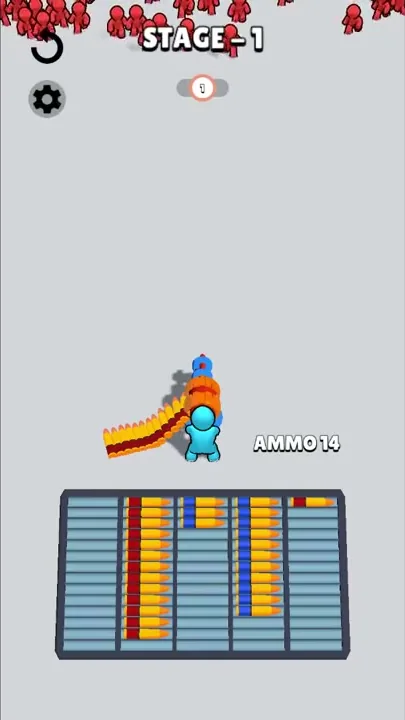
A single crowd and a single circle on the tracker make up Stage 1, with “STAGE - 1” printed at the top. With the belt trailing off the gun, the counter read AMMO 28 and then AMMO 12 a moment later, as the crowd slid lower and gray bodies appeared among it. Once the crowd was cleared, the stage closed on its results screen.
At AMMO 0 the belt is gone. The counter fell back to 0 in the second stage, and more than once there, with red figures still on the field, a “NEED AMMO!!” speech bubble popped up beside the gunner.
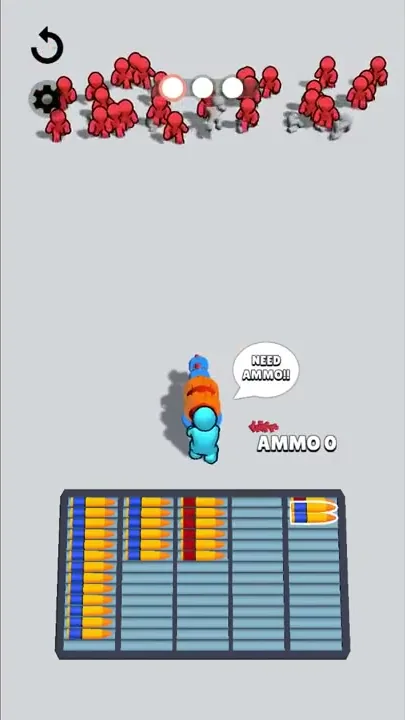
The enemies arrive in dense crowds of red figures that enter at the top edge and work their way down toward the gunner. The artwork is rubber-man style, with smooth, rounded, faceless figures: red for the enemies, light blue for the gunner, whose big gun has an orange drum. Hit figures turn gray and lie on the ground, and small red bits fly off to the right of the gun while it fires.
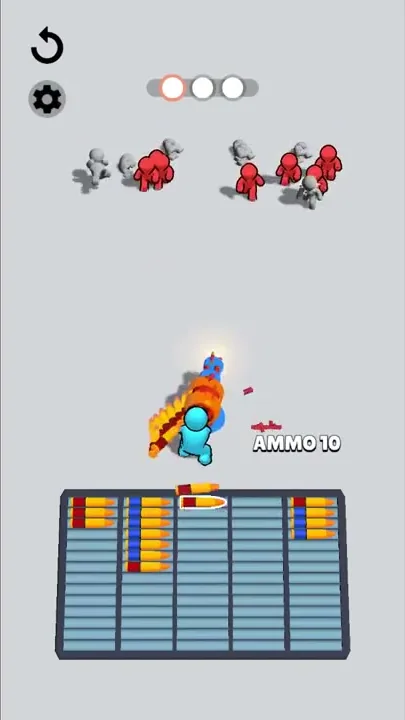
When every figure in a wave is gray, “WAVE CLEAR” appears mid-screen in large white letters with a dark outline, and that wave’s circle on the tracker shows a green check. The words appear just below the gray bodies of the finished wave.
One wave broke the crowd pattern. In the third stage, the wave under the crown was a single red figure far larger than the crowd figures, with a health bar above it, and the gun fired at it as it had at the crowds while a full blue column sat outlined in the tray.
From one circle to four on the tracker
Across the stages, the wave tracker grows. Stage 1 had a single circle. The stage after it stretched the tracker to three circles with no crown, sending one red crowd after another down the screen, and two of the circles carried green checks as the third wave entered at the top.
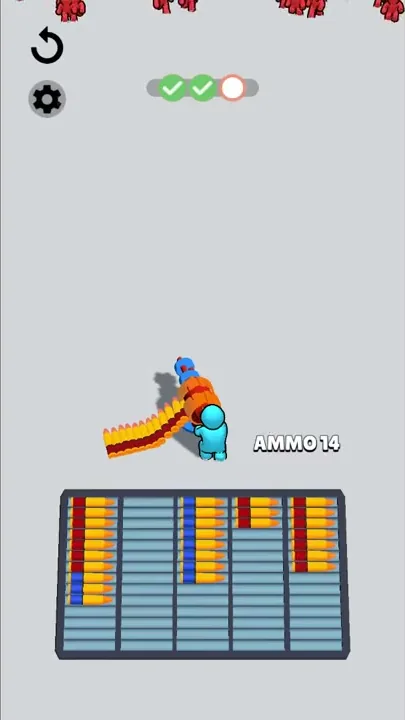
From the third stage on, a gold crown sat above the tracker’s last circle. The third stage kept three circles, and its crowned last wave is where the large red figure came in.
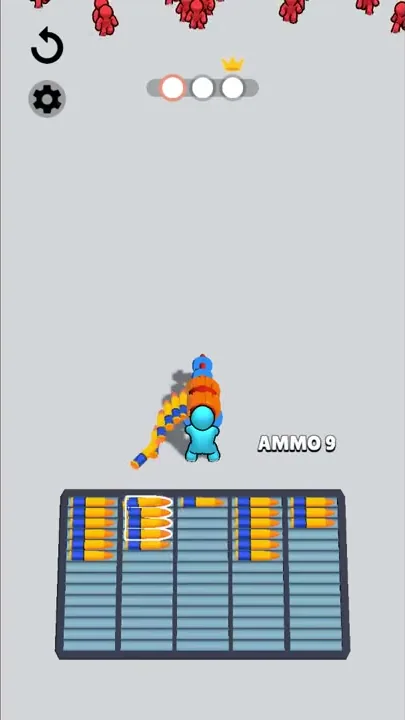
Four circles appeared in the fourth stage, with the crown over the fourth, and its first two waves were checked off in turn. Early in that stage the counter read AMMO 0 with no belt, and a red stack in the fourth column was already outlined. The tray kept the shape it had in Stage 1: five columns, bullets banded red or blue.
Outside the waves themselves, two buttons sit at the top left during play: a circular arrow to restart and a gear for settings. Stage 1 closed on a results screen with a smiling emoji above “Incredible!” and “STAGE - 1 COMPLETED,” plus a green Next button.

Bullets as sorting pieces and gun fuel
We like this kind of pairing a lot. Ammo Sort makes the bullets themselves the pieces of its sorting puzzle, then uses the sorted bullets to supply the gun for its defense. In the third stage a finished red column turned up as a row of red rounds on the belt, and with the belt empty in the second stage, the gunner’s “NEED AMMO!!” bubble asked for more.
The bullets-and-defense dressing also leaves a lot of room for imagination. The stages show one gunner, crowds of red figures and a single large red figure with a health bar. The defense format, the enemy types and the number of units on the player’s side could all be expanded, pushing the whole game toward something meatier than a quick-play puzzle. The setup points past what is on screen today.
The defense up top can be read as the on-screen presentation of the sorting underneath. The player works the tray, and the gun’s fire depends on the ammo the tray produces: rounds pile up on the belt and leave the gun as white tracers, and the red figures they hit go gray.
A bite-sized look around a lone gunner
Even with two genres paired, Ammo Sort still looks bite-sized. On screen it comes down to one light-blue gunner on a plain light-gray field, red figures walking toward it, and a results screen whose only button is Next. What happens if a crowd reaches the gunner, or if the tray runs out of room, is something we can’t speak to.
Sorting red and blue while the crowd closes in
The hands-on part is regrouping two colors. A player lifts the lowest run of red or blue off one column and sets it in another until columns hold a single color. Above the tray, that work is what keeps rounds on the belt and the red figures falling.
The mix speaks to a taste for two-color sorting with a firing line attached, in stages that ran from one wave up to four.
Verdict
Ammo Sort pairs a sorting puzzle with crowd-mowing defense by making the bullets do both jobs, and it is a good take on a kind of mix we’re fond of. In its current form the game still looks bite-sized, yet the ammunition-and-defense dressing leaves wide-open ground for something meatier. Read the score on this page with a small plus attached.