Tile Mania Review: Stacked Tiles Chasing a Blue Star Goal
A blue star badge reading 60 early in Level 1 turns tile sorting into a level puzzle, and this Tile Mania review follows it through five stacked columns.
Game at a glance
Tile Mania
7/ 10
Our score
Sometimes hyper-casual and light casual are just one last push apart.
In this article6 sections
Pick a bright tile off the bottom of a column and it drops into a seven-slot tray below. When three tiles with the same symbol sit side by side there, they vanish together. Tile Mania is a mobile puzzle from the family of tile match games. It builds on tile sort play, with a level goal on top.
As a matching-and-clearing game, it belongs to the same broad family as games like royal match. Its matching works the way a triple-tile matching puzzle does: tiles wait in the tray until a third copy arrives. We played Level 1 until its blue star target was down to 6, and that target is what gives the stacked tiles a level to finish.
Front-row tiles feeding a seven-slot tray
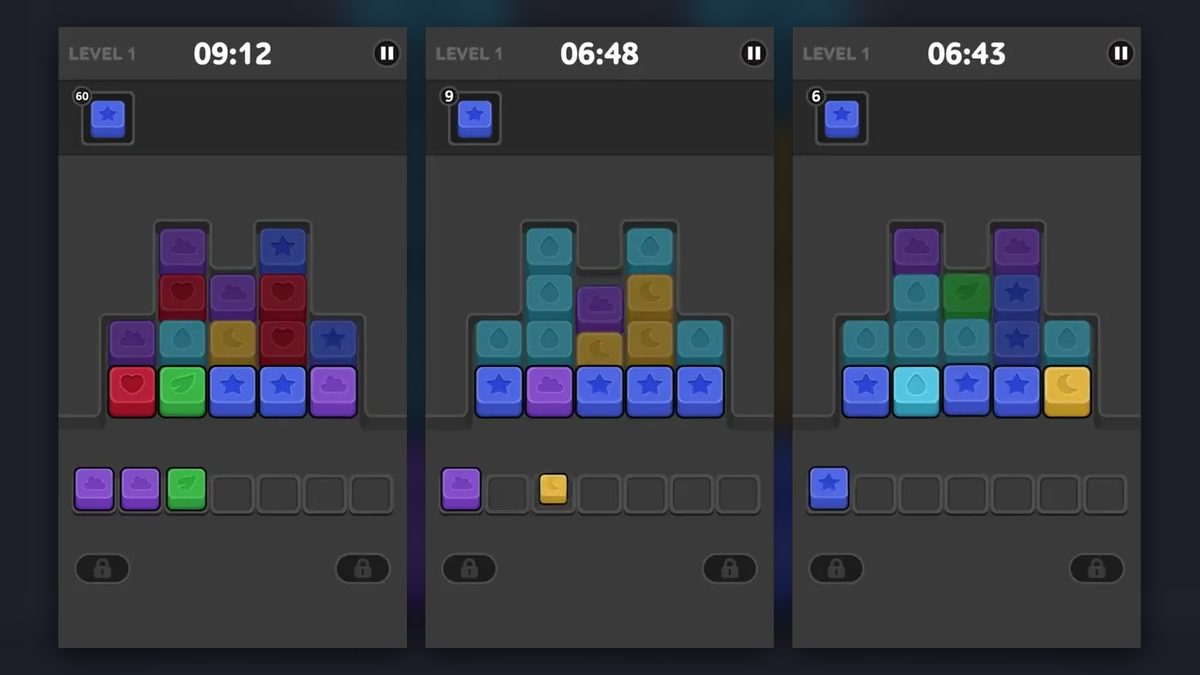
The target in Level 1 is a blue star tile on a card in the top-left corner, with a number badge on its corner that reads 60 early in the level. The badge falls in steps of three, and it only moved in stretches where blue stars were leaving the tray. It stayed at 54 while a set of purple clouds cleared and held at 39 while light-blue drops went. Late in the level it was down to 6.
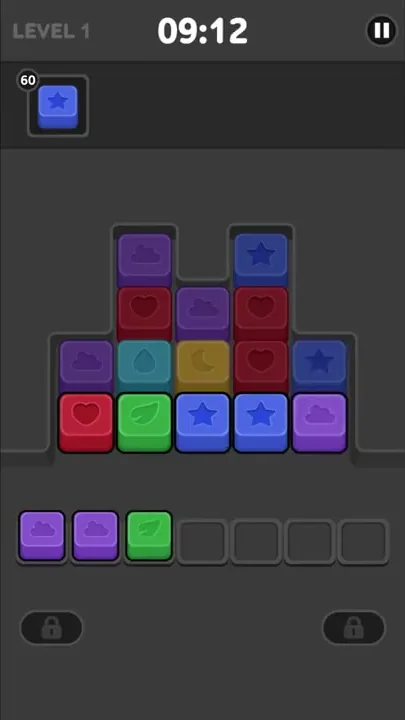
The board below is a single block of five columns. The second and fourth stand four tiles tall like a pair of towers, with a three-tile middle column sitting lower between them. The two outer columns hold two tiles each. Only the bottom tile of each column is shown in full color, and everything stacked above it is shaded darker.
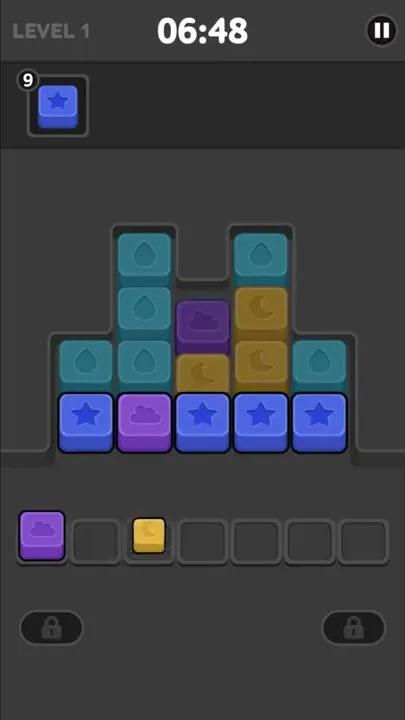
Each tile is a chunky rounded square with an embossed symbol, and every symbol has its own color: red hearts, green leaves, blue stars, purple clouds, yellow moons and light-blue water drops. Tiles match by symbol, and all of them can be on the board at the same moment.
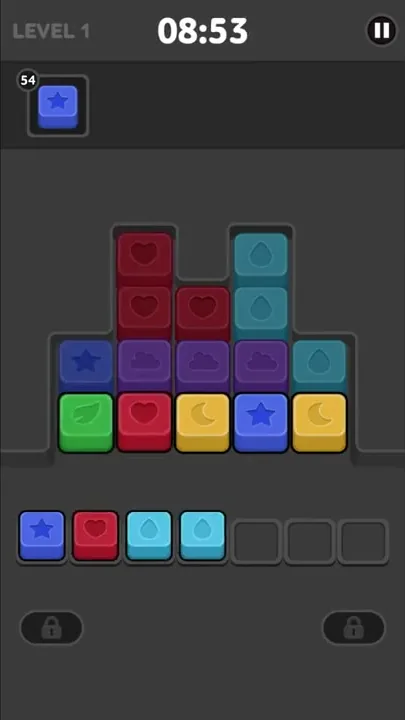
All the tiles seen leaving the board come from that bright front row. The chosen tile glides down into the tray and lands next to any tile with the same symbol that is already waiting there. A round pause button sits in the top-right corner.
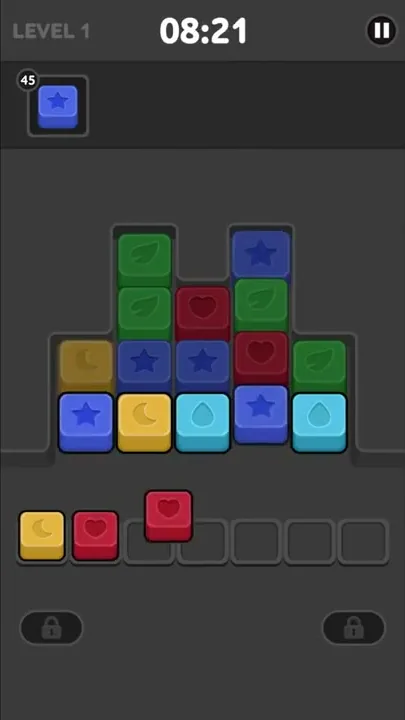
Repeated over and over, that one move is the core of Tile Mania gameplay. A tile sent down either starts a new group in the tray or joins one already there, and a group clears as soon as it reaches three.
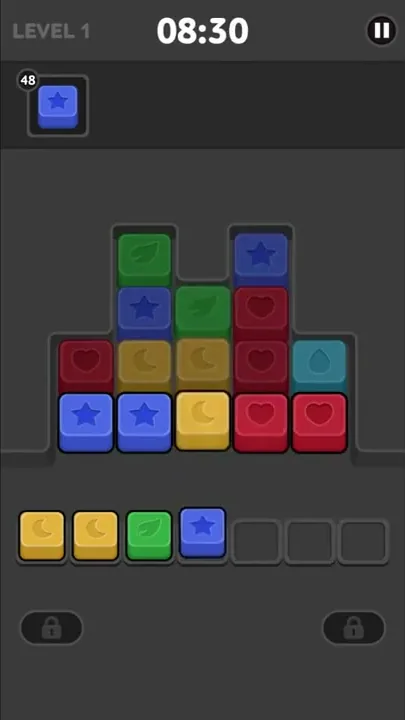
In Level 1, the columns never ran dry. When a bottom tile leaves, the tiles above it slide down one place and a new tile appears at the top. The block stayed full, and its shape never changed.
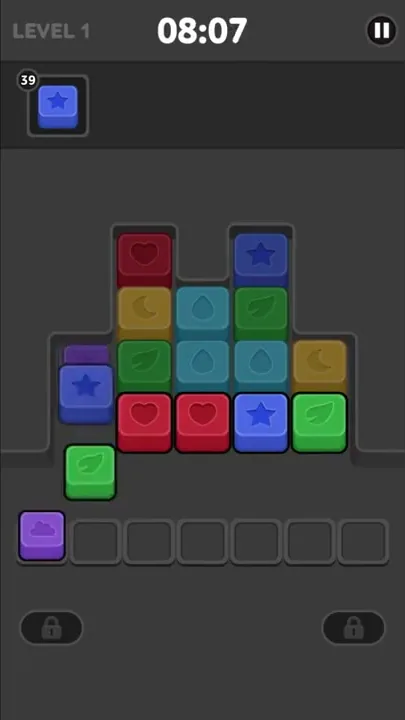
The tray itself is a row of seven slots, and tiles with the same symbol gather side by side in it. When a third matching tile joins a pair, the three shrink away together and the tiles left behind shift along to close the gap.
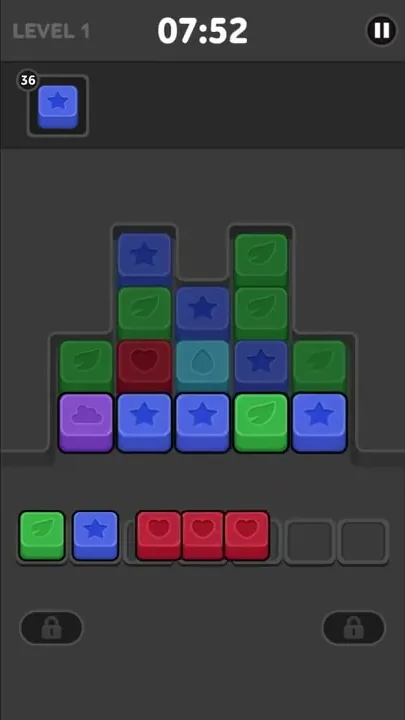
Those seven slots are one of the two limits on the screen. The fullest the tray was seen was five tiles: two pairs plus a lone purple cloud.
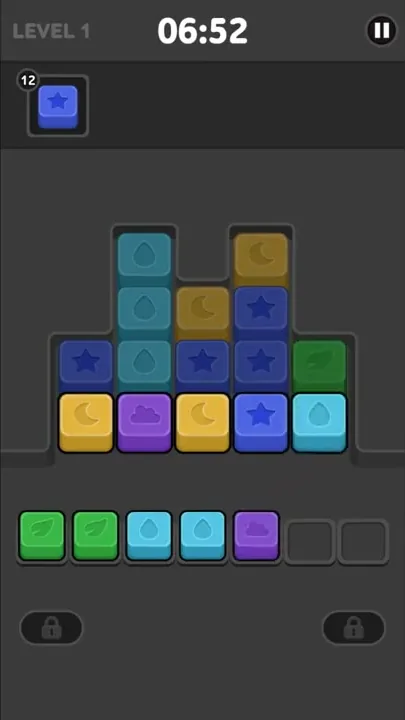
The other limit is a large white clock at the top center, counting down in minutes and seconds the whole time tiles are being cleared. It sits between the LEVEL 1 label on the left and the pause button on the right.
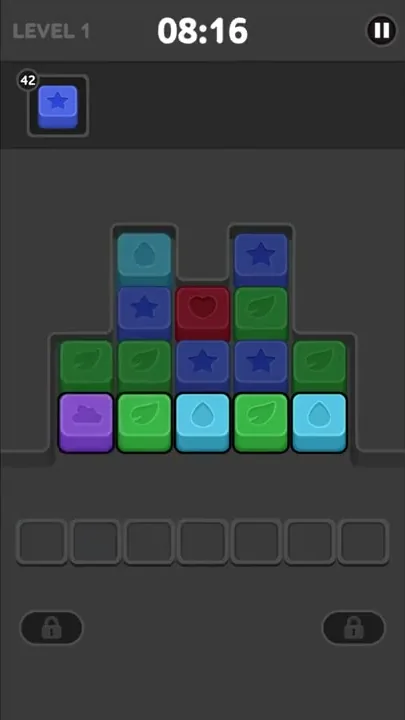
The look is flat and minimal: beveled tiles in saturated colors on a gray board against a dark charcoal background, with no characters or scenery anywhere. Tiles fly down into the tray and slide down their columns, and cleared ones shrink out of sight.
Blue star countdown and two padlocked buttons
Across Level 1, what moves forward is the pair of numbers at the top: the goal badge keeps dropping and the clock keeps running. The five-column block keeps its two towers and the tray keeps its seven slots from early in the level to late in it, and no new tile type or obstacle joins the mix. Late in the level, with the badge at 6, three blue stars sit in the front row at the same time.
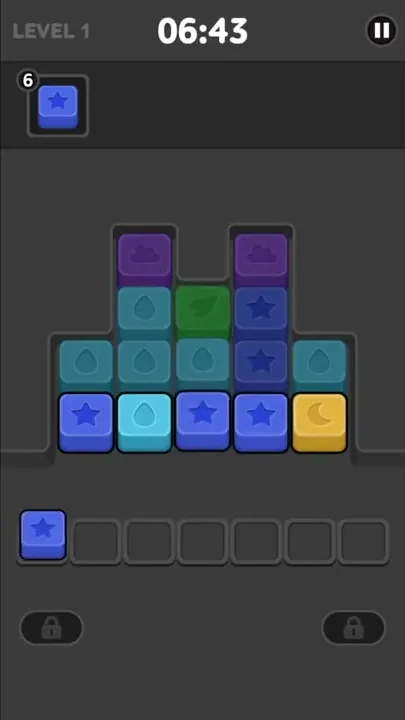
Beyond the play controls, the only other features are two dark rounded buttons under the tray, one at each edge, each marked with a padlock. They stay locked and untouched throughout, and the screen gives no hint of what they do.
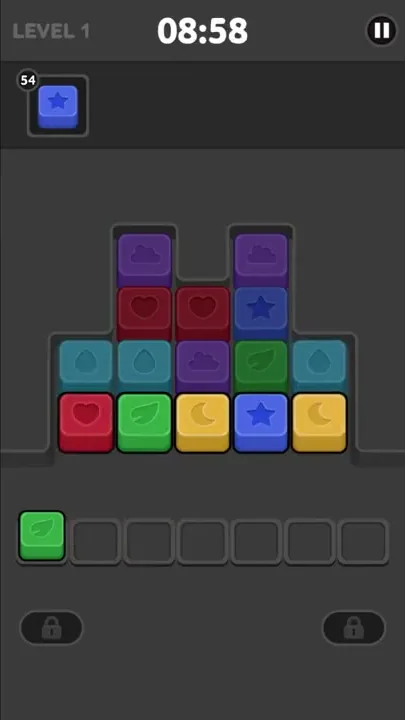
No currency, shop, reward screen or ad appears at any point. Every screen is the same Level 1 play screen.
A goal card turns sorting into levels
We liked what the goal does here. Tile sorting of this kind has turned up in a lot of games lately, and Tile Mania gives its levels a target to clear: the blue star card under the LEVEL 1 label, counting down next to the running clock. That one change makes the whole thing a light-to-mid-weight level-based puzzle game, and a very enjoyable one.
Underneath sits a triple-tile matching puzzle, plus tile sorting, plus that goal. The stacked columns hand over their bottom tiles and refill from the top; the seven-slot tray, where tiles clear in threes, does the matching.
It also left us thinking that a hyper-casual game and a light casual one are sometimes separated by a single final push.
What the badge at 6 leaves unseen
There is no criticism of Tile Mania to report, only limits on what appeared. No win screen or reward shows up, since the badge never dropped below 6. Neither the tray nor the clock ever ran out, so what a full tray or an expired timer does remains unknown. Nothing beyond the one level appears either: no later stage, new tile type, obstacle or booster turns up.
Picking toward one symbol against the clock
Moment to moment, Tile Mania is a string of small picks: one of the five bright tiles along the front, sent down to meet its matches in the tray. One symbol is tied to the goal card while the others pass through in threes beside it, and a clock runs above it all.
That pattern suits a taste for triple-tile matching with a number to bring down and a timer overhead, on a plain screen with no currencies or side menus to manage. The stacked columns give up one tile at a time, and the tile sorting comes with a target attached.
Verdict
Giving every level a target to clear turns a familiar tile-sorting formula into a light-to-mid-weight level puzzle game. The outcome is good, and a lot of fun.