Marine Mayhem Review: Modern-War Card Duels in Portrait
A Marine Mayhem review: toy-like soldiers trade attacks across a wooden barrier in a portrait take on Hearthstone-style card duels.
Game at a glance
Marine Mayhem
7/ 10
Our score
Portrait, casual, re-dressed classic: sometimes a low-cost project is not hard to launch.
In this article6 sections
Hearthstone, the turn-based digital card game, is the closest relative of Marine Mayhem, a mobile card battler played in portrait. The structure carries over: two sides take turns paying for cards, put units on the board and send them at the other side.
The differences are in the wrapping. The dressing is modern warfare, with helmeted soldiers carrying rifles, and the art style is bright and cartoonish. The whole battle also fits on one upright screen. In the one match we played, a loss against a single opponent, those changes were the highlights, and the card battle underneath stayed the classic one.
Soldier cards paid for with a purple gem
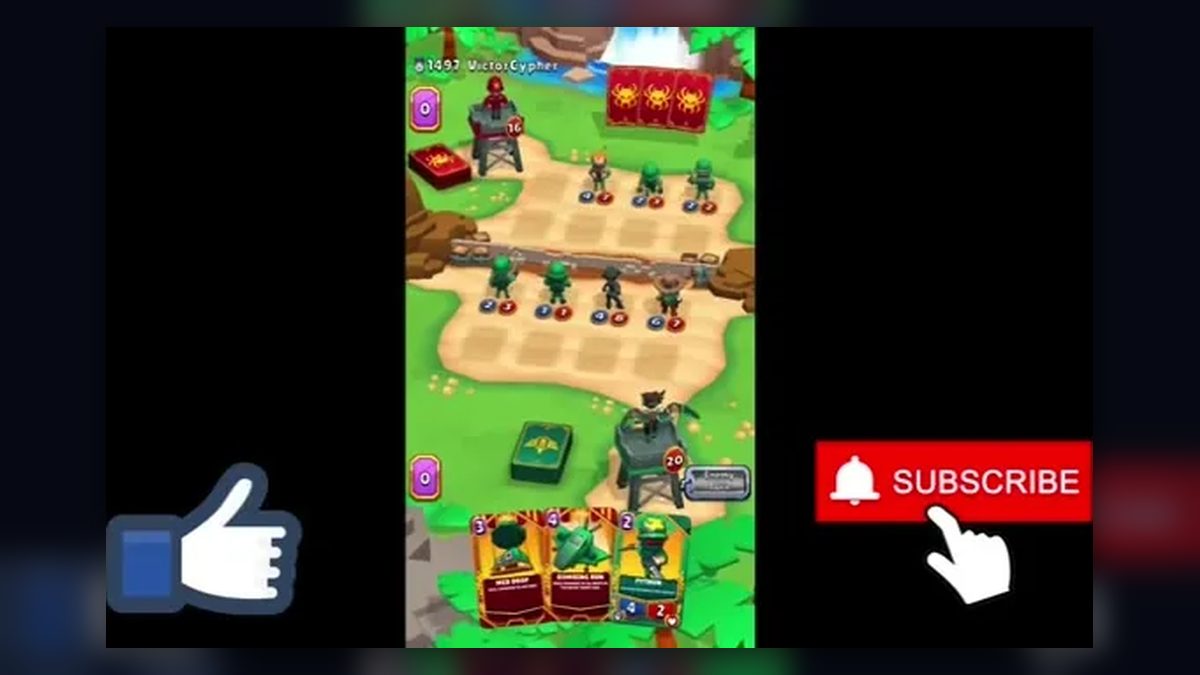
The battlefield is a sandy grid of square tiles in a jungle clearing, with a waterfall at the top and a low wooden barrier across the middle. The opponent plays onto the upper half and the player onto the lower. Each side also has a watchtower with a number badge: the opponent’s stands at the upper left with a red soldier on top, the player’s at the lower right. Both read 20 early in the match and fall as play goes on, and this match ended on a defeat screen right after the player’s tower took a hit.
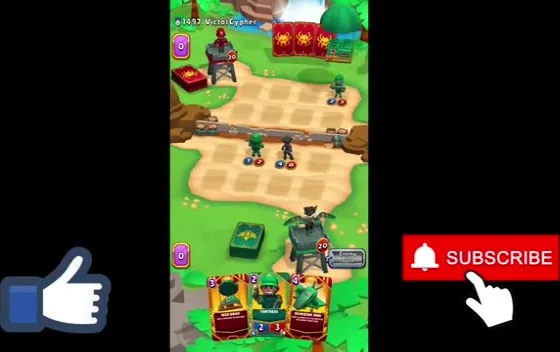
Everything sits in one fixed, top-down portrait view with no scrolling: the hand along the bottom, each side’s gem on the left edge, the board in the middle. A card played from the hand leaves it and turns into a soldier on a tile of the player’s half, and an attack shows up as an arc to its target. A card can also be shown enlarged over the board. A button at the lower right of the board carries one label during the player’s turn and another during the opponent’s.
The Marine Mayhem gameplay loop starts with a banner: each player turn we saw opened with “Your move, Commander!” and the purple gem at 5. That number pays for cards, and each card shows its cost in a purple badge. Played unit cards become soldiers, which then attack across the barrier. After that the opponent takes its turn and builds up its own half the same way.
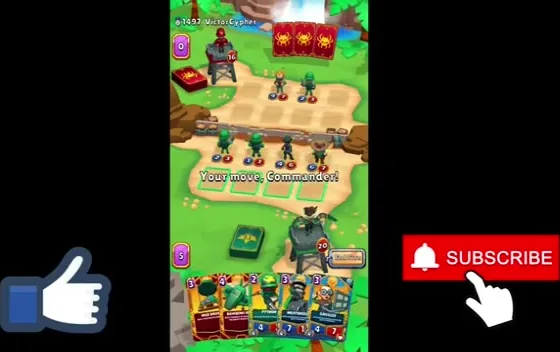
Both sides have a gem: the opponent’s near the top of the left edge, the player’s near the bottom. At the start of the player’s later turns the gem read 5 each time, and it dropped as cards left the hand. The cost badges on the cards use the same purple.
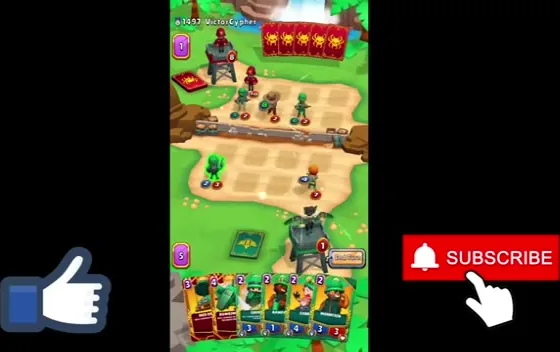
Five cards in hand and the gem at 5: that is how one turn in the opening stretch begins. One card later the hand is down to four and the gem reads 2, while a new soldier stands in the second row behind a front line of four. Later in the same turn the gem is at 0 and three cards are left.
Most cards are soldier cards, with the purple cost badge at the top left and a soldier’s picture above a name banner. Along the bottom sit two boxes, a blue one on the left and a red one with a heart icon on the right. IRONCLAD, a green-helmeted soldier with a rifle, costs 2 and shows a blue 2 and a red 3. Once played, each card becomes a soldier with a small blue badge and a red badge at its feet, and the figures on both halves range from green-helmeted troops and a red soldier to one in a brown hat and an orange-haired figure.
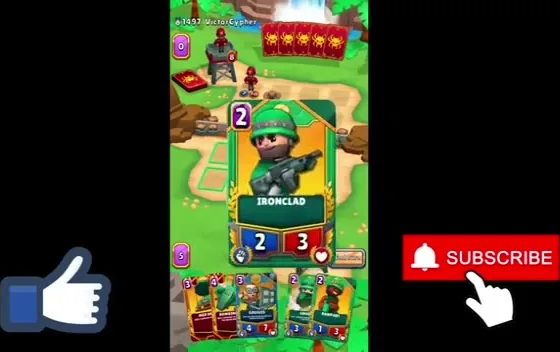
Not every card is a soldier. The two cards with red borders at the left of the hand have no blue and red boxes at all, and they stay in the hand from the early turns to the last without ever being played.
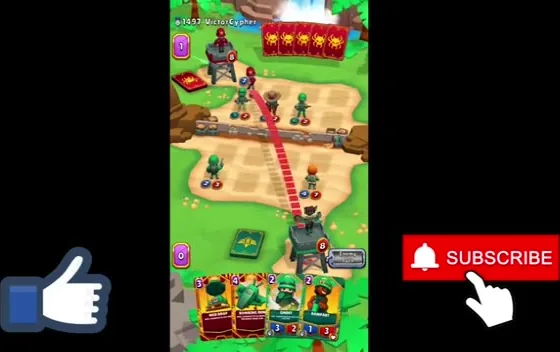
That attack arc is red and dotted, linking attacker and target. Early on, one links a unit at the upper right with the player’s soldiers near the barrier. Later, another runs from an opposing unit near the opponent’s tower all the way down to the player’s tower.
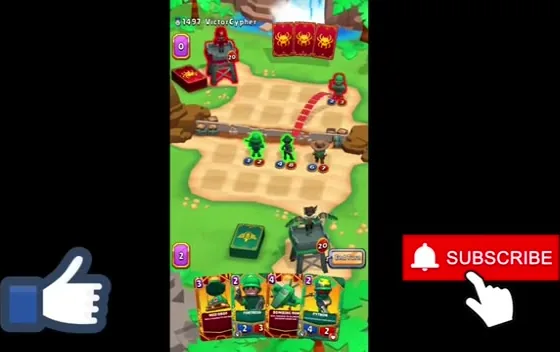
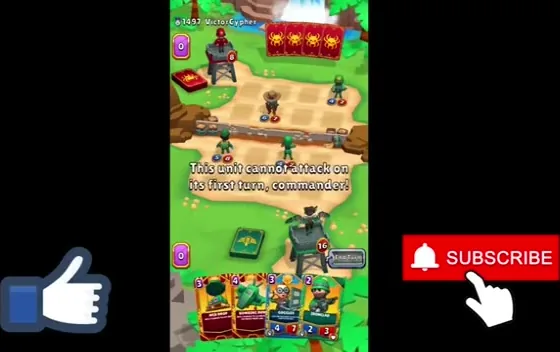
During the player’s turn some of the player’s soldiers carry a bright green outline, at one point three in the front row. A message also spells out a rule: “This unit cannot attack on its first turn, commander!” A soldier placed this turn cannot attack until a later one.
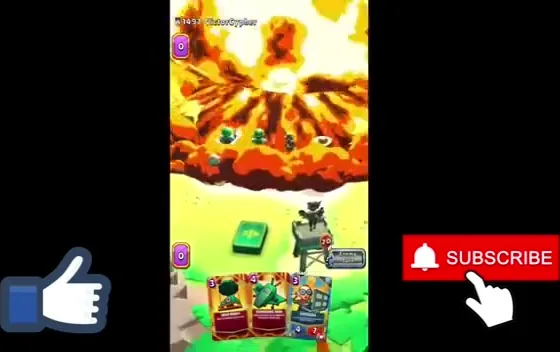
After the opening turns a huge orange-and-yellow blast covers the upper half of the board and the barrier. Just before it, five soldiers stood on the player’s half and one on the opponent’s. Right after it, the upper half is empty and two of the player’s units remain.
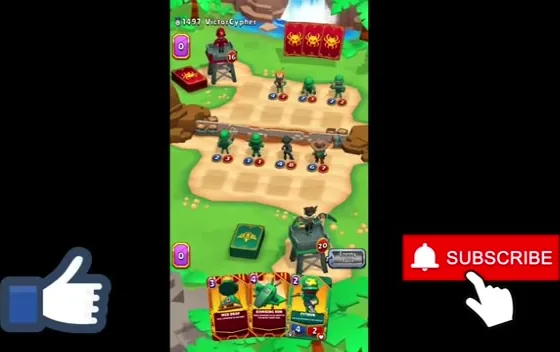
A red deck sits at the upper left of the board and a green deck at the lower left. The opponent’s hand shows as a row of face-down red cards at the top right, three early in the match and five later on. The player’s hand thins as cards are played and fans out wider when the next turn begins.
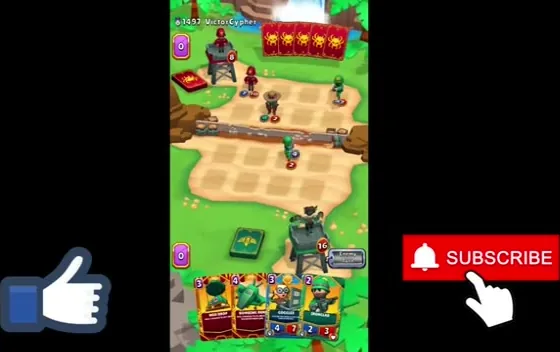
Watchtower numbers falling on both sides
In the opening turns soldiers pile up below the barrier while the opponent’s tower number falls from 20 to 16, then 12, then 8. The player’s tower still reads 20 at that point.
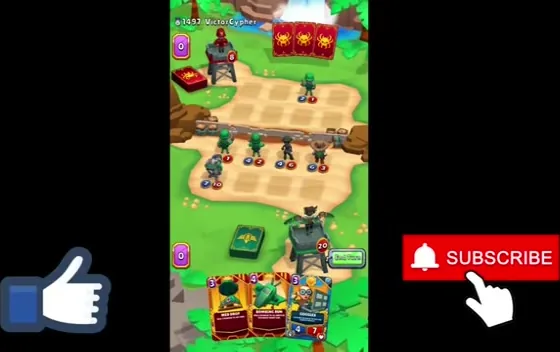
After the blast the opponent’s half fills with more soldiers, while the player’s half never holds more than two units at a time and is empty as one turn begins. The player’s tower falls from 20 to 16 and later reads 8 as an opposing unit’s red arc points straight at it.
From there the player’s tower drops lower still and takes one more hit before the defeat screen appears. A red “DEFEAT!” ribbon hangs under a winged crest flanked by two horns, over the dimmed battlefield, with “TIME TO REGROUP, COMMANDER!” beneath it. Lower down are a bar holding a four-digit number beside a purple badge icon and a green “HOME” button, and the screen shows no rewards or chests.

One more fixture stays on screen for the whole match: a player name at the top left, with a small icon and a four-digit number. The screen does not say whether it belongs to the player or the opponent.
Toy soldiers and watchtowers in one portrait column
We liked the new dressing on Hearthstone-style play. The cards and the board are all modern warfare: IRONCLAD is a green-helmeted soldier with a rifle, and each side guards its own watchtower behind a wooden barrier.
Marine Mayhem also stands the format upright, and we found one hand enough to play it. The fixed top-down view keeps the whole battle on one portrait screen, from the opponent’s face-down cards at the top to the player’s hand at the bottom.
The art style is more casual than that of KARDS, a World War II digital card game. Its soldiers look like bright 3D toys on a sandy field ringed by jungle trees. Even the effects stay cartoonish, from a bright flash on the player’s half to the orange-and-yellow explosion over the board.
A classic card duel in new packaging
There is no direct complaint to make about how Marine Mayhem plays; the point to weigh is where its changes sit. The rules on show are the classic formula, down to a cost printed on every card and a rule that keeps a new unit from attacking on its first turn. What changes is the packaging: the formula is turned portrait, made more casual and given a new dressing. That suggests a low-cost project is sometimes not hard to get off the ground.
One gap simply comes with the result. The match ended in defeat, so a win screen never appeared.
Budgeting the gem across a front row
These mechanics suit a taste for budgeting turns. Each turn means weighing card costs against the number on the purple gem, building a front row below the barrier and remembering that a fresh soldier cannot attack until a later turn. The two watchtower numbers work as a running score that both sides wear down.
The setting fits a liking for modern military themes drawn as cartoon toys. The single portrait column fits playing with the phone held upright.
Verdict
Taken as a whole, Marine Mayhem is a decent card battler whose strengths are in its packaging. The modern-war setting and the more casual art style set it apart, as does a layout that fits on one upright screen. The rules beneath stay close to the classic they come from, and the result hints that a low-cost project can sometimes come together without much trouble.