Color Clash: Paper.io Territory Battles Played With Cards
Color Clash crosses Paper.io's land grab with card battles: two players claim territory with bricks, spending energy on each card they play.
Game at a glance
Color Clash
- Developer
- VOODOO
- Platforms
- Android
In this article3 sections
Color Clash is this round’s pick in a regular series on good examples of fresh ideas in games, chosen using a method for game innovation so that the theory becomes easier to grasp.
The combination this time: Paper.io + card battles
How it plays
First, a screenshot of the gameplay:
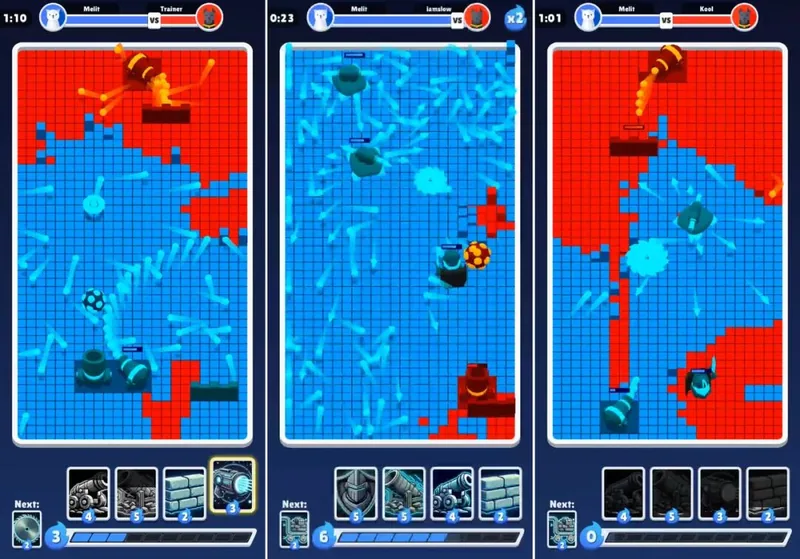
Here’s how it works:
- The core idea comes from Paper.io, where players battle to claim territory and are ranked at the end by how much ground they hold. Color Clash is also about claiming territory, except that bricks are how you take ground, there are only two players, and they fight with cards.
- Players hold a range of cards with different functions and different energy costs.
- To win, you have to plan your energy and your cards sensibly, picking the right card at the right moment.
So each match is a head-to-head fight for territory, played out card by card.
Playing Cards to Turn Tiles Blue
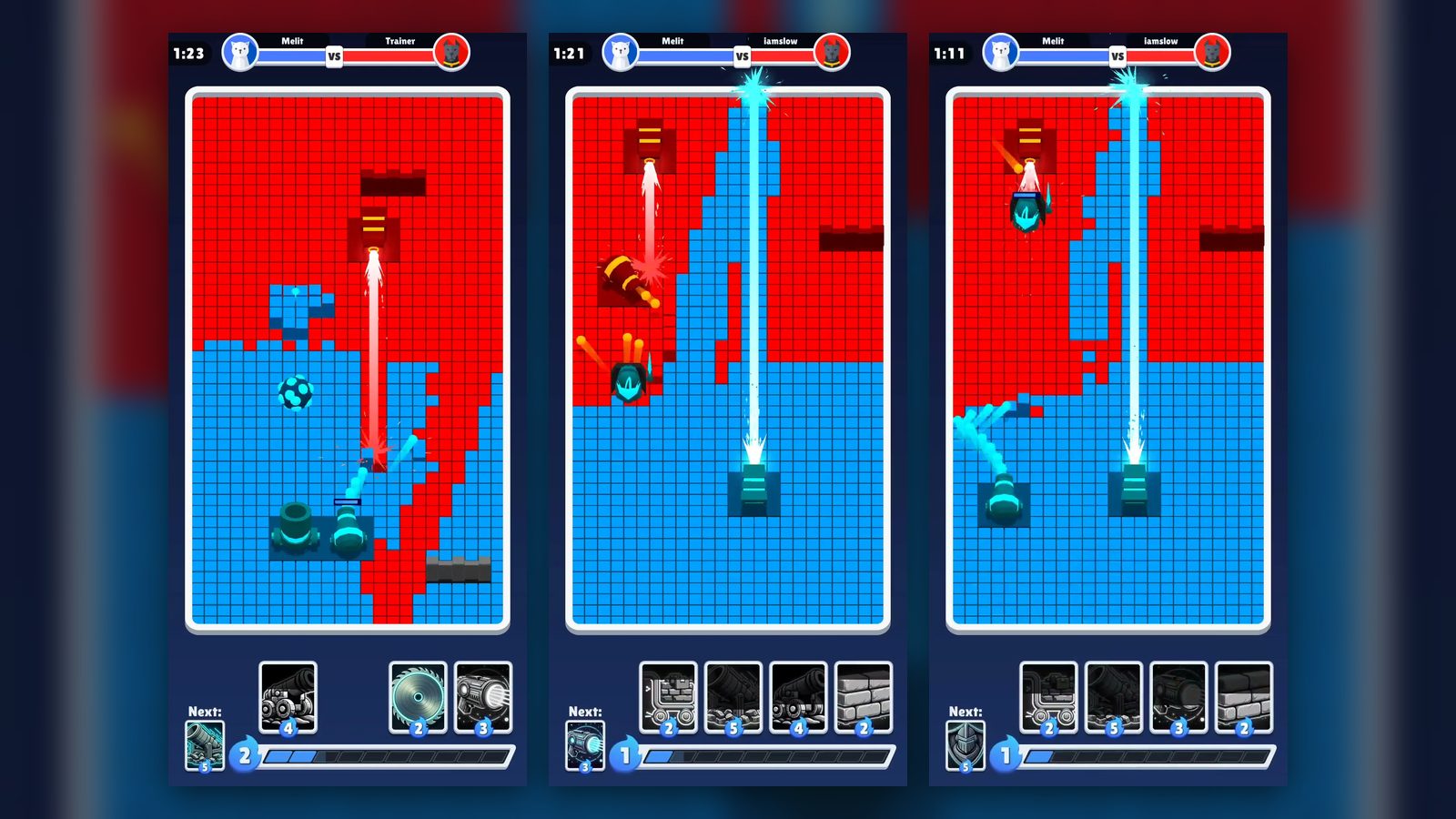
A match of Color Clash opens on a tall grid of small square tiles, with red filling the top half and blue the bottom half. The player takes the blue side, with a four-card hand at the bottom of the screen and one more card waiting under “Next:”. In the first match, against Trainer, the hand held a mortar costing 5 energy, a wheeled cannon costing 4, a saw costing 2 and a laser costing 3, with a 2-cost wall up next. A pointing hand rested over the blue half.
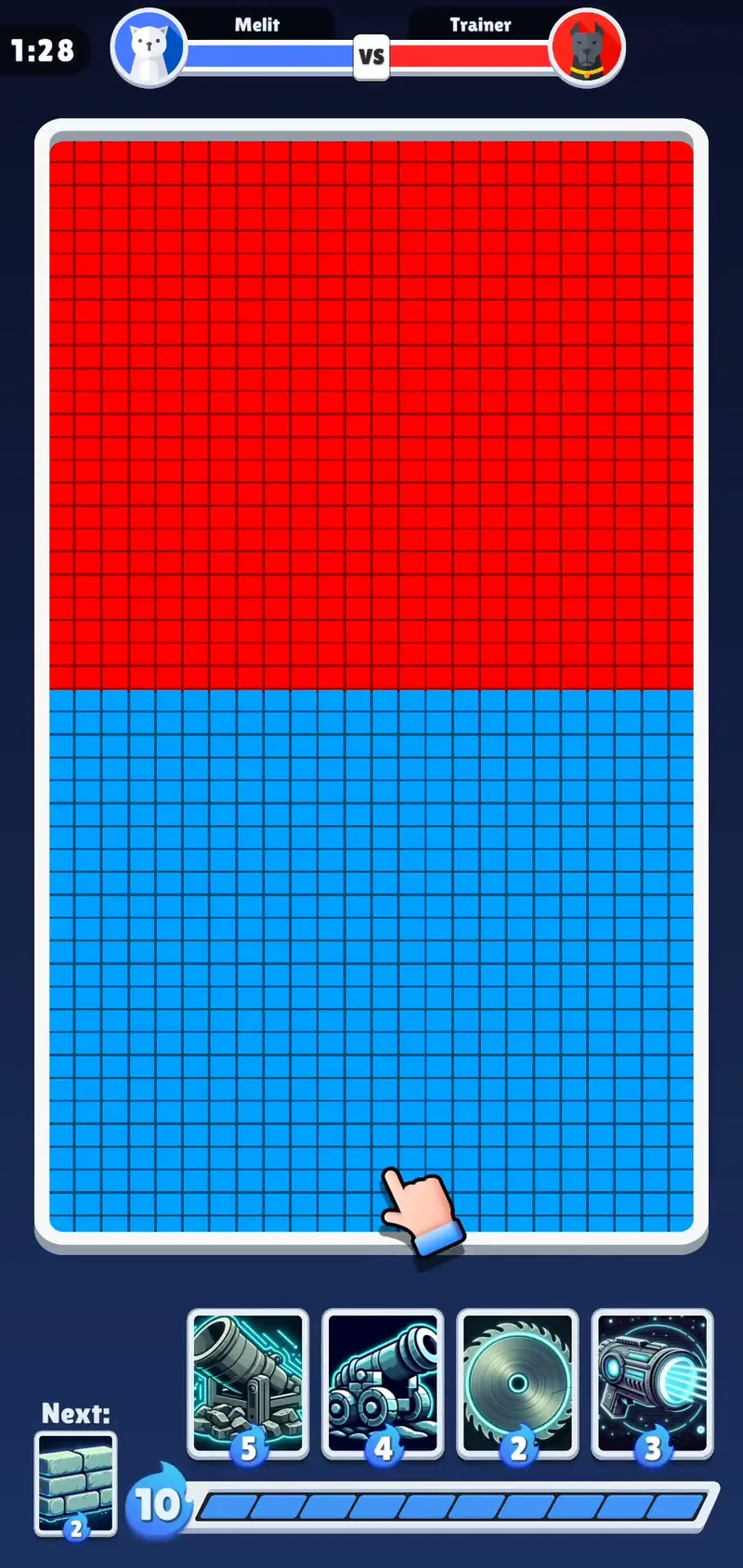
To play, the player selects a card, which lifts up with a yellow outline. The piece then shows on the board as a gray preview before it turns teal, and the card from “Next:” replaces the one just played. Placed weapons fire on their own, shooting into or cutting through red tiles and turning them blue, while the opponent’s red pieces do the same to the blue tiles.
Every card shows an energy cost in a blue drop: 2, 3, 4 or 5. Energy appears as a number in a drop icon next to a meter of 10 segments, which stood full at 10 at the start of the first match and read 2 a few seconds later. Cards that cost more than the current energy turn grayscale, and at 2 energy only the 2-cost saw stayed in color while a red laser cut into the blue half.
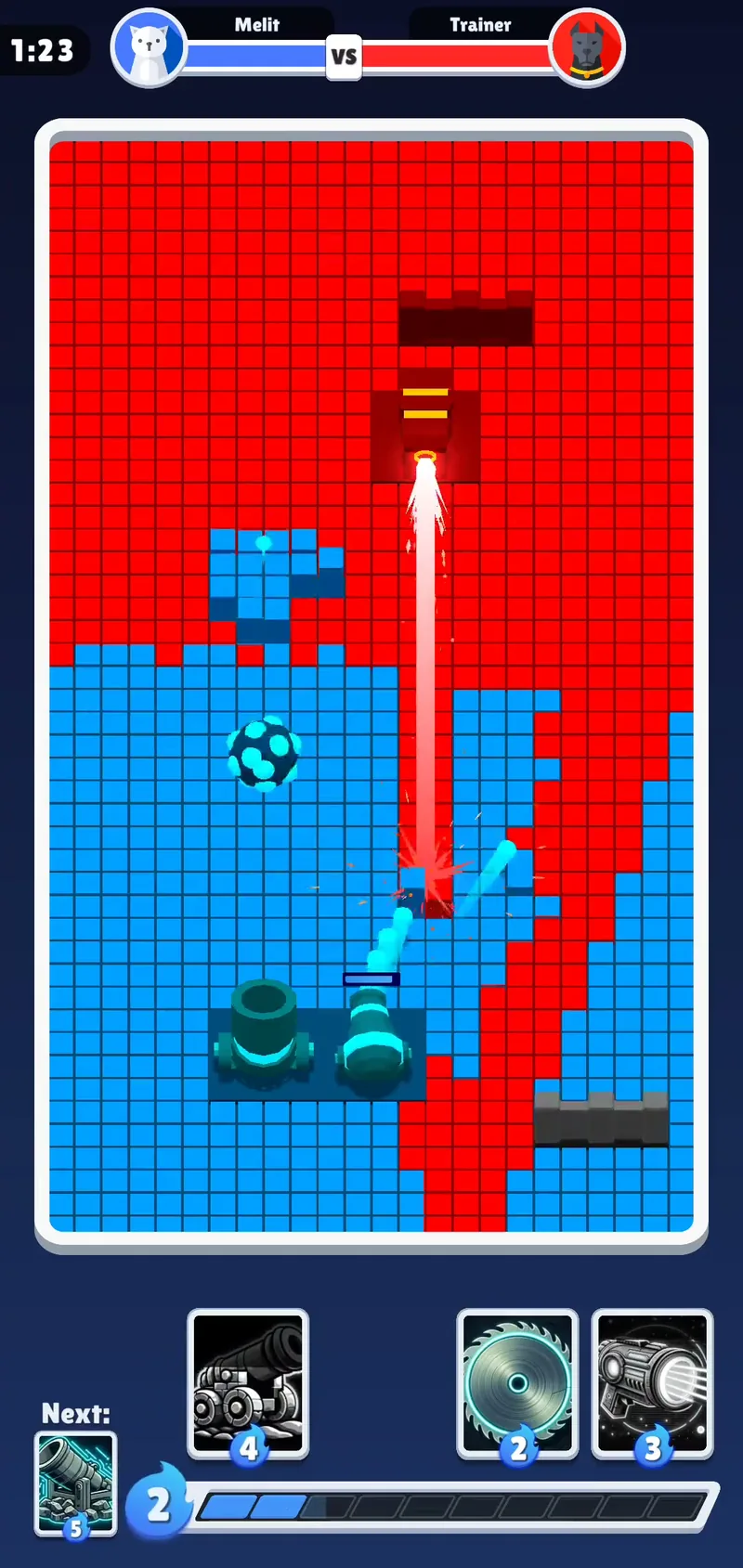
At 0 energy in the first match, every card went dark and the 2-cost cards were partly lit from the bottom. With no card played, the count rose to 2 a few seconds later.
A countdown timer at the top left starts near 1:30. At the top, the blue and red bars meet at a “VS” marker that sits in the center at the start and has moved toward the red side once blue covers most of the board. In the first match, cyan shard and splash effects piled up over the blue area until they covered most of the board with 0:33 on the timer. In the third match they were still scattered at 0:01.
Structures and units in this color clash game are low-poly 3D models, teal for the player and red with yellow or gold trim for the opponent. Small health bars show above some walls, turrets and units at some moments.
On the board, the mortar is a squat, upright teal barrel. Dark balls with cyan spots fly over the board in front of it, and cyan ring-shaped bursts and shards appear on the tiles. The opponent’s red mortar had a red ball with yellow spots in its mouth and another partway down the board, with orange shards spraying out around them.
The cannon is a teal barrel on a square base that sprays a curved stream of cyan pellets toward the red side. The opponent’s yellow-striped red cannon fires chains of orange pellets in sweeping arcs.
The laser card shows a blaster gun, and on the board a stepped teal tower fires a straight beam ahead. In the third match, one beam had just reached the red half, and moments later a column of blue tiles ran along it through the red half to the top edge. Elsewhere, a teal beam ended on a red knight in its path, and a red laser’s beam ended on a teal cannon.
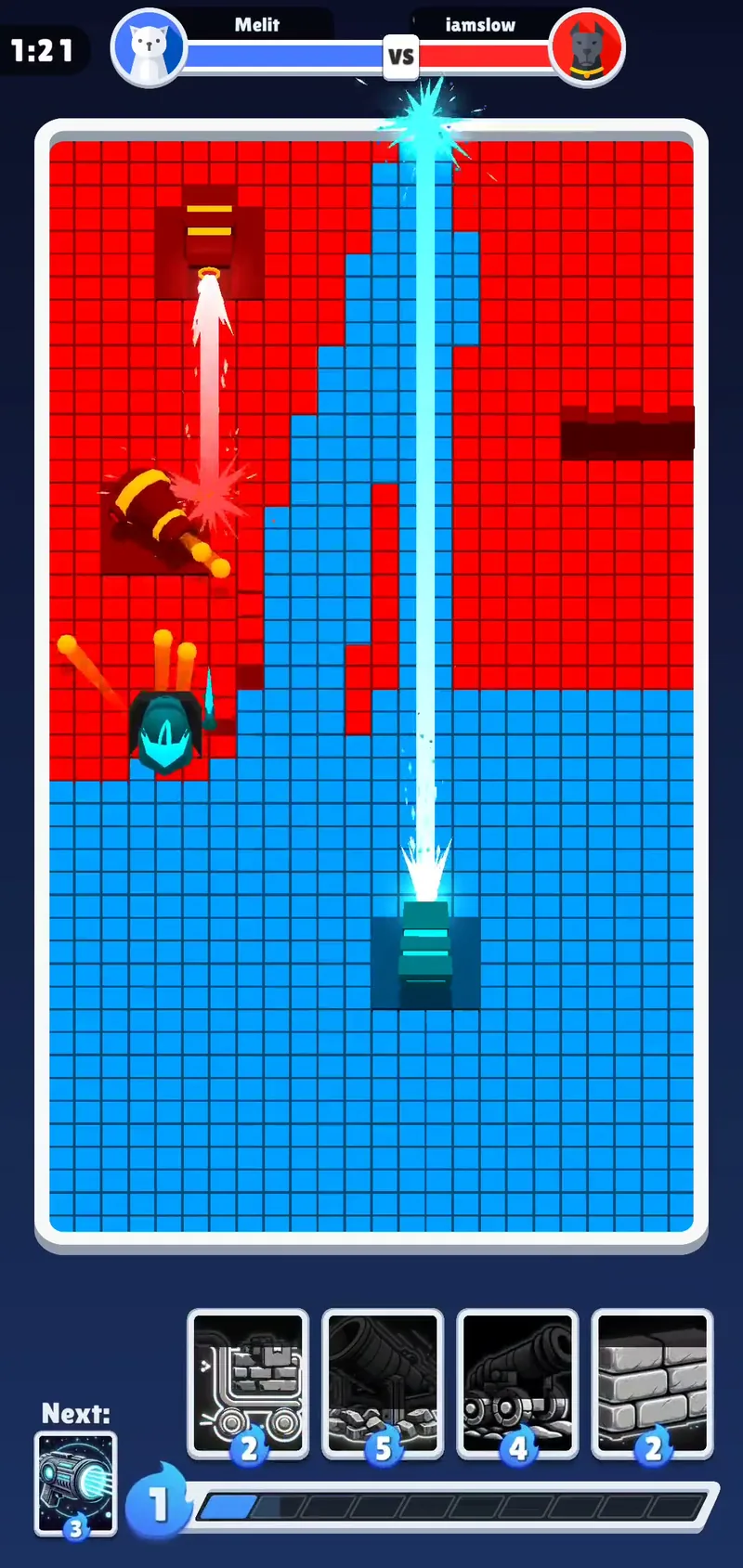
The saw is a spinning blade, cyan for the player and yellow for the opponent. One yellow saw cut at the border in the second match, and another sat at the edge of a fresh red patch cut into blue tiles in the third. Early in the first match, a gray saw blade with a white arrow pointing up showed on the player’s side.
The wall is a low block wall several tiles wide that can show its own health bar, teal on the player’s side and dark red on the opponent’s. In the second match, a red knight stood next to a teal wall while orange pellets landed around it.
From the second match on, the knight (cost 5) and the cart (cost 2) joined those first five card types, and the opponent fielded red knights and red turret units too. The knight card shows a helmet on a shield, and on the board the piece is a teal armored figure with a sword and a health bar. In the third match, one moved through the red half, took a hit from the red laser’s beam and stood right under the tower, and moments later that tower was gone.
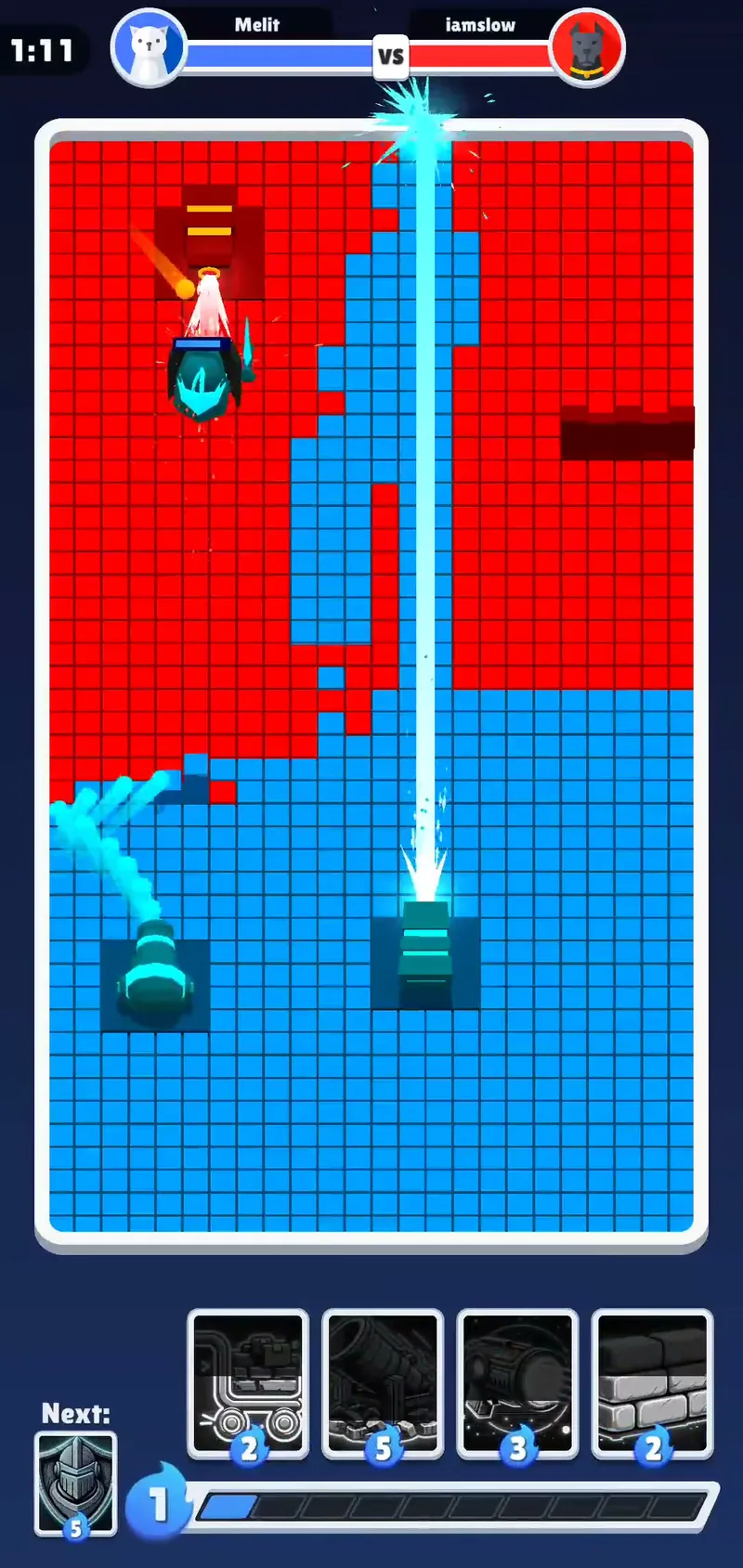
The cart card shows a wheeled cart loaded with bricks. Between one moment and the next in the third match, the card left the hand and a teal turret unit appeared in the red upper-left area. Teal turret units can show health bars, show up in different places from one moment to the next and spray cyan pellets around them. Later in that match, three of them sat in the upper half of a board that was almost entirely blue.
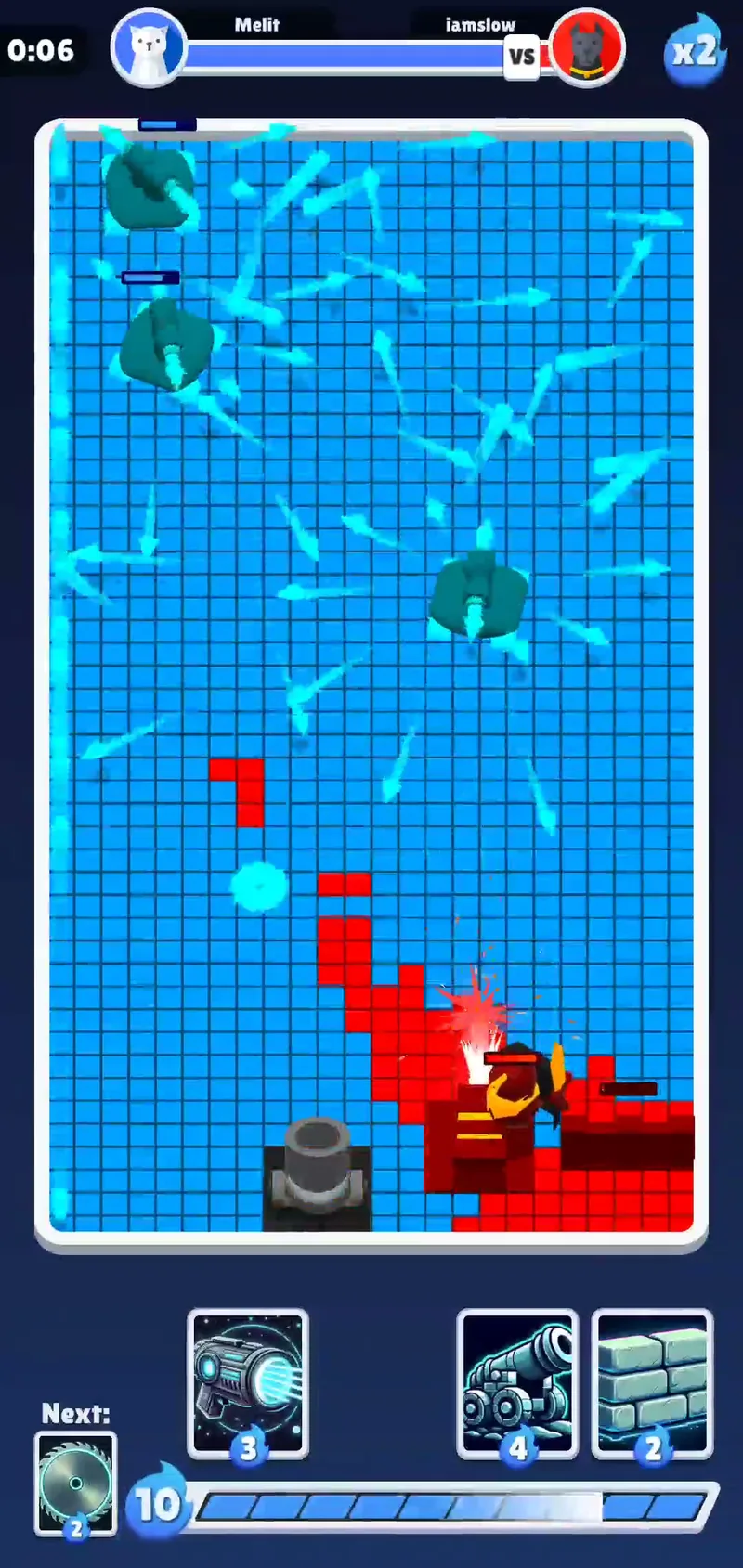
Across the five matches we played, the player’s name stayed “Melit” with a white cat avatar. Each match brought a new opponent name (Trainer, NoobMaster, iamslow, MrPee and Kool), with the same dark dog avatar on red.
The territory moves both ways. Against iamslow, the opponent cut a red patch into the lower right of the blue half and built a red mortar and a red laser there. Against MrPee, two teal lasers stood one near each side edge, and red was down to scattered patches with 0:54 on the timer. Against Kool, a red turret unit attacked a teal laser in the blue half.
Late in a match, an “x2” badge on a drop icon appears at the top right. It showed with 0:43, 0:41, 0:38 and 0:24 left on the timer, and it had not yet shown at 0:48 or 0:49 in the same matches.
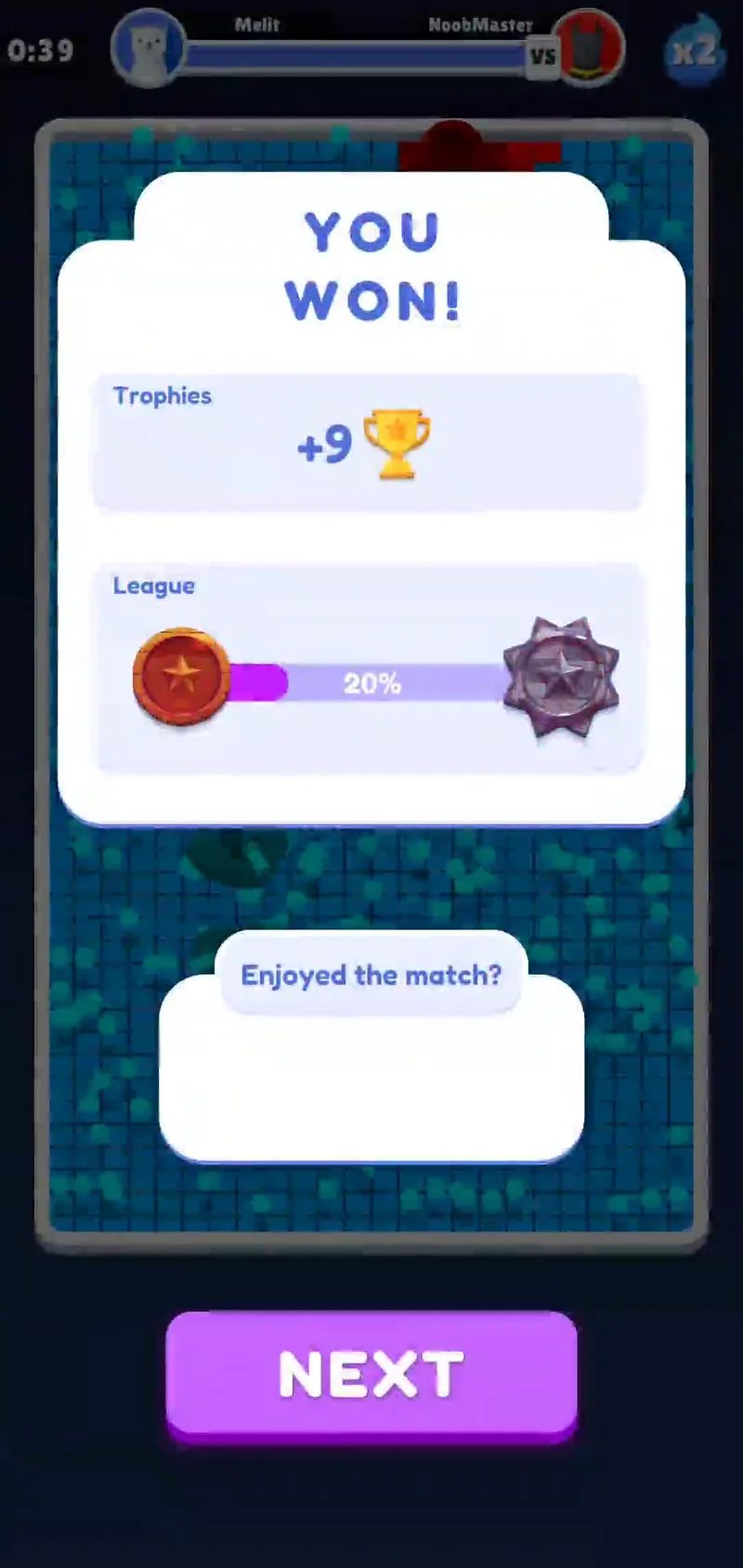
Matches wrapped up at different points on the timer. The “YOU WON!” panel after the second match came up with 0:39 left, after blue had covered almost all of the board. The first match gave way to the next after the timer showed 0:33, the fourth after it showed 0:54, and the third ran down to 0:01.
That panel awards +9 trophies, shown with a gold trophy. Below that, a “League” bar runs from a bronze star medal to a purple-gray spiked star badge and reads 20%. A purple “NEXT” button sits below the panel, and under the result a tab labeled “Enjoyed the match?” sits above a white box.
How it scores
Here’s how it rates in each area:
| Category | Score | Comment |
|---|---|---|
| Core gameplay fun | 8 | Really fun |
| Innovation | 8 | A great creative angle |
| Art style | 7 | Standard casual-game art |
In short:
- Overall score: 8.
- The gameplay is quite inventive. It takes Paper.io’s goal of battling for territory, but actual play uses the controls and rules of a card game, and both the fun and the depth are good.
- The game is still being tuned, and it looks very promising.
Google Play link: https://play.google.com/store/apps/details?id=com.playakor.clashofcolor
More from this series:
Tap-to-clear puzzles + archery: bows and arrows become level pieces, and hitting targets is the goal
Triple-tile matching + number merging + car repair: they’ve made a whole culture of it