Pets Duel-Spirit War Review: Troops Cross Bridges You Build
Paw coins buy both soldiers and the 8-coin bridge pieces they march across: a Pets Duel-Spirit War review of a side-view castle battle game.
Game at a glance
Pets Duel-Spirit War
7.5/ 10
Our score
Still calling it: the age of mobile RTS is coming.
In this article6 sections
Clash Royale is the nearest reference point: two bases face off, and troops come from a hand of cards paid for out of a counter that keeps rising. Pets Duel-Spirit War, a mobile real-time strategy game that belongs with games like Clash Royale, keeps that setup and swings the camera to the side, with a blue castle on the left and a pink one on the right.
The difference is the ground between them, which breaks into gaps and rises into cliffs and floating platforms. The same card grid that sends out animal soldiers also has cards that lay wooden bridges and hang vine ladders, so the army’s route gets built during the fight. We played the closing moments of Level 0, the whole of Level 2 and Level 3, and the start of the level after that, and the mechanics underneath show plenty of potential.
Paw-coin cards for soldiers and terrain
Each battle runs on one loop. Paw coins build up, and cards turn them into soldiers or pieces of path. The soldiers leave the blue castle’s door and walk right on their own into pink versions of the same animals coming the other way, while bridges and ladders carry them over the breaks in the ground. When a battle is won, a Victory panel appears, and Next starts the following level.
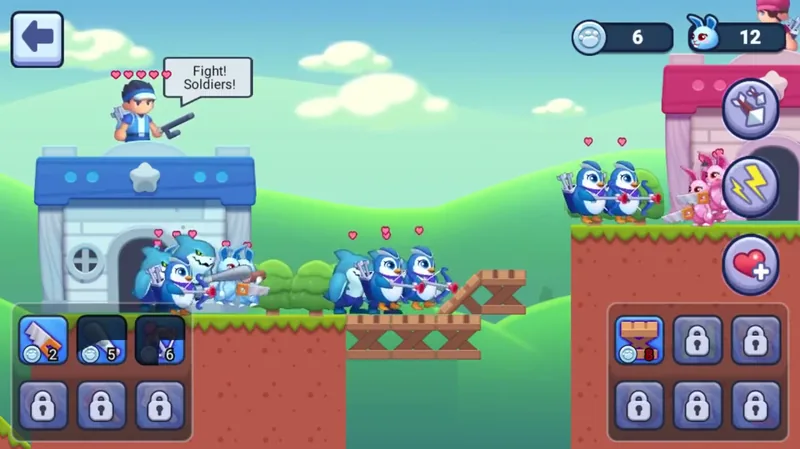
No goal text is shown, and no clock or move limit appears on screen. A hero stands on each castle roof calling out lines such as “For the people!” and “Fight! Soldiers!” in speech bubbles, the player’s in a blue cap and headband under a row of 5 hearts, the rival’s in a pink cap and a shirt marked “A”. Every battle that finished closed on a Victory panel: just before the one for Level 2, blue penguins had reached the pink castle’s roof, and just before the one for Level 3, the pink hero lay flat on that roof.
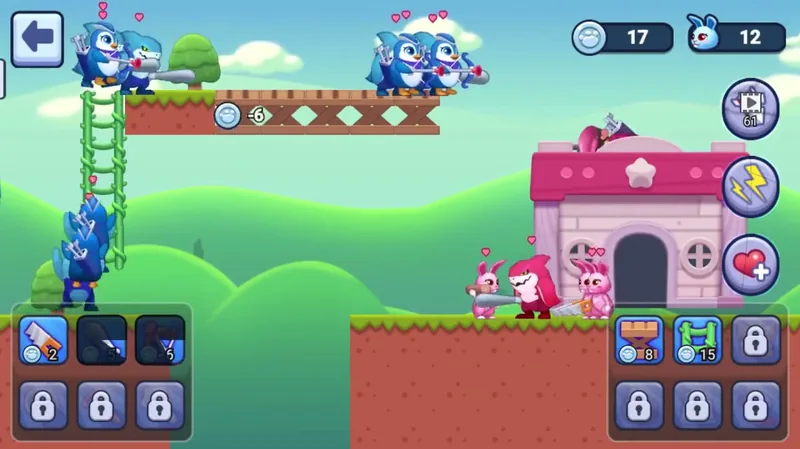
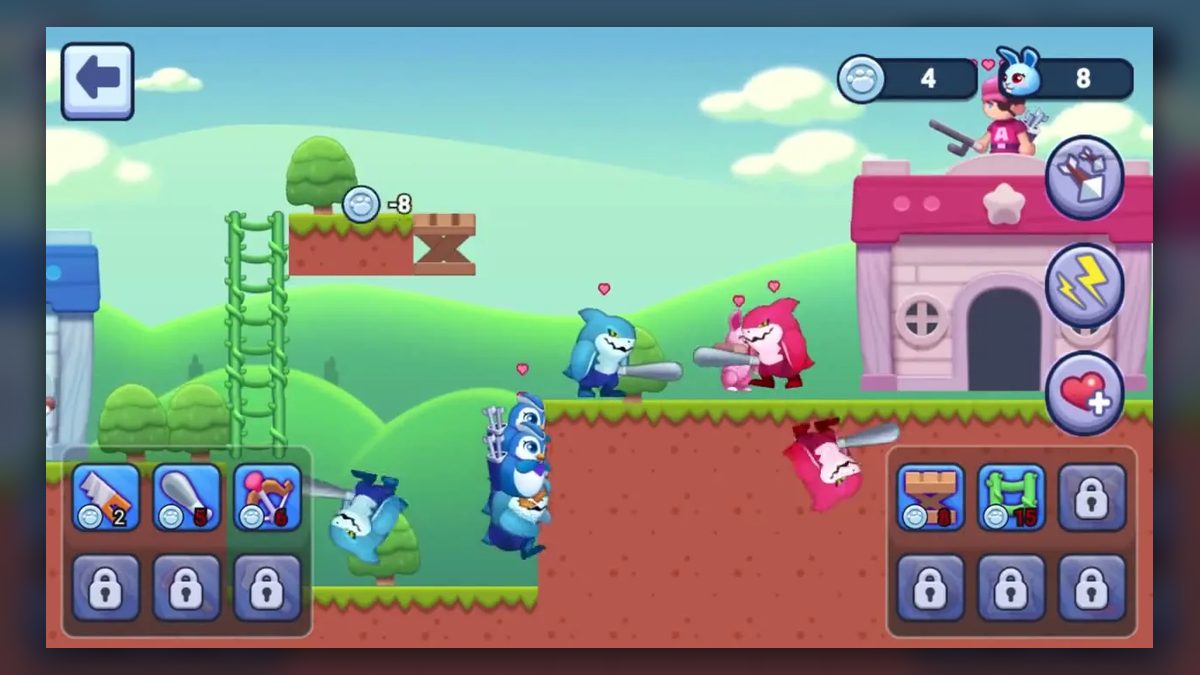
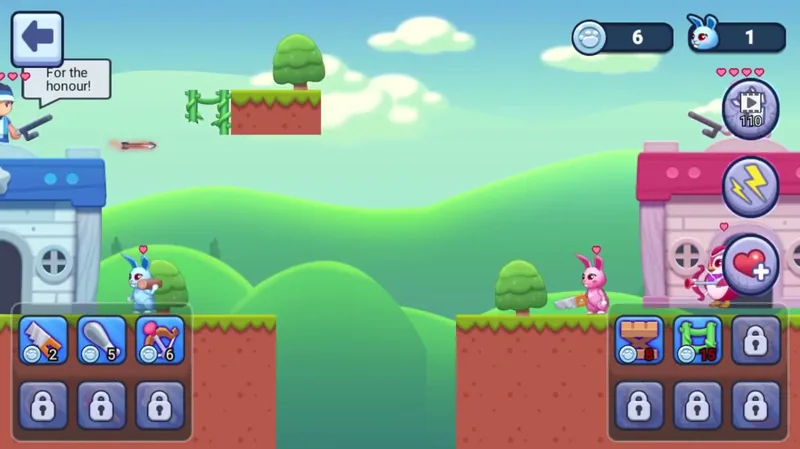
Everything is played through cards. Unit cards fill a 2×3 grid at the bottom left, three unlocked and three padlocked, and build cards fill a matching grid at the bottom right, where at first only the wooden bridge is open. Units walk right on their own while the camera scrolls sideways along the field. A back arrow occupies the top-left corner, and three round buttons run down the right edge.
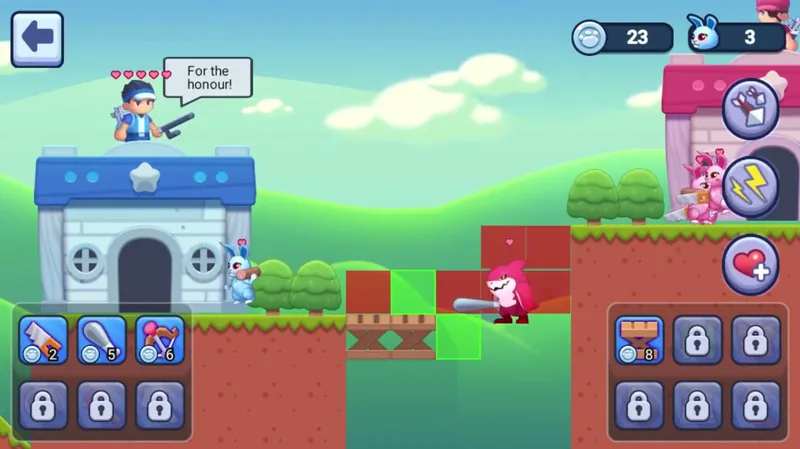
Paw coins pay for every card. A counter with a paw-coin icon at the top right climbs during battle, with “+1” pops over the blue castle and over the pink one as well. The saw card costs 2, the club card 5 and the bow card 6, while on the build side the bridge costs 8 and, once unlocked, the vine ladder 15. A price the counter can’t yet cover shows in red, and each purchase shows as a short pop such as “-8”.
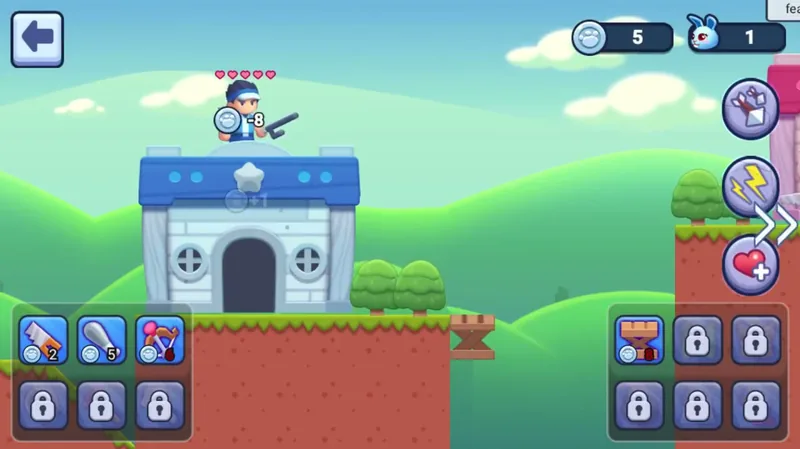
A used card also goes dark for a short time, even when the counter could pay for it again. A second counter, with a blue rabbit icon, sits next to the paw coins.
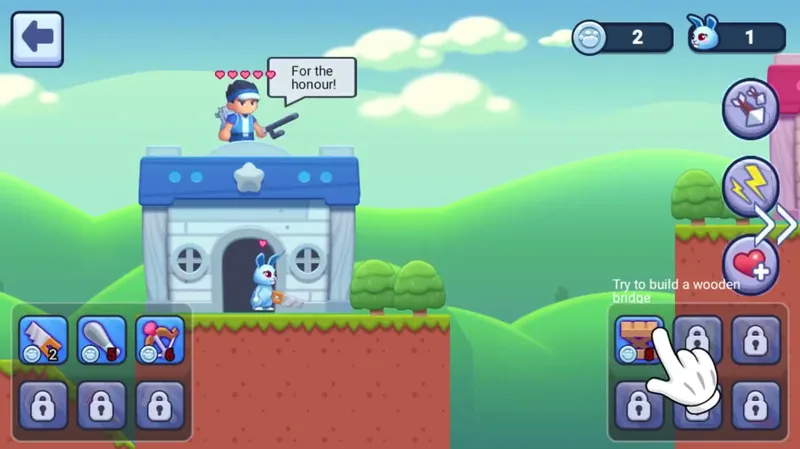
The saw on the cheapest card matches the blue rabbits, who carry saws or wooden logs. They are often seen near home, beside the trees by the blue castle or carrying a log at its door. Pink rabbits with saws and logs gather by the pink castle the same way.
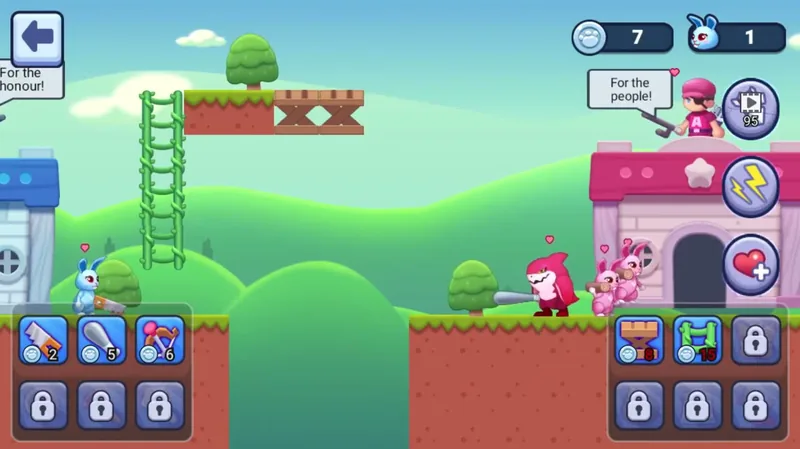
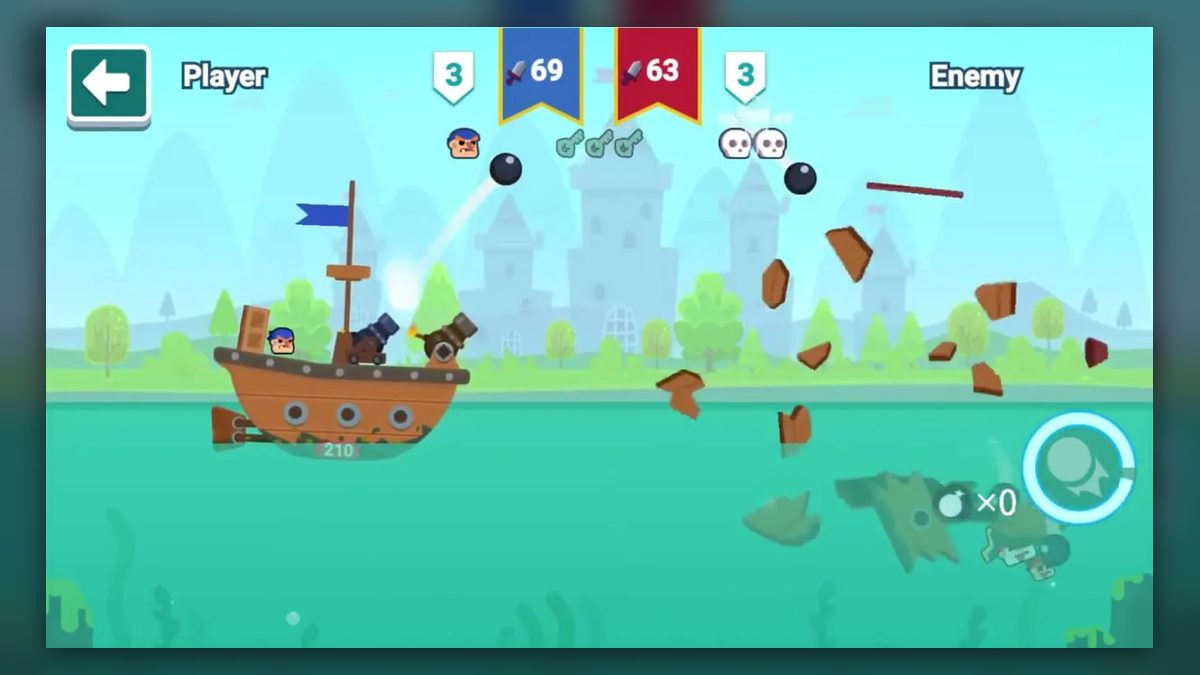
The club card matches the blue sharks, who carry a large gray club. They march alongside the penguins and trade blows with pink sharks at close range. A fighter that gets knocked out flips upside down or lands on its back.
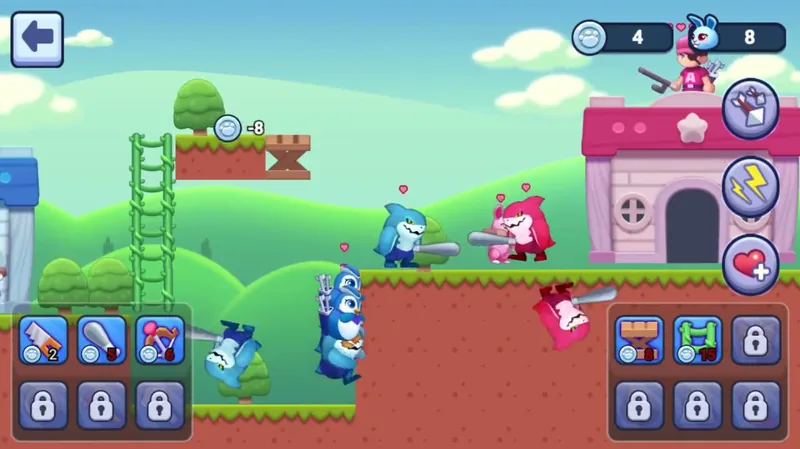
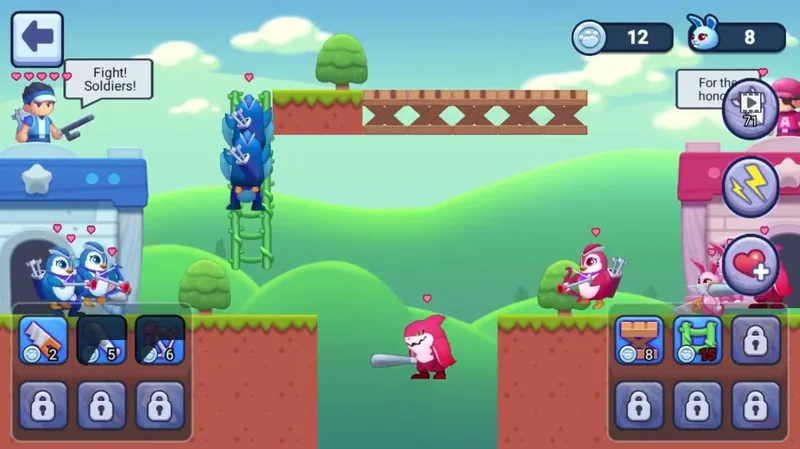
The bow card matches the penguin archers, who carry bows and quivers, and an arrow can be seen flying from their group toward the pink side. Penguins also pile up one above another against cliff faces and the pink castle’s wall. Later they turn up on the high ground and on the castle roof.
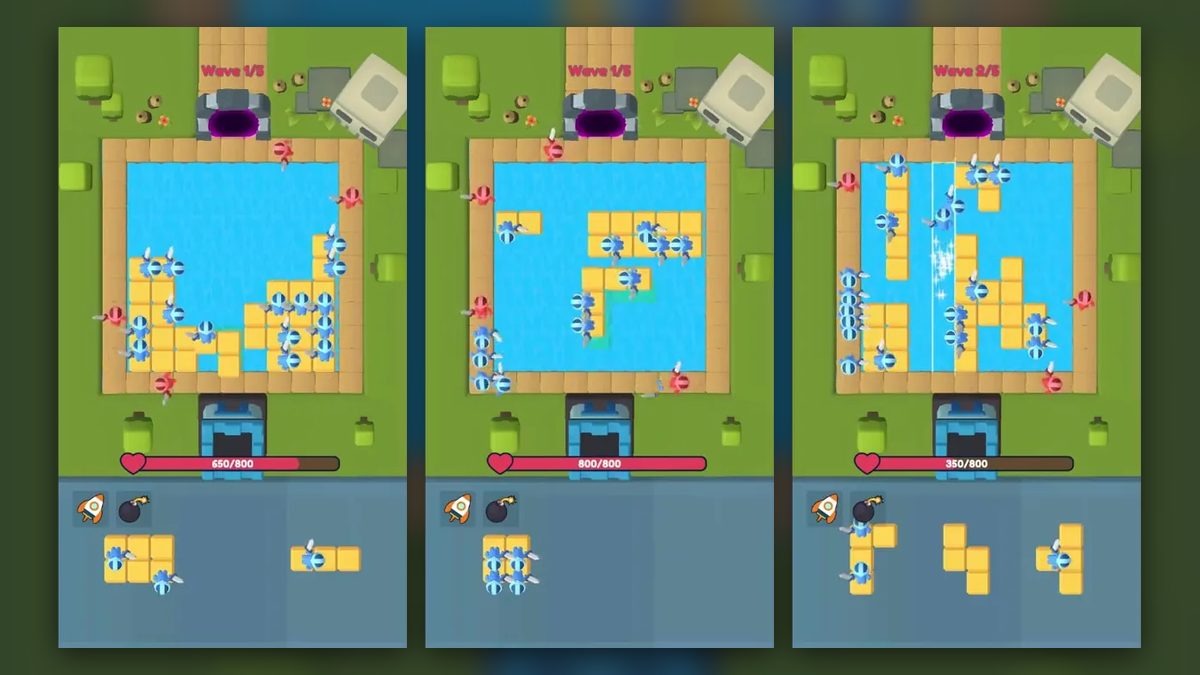
Gaps in the ground separate the castles, and a soldier that walks off an edge drops to the bottom. The bridge card builds a crossing one wooden piece at a time, starting from an edge, and green and red squares show beside the bridge while a piece is being placed. Besides flat pieces there are slanted ones that lead up to a higher row against raised ground, and bridges can also run sideways off a floating platform.
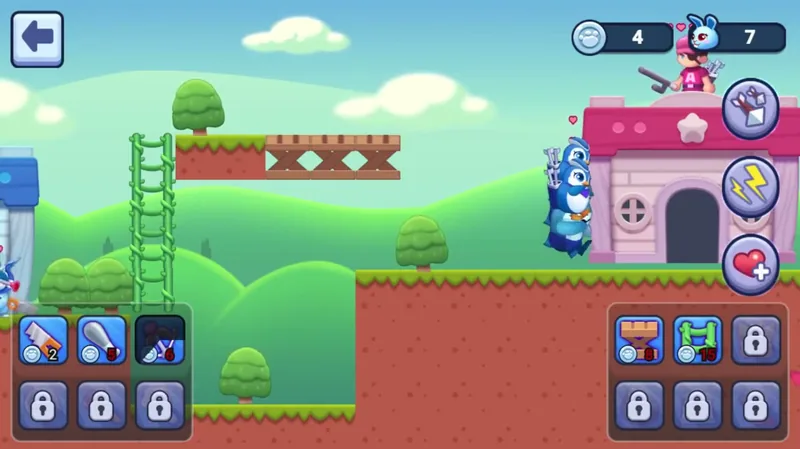
The vine ladder hangs from the left edge of a floating platform, and a green column marks its place under the platform while it is being placed. Blue units climb it to the platform, then carry on across the bridge built off its far side. During Level 3 the message “There is no free position” also appeared on screen.
From flat ground to a sunken valley
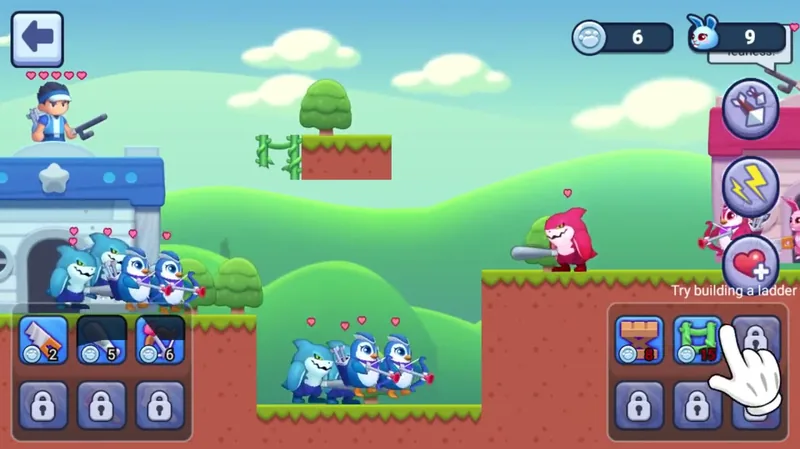
The ground between the castles gets more layered from battle to battle, and tutorial hints point at the build cards along the way. The closing stretch of Level 0 is fought on flat ground. Next comes a gap in front of the raised ground under the pink castle, and as Level 2 begins, a hand taps the bridge card under the hint “Try to build a wooden bridge.” On the blue side the ground ends just past two bushes, and a single blue rabbit with a saw stands in the castle doorway.
The first bridge piece, at 8 paw coins, goes in at the cliff edge. Some blue penguins walk into the gap before the crossing is finished and end up stacked against the cliff face, while the bridge grows to three flat pieces and a slanted one rising to a higher piece. Once the upper row has two pieces and meets the high ground, blue penguins reach the pink castle’s roof, and the Victory panel follows.
Floating platforms come next. Both castles in Level 3 stand on ground of the same height with a wide gap between them, and a grassy platform hangs over the gap with a tree on top and a short green vine stub on its left edge. The vine ladder card unlocks for this battle, leaving four build slots padlocked, and pink penguin archers now fight alongside the pink sharks and rabbits.
The battle after that puts these pieces together. Its middle sinks into a valley with a tree at the bottom, with the pink castle up on a raised plateau to the right and a floating platform, vine stub and all, hanging overhead. A second hint, “Try building a ladder,” points at the ladder card and then at a green column under the platform. Blue troops walk down into the valley and penguins stack up against the plateau’s cliff face, while bridge pieces go out from the platform’s right edge, one at first and then three.
Every win ends on a Victory panel showing the level label and a coin reward, with a green Next button and a pink button marked with a play icon and a bigger coin amount. Across the three wins the plain reward rose from 300 coins to 315 and then 330, while the pink button’s offer climbed from 900 to 1260 and then 1320.
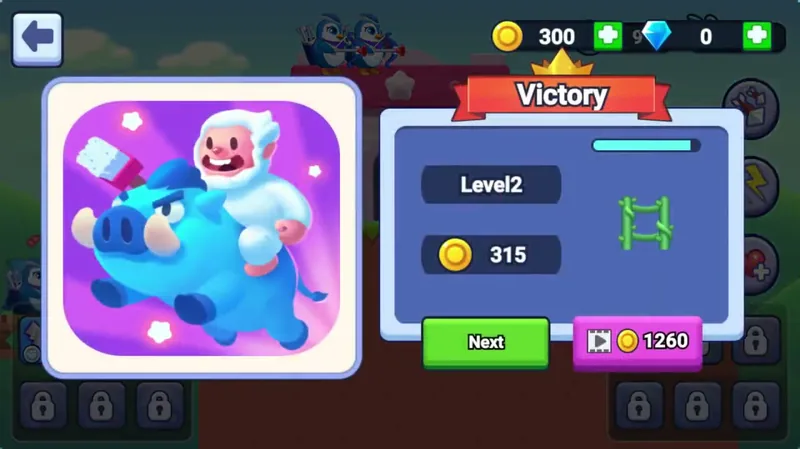
A progress bar on the same panel fills toward a picture of the next card to collect. The first panel pictures the green vine ladder with the bar partly filled, and the second shows the bar almost full, with the ladder card waiting when Level 3 begins. On the third, the picture changes to a white yeti with a big hammer riding a blue boar, and the same rider, on a purple background, fills the left half of every Victory panel.
Coin and gem balances run along the top of the panel, each with a green “+” button. The screen behind those buttons never opens, and no shop appears.
In battle, the three round buttons on the right edge show a hard-to-make-out icon at the top, a yellow lightning bolt and a red heart with a white plus, and a white double chevron sometimes appears beside them. None of them is seen in use. The top button changes during Level 3: its icon gives way to a play symbol over a number that counts down from 110 and reaches 61 near the end of the battle. In the next battle it shows its usual icon again.
Clash Royale’s model, seen from the side
We see real promise in these mechanics. They turn Clash Royale’s model on its side and work terrain and building into it: soldiers still come from a card grid fed by a single counter, but the player also shapes the ground between the two castles while the fight is on.
In Level 3 the route to the pink castle climbs a 15-coin vine ladder to the floating platform and then crosses a five-piece bridge built off its far side. Every piece of it comes out of the counter that also buys the soldiers, so one battle covers two jobs: raising an army and laying its road.
The ground also changes what the soldiers do, which is part of that promise. A soldier that steps off an unfinished edge falls into the gap, and penguin archers pile up against cliff faces and the pink castle’s wall. These interactions change and affect how the different soldier types play.
From here the mechanics could head in several directions: a light, casual real-time strategy game, a card battler closer to Clash Royale, or a slimmed-down version of the big war strategy games.
Rounded castles and a young-looking art style
The art style skews young. It is bright side-view cartoon art, from rolling green hills under white clouds to rounded castles with a star on the front. A small pink heart floats over every soldier, and both armies are cartoon animals color-coded to their castles, blue for the player and pink for the rival.
The battles are also hard to follow from still images. A shot of green and red squares around a half-built bridge, or of penguins piled against a cliff, says little on its own about what is happening. It makes far more sense with the soldiers on the move.
Splitting paw coins between troops and paths
Each battle comes down to dividing one counter while the soldiers walk on their own. Eight paw coins cover one bridge piece, or the saw and bow cards together, and the 15-coin ladder costs more than the club and bow cards combined. The player picks which troops go out and where the next bridge piece or ladder goes; the army does the rest. That fits a taste for card battles where troops push toward an enemy base, with a building job on top.
Verdict
The case for Pets Duel-Spirit War is what its fights could grow into. Clash Royale’s card duels, turned on their side and played over ground the player reshapes as the troops advance, give it the makings of a real-time strategy game. The art style looks young, yet the design beneath it is one to watch. We stand by our forecast that real-time strategy is close to having its moment on phones.