Plane Rush Review: A Sorting Puzzle Dressed as a Flight
Round passengers wearing codes like C3 need their own seats: a Plane Rush review of the sorting puzzle set in a cartoon airplane cabin.
Game at a glance
Plane Rush:Sorting 3D Games
8/ 10
Our score
Bite-sized pure puzzles need some fun packaging; it makes them cuter in an instant.
In this article6 sections
Read the code on a passenger’s head, find the seat that matches it and move the passenger there. Plane Rush, a mobile sorting puzzle, builds every level from that one action inside the cabin of a cartoon airplane, where a code such as “A5” names a lettered column and a numbered row.
We played Levels 2 to 8, picking up Level 2 in its closing moves and stopping partway through Level 8. The airplane theme is what we liked: it turns an abstract sorting rule into a plane full of passengers who each want one particular seat.
Seat codes that turn passengers green
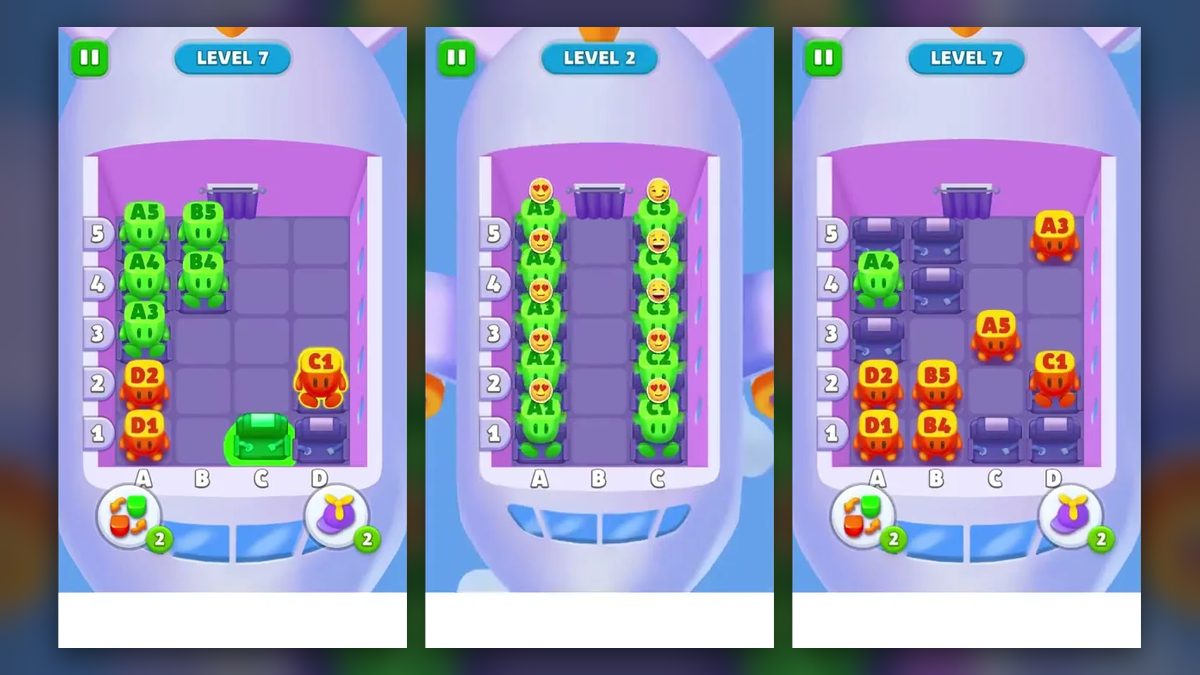
The board is a top-down cutaway of a rounded lavender cartoon airplane. A small purple curtain hangs at the top end of its pink-purple cabin, blue cockpit windows sit at the bottom, and orange engines show on the wings at either side. Rows are numbered 1 to 5 along the left edge, with row 1 at the cockpit end, and columns are lettered along the bottom; seats are dark purple with pale cushions, and the open floor tiles are a lighter purple.
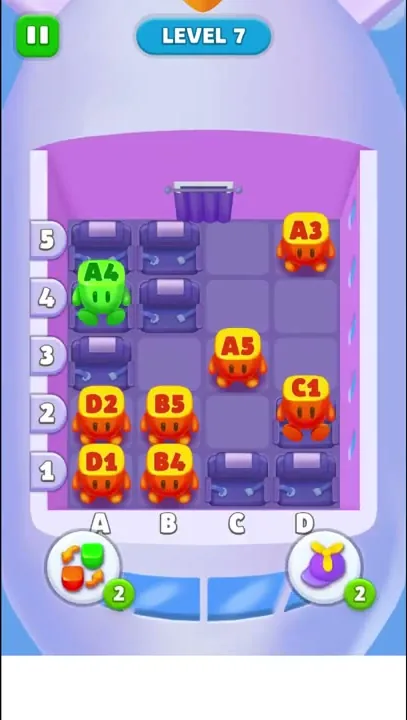
Plane Rush gameplay rests on the passengers, chubby little 3D creatures with a glossy finish and small dark eyes. Each has a bold seat code printed on its head. A passenger anywhere but its own seat, whether on a floor tile or in somebody else’s seat, is red-orange with a yellow label. Once it sits in the seat whose letter and number match its code, it turns green, label and all.
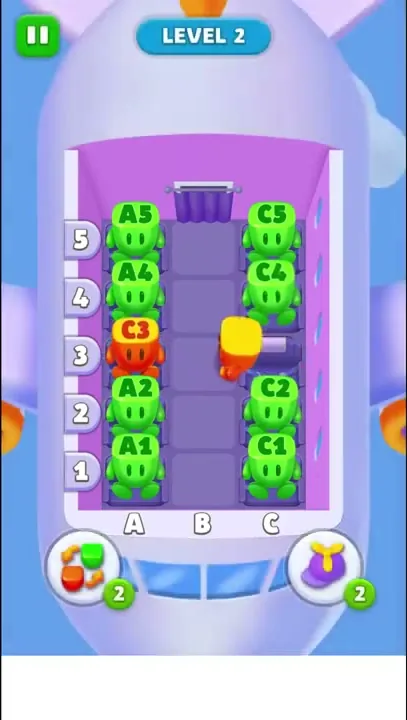
The goal is a cabin where everyone is green. Passengers move one at a time into their own seats, and no goal counter is printed anywhere; the level ends once every passenger sits green in its own seat. The next level label then appears, and between levels the view pulls out to blue sky and soft clouds with the whole plane flying.
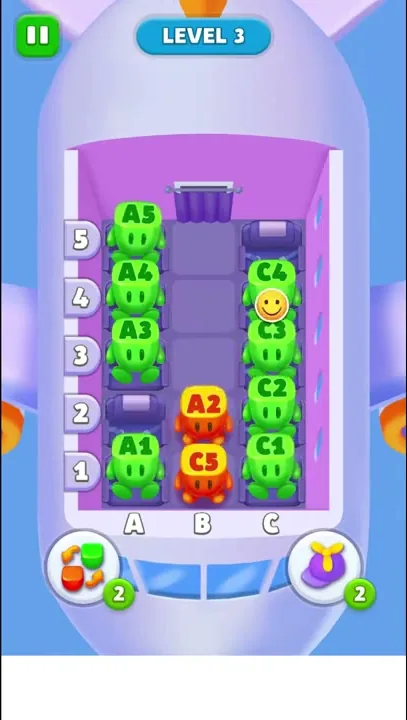
Whichever passenger is being moved gets a yellow outline, and the seat matching its code lights up bright green with a green halo, so the destination is marked on the board. A green pause button sits at the top left, and two round booster buttons wait under the cabin.
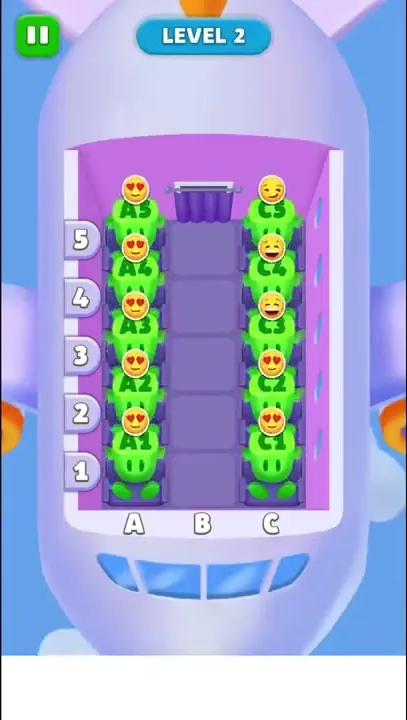
Passengers react when they reach the right place. One that has just sat down in its own seat shows an emoji above its head, heart eyes or a grin for instance, and once Level 2 is complete every seated passenger shows one at the same time.
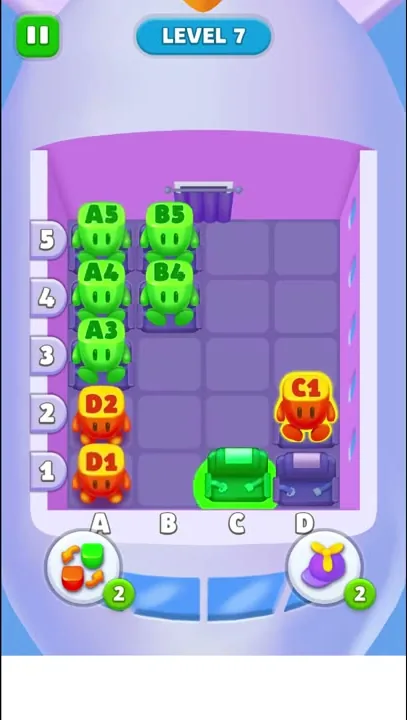
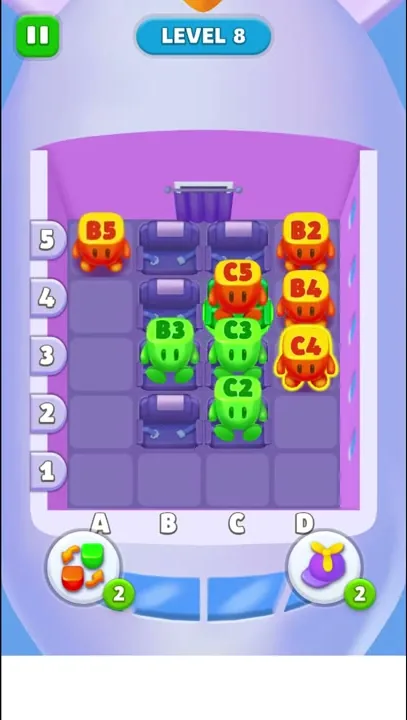
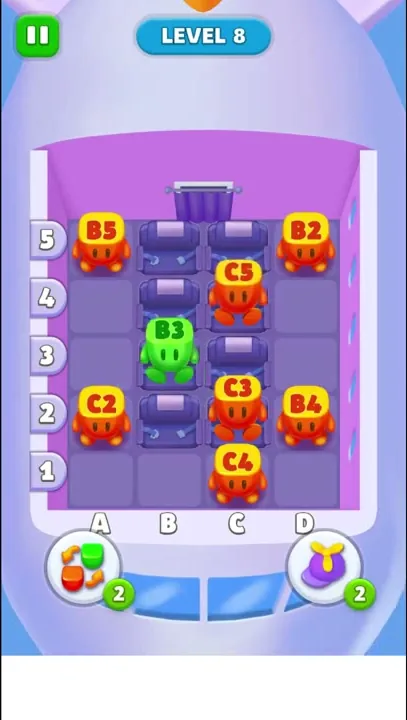
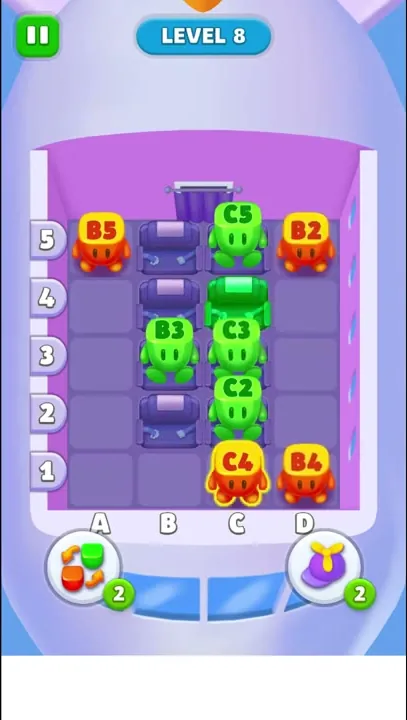
Some passengers sit red in a seat that belongs to someone else, as C4 does in seat C1 early in Level 4 and C1 does in seat D2 in Level 7. The seat’s owner sits down there only after the occupant has moved out. Level 8 has two of these at once, C5 in seat C4 and C3 in seat C2, and at one point passenger C4 stands outlined on the floor beside the seat block while C5 still holds its spot. Seat C4 then empties, and C4 later settles into it.
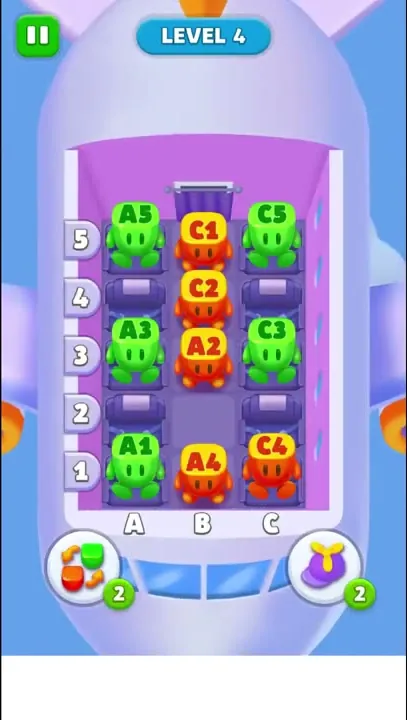
Five passengers already sit green early in Level 4, three in the left column and two in the right. Four red ones stand in the aisle, C1 nearest the curtain and A4 nearest the cockpit, while C4 sits red in seat C1 and four seats stand empty. Partway through, seat C1 is empty and glowing green with passenger C1 outlined, and soon after that the cabin gives way to sky and clouds while the label still reads Level 4.
No move counter or timer appears on the play screen, and there is no lives display. No fail screen comes up either, even in Level 8, where passengers are moved back and forth.
From a single aisle to a center seat block
The first cabins are narrow. Through Level 4 the plane has three columns: seats line columns A and C, five rows each, and column B is a single aisle with the purple curtain at its top end. Passengers wait in that aisle or sit in each other’s seats.
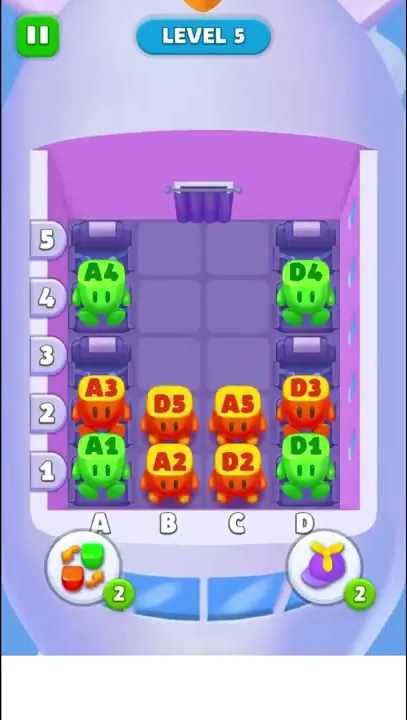
The cabin widens in Level 5 to four columns, A to D. Seats stay on the outer columns A and D while B and C become two aisles side by side, and the plane is drawn wider so that the cabin fills more of the screen.
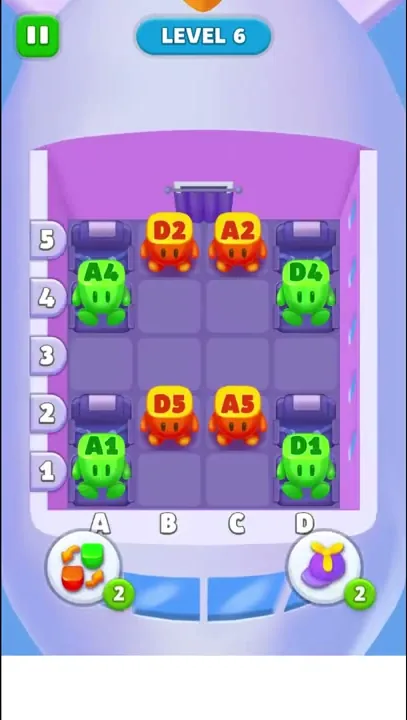
After that the rows start to break up. Row 3 has no seats at all in Level 6, so open floor runs across all four columns and meets the aisles in a cross, while the outer columns keep their seats only in the two rows above it and the two below.
The straight aisles disappear in Level 7. Its seats are scattered over the grid, a group of five in the upper left (three down column A, two beside them in column B) and three more in the bottom-right corner, with open floor everywhere else. Early on, A4 is the only passenger already in its own seat.
Level 8 gathers every seat into the middle: two columns of four in B and C, rows 2 to 5, with open floor around them on columns A and D and across row 1. Only B3 sits green early on. It is the longest of the levels played, and passenger C4 moves around the floor before taking seat C4: first at C1, then at D3, then back at C1, then at A3. By the last moves played, B4 is the only passenger still out of place, outlined at D5 while its seat glows green.
Two round booster buttons sit under the cabin in every level. The left one shows a red and a green passenger with curved arrows, and the right one a purple cap with a yellow propeller. Each carries a green badge reading 2, and since neither booster is used, both badges still read 2 at the end. No coin or gem counter, shop, lives display, offer or ad appears on any screen.
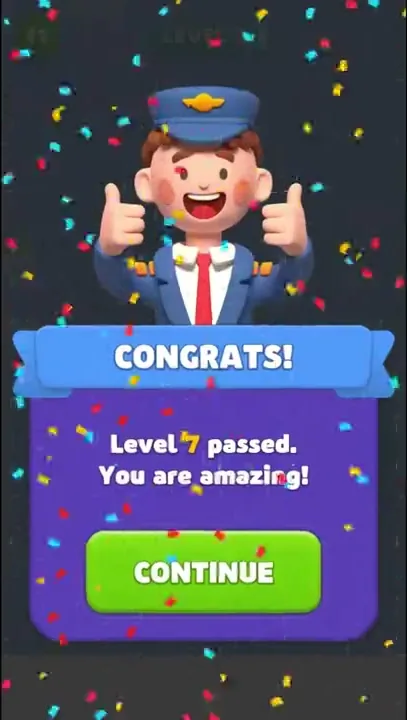
After Levels 5 and 7, a card on a darkened screen reads “CONGRATS!” above “Level 7 passed. You are amazing!”, with “Level 5 passed.” on the earlier one. A smiling cartoon pilot in a blue cap with a gold wings badge and a red tie gives two thumbs up under falling confetti, and a green “CONTINUE” button sits at the bottom. No coins or other reward appear on it.
The airplane theme on a bare sorting rule
The seating theme is a fun way to package a sorting puzzle, and we found the fit very clever. The seat codes are the cabin’s own labels, letters along the bottom and row numbers down the side, so a passenger marked C3 sitting in seat A3 is simply a traveler in the wrong seat.
The theme also gives a very abstract puzzle some humor and life. Passengers flash heart eyes or a grin as they reach their seats, a pilot cheers with both thumbs up on the “CONGRATS!” card, and the plane flies off over the clouds between levels.
A bite-sized puzzle built on pure logic needs some fun dressing, and dressing of that kind can make it cuter straight away. Here that job falls to the chubby passengers with their small dark eyes and emoji faces, and to the cartoon pilot in the blue cap.
The setting also leaves more room to imagine. It opens the door to picturing all kinds of plane-themed progression between levels, with gameplay and systems of their own.
Unused boosters and what comes after Level 8
We have no criticism of Plane Rush. Some parts of it simply stay out of view: neither booster is used, so what the swap-arrows button and the propeller-cap button actually do is not shown.
The plane-themed systems the setting invites are not part of the game as it appears here, since beyond the puzzles there are only the two boosters and the “CONGRATS!” card. Nothing before Level 2 or after Level 8 turns up either, so the later layouts remain unknown.
Matching codes to columns and numbered rows
Every level asks for the same small piece of reading: take a code like “B4”, find column B along the bottom and row 4 on the left edge, and deal with whoever is already sitting there. That suits a taste for sorting by printed labels and grid positions, and for seeing the same grid redrawn as straight aisles give way to scattered seats. It also sits well with a fondness for bite-sized logic puzzles starring cartoon characters, where each passenger seated earns an emoji.
Verdict
Plane Rush takes the bare rule of putting each piece where its label says and recasts it as travelers hunting for their places on a flight. That one choice gives the puzzle some wit and life along with a cuter face, and it matches the rule so neatly that the seating chart feels made for it. The aircraft setting also leaves wide space for flight-themed systems to grow around the levels.