Scavenger Hunt Review: 48 Objects in a 3D Toy Town
Scavenger Hunt review: a 3D hidden-object search for 48 items, from street level up to the sky, in a toy town seen from shifting angles.
Game at a glance
Scavenger Hunt: Find Objects
5/ 10
Our score
Hidden-object games are plentiful, but this is the first we've seen that looks like this.
In this article6 sections
There are plenty of hidden object games, and Scavenger Hunt is one of them, built on a find-the-listed-items scene with a tray of icons along the bottom. The part that stands out is the look of the scene: a full 3D toy town, which the camera shows from changing angles and distances.
We had not come across this visual style in the genre before, and the toy-town look carries a strong character of its own. The search is built around one number printed above the tray: 48.
48 objects hidden around a 3D toy town
The goal is to make all 48 finds the counter above the tray asks for. Each entry on the list has its own target of 1 or 2, and every single find counts toward the 48. Nothing else on screen limits the search: there is no clock, nothing tallies moves or mistakes, no lives are shown, and no fail screen came up.
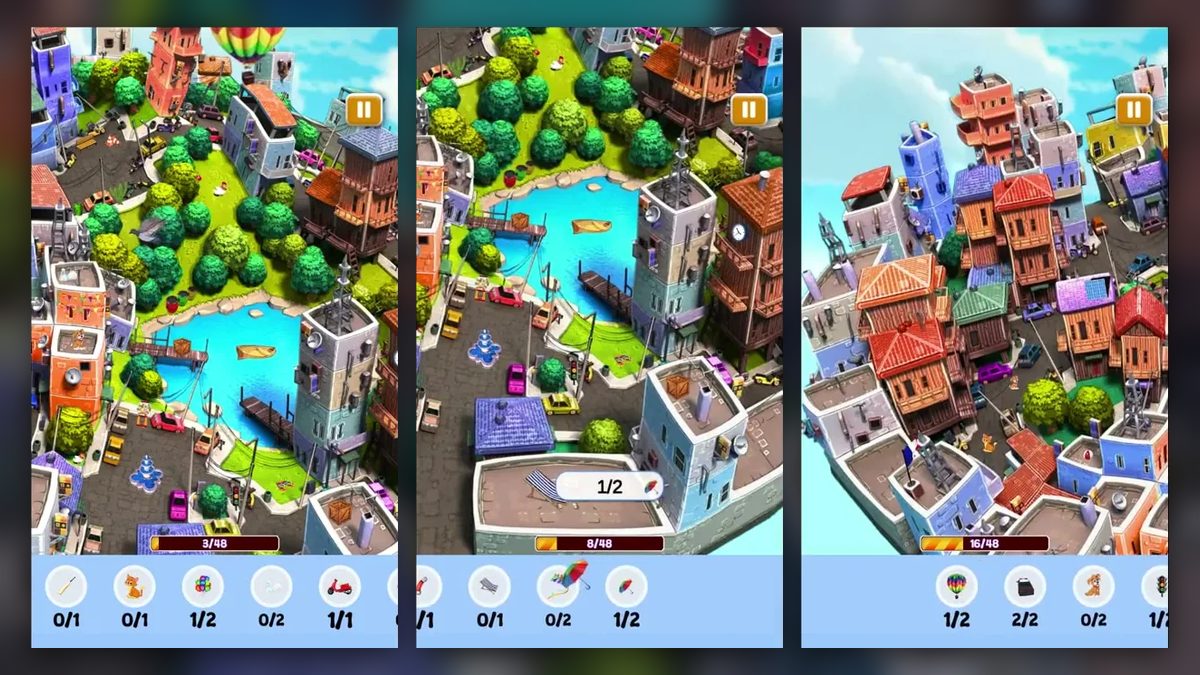
The camera’s angle and distance on the town change from one moment to the next, and the tray’s row of icons slides sideways while the scene and the counter hold still, so the list scrolls. An orange pause button stays in the top-right corner throughout.
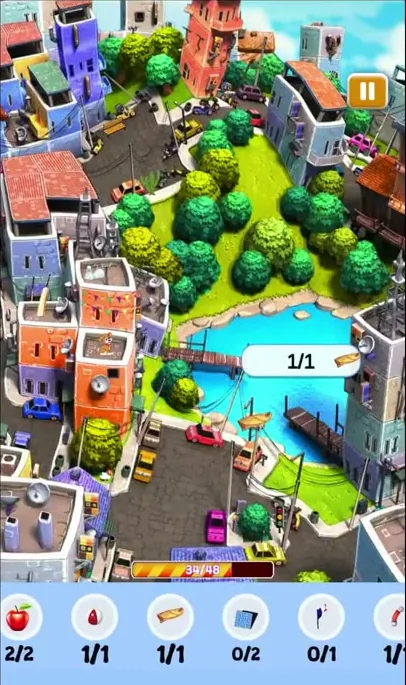
In the one scene we played, the count rose from 1/48 to 34/48 without reaching the end. Every step of that climb follows the same loop: an icon in the tray names an object, and the object is somewhere in the town. Once it is found, it is marked both in the town and in the tray, then it disappears from the scene and the counter goes up by one. That cycle is the core of Scavenger Hunt gameplay.
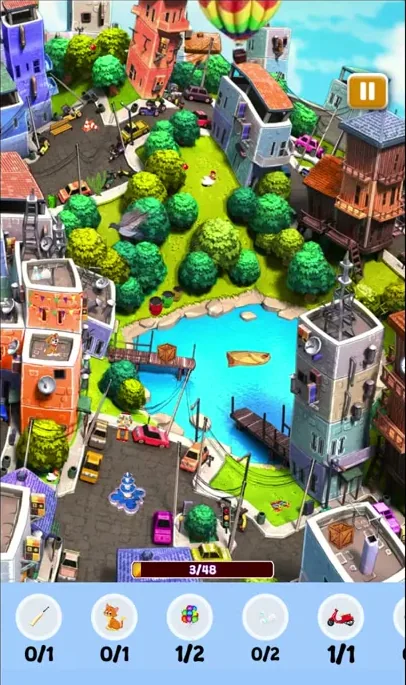
The tray is a light-blue bar along the bottom of the screen, lined with white round slots. Each slot holds an object’s icon with a found/needed count under it, such as “0/2” or “1/2”. Five full slots fit on screen, plus part of another at the edge. The row begins with a hot-air balloon and ends with a beach umbrella, and finished objects keep their slot with a full count such as “1/1”.
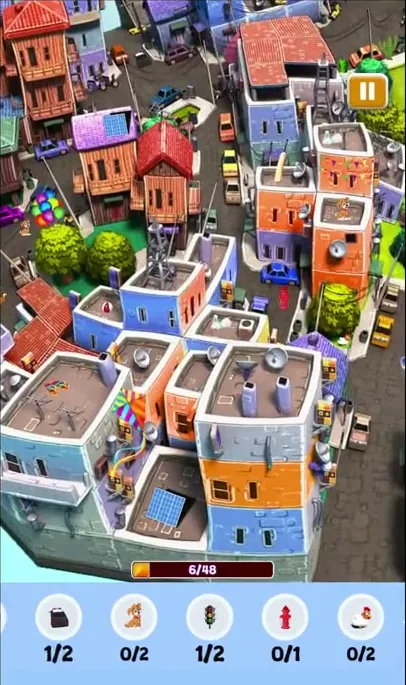
Just above the tray, the counter is a dark red bar with an orange-and-yellow striped fill. The fill grows with every find, so the bar works as a progress meter for the full list rather than for any single object.
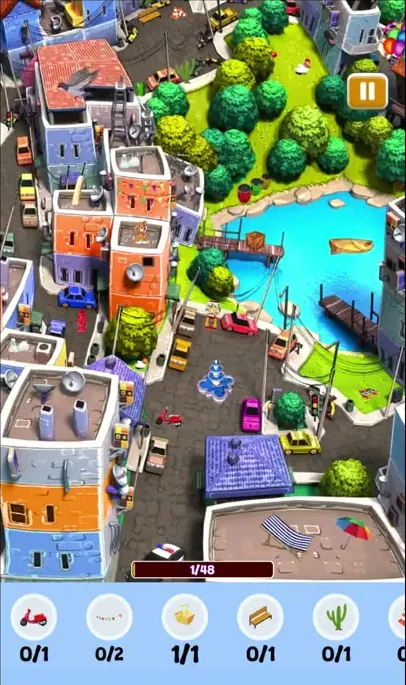
Each find is also marked in the town itself. A white, pill-shaped label appears where the object was, showing its icon and its new count. A wooden crate on the pond’s pier gets a “1/2” label, and the second apple brings up “2/2” with an apple icon on each side.
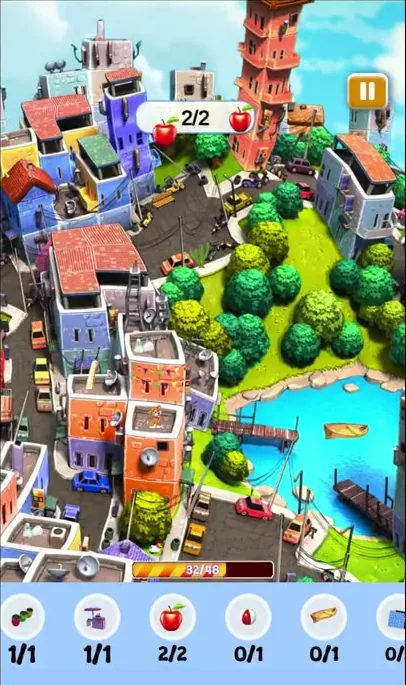
Right after a find, an enlarged copy of the object shows up over or just above its tray slot. A purple stand, a hot-air balloon, a pair of flip-flops and a wooden crate all appear this way. The balloon lands just beside its slot, overlapping the counter bar, while the flip-flops sit over their slot as it ticks to “2/2”.
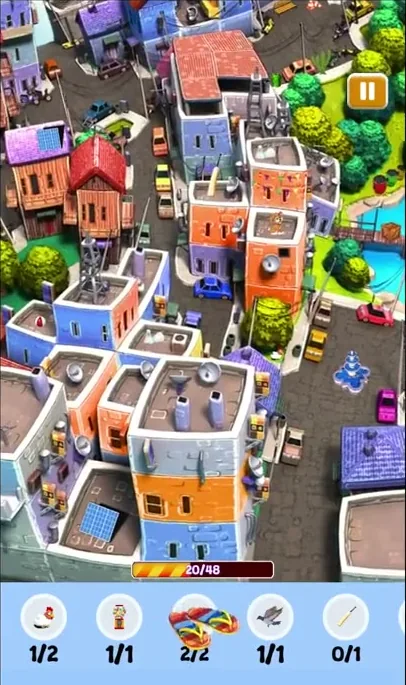
Some objects have to be found twice, and their slots move from “0/2” to “1/2” to “2/2”. Beach umbrellas come as a pair, and so do the apples and the wooden crates. When the first of a pair is found, the half count shows on both the label in the town and the slot in the tray.
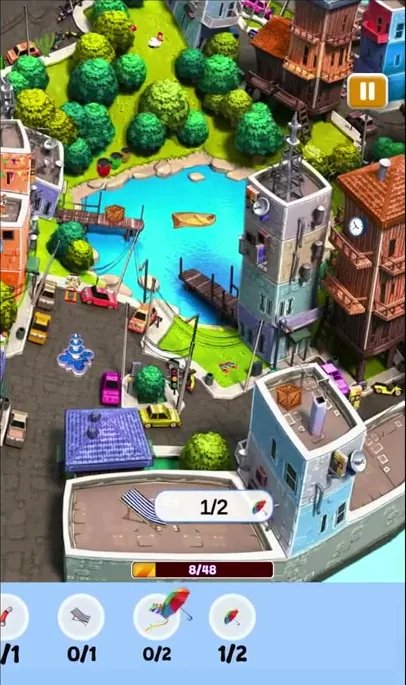
A deck chair and a beach umbrella stand side by side on a flat rooftop near the bottom of the view; the chair’s slot asks for one, the umbrella’s for two. The umbrella is found first, at “1/2”, and the chair follows at “1/1”, after which the rooftop is bare. A crate on the pond’s pier vanishes the same way, and a hot-air balloon floating above a blue tower is gone once the balloon slot reads “1/2”, so objects in the sky are on the list too.
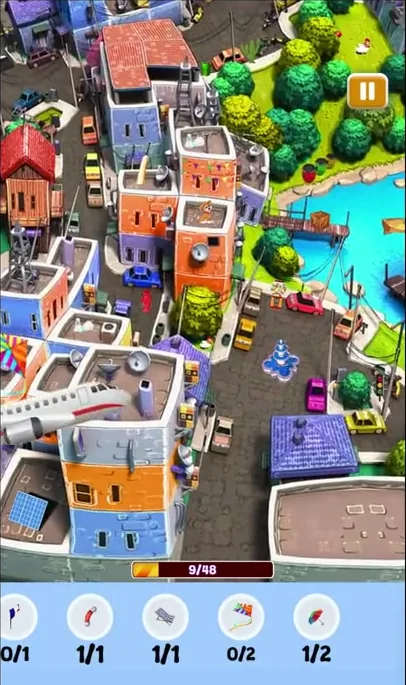
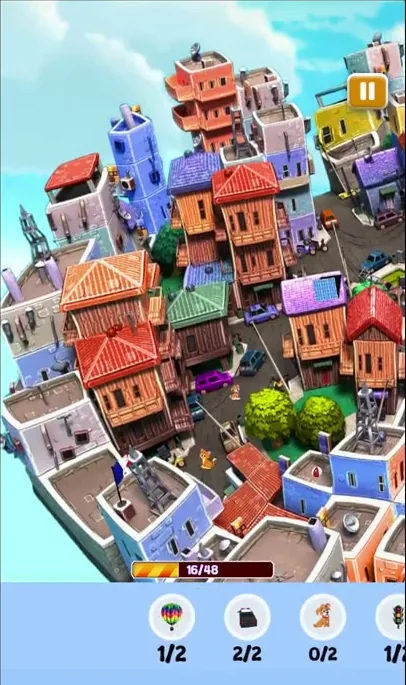
The town is a full 3D model, and the camera keeps moving around it. One moment it gives a near top-down view of the park and pond. Later it tilts to look across the rooftops toward the sky, or drops low enough to show the town’s edge with sky beneath it. Objects are tucked onto rooftops and into the streets as well as onto the pier and into the sky.
One unchanging town and an ad break
No new area or mechanic arrives over the course of the scene, and no level number appears anywhere. The same town stays on screen from first view to last while the counter climbs. Progress shows in the tray, where more and more slots reach their full counts, and in the town, which loses each object as it is found.
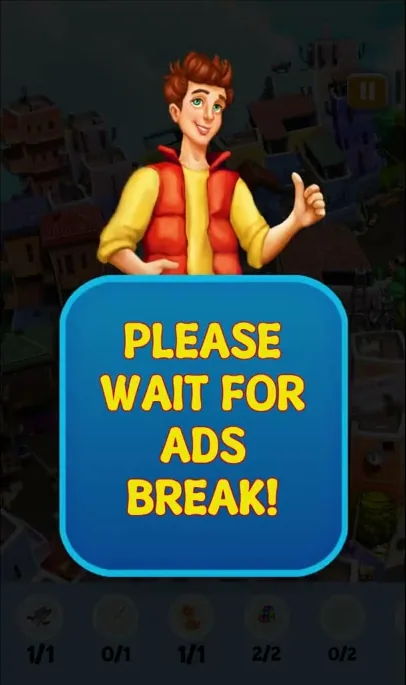
Midway through the scene, the screen dims and a cartoon young man in a red vest gives a thumbs-up above a blue panel reading “PLEASE WAIT FOR ADS BREAK!” Afterward the same town and tray return and the count carries on.
Apart from that notice, nothing on screen points to spending or extras. No coins, gems, hint button, boosters, shop button or lives appear in play; over the town there is only the pause button at the top and the counter and tray at the bottom.
A chunky toy-town look of its own
The look that was new to us comes from a town built like a chunky toy model. Tall, narrow houses in orange, blue, purple, yellow and red stand under tiled roofs beside wooden towers. A park of round, bushy trees runs down to a turquoise pond with a pier and a small boat, and toy-like cars crowd the streets around a blue fountain.
To our eyes the style is a strong one, and the toy look runs through the whole town. Rooftops carry satellite dishes and chimneys, with the odd ladder or solar panel among them. A white passenger plane with a red tail keeps passing over the town while striped hot-air balloons float overhead. From a low angle the town turns out to sit on a block with visible edges, with sky showing beneath it.
What the unfinished scene leaves open
There is no specific complaint to report. The limits that remain come from a scene left unfinished: no results screen or reward appeared, and no second scene followed. With only one ad-break notice seen, how often such breaks come is not shown either.
Scanning a model town as the camera turns
The play here is all looking. Each new angle means scanning rooftops and street corners, or the sky above them, for any object still waiting in the tray, while keeping track of the pairs that need a second find. A taste for picking small items out of a dense, detailed model matches what the game asks for. Since nothing on screen counts down, the counter and the tray are the only measures of progress.
Verdict
In a genre with many entries, Scavenger Hunt is set apart by its 3D toy town, drawn in a style that is distinctly its own. Taken as a whole, the game sits in the middle of the scale.