The Elder Scrolls Review: Fallout Shelter Gets a Throne
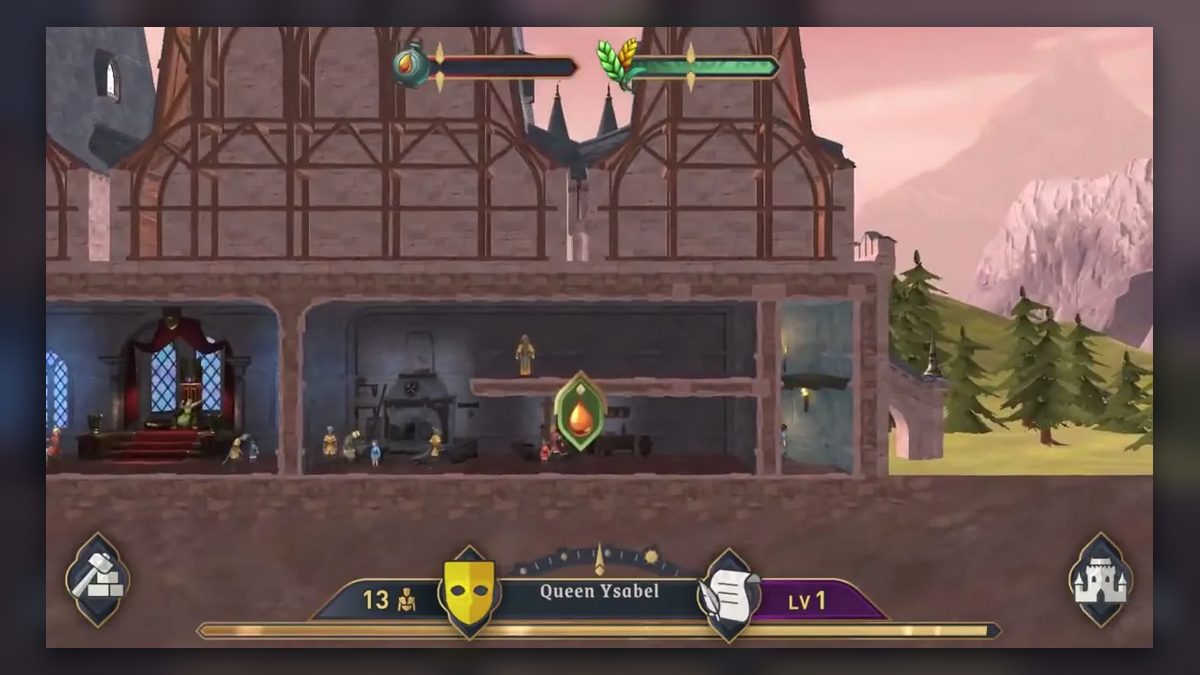
The Elder Scrolls review: a side-view medieval castle where subjects staff the Kitchen and Oil from an Oil Press keeps the workstations lit.
Game at a glance
The Elder Scrolls: Castles
9/ 10
Our score
Fallout Shelter in Elder Scrolls armor, and likely to reach many more players.
In this article6 sections
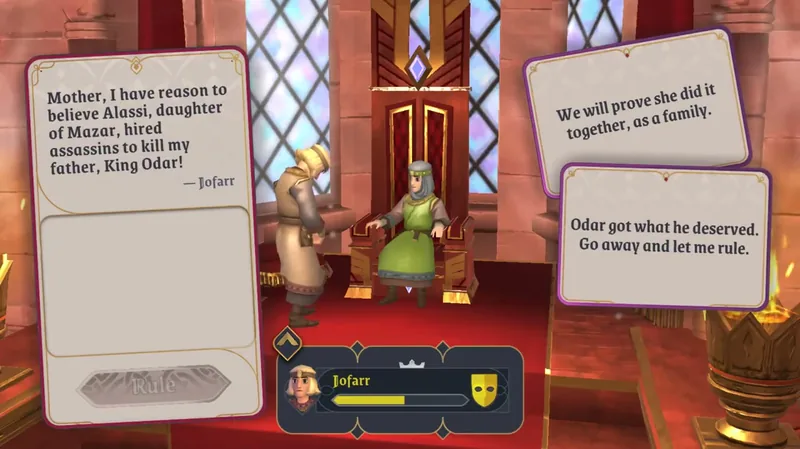
Jofarr, who calls Queen Ysabel “Mother”, stands before her throne and accuses Alassi, daughter of Mazar, of hiring assassins to kill King Odar. Two reply cards wait on the right: one vows to prove it together as a family, the other answers “Odar got what he deserved.” Once a reply is chosen, Jofarr shoots back “This isn’t over.” A notice then reads “Jofarr disliked that.”
Scenes like this break up the building in The Elder Scrolls, a castle-management sim that moves the Fallout Shelter formula, a vault built room by room and seen from the side, into a medieval court. Between conversations, the ruler extends a dollhouse cross-section of the castle and puts new subjects to work making Food and Oil. It rates highly with us, and the move should open the series to a wider audience.
Building rooms and keeping the Oil flowing
There is no stage to clear and no win screen. Progress shows as a Dynasty level in the HUD, and a Castle Report panel hands out tasks that each pay XP. No losing screen ever came up. In the two Dynasty levels we played, no time or move limit appeared, and neither did lives or energy; the only setback was running out of Oil, which stops the Kitchen from making Food.
Everything is played by touch, in landscape. A hammer button at the bottom left opens build mode, where the build pieces sit as icons in a row along the bottom; tapping an icon picks the piece, and tapping a highlighted block removes it. Workstation cards are held and dragged into highlighted slots, new subjects are dragged from the gate into a room, and icons that pop up over rooms are tapped to collect them. In story scenes the ruler picks one of two reply cards, and panels close through Ok and Claim buttons or an X.
Story scenes play out on cards in the throne room, and the speaker’s card on the left holds one line of dialogue with a signature. In Jofarr’s scene, two reply cards on the right take opposite sides, and a grayed-out Rule button sits under the speaker’s card. A bar under Jofarr’s portrait is partly filled in yellow next to a yellow mask icon, and after his reaction an orange frowning mask sits beside the notice.
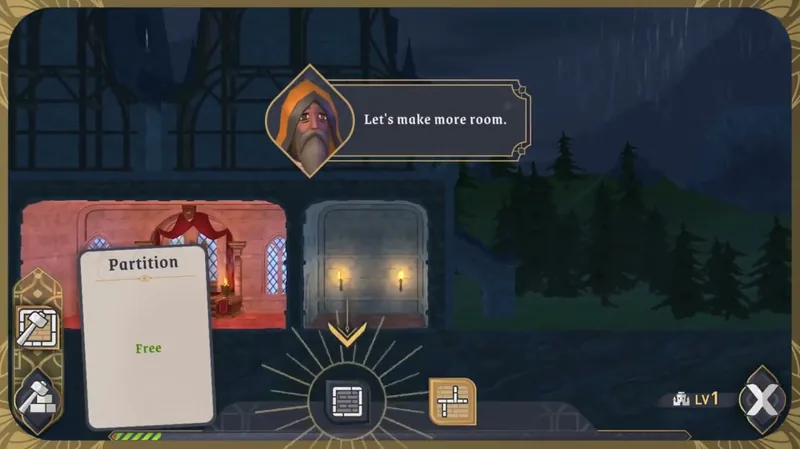
Building starts at night in Dynasty Level 1. When build mode opens, a gold frame surrounds a side-view cross-section of the castle: one red throne room with gray, unbuilt spaces to its left. Almost every step comes as a hint from Cassius the Elder, a gray-bearded man in an orange hood.
A card at the left names the selected piece and its cost. A Room card marked Free sets a wooden frame beside the throne room, and a Partition card, also Free, comes with Cassius’s “Let’s make more room.” and a new torch-lit room next door.
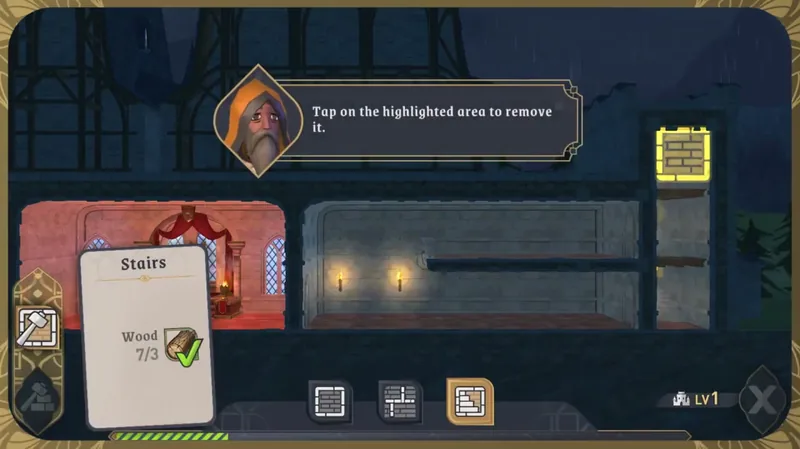
A later Room card shows a Wood line with a green check, and the new room grows wider, with four torches and a window. Cassius moves on with “Let’s add a new floor now. Like walls, floors are free to build.” An upper floor then appears as a ledge across the room.
Stairs follow, announced by “You can also add stairs to connect floors.” The Stairs card carries a Wood line with a green check too. A stair shaft stands at the castle’s right edge, and the block at its top glows yellow under the hint “Tap on the highlighted area to remove it.”
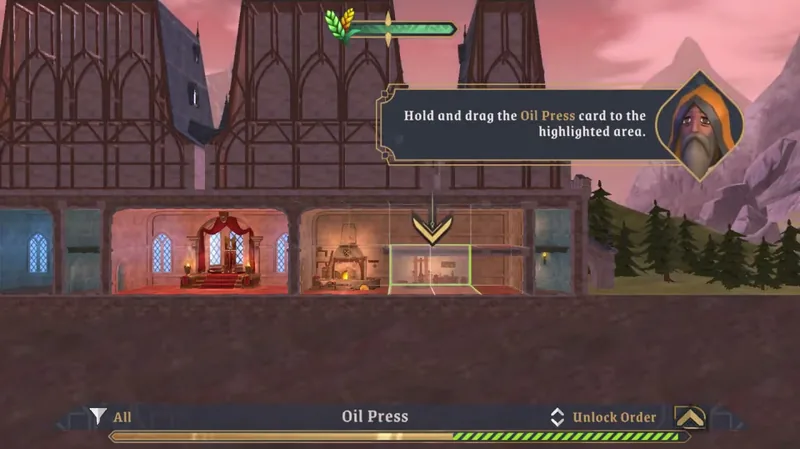
Workstations have their own build screen, framed in green, with a different tab icon at the left and a bottom bar holding an All filter and an Unlock Order sort control. The hint to drag the Kitchen card to the highlighted area comes with a glowing green hearth shape in the new room. Cassius then explains that Oil keeps work stations lit so subjects can work at them, and the Oil Press card goes into a slot outlined in green beside the hearth.
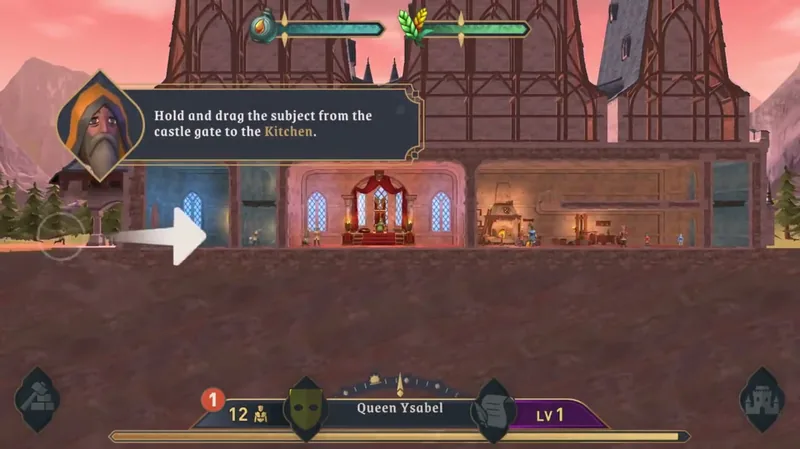
A banner then reads “A new subject has arrived at the gate.” The view shifts to a gatehouse at the left end of the castle, and a white arrow traces the drag from the gate into the castle under the hint to take the subject to the Kitchen. A red 1 badge sits on the population counter while the subject waits, and once the newcomer is placed, the count goes from 12 to 13.
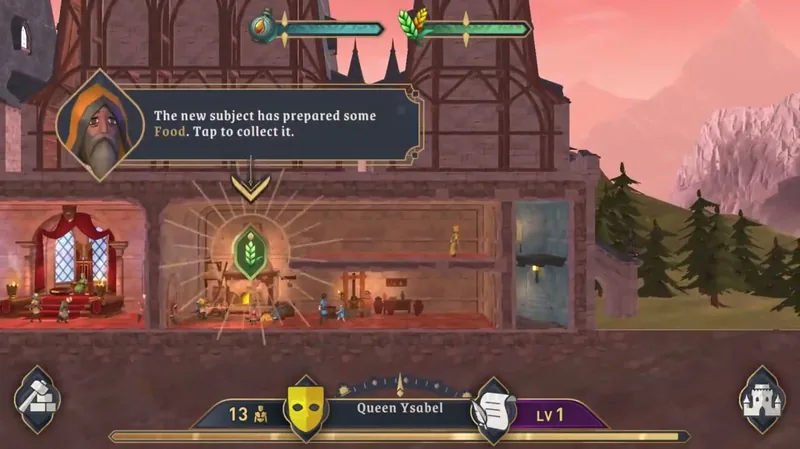
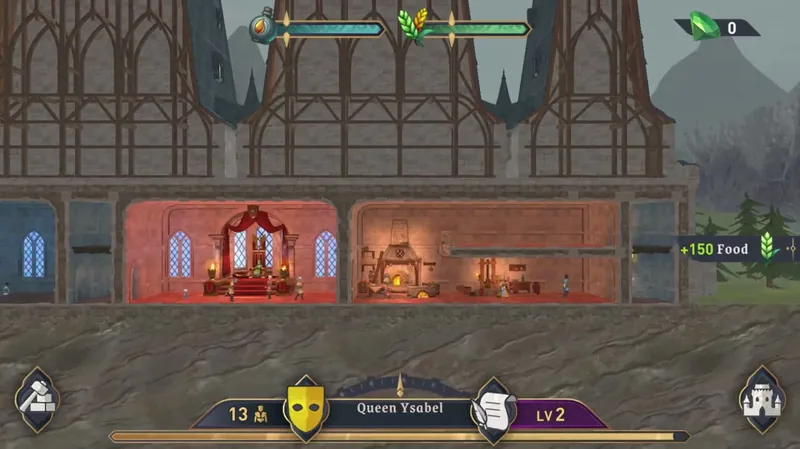
The newcomer goes straight to work. “The new subject has prepared some Food. Tap to collect it,” reads the next hint, set above a glowing green wheat icon over the Kitchen. A tap is answered by a +100 Food notice along the right-hand side, and a later collection shows +150 Food. The Food meter, marked with a wheat icon, sits at the top center.
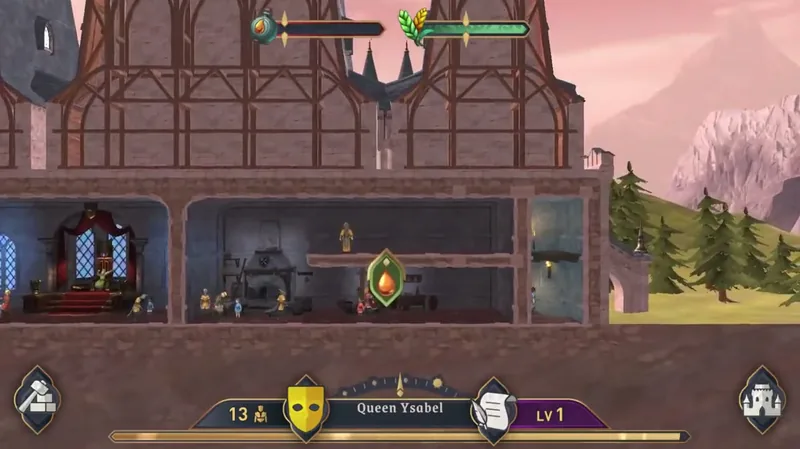
Oil has its own meter, marked with a flask, beside the Food meter. Right after that first Food, Cassius warns that the castle has run out of Oil and can no longer make Food; the Oil meter goes dark and the rooms turn gray-blue. An orange drop icon in a green hexagon then appears over the Oil Press while the rooms stay dim. Soon they glow warm again with the Oil meter partly filled, and a +100 Oil notice turns up later.
Most of The Elder Scrolls gameplay comes down to that cycle: extend the castle, set up workstations, drag in whoever arrives at the gate, and tap the Food and Oil icons as they appear while keeping the Oil flowing. Small 3D figures chat in speech bubbles as they work (“Hey you!” “Huh? Who said that?”). Before the first Dynasty level ends, the Castle Report shows a task, “Assign another subject to the Oil Press,” at 0/1 and worth 25 XP.
From one throne room to Dynasty Level 2
The first Dynasty level is one long guided tutorial. It hands over one system at a time, from a story card and the night-time build tutorial to the first Castle Report task.
By the time build mode closes, the castle has grown beyond its lone throne room. The new room with its upper floor stands beside it, the stair shaft rises at the right edge, and the hammer button at the bottom left is highlighted again.
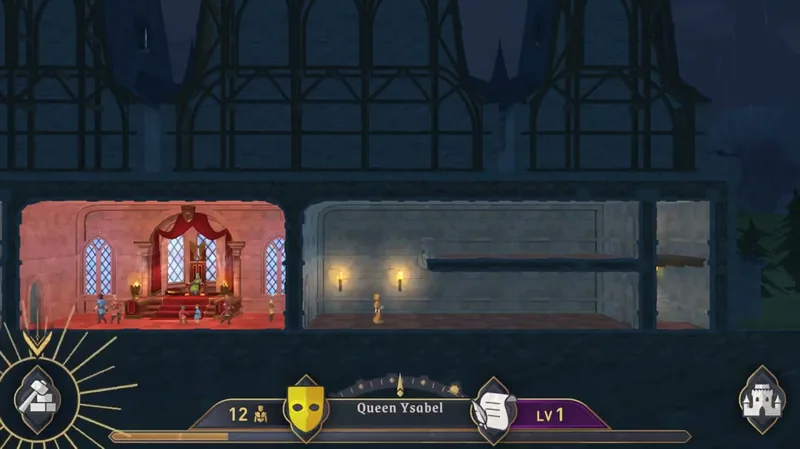
The scenery changes as the tutorial goes on. The sky moves from a rainy night during building to a purple dusk, then a pink sky, then gray daylight. Above the rooms, timber-framed Gothic upper stories stand against mountains and pine trees.
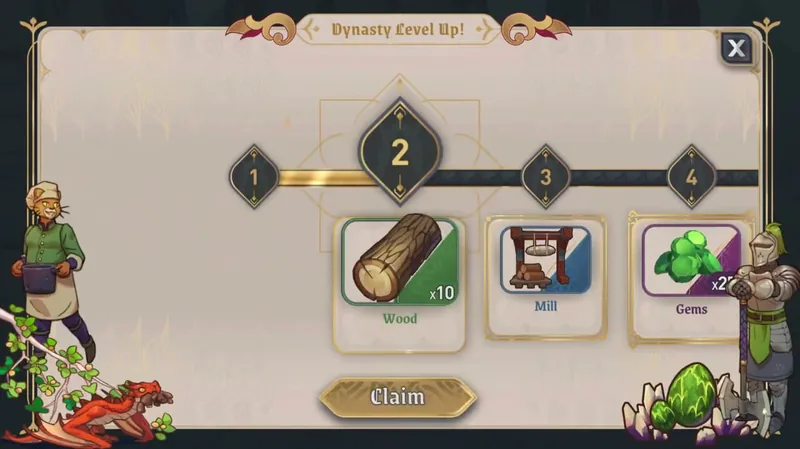
The step up to Dynasty Level 2 arrives through a “Dynasty Level Up!” panel. Its track shows markers numbered 1 to 4 with the 2 highlighted, and reward cards sit beneath it: Wood x10 under the 2, a Mill under the third marker and Gems under the fourth, plus a Claim button and an X. The panel’s flat, illustrated art puts a cat-headed cook with a pot and a red dragon on the left, and an armored knight beside a green egg among crystals on the right.
Afterward the HUD reads LV 2 and a green gem counter appears at the top right, while the scroll icon in the HUD carries a red “!” badge. The camera also moves in for close-up 3D views: cat-headed subjects work by the oven in the Kitchen, and the throne room shows a green-skinned subject and a figure in a horned yellow helmet.
Beyond Food and Oil, two more resources appear. Wood is the building material, shown as a checked line on the Room and Stairs cards and handed out on the level-up track; Gems show up only as that new counter and as the reward under the fourth marker.
The Castle Report panel lists tasks in a Tasks column, each with a purple hexagon reward of 25 XP and a progress bar. At the new level it shows “Upgrade a Kitchen” checked off with a Claim button, “Collect Oil once” at 0/1, and the Oil Press assignment below them. Red “!” marks sit on the task cards, and a LEVEL ring on the left matches the Dynasty level.
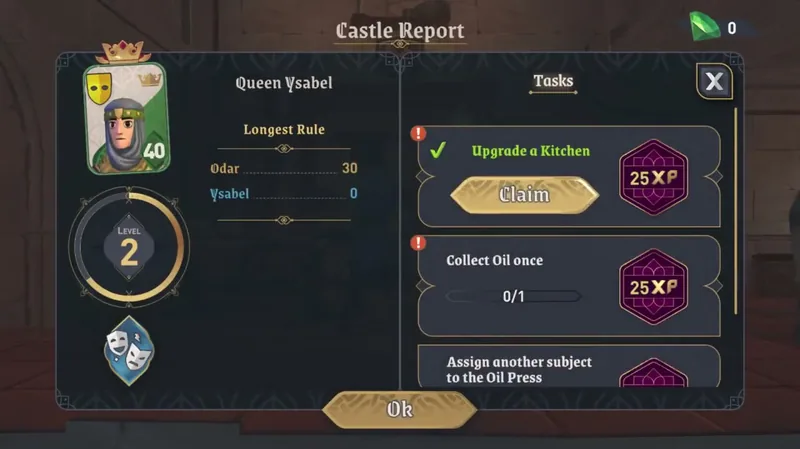
The same panel keeps the dynasty’s record. A portrait card of Queen Ysabel sits under a crown with a yellow mask icon on it, and a “Longest Rule” list holds entries for Odar and Ysabel. A blue comedy-and-tragedy mask icon sits below the level ring.
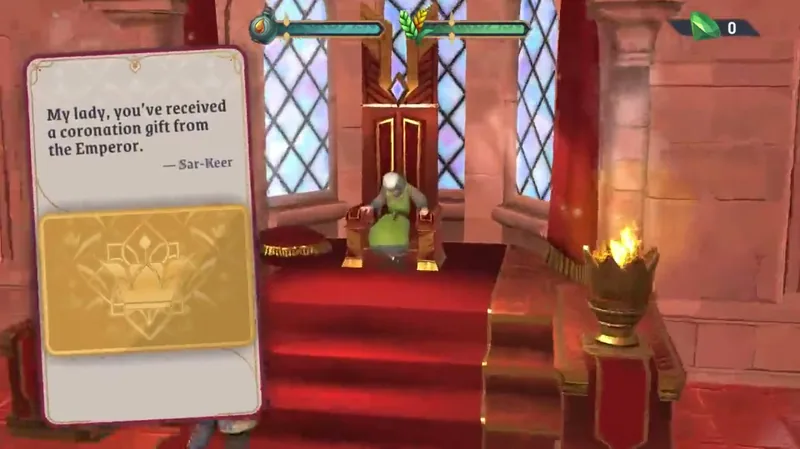
Story cards keep coming after the level-up. One signed Sar-Keer tells the queen she has received a coronation gift from the Emperor, with a gold card bearing a crown emblem below the line.
Fallout Shelter’s vault rebuilt as a castle
Putting the Fallout Shelter formula into the series’ world is a move we see as broadening The Elder Scrolls. That world shows in the details: Jofarr’s accusation over King Odar’s death, a coronation gift from the Emperor, and cat-headed subjects at work in the Kitchen. The series’ earlier games, a card game and first-person action RPGs, struck us as a bit hardcore, and this castle version should be taken up by a broader public than they were.
We think this kind of game comes with a bit of a strategy-game feel built in. That leaves an open question: will anyone build a full strategy game around a shelter seen side-on like this?
What the first two Dynasty levels didn’t show
We have no criticism of The Elder Scrolls to report. Play stopped before the game showed what the Mill on the level-up track does, what Gems are for or what the Emperor’s coronation gift holds, and no screen said whether Castle Report XP is what raises the Dynasty level.
No shop or purchase offer turned up, and no ads either; nothing like lives or energy appeared. Neither Dynasty level put a map or troops on screen, and no battles took place.
Tending a castle one drag at a time
Play here is a string of small jobs: moving a newcomer from the gate into a room, collecting each glowing wheat or oil-drop icon, and returning to the throne room whenever someone wants an answer. People who like arranging rooms in a cut-away building and watching its population climb one subject at a time get that loop in the castle.
The series’ setting comes through in court intrigue, with a murder accusation to settle from the throne and a coronation gift from the Emperor. Anyone who knows the series from its first-person action RPGs meets that world here as room-building and worker management seen from the side.
Verdict
Moving a vault-management loop into a medieval court widens the series’ reach, and this castle sim should land with a broader public than the more demanding games before it. Like other shelter-style games, it also carries some strategy-game feel. The result sits close to the top of the scale.