MiniKing Review: Solo Civilization, One Card per Turn
One card from a pair each turn, four resource counters above zero: our MiniKing review of a light tabletop Civilization for mobile.
Game at a glance
MiniKing | Build YOUR Empire
8/ 10
Our score
A new game that brings light tabletop play to mobile.
In this article6 sections
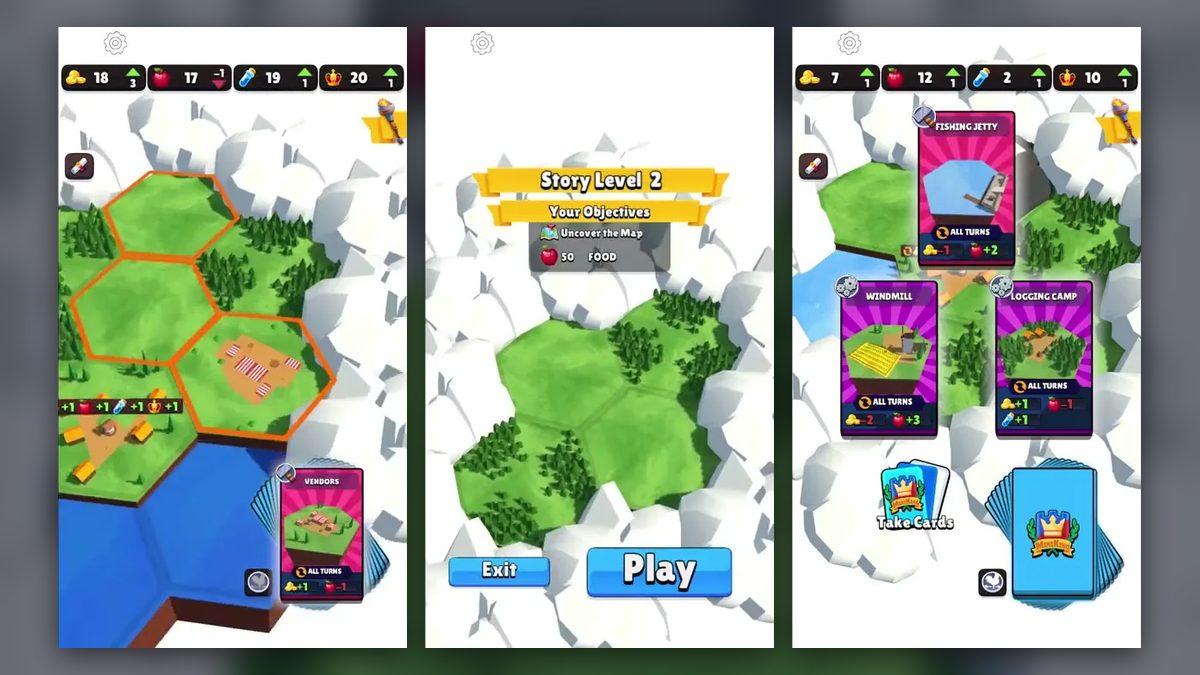
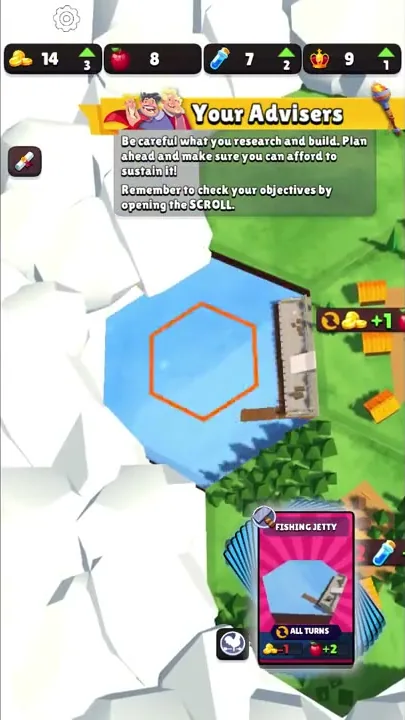
Food is falling by 2 a turn in Story Level 2 of MiniKing when a Fishing Jetty card comes up. It goes onto a hex of open water outlined in orange, and a wooden pier appears at its edge. On the top bar, the -2 beside the food counter is gone.
One card at a time is how this kingdom builder runs. It is a turn-based game on a low-poly hex island where you take one of two cards each turn and keep four resource counters above zero. We see it as a single-player, card-drawn Civilization in the form of a light tabletop game. We played the closing turns of the level before Story Level 2, then the first stretch of Story Level 2.
Two face-up cards and four counters
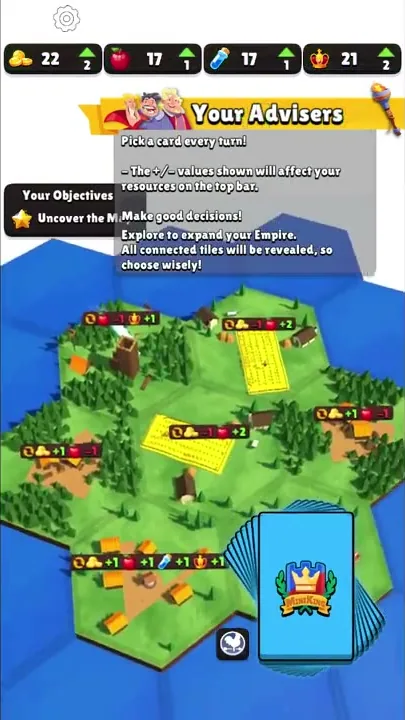
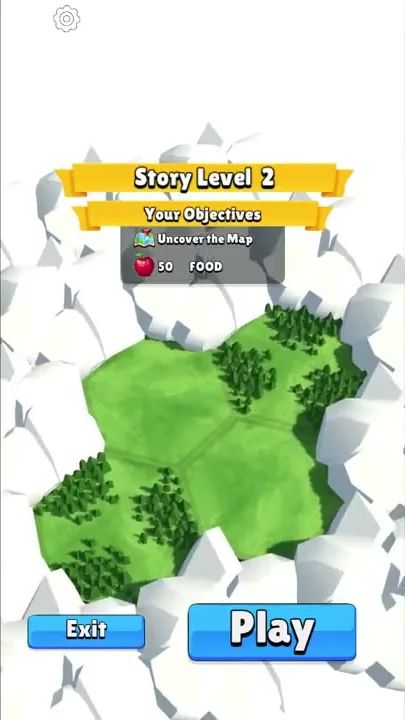
Story Level 2 names its objectives on its opening panel, “Uncover the Map” and “50 FOOD,” then keeps them in a “Your Objectives” box in the upper left during play. The earlier level shows the same box with a star beside “Uncover the M…”, and the rest is hidden behind the advisers’ panel. The other rule comes from a tip: “Keep your resources above ZERO to survive.”
The core of MiniKing gameplay is a choice between two face-up cards dealt from a deck at the bottom right, under the tip “Pick a card every turn!” Each card prints its effects as plus and minus values in the same icons the top bar uses. New cards are dealt face down and then turn over. Between turns the top bar applies each counter’s per-turn rate, shown as floating green numbers such as +2 and +3, so a +2 rate on coins puts two more coins in the pile at the next payout.
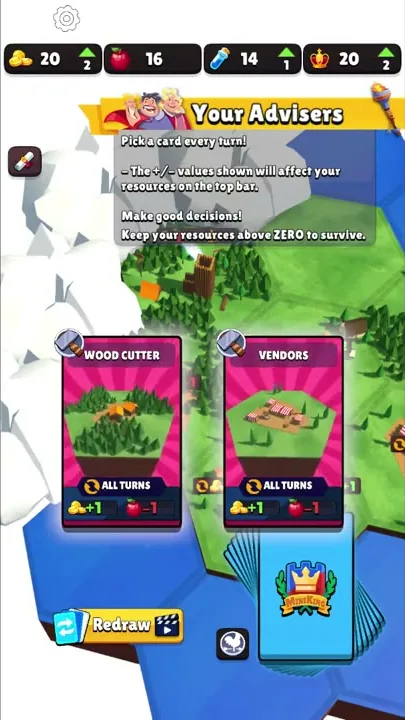
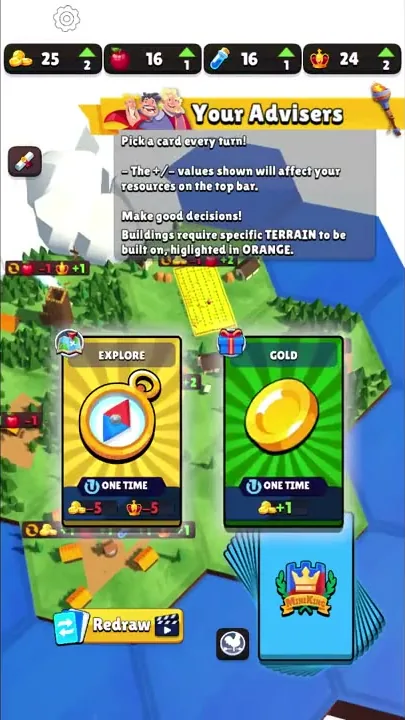
Each card has a sunburst background and a corner icon, color-coded by type: yellow with a map for Explore, pink with a hammer for buildings, purple with gears, blue with a lightbulb and green with a gift box. The backs are blue, with a crowned MiniKing castle logo. Cards also carry a duration, which a tip spells out: “ALL TURNS” will change that rate of income permanently, while “ONE TIME” will change for the next turn only.
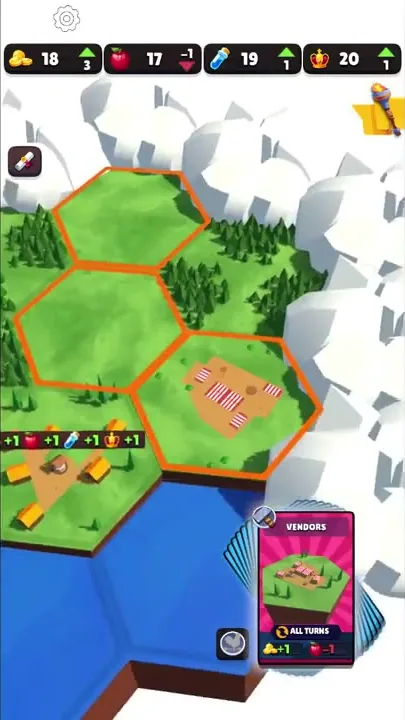
A chosen building card shrinks onto the deck while the hexes it can go on light up with orange outlines, and the building then appears on one of them. Another tip covers the camera: “MOVE the map by dragging and ZOOM by pinching.” The angled overhead view moves in close while a building goes down and pulls back far enough to show the whole island.
The pink building cards with the hammer icon are marked ALL TURNS. Vendors gives +1 coin and -1 food, as does Wood Cutter, while Farm gives -1 coin and +2 food. Each appears as a small model with a floating label repeating its values: market stalls with red-and-white awnings for Vendors, a yellow crop field for Farm, orange huts among pines for Wood Cutter. In the earlier level, Vendors went onto one of three grass hexes outlined in orange, and the coin rate rose from +2 to +3 while food picked up a -1.
Yellow Explore cards cost 5 coins and 5 crowns and uncover more of the island, which otherwise sits under chunky white low-poly cover. A tip says that “All connected tiles will be revealed.” After one Explore in the earlier level, coins and crowns each fell by three: the 5 it cost, less a turn of +2 income.
After a later one, the zoomed-out view showed the whole island ringed by blue water. Its labels put the settlement at +1 on all four counters and two yellow farm fields at -1 coin and +2 food. Two more tiles carry +1 coin and -1 food; a brown tower carries -1 food and +1 crown.
The green Gold card has a gift-box icon and gives +1 coin as a ONE TIME effect. One was offered beside an Explore card, and the coin and crown counters that followed fit Explore being the one taken.
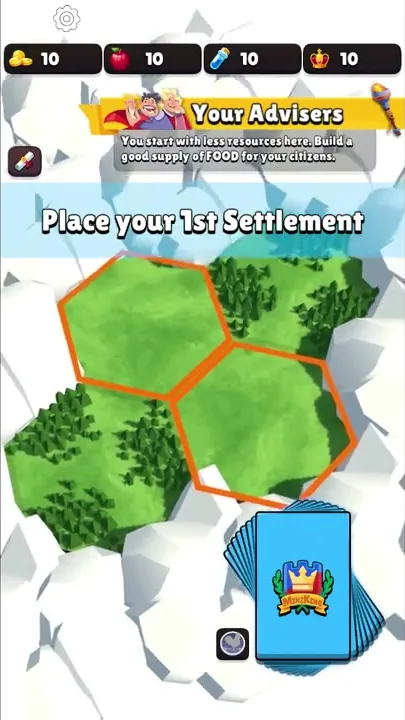
Four uncovered hexes and 10 of each resource are what Story Level 2 hands over at the start. Two of the hexes are grass and two are forest, and a banner reads “Place your 1st Settlement” with the grass pair outlined in orange below it. The settlement, a cluster of yellow-roofed huts, carries a +1 label for all four resources, and once it is down, each counter on the top bar gains a +1 rate. The earlier level’s settlement wears the same +1 label.
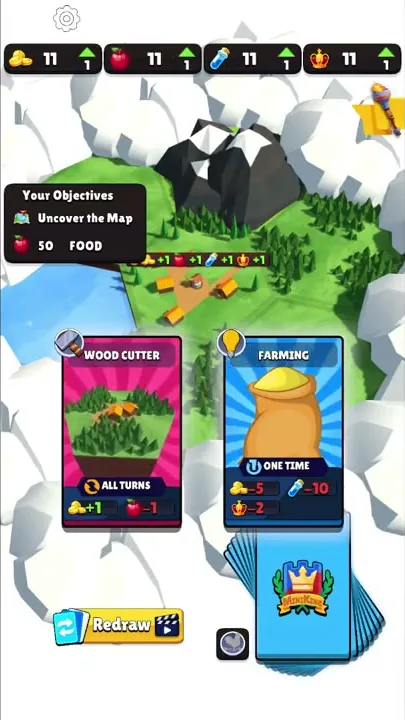
Soon after, a Wood Cutter came up against Farming, a blue card showing a sack of grain, marked ONE TIME, that costs 5 coins and 10 vials, plus 2 crowns. On the following turn the counters had moved by exactly Farming’s costs, less a turn of +1 income on each. In the earlier level, the vial counter took one steep drop, and the next pair of cards included a Farm.
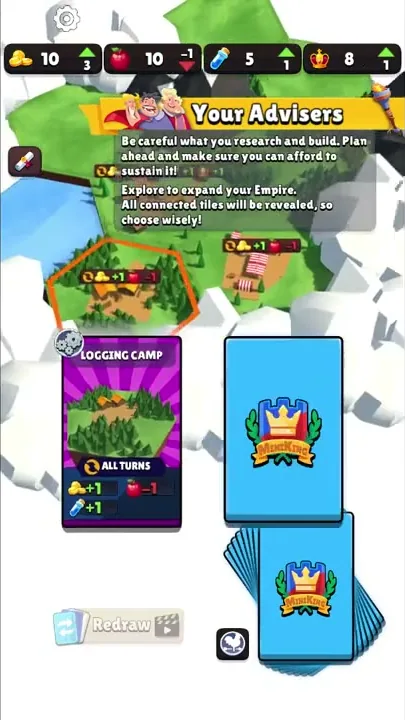
Purple cards carry a gear icon and are marked ALL TURNS: Windmill gives -2 coin and +3 food, and Logging Camp gives +1 coin and -1 food plus +1 vial. With Logging Camp face up, the hex outlined in orange was the forest tile where the Wood Cutter’s huts stood. That tile’s label then showed +2 coin and -2 food with +1 vial, and on the top bar the coin rate rose to +4 and the vial rate to +2 while food fell to -2. An earlier tip notes that “Farms can be upgraded with a Windmill and Granary.”
Terrain decides where a building can go: a tip says buildings “require specific TERRAIN to be built on,” highlighted in orange. Vendors and Farm went on grass and Wood Cutter on forest. The pink Fishing Jetty, at -1 coin and +2 food, went on water, where a wooden pier appeared with its tile label beside it. At that point food was still far short of the 50 that the level’s objective asks for.
Advisers, booster packs and a leaner start
Rules arrive a few at a time through the “Your Advisers” panel, a gray box under a yellow banner showing two cartoon characters. A new tip appears every few turns. In the earlier level the first ones explain picking a card and reading its +/– values, then farm upgrades and the two card durations. After those come Scouts that “explore one random tile every turn for you” and the warning about keeping resources above zero. The last ones there cover terrain marked in orange and Explore.
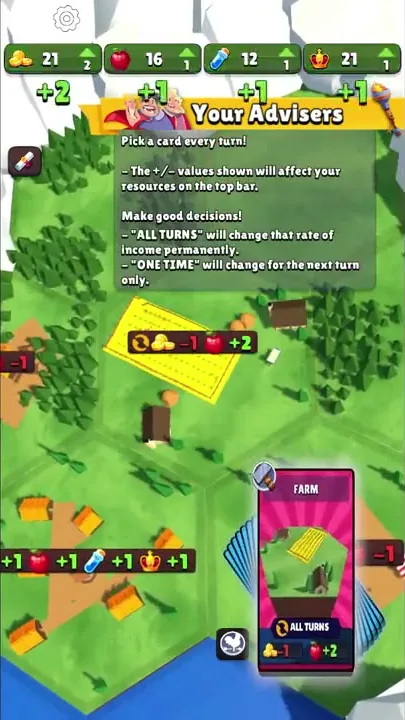
The tips in Story Level 2 open with the smaller supply of resources and move on to dragging and pinching the map. One warns, “Plan ahead and make sure you can afford to sustain it!” Another says to check your objectives “by opening the SCROLL.”
That level opens on a panel that names it and lists its objectives above Exit and Play buttons. Play then starts over on a fresh map of four hexes with lower starting resources, under the tip “You start with less resources here.” This island has dark, snow-capped mountains among its grass and forest.
The new card types in that level came out of a Booster Pack. A silver pack stamped with the MiniKing logo appeared over the board and opened into three face-up cards: a pink Fishing Jetty on top, with the purple Windmill and Logging Camp below it and a Take Cards button underneath. Logging Camp and Fishing Jetty were both dealt in later turns.
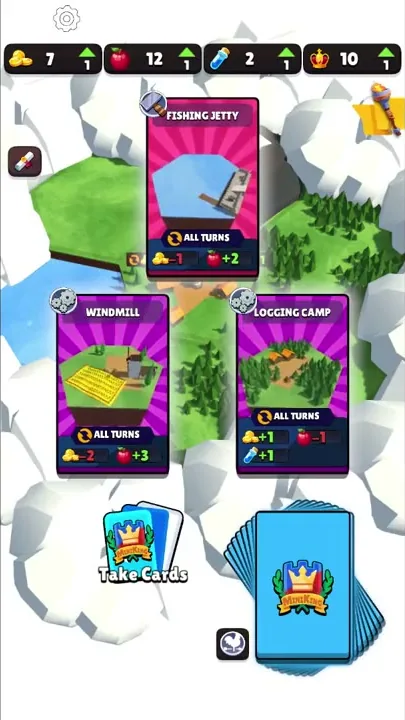
Costs and income run through four counters along the top. There is a coin pile and a red apple that the objectives call FOOD, then a blue vial and a crown. Each box shows its amount and a per-turn rate with a green up arrow or a red down arrow. When income lands, the boxes flash green and floating numbers such as +3 appear, and a falling counter’s box turns red, as food’s did while it ran at -1.
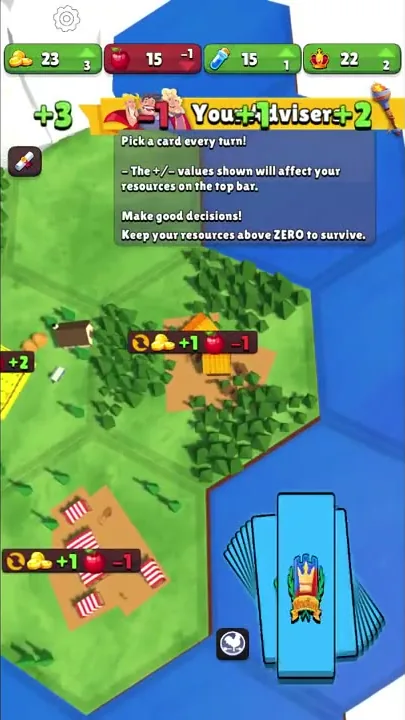
A Redraw button with a card icon and a clapperboard icon sits below the left card while two cards are face up, and it is grayed out while cards are face down or one is being placed. The screen also holds a gear icon at the top center and a small scroll-like button in the upper left; a torch-and-banner icon sits in the upper right and a round icon left of the deck.
A solo Civilization dealt from a deck
The highlight for us is the concept: Civilization as a single-player card game on hex tiles. Each turn’s strategic decision is one card out of two, and those cards handle the resources and the land, with Explore buying more of the map and buildings changing income for good. In Story Level 2 that meant setting a Wood Cutter’s +1 coin and -1 food on every turn to come against Farming, a one-time bill that included 10 vials in a level that starts each resource at 10.
It is also a new game that moves a light tabletop game onto mobile. The cards have sunburst art and blue backs with a crowned castle logo, and three new ones once arrived in a silver booster pack. The hex tiles surface from white cover as Explore opens the map, which is moved by dragging and zoomed by pinching.
Armies and the zero line, still unseen
We have no complaints to list. The game’s cards are meant to deal with armies and population as well, but neither came into view here: no army cards or military units came up, and none of the four counters is labeled as population, though one tip asks for a good supply of food “for your citizens.” No fail screen appeared either, so what happens when a counter reaches zero, and what later levels ask of you, are both still unknown.
Budgeting four counters across a hex map
Every pick here comes down to adding and subtracting the numbers printed on two cards. Gains and costs are printed in the same icons as the top bar, so choosing means working out what each of two cards does to four counters, both on the next turn and on every turn after it.
Placement puts a terrain question on top: the Fishing Jetty went on water, and the Logging Camp’s orange outline landed on the hex where a Wood Cutter stood. A liking for that kind of bookkeeping, and for setting pieces on a board, is what these mechanics call on. Set beside games like Capybara Go, Habby’s light roguelite adventure, MiniKing is light as well, but its picks shape a hex island and four counters, one card per turn, while the advisers feed in rules as play goes on.
Verdict
MiniKing shrinks Civilization down to a single-player card game, with a tiled island for a board and two cards behind every decision. That central idea is the highlight. As a newcomer that carries a light board game over to the phone, it earns a good mark from us.