Tower Defense Review: A Gold Mine and Clouds to Explore
A Tower Defense review of castle battles where a gold mine pays out 45 coins and an Explore button rolls back the clouds over the map.
Game at a glance
Tower Defense:Conquest
6.5/ 10
Our score
RTS gathering and fog clearing, folded lightly into tower defense. It makes sense.
In this article6 sections
Place a crossbow tower beside a dirt path and confirm it with a green check, and it starts shooting at the foot soldiers marching toward your walled castle. Tower Defense is a 3D tower defense game for mobile, played in portrait. Its castle defense against marching columns puts it among the games like Clash Royale on this site.
Around that core, it crosses tower defense with two pieces of real-time strategy: a gold mine that pays out coins, and an Explore button that pulls back the clouds hiding the rest of the map. Both are folded in lightly, and the mix comes across as reasonable. The subject borrows Warcraft’s humans-versus-orcs setting, and the player holds a human-style stone castle. We played the tutorial battle through to its WIN! screen, then the opening stretch of a second battle.
Building towers beside the castle road
Enemies walk in columns along a winding dirt path that ends at the player’s castle, a walled stone fort with buildings inside, at the lower left of the map. Towers placed beside the path fire on the enemies as they pass. No goal is printed during play. A castle icon at the top of the screen has a counter and a segmented bar; neither changed during the tutorial or the opening stretch of the second battle. The maps are low-poly 3D islands of grass, ponds and pine trees, seen from a high, angled camera.
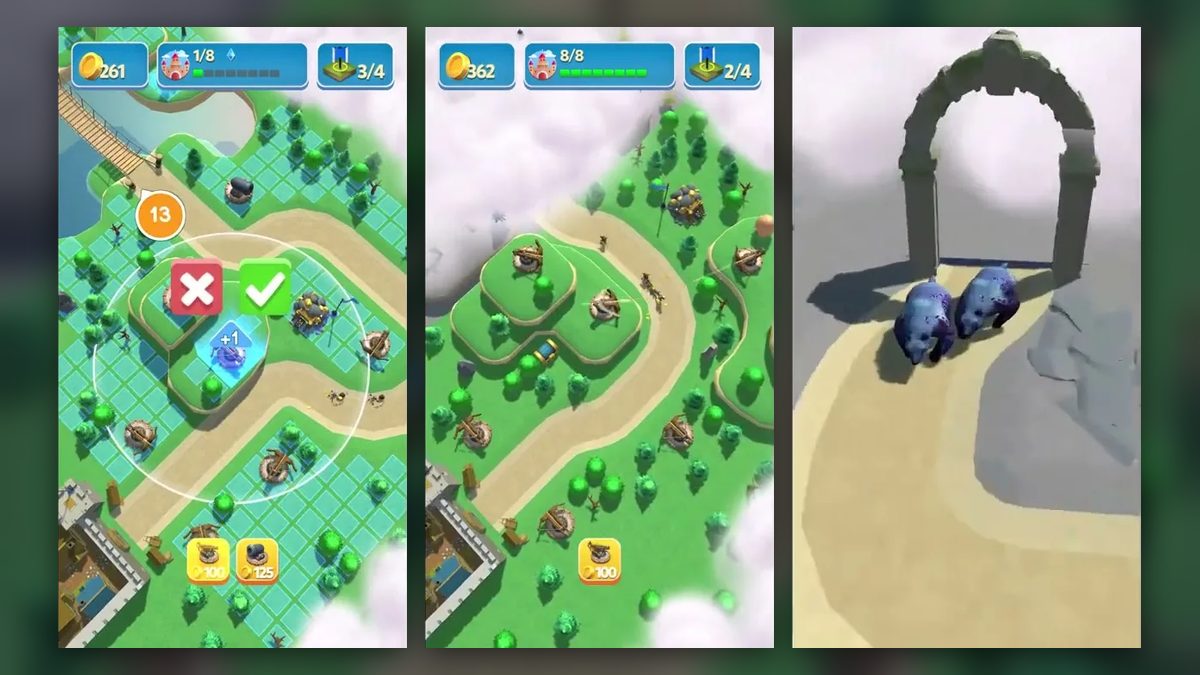
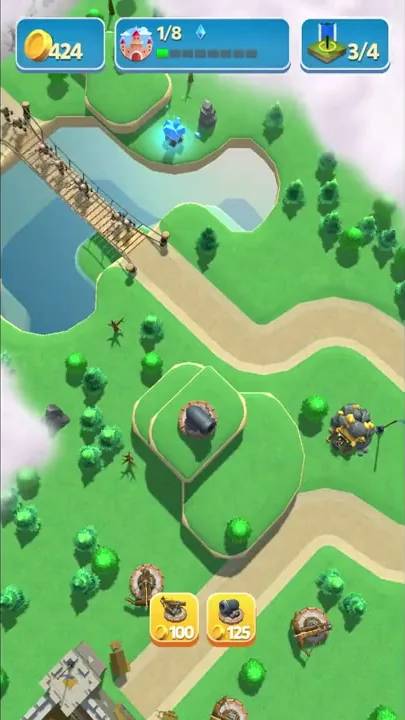
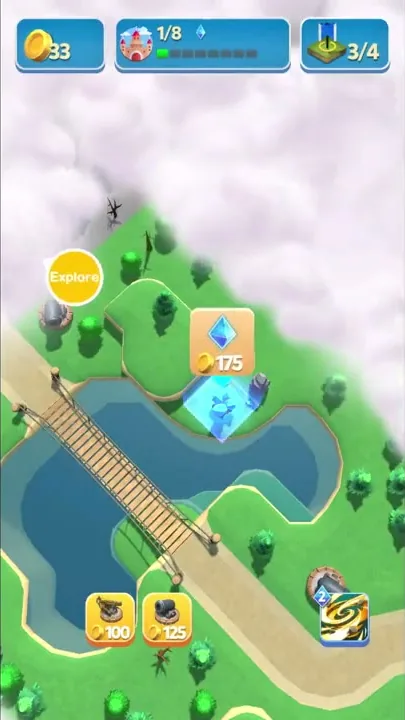
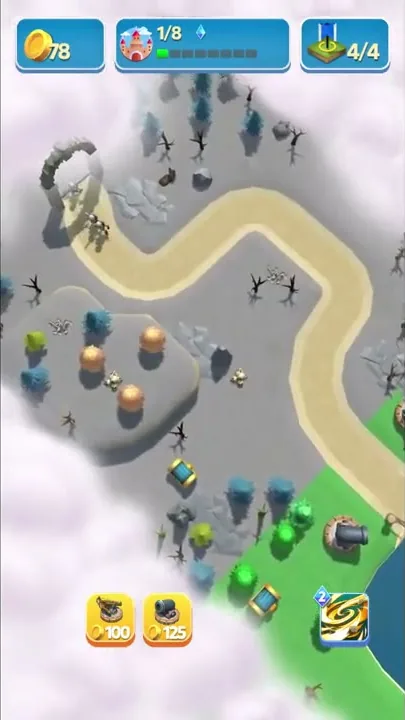
Early in the tutorial battle, the map is a green island. A dirt path crosses a pond on a rope bridge and bends past a hill on its way down to the castle. A gold-studded rock with a blue flag stands beside the path, and a glowing blue crystal sits on the far bank. Some cannon and crossbow towers are already standing, white clouds cover the edges, and two yellow build buttons at the bottom offer a crossbow tower for 100 coins and a cannon tower for 125.
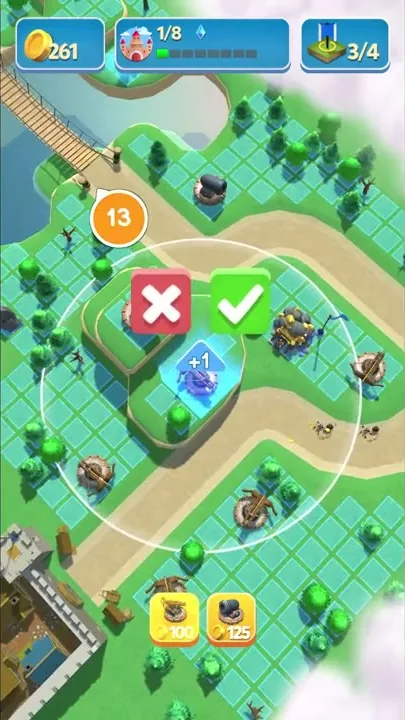
When a tower is being placed, the map switches to build mode. A translucent grid spreads over open ground, teal on grass. A ghost of the tower with a +1 badge sits on a highlighted tile inside a white circle that marks its range, with a red X button and a green check button above it. Later in the tutorial, a white cartoon hand points at a freshly placed tower.
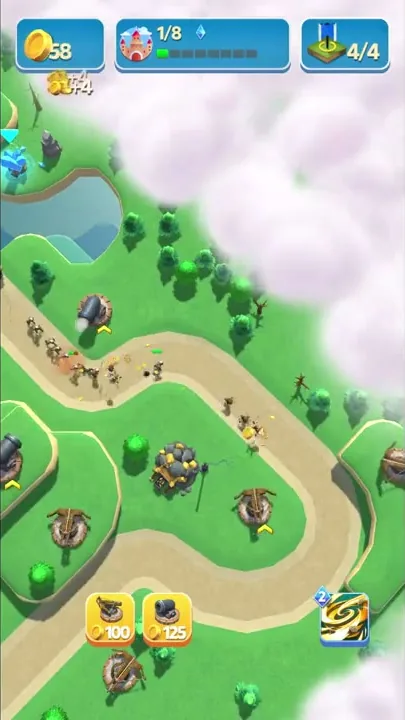
Underneath the extras, the tower defense gameplay runs along one path. Soldiers file along it with small green bars over their heads while the towers open fire as they pass. Coin numbers pop up as this happens. At one point a 5 with a coin icon floats above the enemy column while +5 appears under the coin counter at the top left, and later a +100 appears under the counter, though nothing on screen shows where it came from.
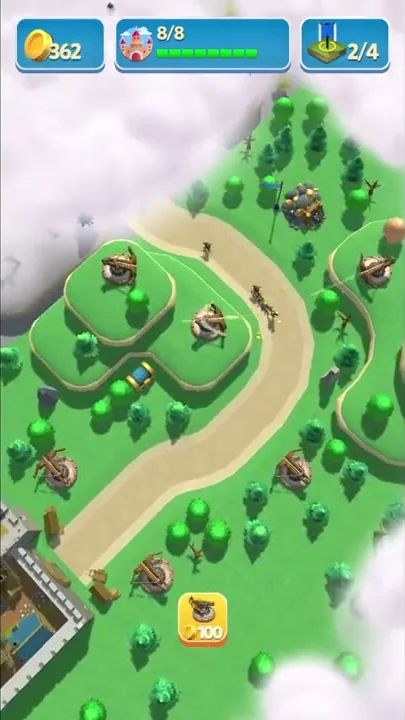
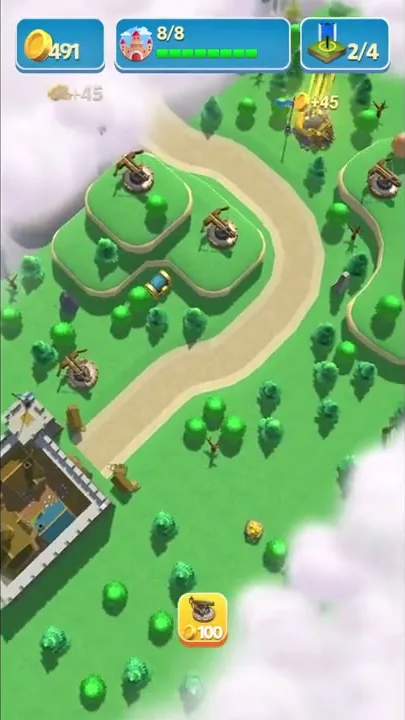
The crossbow tower is a wooden crossbow on a round stone base, bought from the 100-coin button. It stands beside the path and shoots at enemies walking past. In the second battle it is the only tower on offer, and several go up on both sides of the path.
The cannon tower costs 125 and sits on the same kind of round stone base, a black barrel aimed at the path. When a cannon fires, an orange muzzle flash bursts from it. In the tutorial, a cannon on the green bank shells a line of soldiers marching through the gray ground that exploring opened up.
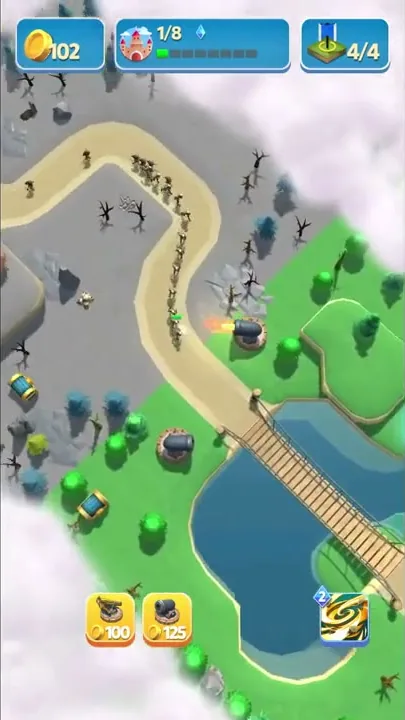
Some cannon and crossbow towers carry a small yellow chevron below the base. Others of the same type have none.
The gold mine is a rock studded with gold. In the tutorial it stands beside the path with a blue flag next to it. In the second battle it starts with a white marker floating above it and has a blue flag by the time the opening countdown reaches 9. Then it sends up +45 with a coin icon, and the same +45 appears under the coin counter.
Clouds are the other extra. Thick white cloud hides every unexplored part of the map. Partway through the tutorial, a round yellow Explore button appears where the cloud cover begins, just past the far end of the rope bridge. Pressing it pulls the clouds back and opens more of the map, and the flag counter in the top bar ticks from 3/4 to 4/4.
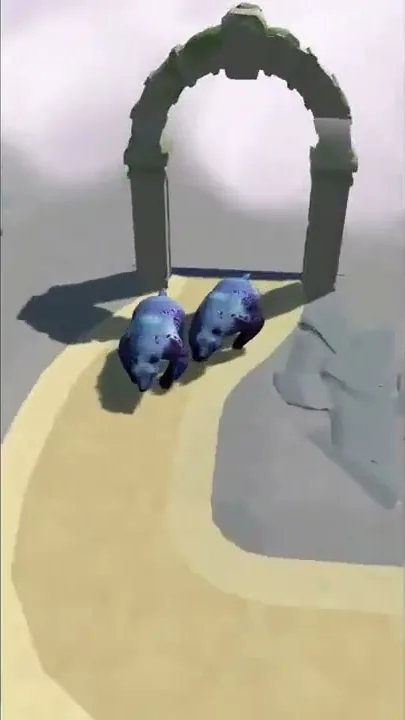
The attackers are columns of small foot soldiers. Late in the tutorial, two blue bears walk out under a stone arch and follow the path. Now and then the camera drops to path level for a close look at an arrival: soldiers crossing the rope bridge, figures stepping out of the clouds, the bears passing under the arch.
A glowing blue crystal stands on the far bank of the tutorial’s pond. For a while a tag above it shows a blue diamond and 175 with a coin icon, and later a cyan arrow marker replaces the tag. The same blue diamond icon sits beside the castle counter, where one diamond becomes two by the end of the tutorial.
Small blue boxes trimmed with gold lie on the ground, on the grass and in the gray area. They look like chests, but none is opened on screen.
Once the Explore button appears, a square card with a yellow-and-black swirl picture sits at the bottom right of the tutorial screen. Its corner badge shows a blue diamond and the number 2. It goes unused for the rest of the tutorial and is gone in the second battle.
From the tutorial island to the world map
New ground opens up in the middle of a battle. After the tutorial’s Explore, the clouds pull back from a gray area of bare black trees and blue-tinted pines that looks nothing like the green meadows around the castle. The path continues through it to a stone arch, and soldiers start arriving from that end. The build grid spreads over the gray ground in blue-violet, so towers can go there too.
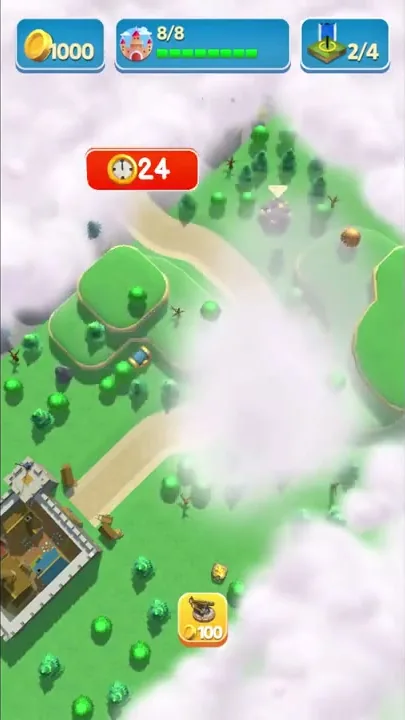
The second battle offers fewer tower types. After a Loading… screen, a new map opens with clouds over most of it. The castle again sits at the lower left with a dirt path coming down toward it from the top, and another gold-studded rock waits near the top. A small blue-and-gold box rests on a hill, a round orange-brown mound stands on the right, and there is only one build button this time: the crossbow at 100 coins.
A countdown now opens the battle. A badge with a clock icon reads a red 24 when the map appears and turns orange as it counts down to 4, while crossbows go up beside the path. During the countdown, a red X tag with a coin icon and the number 20 also hangs over one spot beside the path. Enemies are on the path shortly after.
The tutorial ends on a WIN! screen with a blue background patterned with ribbon badges. Under the words Tutorial Complete! Reward it lists 100 green ribbon badges, 432 coins and a purple orb line at 0, with a NEXT button below.

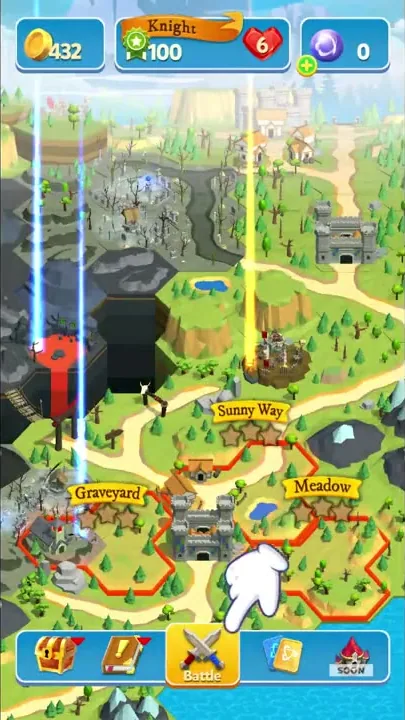
The coin reward carries over to the world map that comes next, where the coin counter shows the same 432. An orange Knight banner at the top shows the green ribbon badge with a number beside it, and a red heart with its own number sits at the banner’s right end. The top-right corner holds a purple orb counter with a green plus button. Battle coins are counted separately: the second battle opens with its own counter at 1000.
The map is a 3D landscape split into hex-shaped regions with red-orange borders. A castle stands in the central hex, and columns of blue and yellow light rise elsewhere. The named regions (Sunny Way, Graveyard, Meadow) each show three empty stars under their names, and the tutorial hand points at one of the regions. A menu bar runs along the bottom: on the left, a treasure chest tab and a book tab, both with red markers; in the middle, a highlighted Battle tab with crossed swords; on the right, a card tab and a tab labeled SOON.
No ads appeared at any point, not even between the reward screen and the next battle. No shop or special offer came up either.
Mining and scouting folded into defense
The highlight is how lightly the real-time strategy pieces are worked in. In the battles played, resource gathering centers on a gold-studded rock on the battle map. In the second battle it gains a blue flag and sends +45 to the coin counter. In the tutorial, map expansion comes from a yellow Explore button at the cloud edge, and both sit on the same map as the path and the towers.
We also found the pairing reasonable, because the two styles share some common ground. The tutorial shows it on the map. Once the clouds pulled back, the build grid covered the new gray ground, and a fresh crossbow tower went up there, beside the path the two blue bears were walking along. In the second battle, the mine’s payout goes into the same counter that pays for crossbows.
An unused swirl card and unopened tabs
We had no complaints about Tower Defense. What follows are limits of what appeared on screen, not faults.
No fail or game-over screen came up. The tutorial ended on its WIN! screen just after two bears were seen on the path, so neither the rules for losing nor the way an ordinary battle is won ever appear. The second battle was still in progress at the end.
Several features were visible but never used. The swirl card stayed in its corner, and none of the gold-trimmed boxes was opened. On the world map, the four tabs around Battle stayed closed, and so did the heart and the purple orb’s plus button. No upgrade menu appeared either, so the yellow chevrons and the +1 badge are never explained.
The humans-versus-orcs subject also shows mostly from the human side. The attackers were foot soldiers and blue bears, and none of them was clearly an orc.
Scouting under clouds while the towers fire
Most of the play is placement: pick a build button, find a tile on the grid, read the white range circle, then confirm with the check. Alongside it runs a thread of claiming the map. A flagged gold mine pays into the coin counter, and the Explore button shows where the path goes once the clouds lift.
That combination fits a taste for laying out a defense tile by tile while the board itself grows. It also carries a little of the gathering and scouting that real-time strategy games are built on, set inside a castle defense on a single path.
Verdict
Tower Defense is one more game that crosses two styles of play, and it keeps the second style small. Towers still do the defending, while the real-time strategy side comes down to a rock to mine and a fog line to push back, on the same field as the crossbows and cannons. The building-and-upgrading side of tower defense on one hand and gathering and expanding on the other have enough in common that the combination reads as reasonable. That light, sensible pairing sums up where we land on it.