Tile Clash: Tile Matching Meets Tower Defense and Archero
Tile Clash blends tile matching, tower defense and Archero-style hero levels, and ends up feeling like a numbers-driven midcore game.
Game at a glance
Tile Clash
- Developer
- Seikami
- Platforms
- Android
In this article3 sections
Every so often we pick out one of the better inventive games on the market to show a method for designing new games at work and make it easier to grasp. This time it’s Tile Clash.
The combination: tile matching + tower defense + Archero (Archero is the action game where you dodge to move and stop to shoot).
How it plays
Here’s what it looks like:
Here’s how it works:
- The game is built on tile matching, but the core goal has changed: the fun has moved from clearing tiles to tower defense, holding off enemies, and to watching your numbers grow. The matching is only a means to an end and is no longer fun in itself.
- The layout is the same as in a standard tile matching game, where you tap tiles into a small tray and three of a kind clear, with these differences:
- The core loop works like this:
- Overall, the structure follows Archero’s model of stages plus heroes. You can choose which heroes to use at the same time.
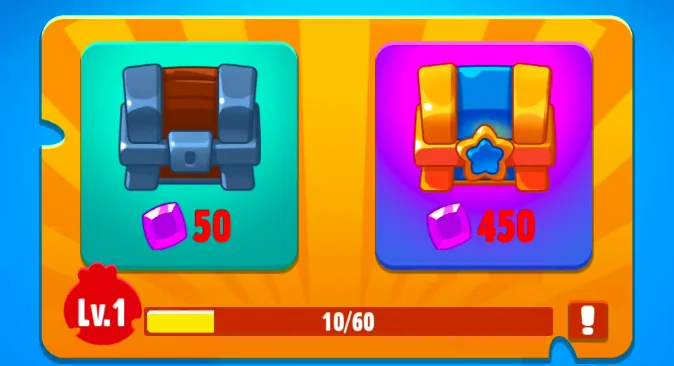
- New heroes come from opening chests.
Those are the basics of how it plays.
Tapping Tiles to Summon Chicken Defenders
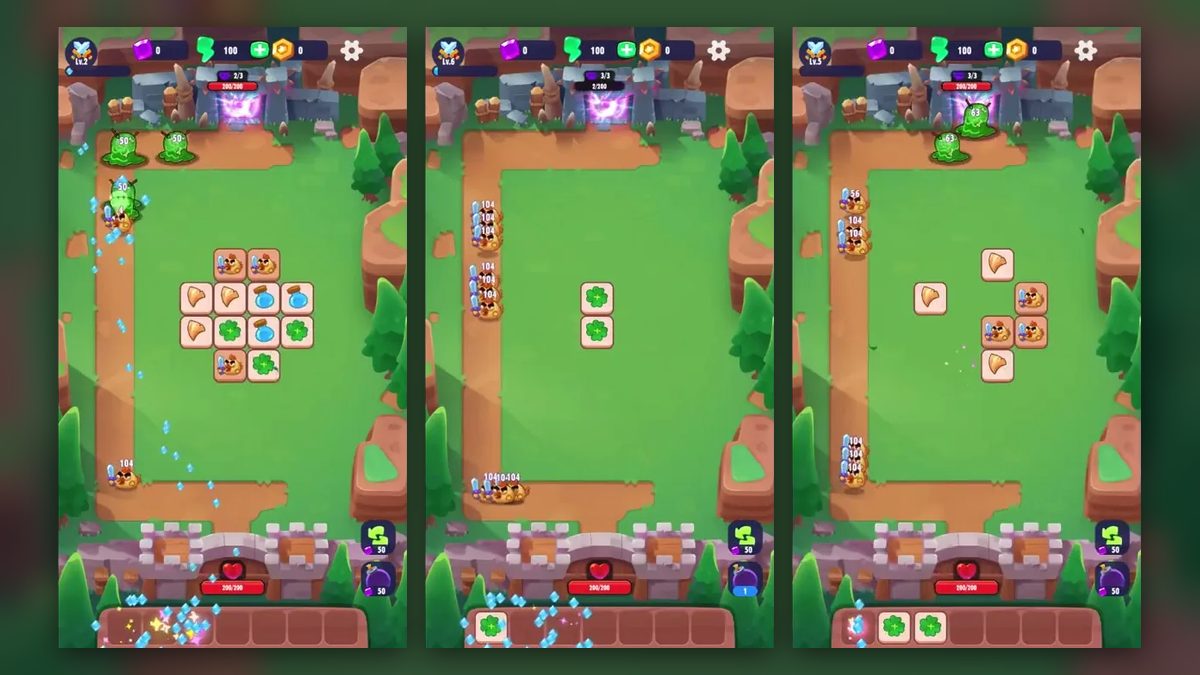
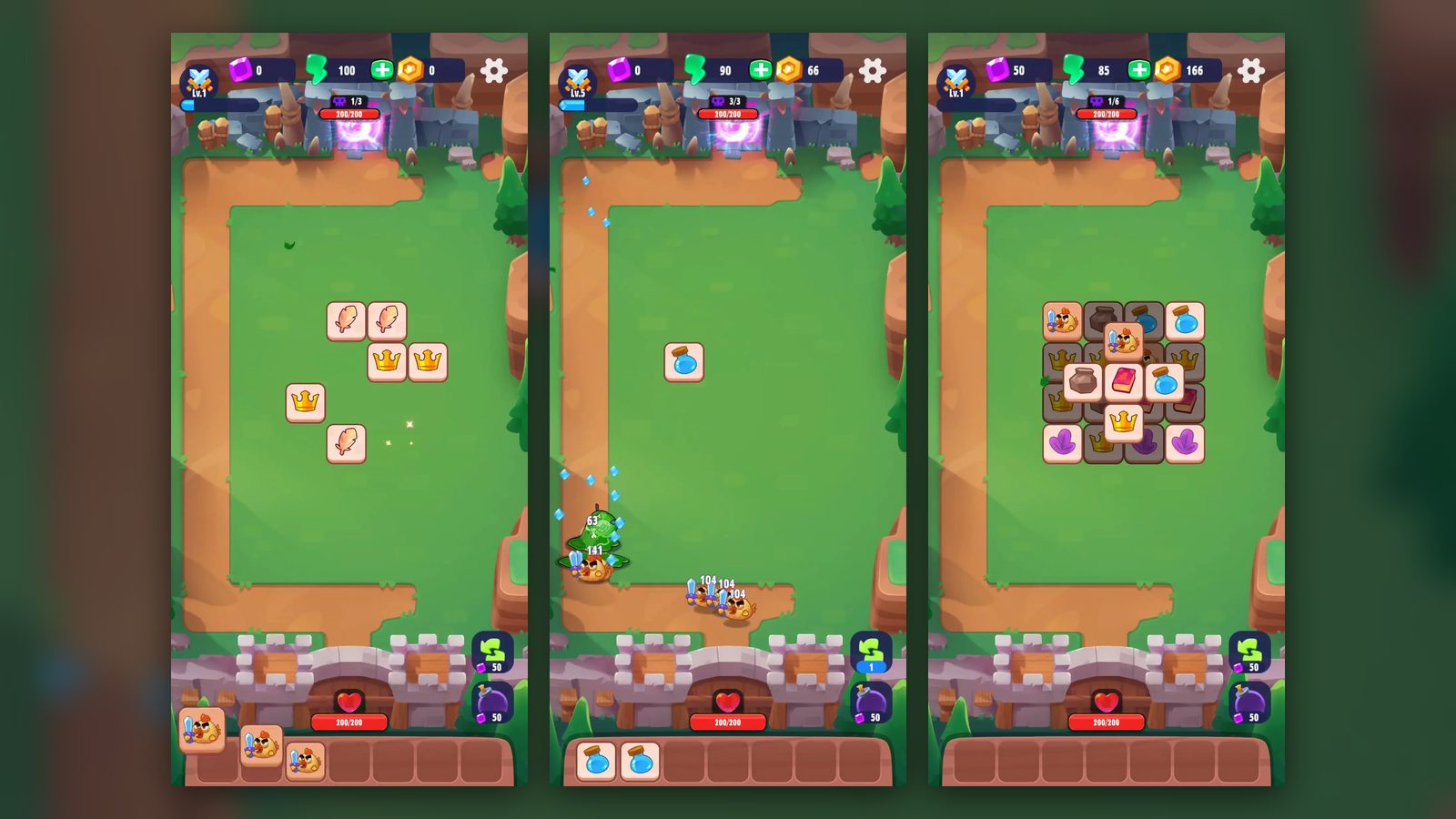
A run of the Tile Clash game plays out in a fixed portrait view seen from above. A green field sits inside a U-shaped dirt path, with a stone gate holding a purple swirling portal at the top and a white stone castle with a heart emblem at the bottom. The tile board sits in the middle of the field, and a seven-slot tray runs along the bottom edge.
Play runs on taps. In the tutorial, a red bird in a purple wizard hat gives hints in blue speech bubbles while a hand pointer taps tiles: “Tap blocks to match three identical ones and gain experience points.” Skill cards and pop-up buttons take a tap as well, and the heroes walk and fight on their own.
The first board is a single layer of rounded tiles in a cross shape, two rows of four with a pair above and a pair below. It holds three each of feather, gold crown, gold fish bone and chicken hero tiles, the last showing an angry chicken with a blue sword on an orange background. “Match the blocks with characters, you can summon corresponding heroes to fight for you!” the bird says, and once three chicken tiles clear from the tray, a chicken hero labeled 104 walks out onto the path.
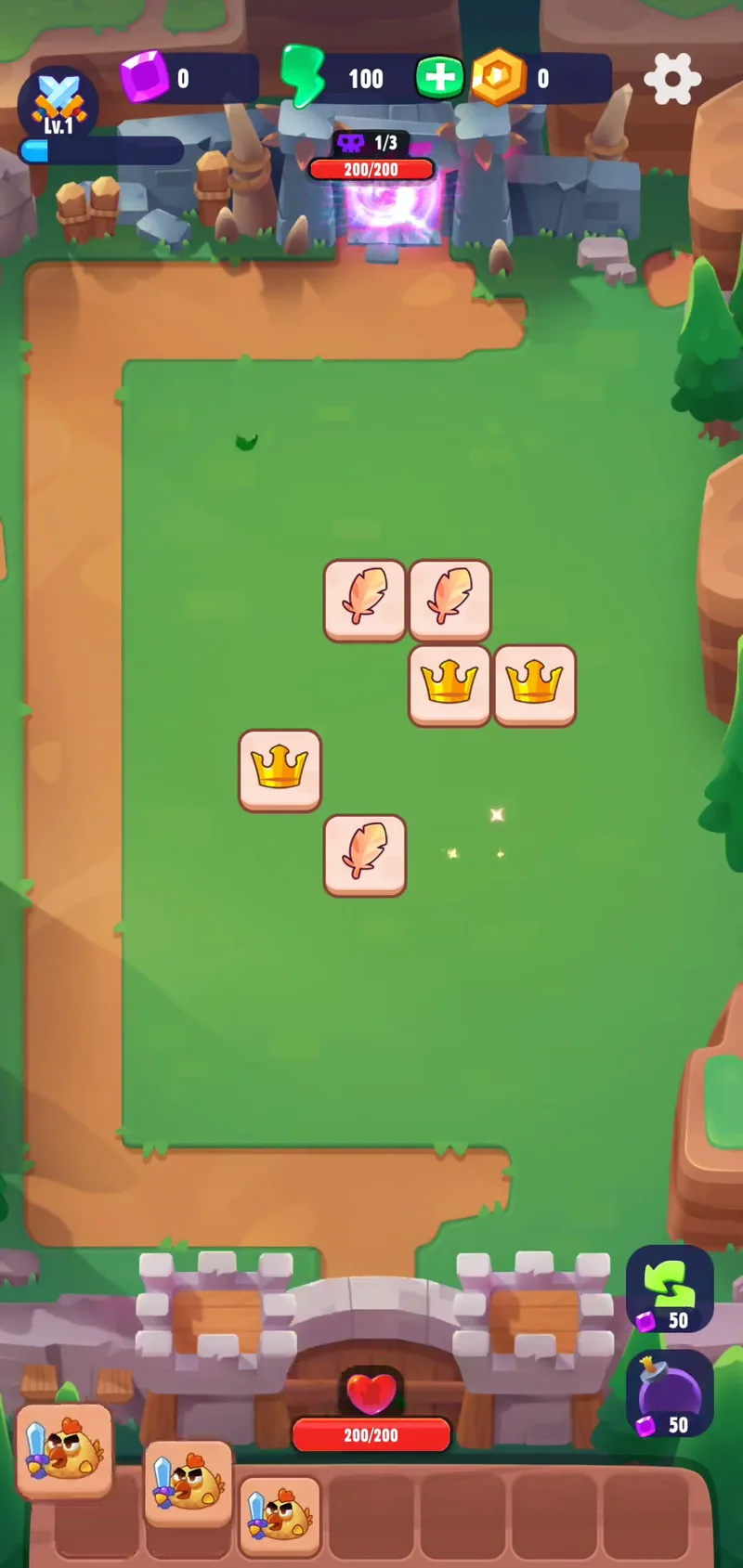
The other tiles are items, and they clear in threes the same way. Their matches burst into blue crystals that stream up to a blue experience bar under a crossed-swords “Lv.” badge at the top left. When the board is empty, a fresh set of tiles grows in from small to full size, and in the first run the new sets came in the same cross shape with the same four types.
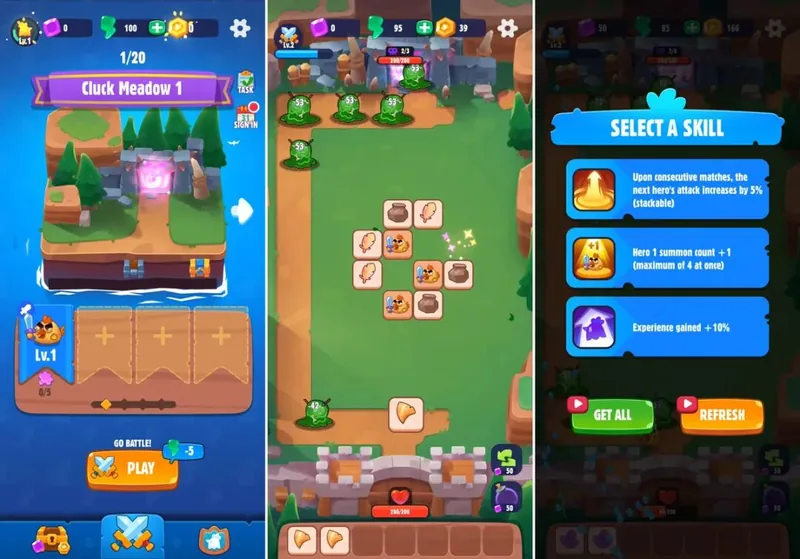
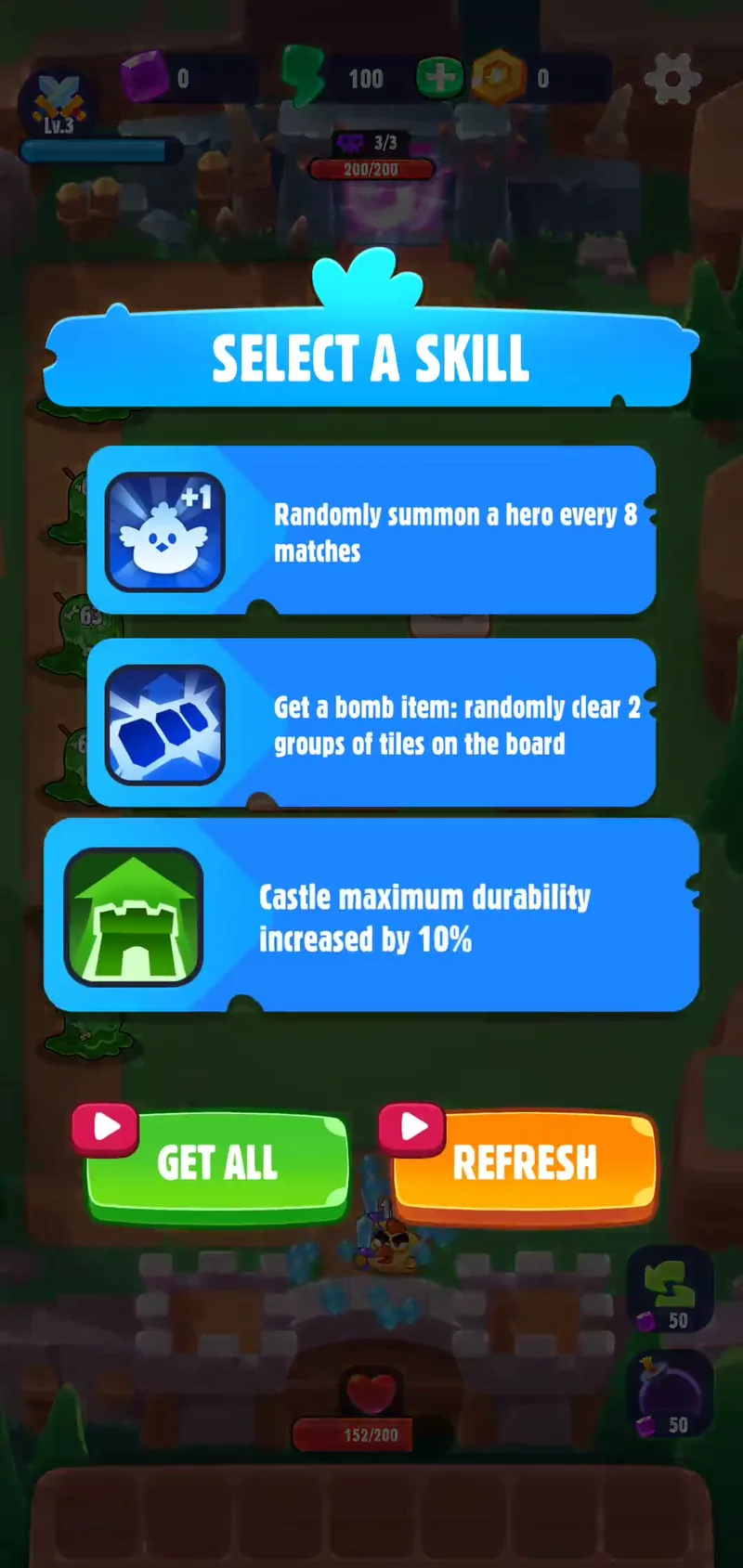
When the badge goes up a level, play pauses under a “SELECT A SKILL” pop-up with three cards. The cards on offer included “Experience gained +10%,” “Hero 1 summon count +1 (maximum of 4 at once),” “Randomly summon a hero every 8 matches,” “Get a bomb item: randomly clear 2 groups of tiles on the board,” “Castle maximum durability increased by 10%,” “All heroes’ attack +10%” and “Get 60 gold coins.” Beneath the cards sit a green GET ALL button and an orange REFRESH button, both marked with a play-button icon. The first pop-up came at Lv.2, and the badge reached Lv.4 in the first run and Lv.5 in the third.
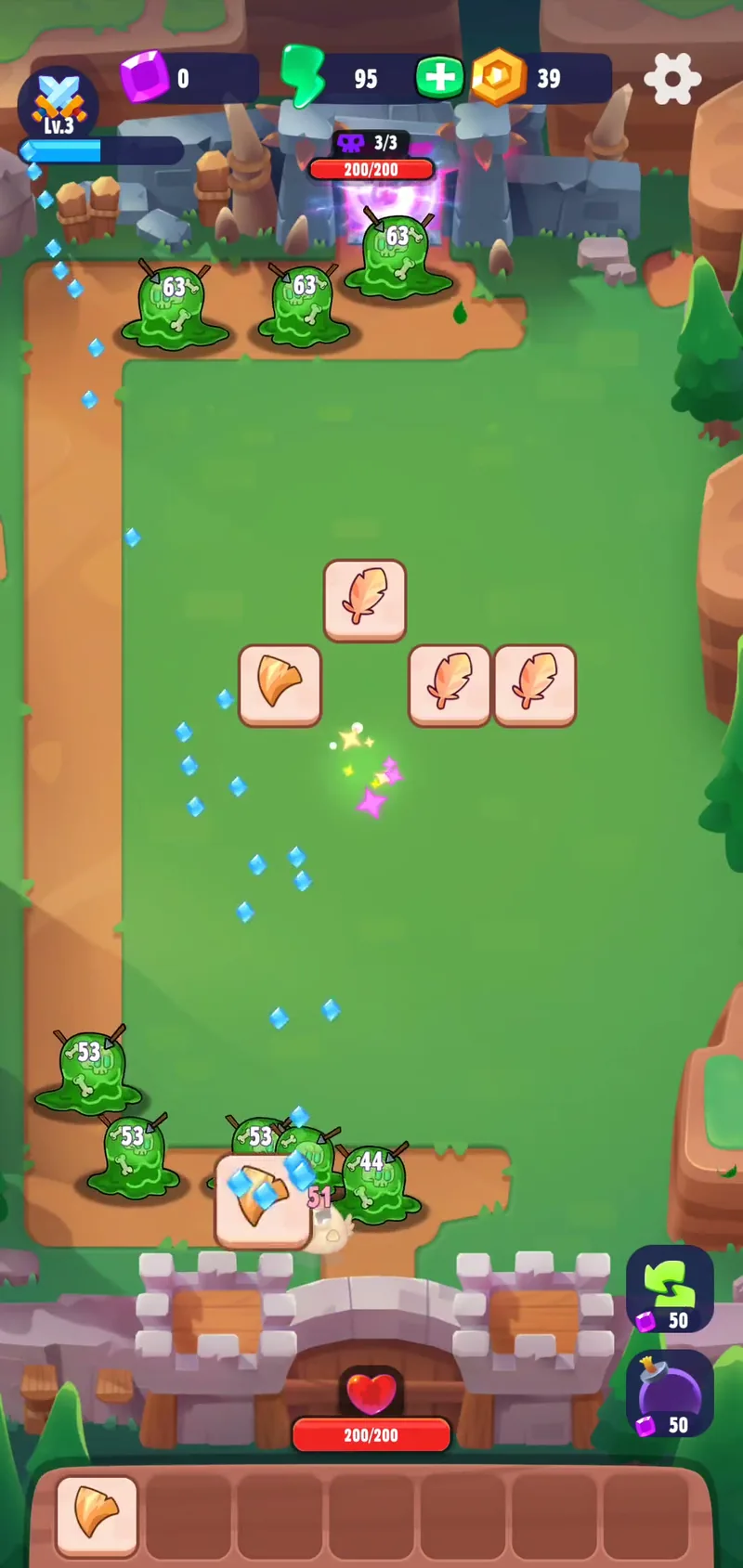
Meanwhile, green slimes with a bone and a skull face come out of the portal, which carries its own 200/200 bar. They walk the path left along the top, down the left side and along the bottom to the castle gate. Each carries a white number that drops when heroes hit it, as when one slime went from 50 to 46, and a wave counter beside a skull icon read 1/3 at the start of the first run.
Summoned heroes appear by the castle and walk up the path to meet the slimes, fighting them up close. The 104 above a hero drops during fights too, to 62, to 60 and once as low as 4. Several heroes can be out at once: in the third run four stood on the path together, three of them by the castle and one labeled 141 fighting a slime.
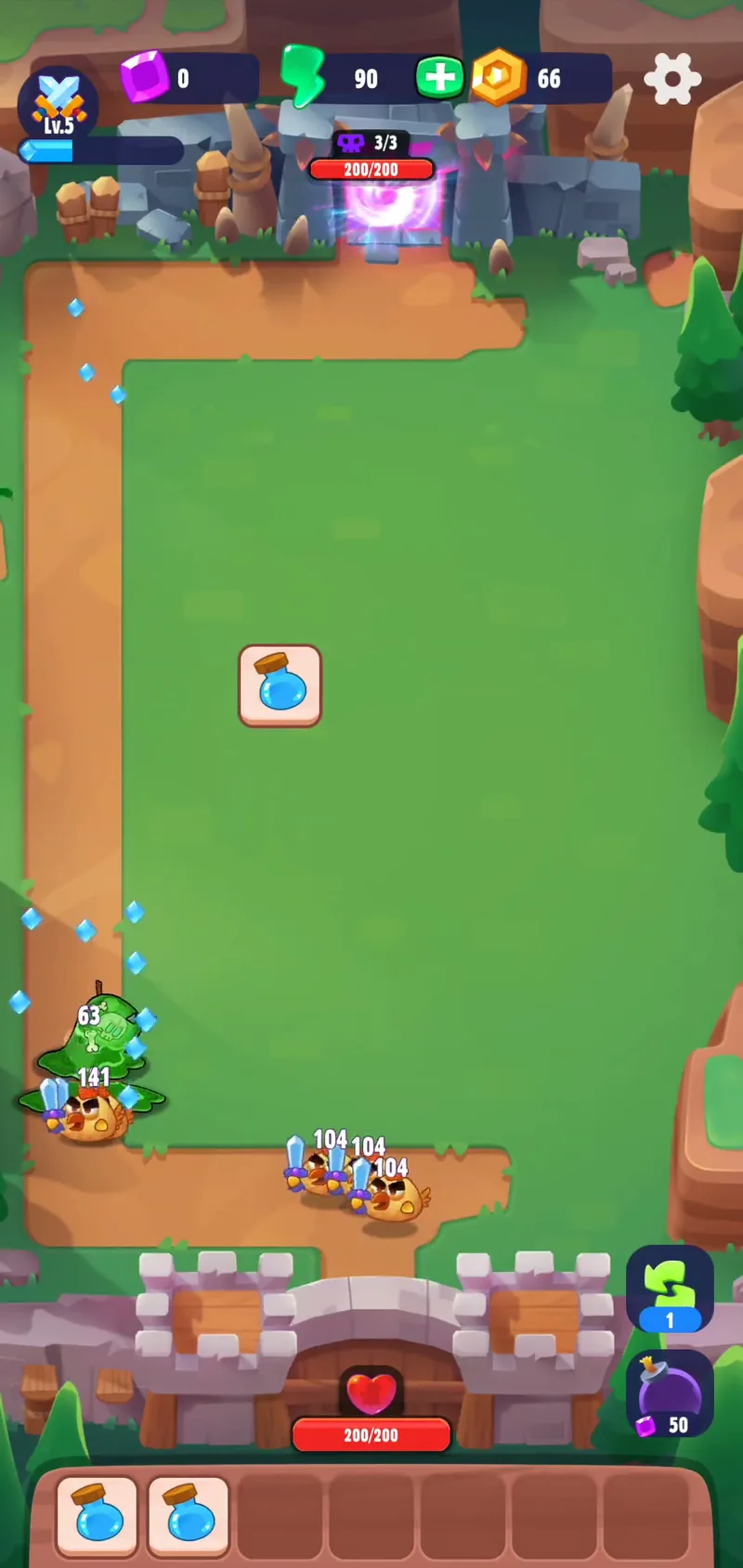
The castle has a heart bar of its own that starts at 200/200, and slimes that reach the gate wear it down. In the first run it fell to 152/200, then to 108/200 with two slimes at the gate, and in the second run it was at 48/200 by wave 3/3. At 0/200 a “REVIVE?” pop-up shows a big heart with a number in it, a gray button priced at 100 gems and an orange REVIVE button with a play-button icon.
The first run then moved to a broken-heart “FAILED” screen reading “You have defeated 13 enemies.” Its REWARDS panel listed 39 coins and 26 yellow chicken-shaped icons, with a green GET button and an orange X2 button carrying the same play-button icon. Three of the four runs reached 0/200. In the third, the castle bar still read 200/200 as the heroes spread along the whole path with one up by the portal, and that run ended with coins, purple gems and pink puzzle-piece icons flying across a blue screen.
In the first run the wave counter moved from 1/3 to 2/3 to 3/3, and the slimes coming out carried higher numbers: 50 in wave 1, 53 in wave 2 and 63 during wave 3. By wave 3/3 a line of them stretched from the portal down the left side of the path. The Lv. badge was back at Lv.1 when the second run began.
Across the three 3-wave runs we played, each run dealt a different set of four tile types in the same cross shape. The second brought brown clay pots and tan curved horns alongside feathers and chickens. The third swapped in blue potions next to crowns, fish bones and chickens.
The run after that was a 6-wave stage, its counter reading 1/6. Its board has two layers: a 4x4 grid whose covered tiles are shaded darker, and five more tiles set offset on top. Lower tiles show in full color once the tiles above them are gone, and red book and purple leaf tiles join the chickens, pots, blue potions and crowns.
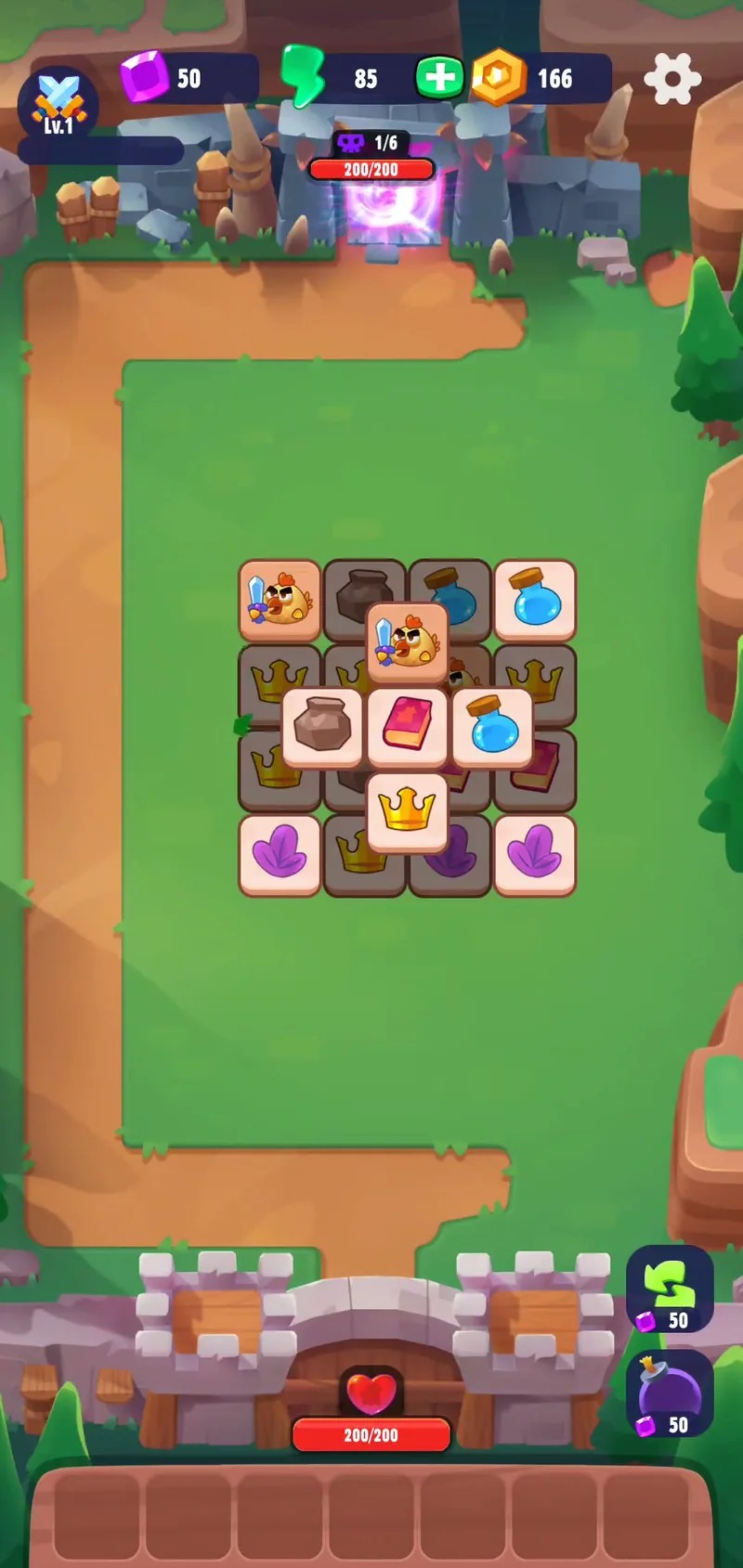
In this stage the slimes carried 57 and then 72. A red-orange chicken with a purple blade, labeled 100, shows up among them near the portal, at the top-left corner, on the left side and at the lower-left bend, and a fireball streaks over the castle. The castle bar went from 170/200 to 93/200 by wave 2/6 and then to 0/200, and the REVIVE? pop-up came up again.
Two round booster buttons sit at the right edge above the tray: a green arrow-shaped icon and a purple bomb, each priced at 50 with a gem icon. For part of the third run the green one carried a blue “1” badge in place of its price. Counters along the top track energy (a green lightning bolt with a plus button), hexagonal gold coins and purple gems.
Energy read 100 in the first run and 5 less at the start of each later run, going 95, 90 and then 85, and the home screen’s PLAY button carries a “-5” energy tag. Coins come from run rewards, and the total rose between runs. The gem counter held at 0 until gems flew in at the end of the third run, after which it read 50.
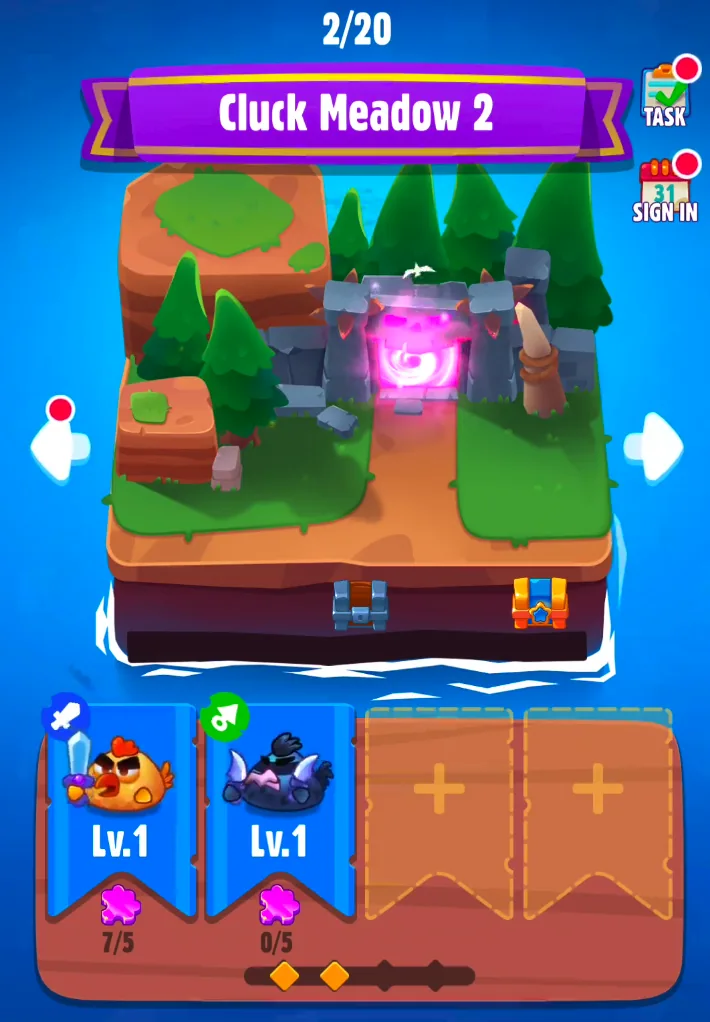
After the 6-wave stage comes the home screen. It shows “2/20” above a “Cluck Meadow 2” banner with left and right arrows, and the stage itself as a floating 3D island holding the portal gate, with a blue-gray chest and a gold chest with a star on its front edge. A row of four lineup slots holds the chicken hero card, marked Lv.1 with a pink puzzle-piece icon and “0/5,” next to three empty slots marked “+,” with a progress bar with diamond markers underneath. The screen also carries “GO BATTLE!” and an orange PLAY button.
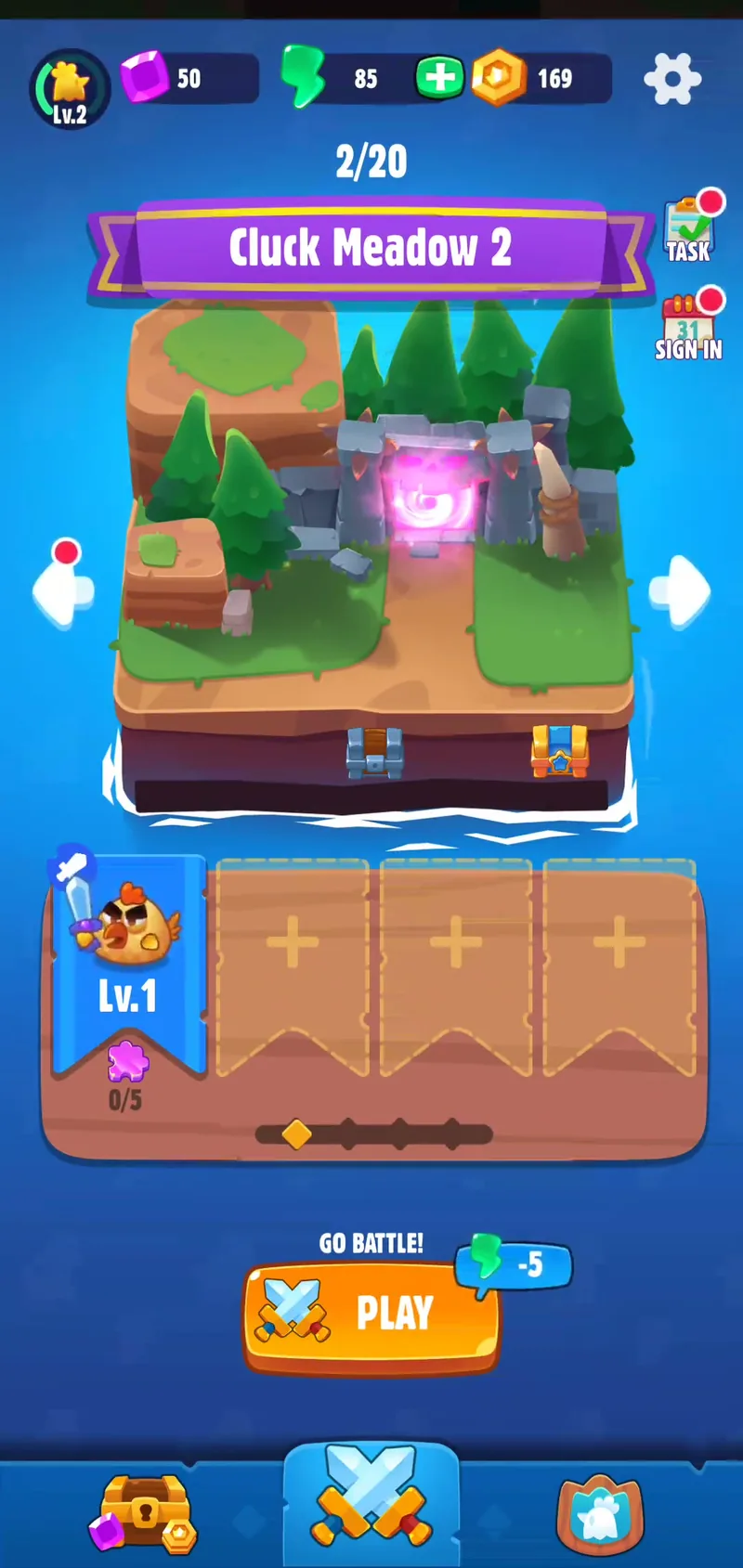
On the right of the home screen, TASK (a clipboard with a check mark) and SIGN IN (a calendar showing 31) both carry red dots. Three tabs run along the bottom: a chest with a gem and a coin, the selected crossed swords, and a shield with a white bird icon. A round badge at the top left with a yellow chicken icon and a green ring shows the player level, Lv.2 here after Lv.1 on the reward screens of the second and third runs, where yellow chicken icons flew in with the coins.
How it scores
Here’s how it rates on each point:
| Category | Score | Comments |
|---|---|---|
| Fun of the core gameplay | 6 | Some fun, but with shortcomings |
| Originality | 8 | A very good creative angle |
| Art | 7 | Midcore-style art with some style of its own |
Overall:
- The idea is really good, but the way the genres are combined falls short in places. Overall score: 7 out of 10.
- Putting the two styles together causes a problem: the fun of tile matching is gone, and so is the hands-on control that makes midcore games fun, which leaves only the pure appeal of numbers going up.
- In the long run, the game comes down to how fast you can clear tiles and which skills you pick when you level up, and that puts its staying power under serious strain.
- For now, the range of skills and heroes is still thin, and the game is still in testing. Here’s hoping the developer can fix the problems above, because then it would be a very good game.
Google Play: https://play.google.com/store/apps/details?id=com.seikami.tile.clash.battle
More from this series:
Bouncing-ball brick breaker + Paper.io: grab territory in online battles by breaking bricks
Another promising fresh idea for word puzzles: spelling words + matching blocks of real objects
Tile matching + threading candied fruit onto skewers: a very creative mix
Tetris, the falling-blocks classic, as live PvP against real players
Claw machine + chain reactions + matching: a very creative mix