The Mobile Game Design Move That Made Airplane Chefs Fly
Airplane Chefs lets you walk up and down a plane's aisle, and that one piece of mobile game design fixes problems cooking games have had for years.
Anyone who has played a cooking game knows the routine: customers order, the clock runs down, and you rush to cook and serve before time is up. Airplane Chefs keeps that routine but moves it onto a plane, where you also walk the aisle from row to row. That one change says a lot about mobile game design: why some games wear players out, why a genre can feel the same chapter after chapter, and how a single new rule can fix several old problems at once.
Background
In 2023, Airplane Chefs became the new breakout in China’s cooking-game market. Five months after launch, it sits in the top five of the iOS free casual games chart and the top 30 of the iOS free games chart, and on the download charts it is far ahead of the long-established cooking heavyweights there.
In our view, Airplane Chefs plays quite differently from traditional cooking games, and those differences expose where the genre falls short. Drawing on years of designing cooking games, and on how we look at game design and the player’s experience, this piece takes up three questions:
1. Why do cooking games get so many downloads but earn only modestly?
2. What design let Airplane Chefs break out and take off from the crowd of cooking games?
3. What problems would a cooking game have to solve to become a breakout hit?
The core gameplay of cooking games
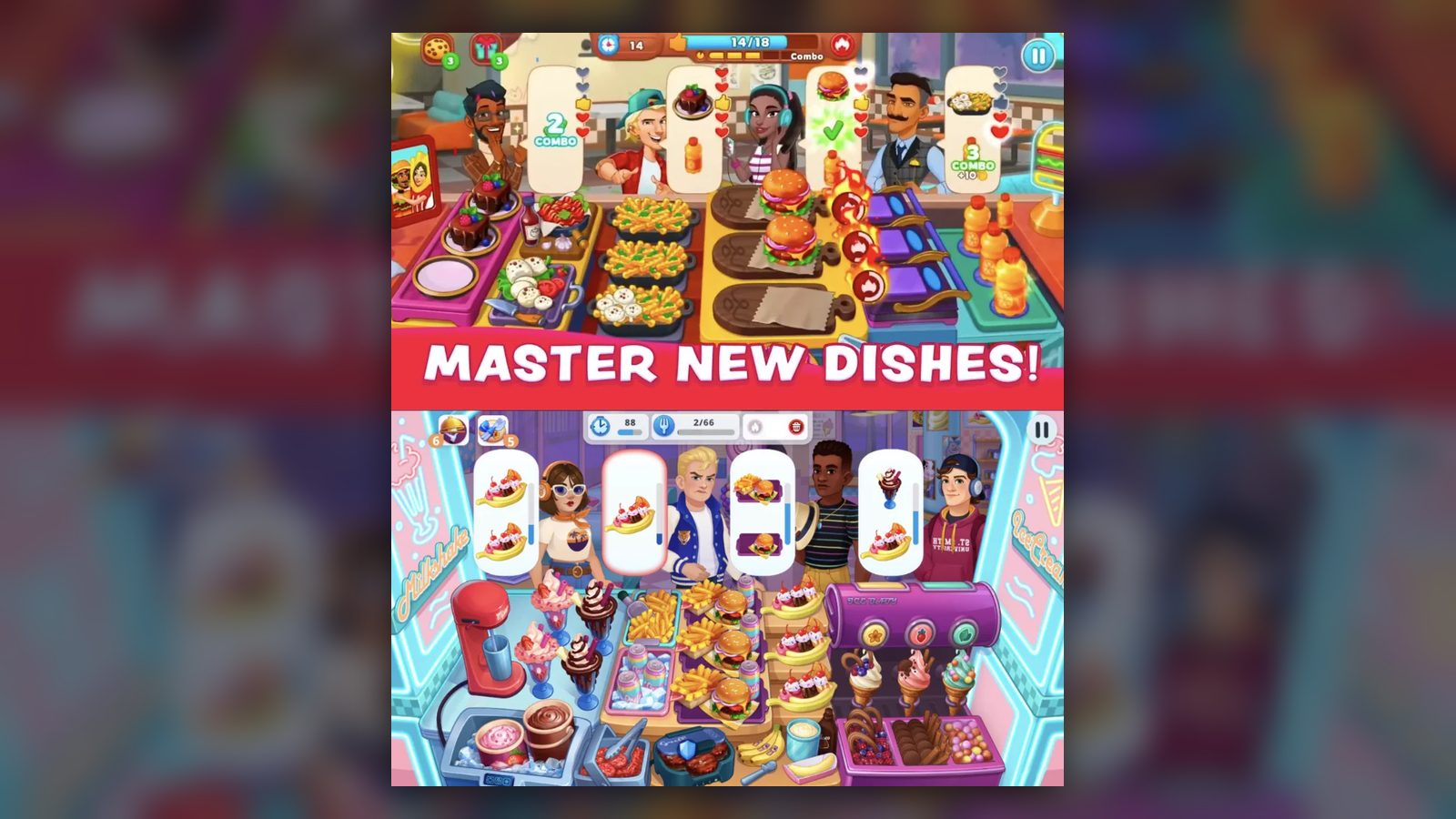
At its core, a cooking game is a cooking-themed time-management matching game.
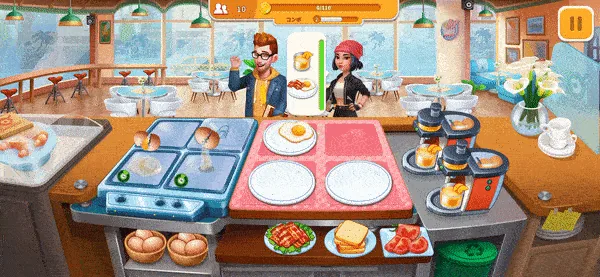
Cooking-themed means the game has you play a chef cooking for customers, and it draws players in with a big spread of mouthwatering food.
Time-management describes the goal and the challenge: meet the level’s target within the time limit and you pass; miss it and you fail. Players are under “time pressure.” (A regular match-3 level, by comparison, has no time pressure.)
Matching game means customers order specific dishes, and you turn raw ingredients into those dishes and hand them over, “matching” each order, after which the customer pays and leaves and you move on to the next order.
Where cooking and time management games fall short
Traditional cooking games offer an experience all their own. That experience gives the genre its particular charm and wins it devoted fans, and to some extent it is also the weak spot that keeps these games from becoming breakout hits. Here is a quick breakdown of the experience at the core of the gameplay.
The fun of a cooking game is this: within set limits (time, customers, orders), using your own hand skills and how you plan your time to finish orders faster and more accurately. Along the way, players go through a closed loop of “learning, getting the hang of it, mastering it, feeling the pressure, beating the challenge.”
Here is that core experience, taken apart piece by piece:
1. Time pressure raises the barrier to entry
Because cooking games are time management games, time pressure is a central part of the experience: players act under a countdown that ends in failure. That brings a degree of thrill and tension, and the right amount of tension makes clearing a level feel more rewarding.
Seen from another angle, though, time pressure also sharply limits when and how people can play. To play well, players have to be focused, attentive, serious and quick.
Staying tense with no chance to relax drains players’ energy to a degree, cutting both how long they play in a sitting and how long they stick with the game (a whole night of Angry Birds should be far less tiring than a whole night of Street Fighter). It also filters out a lot of players who are all thumbs or simply laid-back: many people, casual players especially, just don’t like games that make them “tense.” So cooking games are hard to get into, and they sort players hard, which greatly limits how widely the genre can reach and how many people it can win over.
2. Order matching and the restaurant-by-restaurant map make the experience repeat itself
As mentioned earlier, a cooking game is really a “matching” game. Each chapter’s maps set level goals with a few different types of orders, and the number and mix of those order types change how hard a level is.
Further into each chapter, players meet more and more customers whose orders are hard to fill. To handle them faster and complete more orders per level, players need both skill inside the level and upgrades outside it. So in the last few levels of every chapter, players always end up scrambling, running the whole restaurant at full speed.
But once players clear a chapter and move on to a new chapter and a new restaurant, the orders and kitchen tools change with the restaurant. Players have to learn new recipes, a new sequence of steps and new tap routes all over again, and the difficulty starts over with slow-paced customer orders.
Then, as kitchen tools unlock and get upgraded and players grow familiar with the levels and the steps of each order, the difficulty climbs again and leads into a fresh round of scrambling.
Every map after that repeats the same process, again and again.
That cycle is the difficulty curve of a cooking game.
Overall, the difficulty curve of today’s cooking games is fairly simple and dull. In every new chapter, players repeat the same cycle: levels that are too easy, then levels of moderate difficulty, then levels so hard they’re exhausting. That leaves players with the same negative experience at the start and at the end of each chapter, one the game has no way to fix.
Early in each chapter, orders are simple, the actions are easy and no strategy is needed, so players feel like they are “standing around” with nothing to do.
In the hard levels at the end of each chapter, the demands on players’ skill, speed and accuracy are extremely high, and the experience turns into a “Fast & Furious” ride.
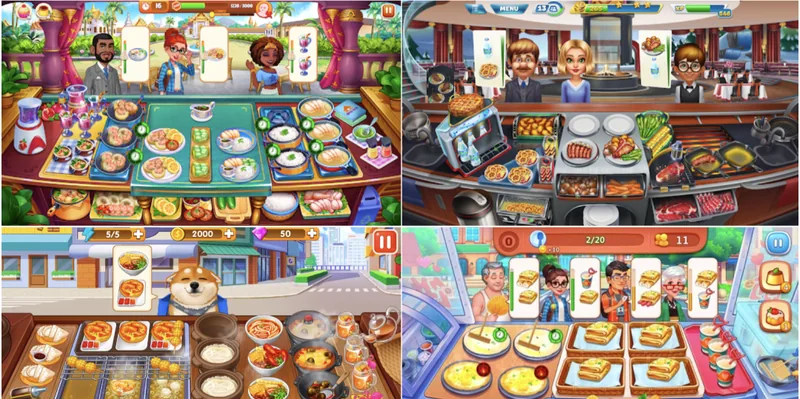
Within a chapter, the difficulty of each level comes down to a dynamic balance between how many actions players must make and how hard the customers’ orders are. After a few chapters, players easily notice that each map is basically a reskin (different food and kitchen tools), while the controls and the pacing of each level repeat heavily. Cooking games are hard to get into and have a thin, blunt difficulty curve, and these two things are major reasons the genre struggles to produce breakout hits.
3. Is art the only thing left to compete on?
Because the time pressure and order matching of traditional cooking games box the genre in, cooking games have ended up where matching puzzle games are today: in a downward spiral of competing on art and on ad spending. Studios have also brought fake ads (ads showing gameplay that isn’t in the game) into the cooking genre, which does no good to the flow of fresh blood into the genre or to the health of the market as a whole.
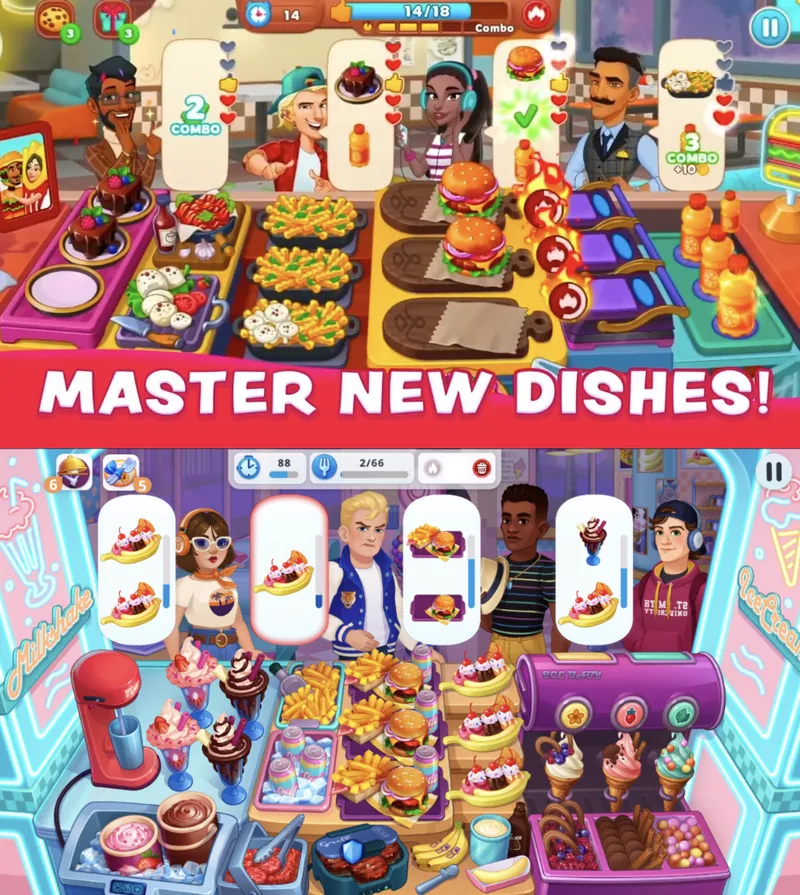
Yet Airplane Chefs, whose art style is nothing special, managed to stand out right now, and we think that is because its design fixes the weak spots of traditional cooking games laid out so far. So how does it fix them?
The “strike from a higher dimension” in Airplane Chefs’ design
Here is how a round of Airplane Chefs plays.
In Airplane Chefs, you play a flight attendant serving meals to passengers on a plane. You prepare dishes in the galley, load them onto a cart, then push the cart into the cabin, fill orders row by row, collect the passengers’ empty trays and head back to the galley, going back and forth to pick up food and deliver it.
To make the theme and the gameplay fit together better, the designers came up with a brand-new mechanic: a Y-axis for moving forward and back. Besides serving the customers along the horizontal X-axis on screen, you can use the Forward and Back buttons on the right to move along the vertical Y-axis, switching which row of passengers you serve and returning to the galley to prepare food.
Having played it, we found that the Y-axis solves at least a few problems:
1. Presentation: the map now has a visible front and back. And since you move around within the map, the scenes look much richer and it is easier to feel you are really there.
2. Controls: the Y-axis lowers the demands of plain tapping on the screen, because players also use the movement buttons on the right side of the screen to move between rows. Tapping on one flat screen becomes tapping across several scenes and planes, and that changes how the game plays enormously. Cooking games used to offer one kind of input, and difficulty could only be raised by adjusting the number of orders and the gaps between them; now the difficulty curve can be designed around a combination of where customers sit and how fast they eat.
3. Difficulty curve: in the past, difficulty in cooking games could only be tuned through the number and difficulty of customer orders, so each chapter’s difficulty curve and level design were very one-note. With the Y-axis, customers no longer appear in one row of 4 spots but in N rows with 4N spots. Add tray collection on top, and designers have more dimensions to work with when shaping each chapter’s difficulty curve. Difficulty tuning goes from a single dimension to many, which leaves far more room for designing the difficulty curve.
This isn’t blind hype, either: two years ago we studied Airplane Chefs in depth (it launched outside China quite a bit earlier) and analyzed what the Y-axis design actually improved and changed in traditional cooking games.
In a sense, adding the Y-axis is a bigger deal than one extra dimension of play. Once it is in the game, the way it fixes the weak spots of traditional cooking games is a “strike from a higher dimension”: an advantage that older games, played on one flat plane, have no answer to.
Fixing several weak spots of earlier games in the same genre with a single design is exactly the “elegant and sophisticated” kind of mobile game design we have long championed.
The takeaway
The leap in how Airplane Chefs plays comes from adding the Y-axis. It rethinks the scene presentation, level experience, art style and range of themes of traditional cooking games along a new dimension, and solves all of them together. That may be why it took first place among cooking games as soon as it launched in China: with the old weak spots fixed, this new take on the cooking game’s look and gameplay is simply far richer and more fun for players.
A prediction, then: if a cooking game ever becomes a big money-maker, it will not use the traditional cooking formula. More likely, like Airplane Chefs, it will appear out of nowhere with some new gameplay rule that greatly eases, or even fixes, the gaps in experience and the level design flaws of time-management matching games, and that same form will give players something strange and fresh to look at through a different visual approach.
The end
Thanks for reading