Two Kinds of Luck: Mobile Game Design in Carrot Fantasy 4
How Carrot Fantasy 4's weekly contest pairs a new map every day with a boss whose skills come at random, and what that says about mobile game design.
Carrot Fantasy 4’s weekly contest, a case study in mobile game design
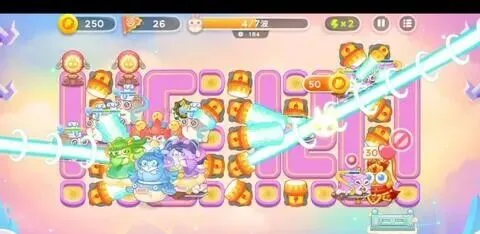
Most games mix strategy with luck, and getting that mix right is a big part of mobile game design. This piece looks at one mode that does it well: the weekly contest in Carrot Fantasy 4, a tower defense game where you place turrets to hold off waves of enemies. First, the rules.
Like the timed leaderboard events in Homescapes, Township and many other casual games, the mode puts you on a leaderboard each week with 29 other players (who might also be 29 bots). Everyone is ranked by score: high scorers move up to a higher tier, and the rest either keep their tier or drop down.
In Carrot Fantasy 4, this scoring mode is called the weekly contest. Its rules are below, with a few extra notes added.
Weekly contest rules
The basics: A new map made just for the contest comes out every day. On it you have 30 health points, you must use a set lineup of turrets, and the enemy types and formations are fixed as well, usually 6–10 waves in all. When the enemies reach wave 4, a weekly contest boss appears. Hitting the boss with your turrets makes it drop points, and the more damage it takes, the more points it drops. The boss usually leaves 240 seconds after it shows up. The day’s level ends when you get through every wave or lose all 30 health points.
Scoring: When the level ends, the points the boss dropped plus the health you have left make up your score for the day.
The boss: It is made up of four different mini-bosses and one merged boss. Each mini-boss has a health bar, and when one is emptied the next mini-boss appears, until the final merged boss arrives. The merged boss has unlimited health. Each mini-boss has one particular skill, and the merged boss uses the four mini-bosses’ skills at random.
Special rule: Damage to the merged boss drops more points than damage to the mini-bosses.
Leaderboard: Your scores for all seven days of the week, Monday through Sunday, are added up and ranked in a group of 30 players. Depending on the tier, some players are promoted, some stay where they are and some are demoted for the next week’s leaderboard. Rewards go out every week based on tier and final rank.
The weekly contest has an extremely strong pull on us. Every replay ad it offers each week gets watched, and over time a few dozen yuan (less than $15) went into diamonds for the 30-diamond replay fee, which in hindsight looks a bit like being a sucker. The mode is also heavily discussed on platforms such as Bilibili, a big online community in China, and it has a dedicated following of its own.
So in our view, the mode itself is a very successful design. What follows is one reading of it, and quite possibly some over-reading too.
The weekly contest’s mix of strategy and randomness
Strategy and randomness
Strategy and randomness in games have always come as a pair, each supporting the other. They also push against each other and compete for the same ground: the more random a game is, the more its strategy, or its room for strategy, gets squeezed.
Three examples, from least strategic to most:
1. Buying a lottery ticket: pure randomness, with nothing to do with strategy. No strategy you try can change the odds of the outcome itself.
2. Dou Dizhu (Fight the Landlord), a card game popular in China: a combination of randomness and strategy. The randomness comes from the starting hands you and the other players are dealt, which are never quite the same from game to game.
The strategy comes from your counting, or from finding the best way to play your hand given how strong your cards are compared with everyone else’s.
3. Stacking building blocks: decided purely by strategy (and execution). The only things that affect the result are your building plan and the fine control of your hands.
· · ·
Randomness in games, in turn, comes in two kinds: preset randomness and triggered randomness.
Preset randomness is information you get before you start making decisions, such as map generation in Civilization or in roguelike games: every time you start a new game, you get a random setup, and you have to plan your strategy within it.
Triggered randomness is random interference that comes in response to your decisions, moves and results, and you have to handle it with on-the-spot strategy. Chess and card games are typical examples, since every move you make shifts with your opponent’s on-the-spot choices.
The two kinds also make strategy play and feel different.
Preset randomness and long-term strategy from the weekly contest’s base rules
Back to the strategy and randomness in Carrot Fantasy 4’s weekly contest.
On the preset side, the map, enemies and turrets change once a day, and that is what the contest’s replay value rests on from one day to the next. Every day you have to lay out a new long-term plan, and you can replay that day’s level again and again.
Inside each day’s level, you start with very few places to build, only one or two, so the whole day’s strategy grows out of a single turret on a single spot. Opening up the map, setting up your defenses and choosing your targets are all your own decisions (this assumes you’ve played a Carrot Fantasy game before).
As the level goes on, you can open up the map yourself while the enemy waves keep coming, choosing between coins, turrets and new build spots. From there, different parts of the map call for different ways of opening them up.
So the way you open up the map over the course of one day’s contest is long-term strategy under preset randomness.
You also need a turret plan that fits your map plan, based on the day’s enemies and the turrets on offer. That is long-term strategy under preset randomness as well.
Triggered randomness and on-the-spot strategy from the boss
Preset randomness and long-term strategy on their own are the strategic base of the main levels in the Carrot Fantasy series, or put another way, the core of their fun.
The boss that the weekly contest adds brings triggered randomness and the on-the-spot strategy that comes with it, and these fuse with the map’s own preset randomness and long-term strategy to create a kind of chemistry.
So the experience that triggered and preset randomness create together is, in our view, the main reason the weekly contest in Carrot Fantasy 4 draws in so many players, us included. It gives you the security and sense of control that come with long-term strategy, plus room to get better at it. At the same time, triggered randomness brings the fun of challenge and chance, along with a little loss aversion (the sting of losing ground you had) and the payoff of a good call, so the mode keeps moving forward in a balance that swings back and forth between strategy and luck.
The contest’s replay option feeds your sense of control over that long-term plan, or simply the wish to “get off to a good start.” Even on a replay, the triggered randomness you run into inside the level still makes the run play out differently. That is also why many people who make weekly contest guides replay the day’s level several times, or even dozens of times, every day.
In a real weekly contest battle, both kinds of randomness are at work in the same run: the day’s set map and turrets on one side, and a boss whose skills come at random on the other.
The weekly contest takes about 15 minutes a day, or around 30 minutes once you add replays unlocked by watching ads. That guaranteed daily playtime, and the habit of coming back, has greatly extended Carrot Fantasy 4’s long-term life and eased the letdown of its slow updates to the main levels. (For the most dedicated players, new main levels come so slowly they barely register, and the slow pace has also pushed the new ones toward being hard just for the sake of being hard, but that’s a topic for another day.)
Wrapping up
Combinations of preset and triggered randomness show up in all kinds of designs, across all kinds of games.
Still, the way Carrot Fantasy 4’s weekly contest combines them is a really interesting case, both in the proportions of randomness it uses and in how it packages them, on paper and in actual play. Wrapping a leaderboard around it, with rewards and goals beyond the level itself, pushes the reward-driven chase even further.
In many roguelikes, and in the roguelike modes of all sorts of other games, most of the “too hard” or “boring” moments we’ve run into also come down to randomness and strategy falling out of balance. The rise of the roguelite genre, for example, is in part about using the certainty and steady build-up of progression (upgrades that stay with you between runs) to ease the uncertainty that comes from a roguelike’s pure randomness.
Walking through the weekly contest here is also a reminder to ourselves to keep checking, in any design, how randomness and strategy relate and how that plays. That means checking how their weight, presentation and feel change what players actually experience, both in the moment and across the game as a whole.
· · ·
Further reading
Randomness and Game Design