What Block Blast! Gets Right in Mobile Game Level Design
How Block Blast!'s mobile game level design differs from Woodoku's, from an 8x8 board to a clear every 2.1 moves on average instead of 3.9.
Block Blast!, where you drop shapes onto a grid to clear full rows and columns, is a light tweak on Tetris, the falling-blocks classic, and without question a very successful one. It still holds No. 3 on the US top free chart. Followers keep coming, and the free chart always has a few games putting their own small twist on it, but few of them get it right. The biggest reason is that they never work out what matters in mobile game level design. As the saying goes, the simpler the game, the harder it is to make, because so much rides on the details. Get them right and you have the game; miss them and you only have its outward shape. This look at its puzzle game design starts by setting it next to two rivals to pin down what its modest variation actually is. From there it works step by step through the level design that shapes every round you play.
Block Blast! and its rivals
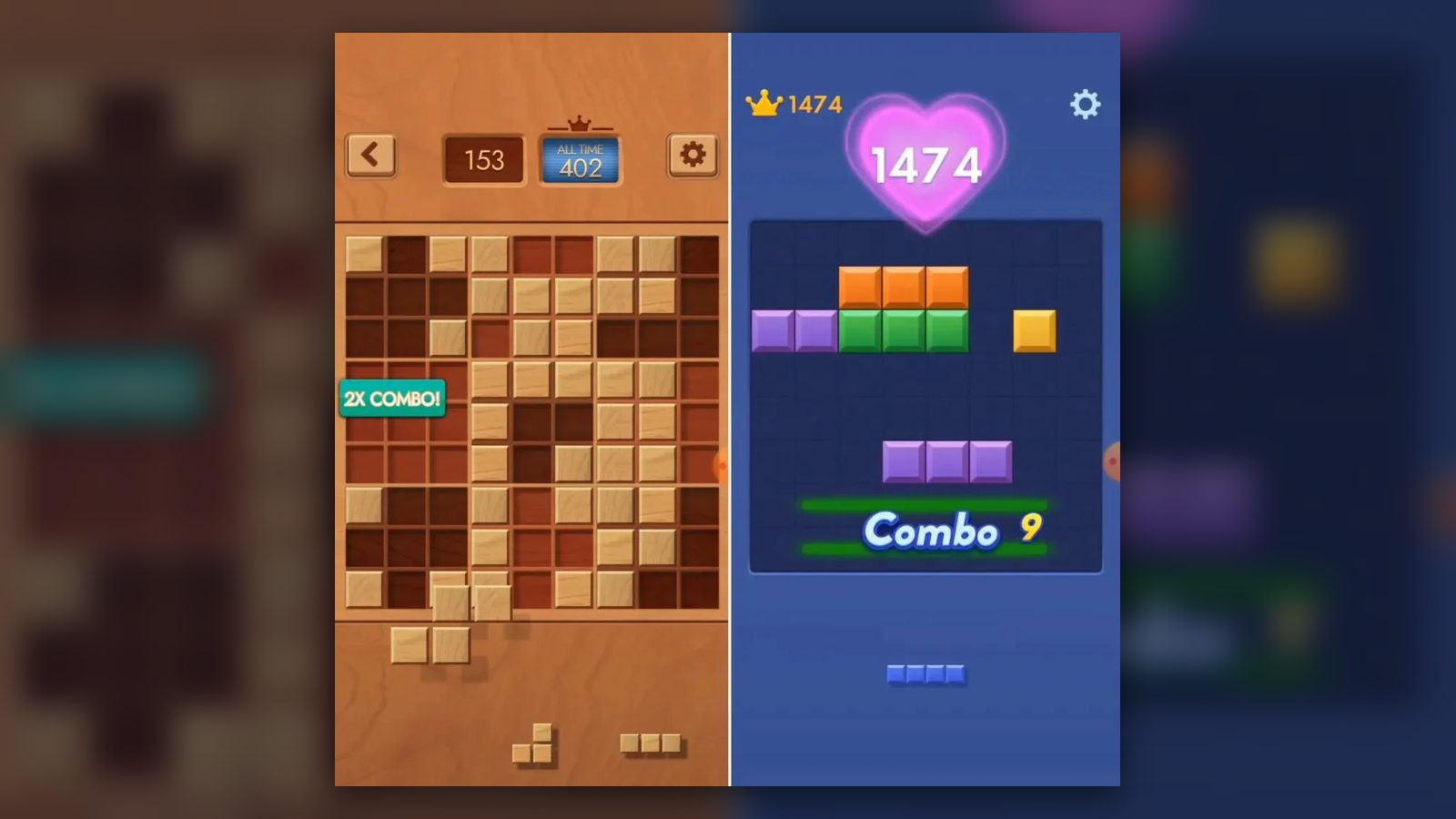
Two rival games serve as the comparison. Here is how the screens of all three line up:
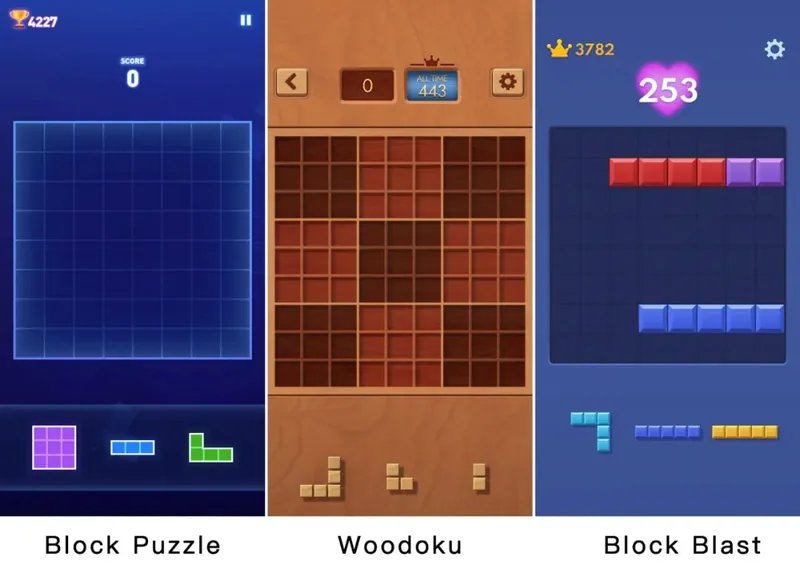
And here are the numbers for all three:
| Game | Released | Total downloads | Free chart rank |
|---|---|---|---|
| Block Puzzle | March 2019 | 10M | 124 |
| Woodoku | March 2020 | 50M | 25 |
| Block Blast! | September 2022 | 100M | 5 |
The table and some hands-on time with each game point to these early conclusions:
- Block Puzzle plays very much like Block Blast!, and going by the release dates, Block Puzzle was most likely the first of the two. They differ mainly in art style and in how they make money. The levels themselves are not very different.
- Woodoku plays somewhat like Block Blast!, but you can clearly feel the differences. It is also still running large ad campaigns to win new players, which at least shows that both its gameplay and its way of earning back that ad spend work very well.
That raises a question. Block Puzzle and Block Blast! play almost the same and differ only somewhat in art and money-making, so why did they end up so far apart? The answer is fairly complicated. Our guess is that it covers a lot of ground. Art and money-making explain part of it, but the publishing side, meaning how each game was launched and promoted, may count for more.
When you study a game’s mechanics and its approach to levels, playing only games that are nearly identical can make many of the details and differences hard to notice. It works better to play rivals that differ to some degree. The contrast shows where the games part ways and points toward a way to analyze them.
So for level design, Woodoku is the main comparison here, because it opens up a way to analyze that design. The two games differ in these ways:
1. The board has fewer cells, going from 9x9 to 8x8. The rule that clears a filled 3x3 square of nine cells is gone too.
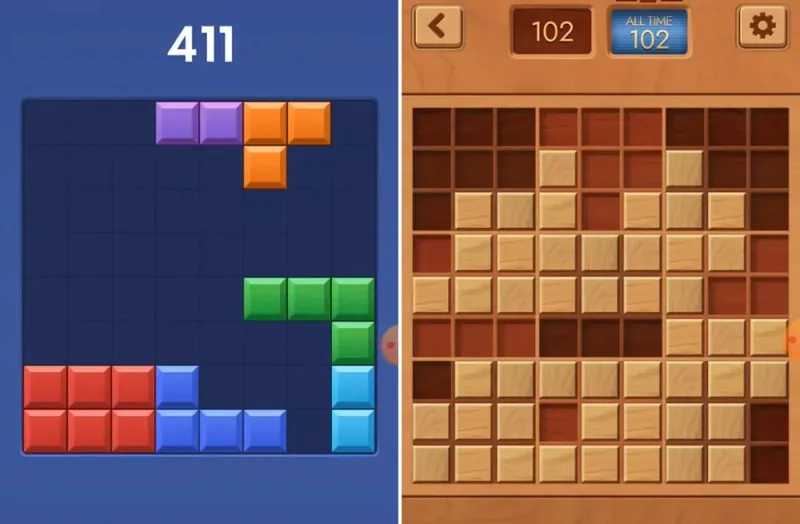
2. Fewer kinds of block shapes show up, and some of the odd shapes have been removed.
3. On the art side, leaving aside Woodoku’s wooden look and judging the visuals alone, the colors are brighter and the effects stand out more.
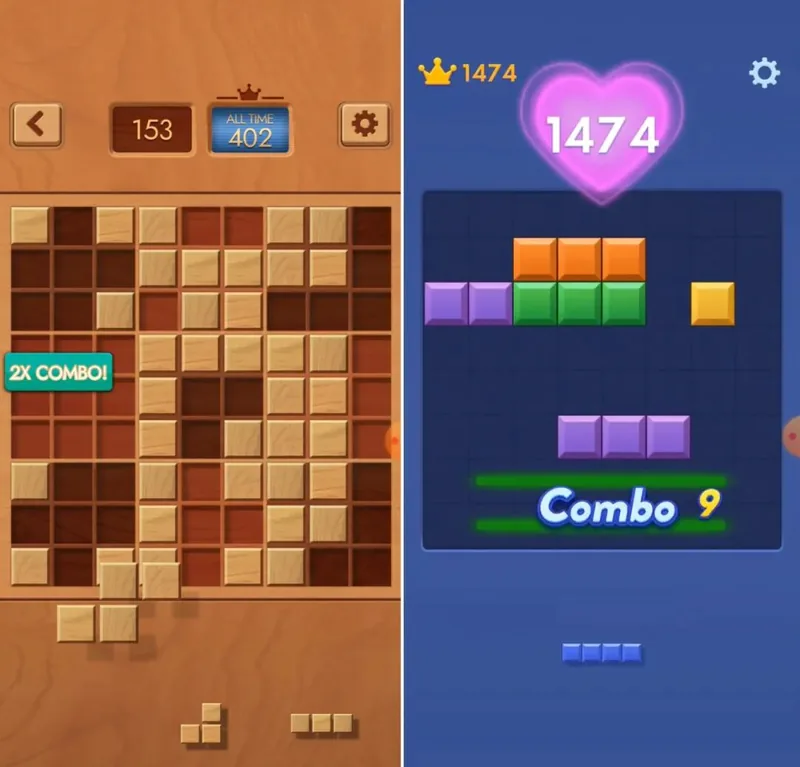
4. Rounds last a different length of time. Here is the average length of a round across the many rounds we played of each:
| Game | Time per round |
|---|---|
| Woodoku | 2.5 minutes |
| Block Blast! | 4 minutes |
5. Back-to-back clears (combos) come more easily, and the clearing pace is faster
| Game | Moves per clear |
|---|---|
| Woodoku | 3.9 |
| Block Blast! | 2.1 |
6. The goal of the game, or in other words its core source of fun, is different