Block Crush Review: Goals Built Into the Wooden Board
A Block Crush review: red gems, soda bottles in a stand and oranges on fruit bushes sit fixed in a wooden 9x9 grid as the goals to collect.
Game at a glance
Block Crush:Wood Block Puzzle
7/ 10
Our score
Plenty of block puzzles try to go heavier. This one actually puts in the work.
In this article6 sections
Drag a plain wooden shape onto a 9x9 board and complete a row, and the wood splinters away, taking any gem in that row with it. Block Crush, a portrait-mode mobile puzzle, keeps that line-clearing formula from block puzzle games and gives every level a goal: a set number of items fixed on the grid, from gems to soda bottles to oranges, counted down in a panel at the top.
We played five levels and part of a sixth, moving from green and red gems to a soda stand and, last, a patch of fruit bushes. Of the goal-based block puzzles to cross our desk, it is the most mature so far, and the care behind each board shows.
Plain wood pieces, goals set into the board
Each level lists its goals in a panel at the top center of the screen: an icon for every item with the number still needed. There is no move counter or timer next to it, and the only limit in sight is the space left on the board. As items leave the board, each counter ticks down, and once a goal is met a green check takes the place of its number; when the first board’s goal was done, the panel lit up inside a sparkling border. Once every goal is checked, a purple “LEVEL COMPLETE” badge lands on the board under a gold crown and two golden trumpets, with confetti in the air.
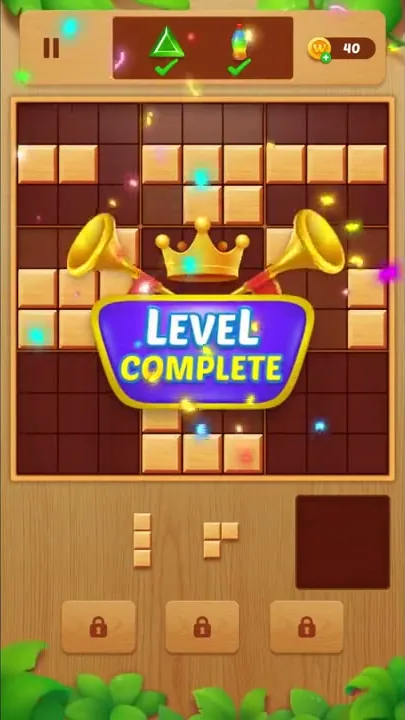
Pieces wait in a tray below the board, up to three at a time, and you drag them onto the grid one by one. When the tray runs empty, a new set appears. The shapes are plain wood with nothing printed on them: single blocks, straight bars of several lengths in horizontal and vertical versions, 2x2 squares, corner and L shapes, T shapes and an S shape. The pause button is tucked into the upper left corner, and under the tray sit three wooden buttons with padlocks, with an empty dark square off to the tray’s right.
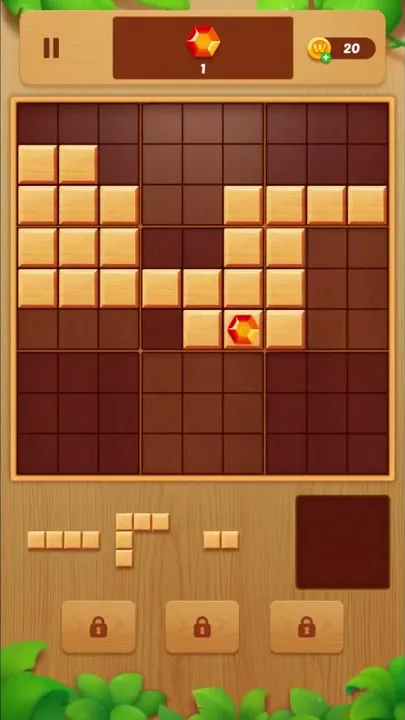
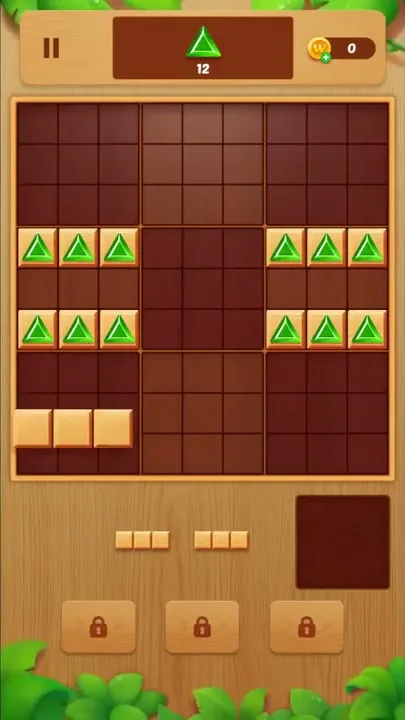
The board is a 9x9 grid of reddish-brown wooden cells, split into nine 3x3 squares in alternating dark and light shades, with leafy foliage along the top and bottom of the screen. A completed row breaks into flying splinters, and any goal item in it is collected. In Level 2, the green gems in the middle column are gone by the time the opening banner has cleared, and the counter falls from 12 to 6.
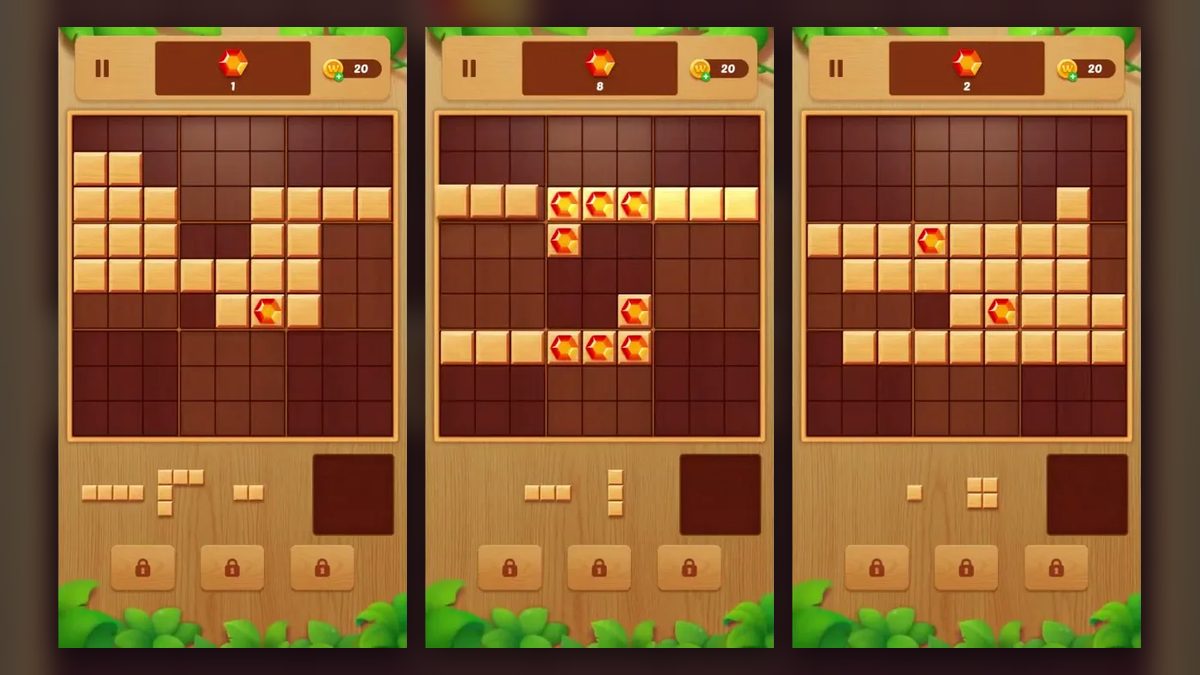
Gems are the first goal item: green triangular ones and red hexagonal ones, each on a wooden tile that fills a single cell. When a gem’s line clears, the gem lifts off the board and its counter drops by one. Early in Level 3, the goal panel asks for 8 red gems, which trace an S-like outline around the middle. The third row is already filled with wood on both sides of its three gems.
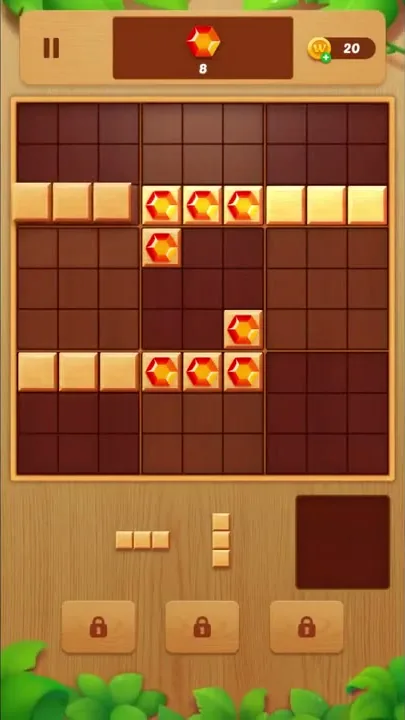
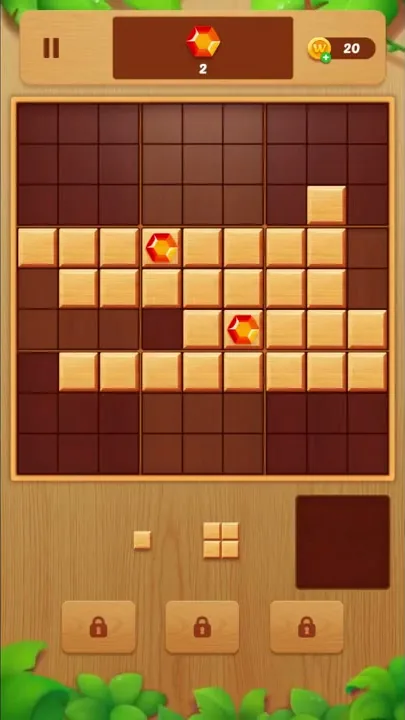
That row and the seventh, which holds three more red gems, are both gone shortly after, and the counter falls from 8 to 2. The last two take longer. One sits in the fourth row, which ends up one cell short while the tray offers a single block and a 2x2 square; once that row fills, its gem goes too. The final gem, in the sixth row, stays put while wood crowds the upper two-thirds of the board, and the level ends only when that gem clears.
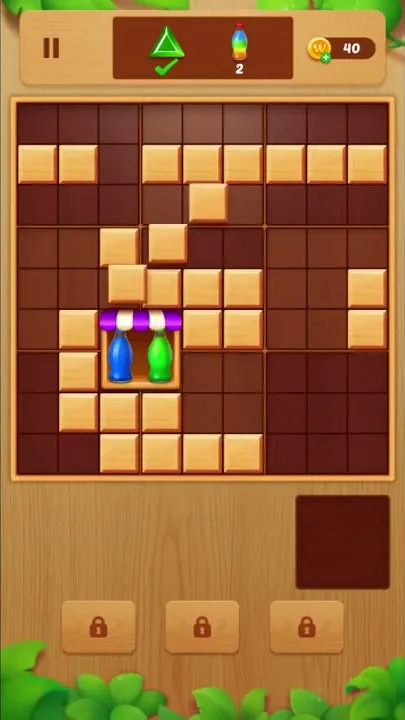
The soda stand is a 2x2 block under a purple-and-white striped awning, with an orange bottle standing between a blue one and a green one. The goal counts bottles, not the stand. The bottles leave one at a time; the orange one rises out of the stand while wood nearby splinters, and the stand keeps its place on the board as long as any bottle remains inside.
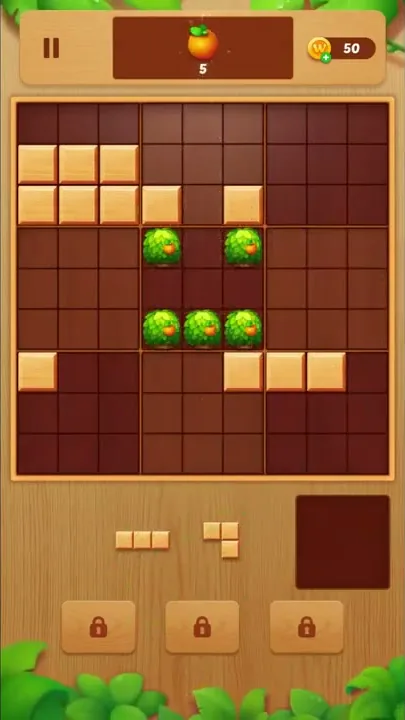
Fruit bushes are single-cell green shrubs, each showing two oranges, and they give up their fruit in stages. In Level 6, once the wood in the row between them and in the square to their right had cleared, all five bushes were down to one orange each and the goal had dropped from 10 to 5. When the row holding three of the bushes emptied, those three vanished and the count fell to 2.
From split gem rows to fruit bushes
A wooden banner across the dimmed board opens Level 2 and Level 6, showing the level number and the goal item with its count. The early boards stick to gems and a single goal each, and what changes from one to the next is where the gems sit and, in Level 3, their color.
The first board splits two rows of green gems with a three-cell gap in each. Level 2 runs green gems down the middle column and along a row, and Level 3 bends red gems into an S-like outline. The first board and Level 2 are each cleared within about ten seconds, while the red S takes about a minute.
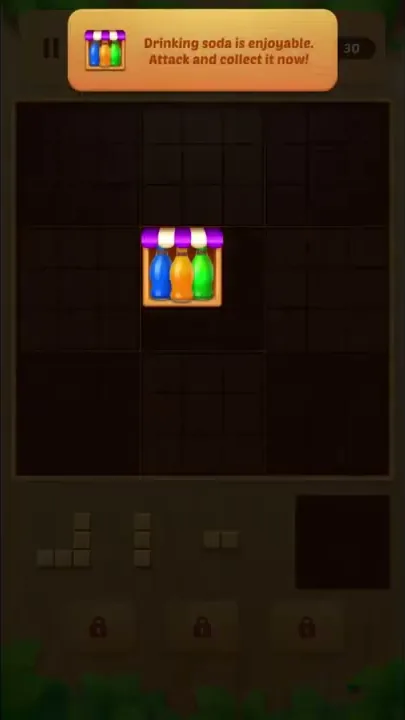
Then the goal items change. The soda stand appears in Level 4 as the only object on an empty board, picked out by a spotlight while the rest dims and an orange bubble at the top reads “Drinking soda is enjoyable. Attack and collect it now!” The level itself is short, wrapping up soon after the wood around the stand starts to break.
Level 5 is the first to combine goals, asking for 2 green gems and 3 soda bottles at once. The stand also moves off-center to sit where four of the 3x3 squares meet, with the two gems placed diagonally in the upper middle of the board. The gem goal gets its check first, and the bottles follow one by one, orange first and green last.
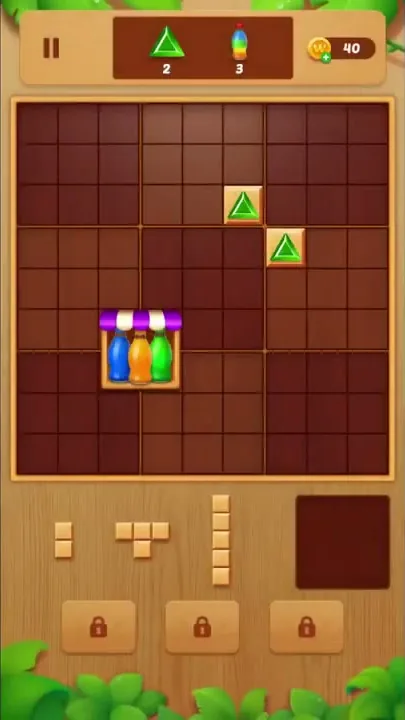
After a stop on the level map, Level 6 swaps in fruit bushes: five of them in the center square, two in one row and three side by side two rows below, each carrying two oranges for a goal of 10.
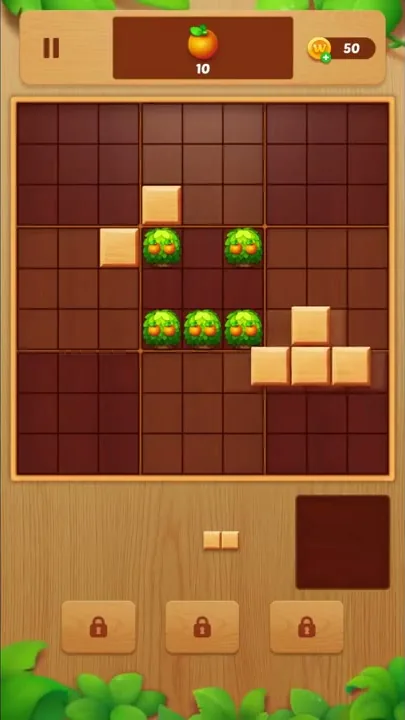
Twice the grid got heavily packed: around the last red gem in Level 3 and around the remaining bushes late in Level 6. No level was lost either time.
Outside the boards, coins are the currency on display. A gold “W” coin counter with a small green plus occupies the upper right of each level screen and climbs by 10 each time a level is cleared. After Level 2, an “Excellent!” panel topped with yellow flowers shows the finished goal and the rewards, +10 coins and +1 pink gem, above a green “Claim” button and a gray button with a play icon and +140 coins.
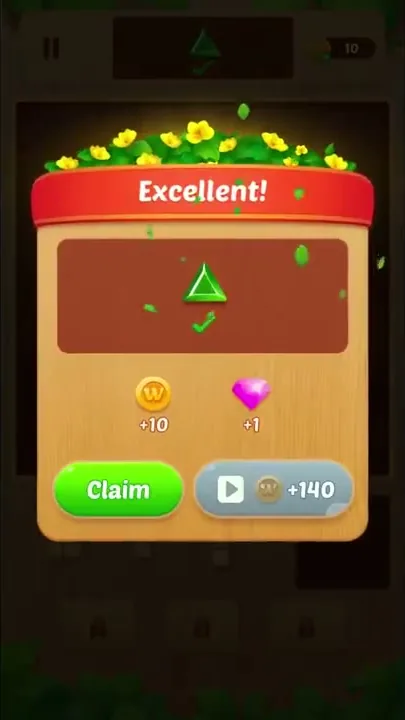
Pink gems show up only as that reward, and the level screen has no counter for them. The play-icon button is the only ad-related element in sight; no banner or interstitial ad came up during play.
Before Level 6 came a bright cartoon garden map, unlike the wooden boards, with a river spilling over a waterfall among flowers and rocks. Numbered orange nodes climb a path toward gray ones with padlocks, and a big green “LEVEL 6” button starts the next level. Beside node 5, a pink-and-gold chest opened with “+10” and a “W” coin rising out of it.
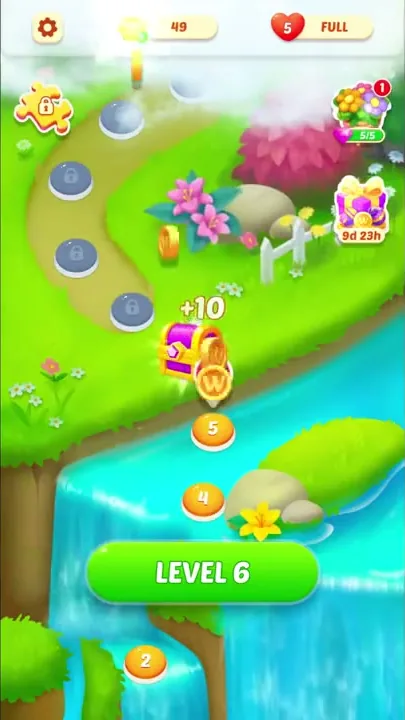
The edges of the map hold more icons. In the upper right corner, a red heart showing 5 and the word “FULL” tracks lives, with a flower bouquet icon below it carrying a red badge and a green bar. A purple gift box with a gold ribbon on the right side shows a timer in days and hours, while the upper left corner holds a gear button and a yellow puzzle-piece icon with a padlock.
Set layouts instead of gem-stamped pieces
Block Crush is truly made with care. Many attempts to give block puzzles more weight fall short, often not because the idea was wrong but possibly because it was never carried all the way through. This one is carried through, with each goal item set out in its own board layout and leaving the grid in its own way.
That care starts with where the goals live. The fairly simple route would be to stamp gems onto the pieces in the tray, but here the pieces stay plain wood and every goal is set into the board in a deliberate pattern. The first board splits its green gems into two broken rows, and Level 3 bends its red ones into an S. Level 5 parks the soda stand where four 3x3 squares meet, and Level 6 gathers its bushes in the center square.
The level animations get the same attention. Cleared wood bursts into splinters, a collected gem floats up off the board, a bottle rises out of the stand, and each finished level gets its crown-and-trumpets badge. When the soda stand first appears, the board dims around it under a spotlight with a short line of text.
The goals also have a little of the style of Royal Match, the castle-restoring match-3: item icons with counters, and bottles and oranges collected from objects on the board. It is the first Royal Match-like block puzzle to reach us, which puts Block Crush loosely among games like Royal Match.
Padlocked buttons and other unopened corners
Nothing in Block Crush drew a complaint. Some parts simply stayed out of reach. The three padlocked buttons under the tray never opened, and on the map the puzzle-piece icon kept its padlock while the gift box and the bouquet went unopened.
Pink gems arrive as a win reward with nothing showing what they are for. No fail screen ever appeared, so what happens when no piece fits remains unknown, and nothing beyond the sixth level came up.
Clearing lines with a checklist on top
The moves are the ones any wooden block grid uses: drag a shape over and drop it to fill a line. The difference is a target: the goal items sit in fixed spots, such as the row holding the last red gem or a row with a fruit bush, and the panel at the top counts them down to a green check. That fits a taste for aiming at something specific on the board rather than clearing wherever space allows, and for a map of numbered levels to work through.
Verdict
Block Crush works the goal-and-counter structure into a block puzzle at every step, from the way each board is laid out to the animation as each item leaves it. It is a good, carefully made game, and the most fully formed take on this blend that has reached us so far.