Block Mage Review: Tetris Shapes Versus Marching Monsters
Block Mage review: Tetris-style pieces from a four-slot tray land on rows of cartoon monsters that step one row closer every round.
Game at a glance
Block Mage
7.5/ 10
Our score
Another Tetris game riding the movie buzz. Call it a Tetris revival, sort of.
In this article6 sections
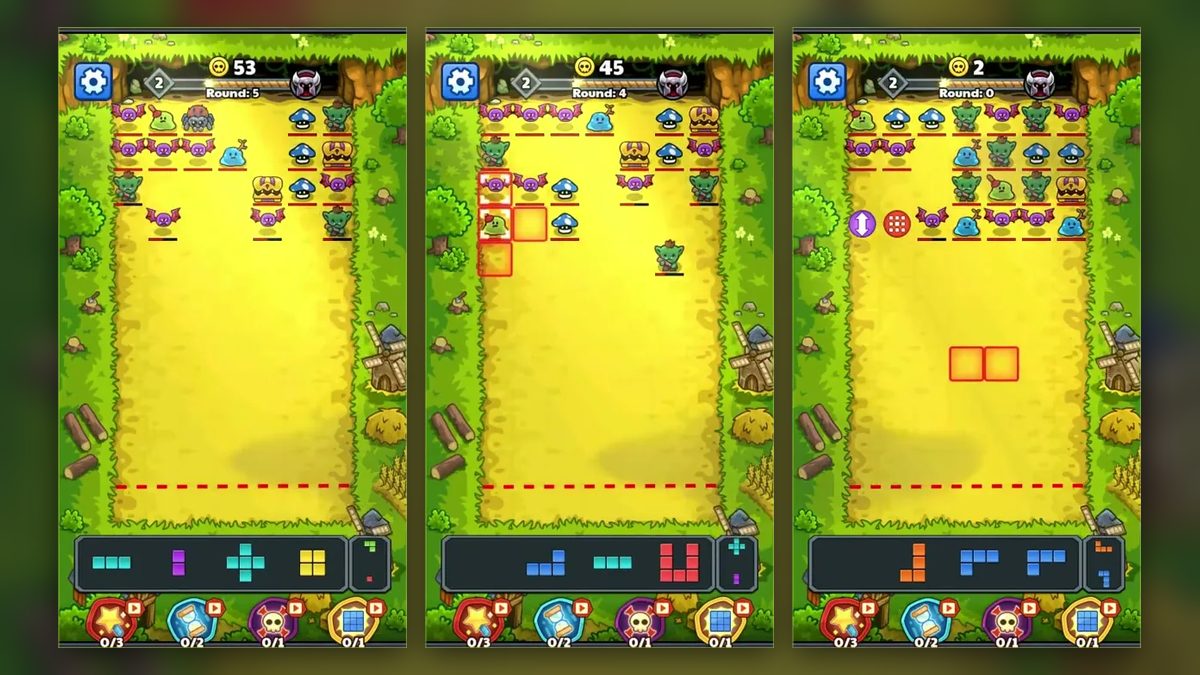
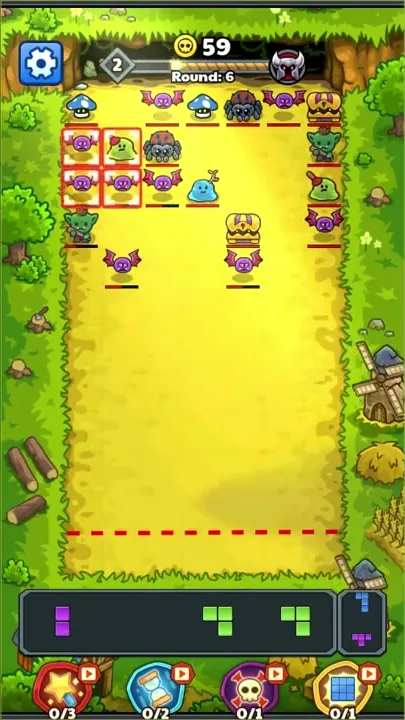
In Round 4 of Block Mage, a piece’s red outline hangs over a purple bat and a green slime at the left edge of the formation. We set it down. Both monsters vanish as coins fly to the counter, and the number in the diamond at the top left drops to 0. Moments later the formation slides a row down the sand, and the run’s first gray spider stands in the new top row.
Block Mage sits among the block puzzle games but sets the shapes of Tetris, the line-clearing classic, against portrait tower defense: monsters step down from the top, and pieces from a tray clear them away. The single run we played went from Round 0 to Round 17 with no level number and no end screen. The draw is a rule set that plays like both Tetris and a block puzzle.
Tray pieces against a stepping monster formation
The field is a strip of yellow sand seven columns wide, framed by grass and trees, with logs on the left and a windmill and hay bales on the right. Chunky 2D cartoon monsters fill its top rows, and a red dashed line crosses the sand just above the tray. Covering monsters with pieces removes them. There is no goal card: the top bar has a thin bar with a “Round:” counter beneath it and a horned, red-eyed monster head at its right end.
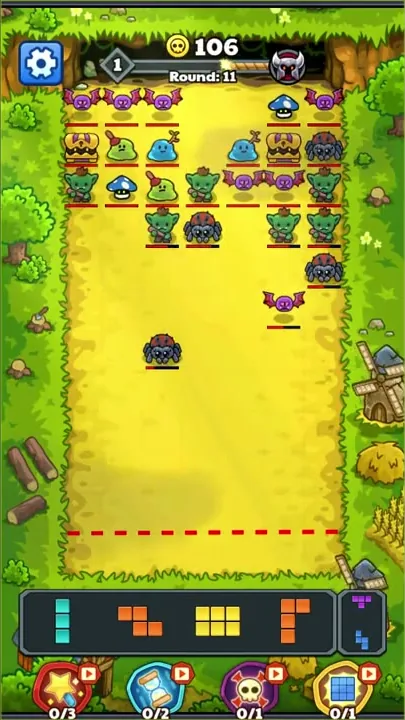
A number in a diamond at the top left falls as pieces go down, and a round usually starts with it at 3. Each time it hits 0, the round number goes up by one and the whole formation shifts down a row, while a fresh row grows in at the top from small sprites to full size. Over the run the lowest monsters got only a little past the middle of the field, and no fail or game-over screen appeared.
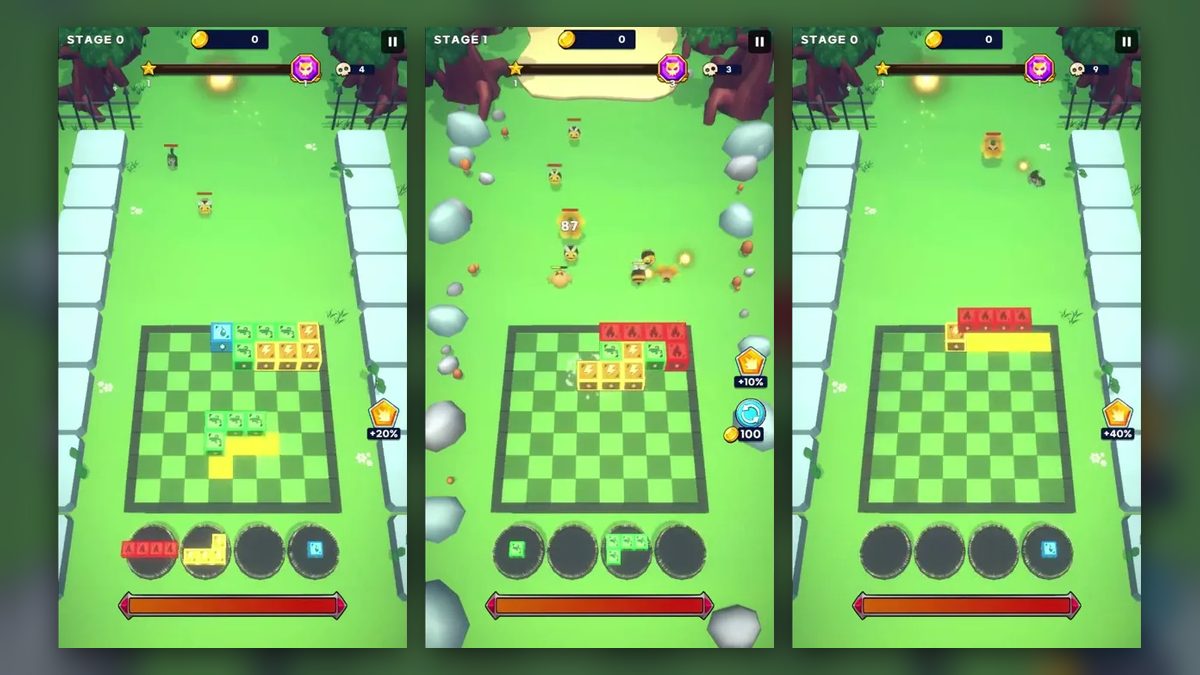
Pieces sit in a four-slot tray under the field. Moving one out empties its slot and puts red-outlined squares on the cells it will cover, whether those hold monsters or bare sand. No piece is seen being rotated.
The pieces are colored purple, blue, orange, cyan, green, yellow and red. Shapes include a two-block piece, straight lines, T, L and S shapes, a 2x2 square, a 3x2 block, a five-block plus and U shapes. A small box at the tray’s right end shows two more small shapes, and the tray is full again shortly after a piece leaves it.
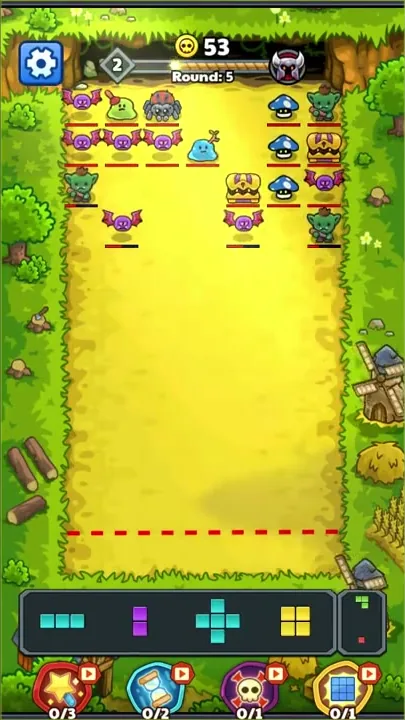
Block Mage gameplay comes down to one move, repeated. A piece goes over a group of monsters, and after it lands, monsters under it disappear, with coins popping out of their cells toward the counter; how many hits each monster takes is never shown. The piece shows its own color for a moment, then turns to gray stone that cracks apart with white sparks. After a few placements the formation steps down, and play continues on the formation while new rows arrive.
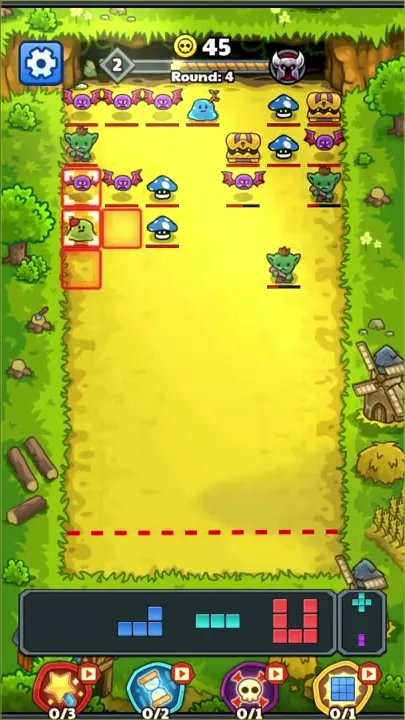
The monsters include green slimes with a red tuft, blue mushrooms, purple bats, green goblins and light-blue slimes with a small mark above the head. Each stands over a short bar, red under most of them and dark or partly dark under a few.
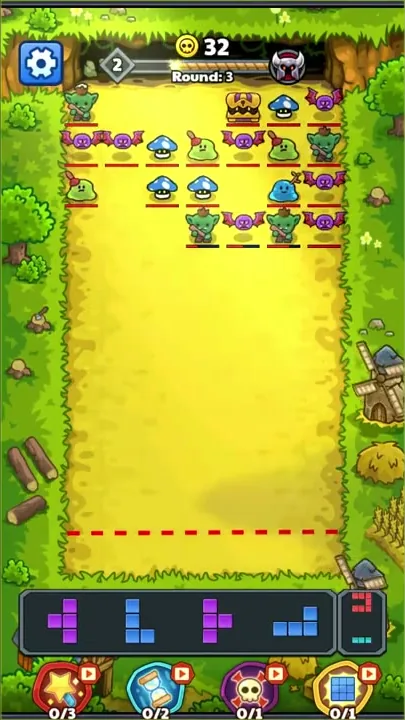
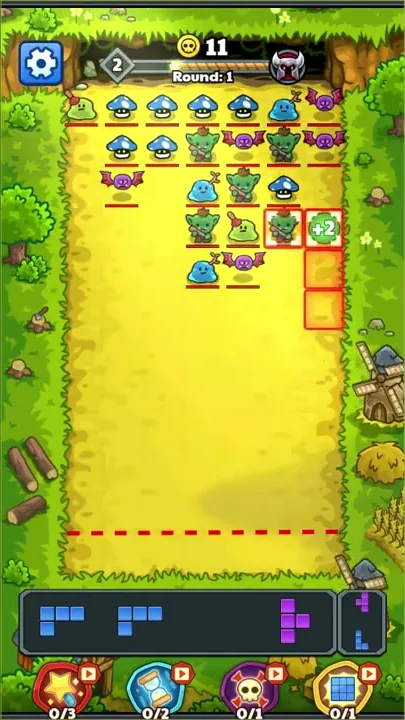
Gold treasure chests with teeth stand in the formation like any other monster, and some leave a token in their cell once gone. A chest on the right gave way to a green +2, and a later one in the left column to a pale up-down arrow.
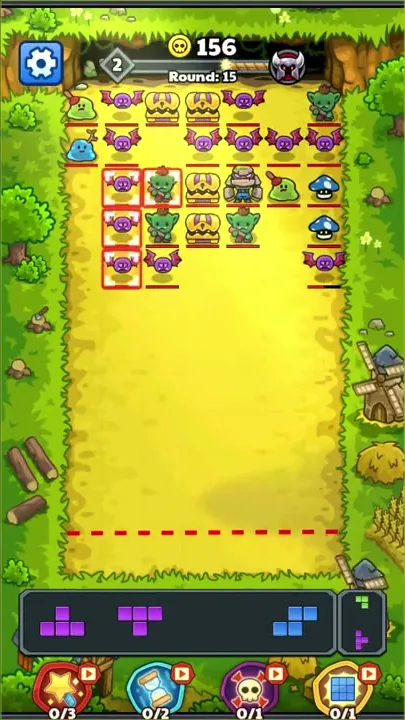
The +2 token is a green circle printed with “+2” that fills one cell of the formation. A piece’s outline can be laid over it along with the monsters beside it. In Round 15 a +2 next to a spider disappeared, and the diamond number rose from 1 to 2 without a new round starting.
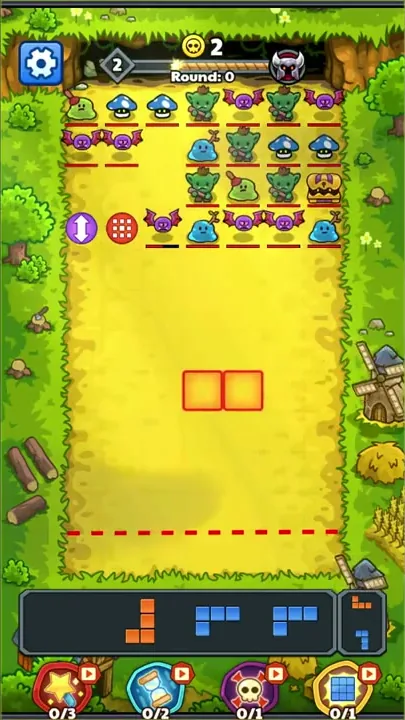
Early in Round 0, two more tokens sit at the left end of the fourth row: a purple circle with a white up-down arrow and a red circle with a grid pattern. Later, after the pale up-down arrow appears in the leftmost column, that column holds no monsters at all by early Round 13.
A green +2 circle sits at the right end of the fourth row as Round 1 begins, with the diamond at 3 and the arrow and grid tokens moved down to the fifth row. An L-shaped piece goes over both tokens and the bat beside them, after which the diamond reads 2 and both tokens are gone. The leftmost column is now empty below its top row. The next piece covers the +2 and a goblin, and once the +2 has vanished the diamond is back at 3, still in Round 1.
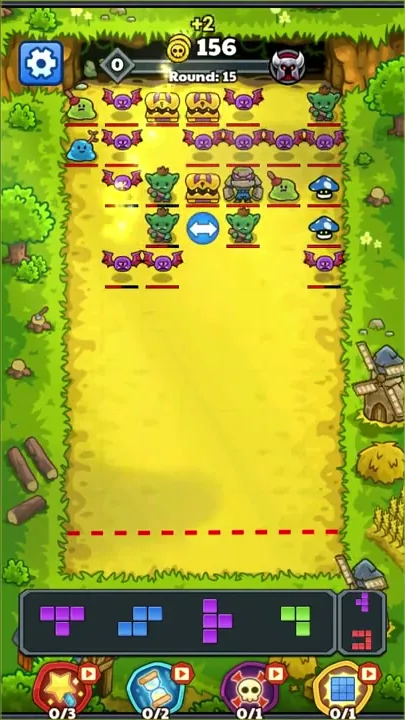
Another token, a blue circle with a white left-right arrow, turns up in Round 15 where a gold chest stood a moment before, with a goblin on each side. Like the other tokens, it takes up a full cell of the formation.
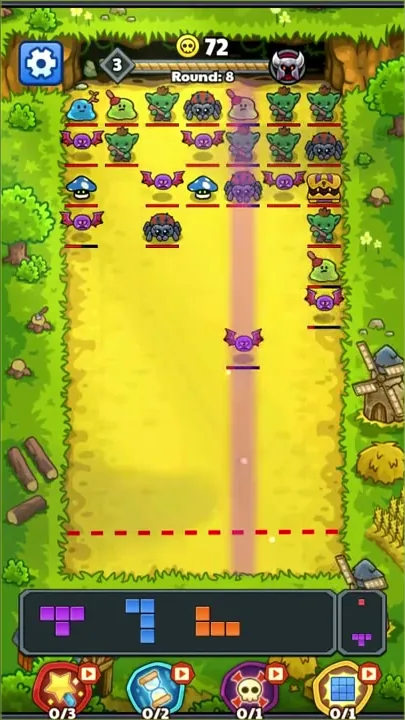
In Round 8 a pink beam runs the full height of one column, and the monsters near its top turn faint. Shortly after, that column is empty apart from a single spider. A gold chest had stood in it just before the beam appeared.
Spiders and armor join a thicker formation
New monster types join as the rounds climb. A gray spider with red markings appears in the top row in Round 5, the first newcomer after five rounds of the starting cast. By the next round there are two, and spiders are on the field most of the time after that.
Much later, a gray, helmeted armored monster steps into the top row in Round 13. It keeps to its column for the rest of the run, one row lower each round, and is still standing in Round 17.
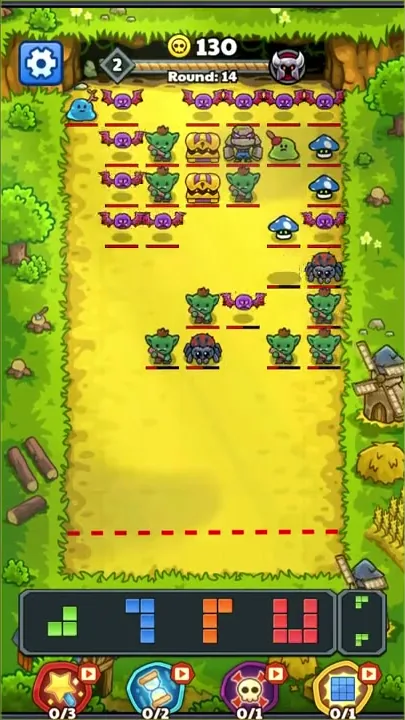
The formation itself grows. The monsters fill the top four rows in Round 0; by Round 17 they fill the top five, with a bat further down. Gold chests bunch together as a 2x2 block in the middle columns in Rounds 16 and 17, and by the end two armored monsters share the field.
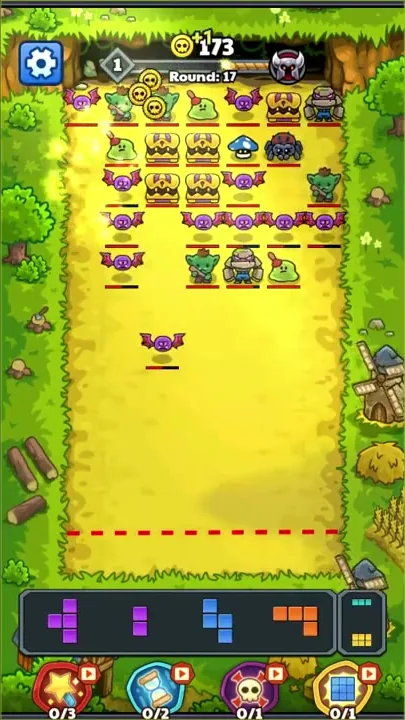
Coins are the one currency on screen. The gold counter at the top center climbs as coin icons fly up from defeated monsters, sometimes with a small “+1” or “+2” above it, but nothing is bought with coins in the run.
Four round booster buttons sit under the tray: a star on red, an hourglass on blue, a skull on purple and a blue grid with a gold border. Each wears a small red play-button badge. The star’s label reads “0/3” and the hourglass’s “0/2”, while the skull and the grid read “0/1”; the labels never change, and none of the buttons is used.
A blue gear button at the top left is never opened. No ad or shop appears at any point, and no offer or reward screen ever pulls the screen off the play field; lives are not shown either.
Tetris shapes, block-puzzle placement
The rule design is the highlight, and the tray shows both of its parents. Many of the shapes are Tetris pieces, such as the T and the L. How they are used comes from block puzzles: any piece is picked from the tray and set down anywhere on the grid, the same rule behind games like block blast. Shapes Tetris never had also turn up, the 3x2 block and the five-block plus among them.
Block Mage also belongs to a wave of games that pair Tetris, a casual mechanic, tightly with mid-core progression and combat dressing. On this field the combat dressing is plain to see: pieces land on monsters that stand over short bars, and the defeated ones burst into coins for the counter. We’d count it, loosely, as part of a Tetris revival.
Monster defense riding the Tetris movie’s buzz
The one jab is about the movie hype. Block Mage arrives in a run of recent Tetris games that, as we see it, ride the buzz of the Tetris movie.
A few things also stay outside what the run showed. The screen never explains what the diamond number counts or what the tokens do, and the trigger for the pink beam is not shown. No upgrade or character screen appears either, so the mid-core progression side of that formula is not visible here.
Aiming shapes at a crowd that keeps coming
Most of the play is deciding where a shape goes. A piece leaves the tray, its red outline is lined up over a patch of monsters, and it is set down, while the formation refills from the top and edges down a row each round.
Players who know Tetris will recognize the shapes, though no piece falls here: every piece is placed by hand, anywhere on the grid. The defense half is clearing the formation piece by piece while fresh rows grow in above it.
Verdict
Block Mage’s highlight is its rules: Tetris pieces placed the block-puzzle way, here turned on monsters marching down a portrait field. It is one more game leaning on the attention around the Tetris movie, and that is the one knock against it. Still, it ties the casual Tetris mechanic tightly to its combat dressing, which earns it a loose place in a Tetris revival.