What Hill Climb Racing Gets Right About Mobile Game Design
Snow maps that slide, moon gravity and a sequel built on upgrade parts: the mobile game design behind Hill Climb Racing's long run.
Hill Climb Racing looks crude and gives you two buttons and one goal, yet it became one of the most downloaded series in mobile gaming. This long, detailed look at the mobile game design behind it covers the physics that carried the first game and the systems that carried the sequel.
Some background on the series
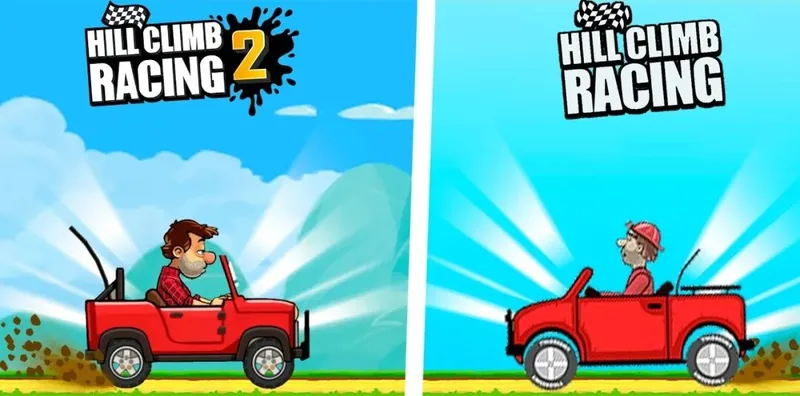
Hill Climb Racing (HCR for short) has two games so far: the original Hill Climb Racing (HCR1) and Hill Climb Racing 2 (HCR2). Both come from the Finnish studio Fingersoft.
HCR1 came out in 2012 and was a hit from launch. In 2018 it became the second Finnish mobile game, after Angry Birds, to reach a download count that very few games ever see.
The sequel, HCR2, followed in 2016. Seven years later it still ranks in the top 10 of the top-grossing racing charts in 31 countries.
The series has now been downloaded billions of times worldwide, and millions of people still play it every day.
Here we look at why HCR managed to succeed twice in a row, and at what each of the two games does especially well that is worth learning from and thinking about.
We started playing HCR1 between 2015 and 2017 and have played HCR2 from 2020 until now: more than 1,000 hours across the series and around 5,000 yuan (roughly $700) spent, which makes us fairly hardcore HCR players.
How the Hill Climb Racing games play
The way it plays is simple enough to grasp at a glance.
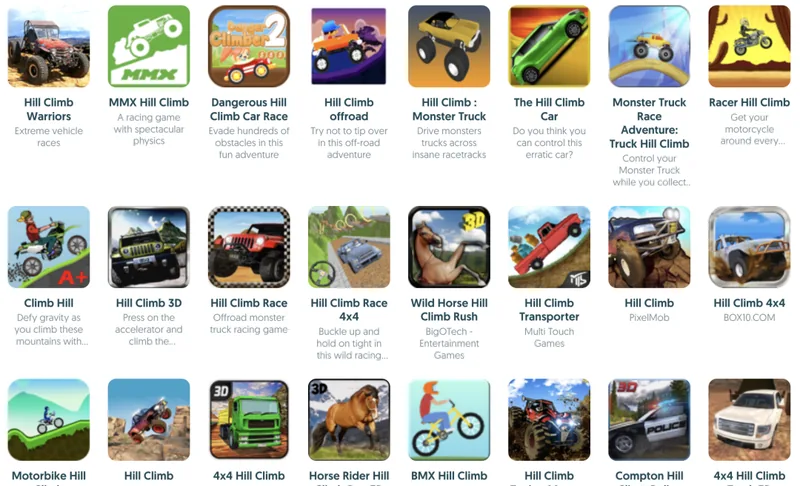
Put briefly, the core gameplay of HCR resembles side-scrolling runners such as Tencent’s endless runner Tiantian Kupao, Ninja Must Die, Ski Safari and Jetpack Joyride: you move from left to right through a side-on course, and the controls and structure follow that model.
1. Controls: the left button is the brake, which slows you down and tips the vehicle back (rotating it counterclockwise); the right button is the gas, which speeds you up and tips the nose down (rotating it clockwise). With just these two buttons, the player keeps the vehicle moving forward, left to right across the screen, for as long as possible over every kind of terrain on the map.
2. How a run ends: driving burns fuel, and the fuel-can icon in the top-left corner shows how much is left. When the tank runs dry, the run is over. It also ends if the driver’s head hits the ground, an obstacle or any other solid object, for whatever reason.
3. The goal: drive as far as possible and collect as many coins as possible. Coins upgrade your vehicle’s stats, so the stats themselves help it go further and post better results. Coins also unlock more maps and more vehicles; each vehicle has different stats and handles differently, and each map has its own obstacles, terrain and physical properties.
So the core controls and goal of HCR rest on very basic, simple rules that almost anyone can pick up, and that is a precondition for the huge number of people who play it every day and for its unusually broad audience.
So how has a series with a crude art style, a single way to play and a flat goal stayed this popular for so long (HCR1 alone was still drawing huge download numbers in 2022)? Its excellent core design and the details of how it plays deserve much of the credit.
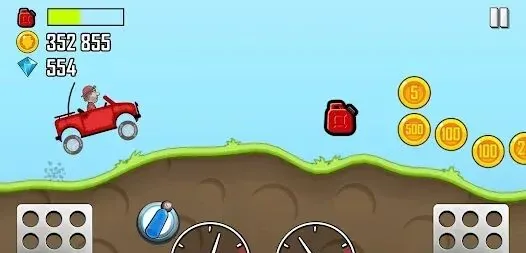
Crude on the surface, careful underneath: the meticulous physics that sets Hill Climb Racing 1 apart
As mentioned, the core rules of HCR are less like a racing game and more like a side-scrolling runner with a racing theme (side-scrolling runner here meaning the left-and-right, two-thumb controls and the high-score rule of “dodge the obstacles and go as far as you can”).
The racing theme brings the kind of control challenge you get in a racing game, plus the thing racing fans love most: tuning up their cars.
Beyond those two essential systems, though, the standout in HCR1 is its fine-grained, carefully judged physics, built around the vehicles and the maps.
1. Physics in the maps
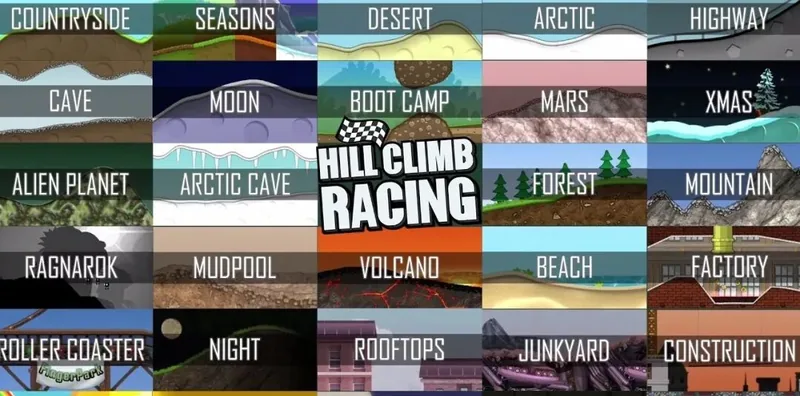
The maps in HCR1 work a bit like the tracks in many racing games: each one has its own look and theme.
But beyond style and terrain, each map in HCR1 also has its own physics. Drag, friction, gravity, and the rise and run of the ground all vary.
Snow maps are more slippery, for example, the moon has lighter gravity, and the highway map has smoother terrain and a less bouncy road surface, and so on.
So even the same vehicle handles and performs differently from one map to the next, and every map has some types of vehicle that suit it and others that are a terrible fit.
Each map also has plenty of deliberately designed signature terrain and choke-point obstacles: the volcano map has lava that melts your vehicle on contact, the cave map squeezes you under a low, cramped ceiling, and so on.
On top of that, very little repeats within a map in the HCR games: you can drive for more than ten minutes and rarely meet terrain or an obstacle you’ve already seen. Many other runners stitch together random chunks of course, so a few minutes in you’ve memorized the layout and could play with your eyes closed. Next to them, HCR is remarkably generous.
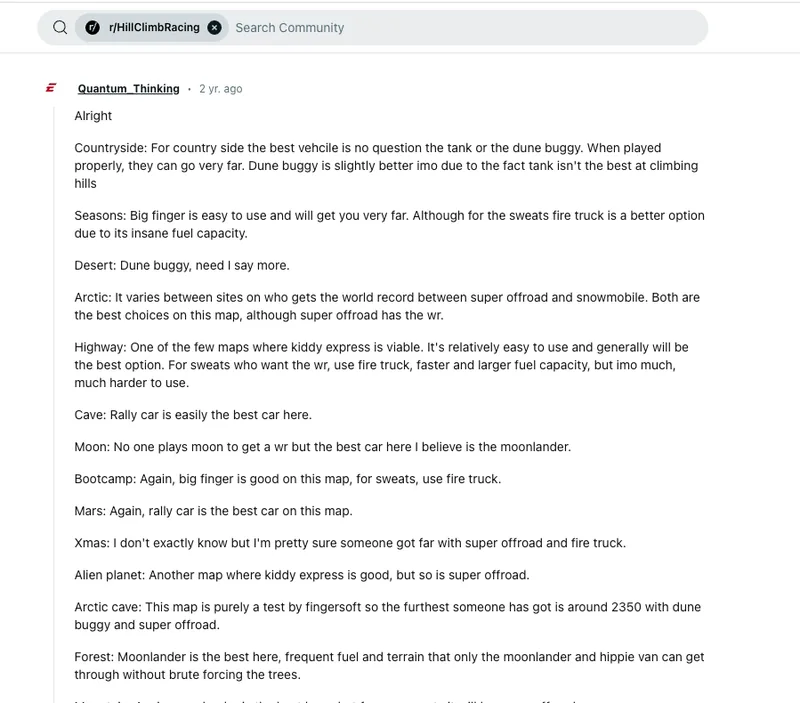
2. Physics in the vehicles
In HCR1, the vehicles differ in more than their looks: their shape and their physical performance differ too, and both have a big effect on how each one handles and what it is like to drive. Many racing games are cautious with their performance numbers, but in HCR1 the stats of different vehicles are worlds apart. Acceleration, torque, top speed, bounce, body stability, drive power, the spin you get off a jump and more are all varied and fun to play with. That makes every vehicle a lively surprise, and it greatly adds to how much each one offers and how long it takes to master.
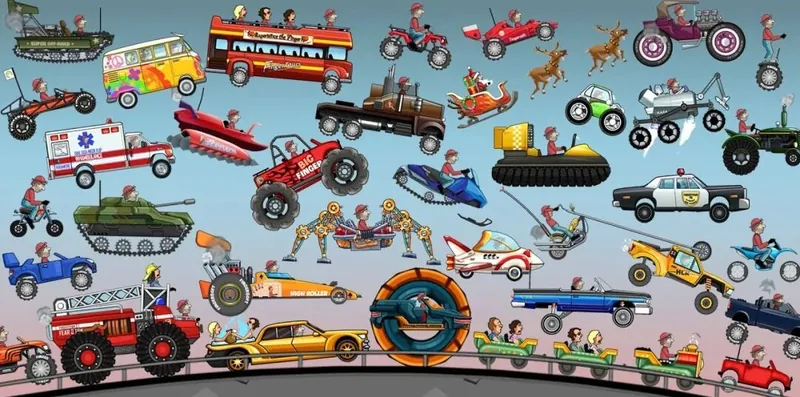
The tank’s tracks roll easily over small bumps; the sports car reaches very high speeds with little effort but is terrible on off-road maps; the snowmobile takes snowy mountains as if they were flat ground; the hovercraft barely sinks in liquid hazards, and so on.
It is fair to say that the detailed design and tuning of each vehicle’s handling in HCR1 is on par with what a professional AAA racing game spends on its cars (and well ahead of the car detail and handling in the KartRider mobile game we’re playing right now). It shows how seriously the developer takes the driving.
3. Vehicles plus maps: a combination full of surprises
Both halves of HCR1, the vehicles and the maps, got a great deal of design work on their traits and properties, and for a game like HCR1, which has nothing but an endless mode, that is crucial.
Every new vehicle you unlock is a whole new way to play.
And because the vehicles are so distinct, even switching to another one on the same map makes driving it feel almost like exploring it for the first time. Add each map’s new terrain, obstacles, gravity and special elements, and the same vehicle needs a completely different driving style, and a different route to a high score, from one map to the next.
With map design this careful and vehicle design this distinctive, every new map or vehicle a player unlocks brings far more surprise than new content in other racing or running games.
That is the secret behind how HCR1, with extremely simple rules and a single mode, drew in an enormous number of players.
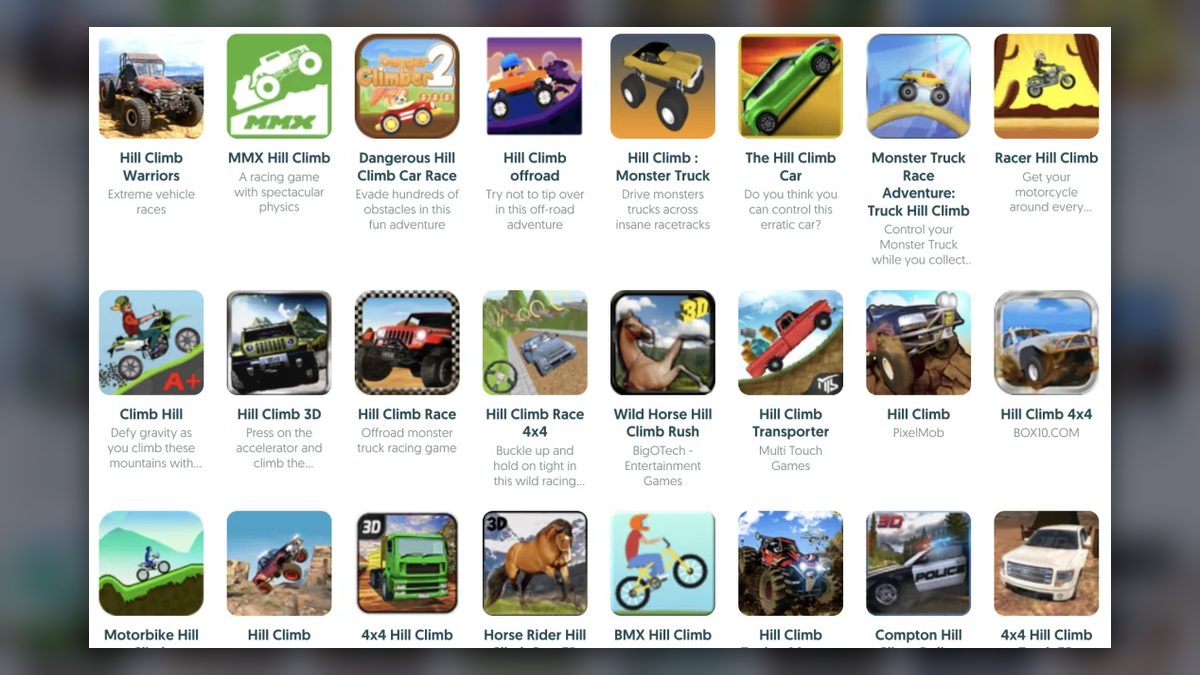
Without exaggeration, there are at least a hundred HCR1 copycats on the market. We’ve tried a few, and most of them win only on graphics. Compare the map design, the physics tuning of the vehicles, or simply how much fun they are once you start playing, and not one of the copies comes close.
Building on its own gameplay: how the modes and upgrade system of Hill Climb Racing 2 brought new growth
As covered earlier, the carefully crafted, finely tuned maps and vehicles of HCR1 gave the series an excellent core and a real edge. On that foundation, the Fingersoft team released the sequel, HCR2, in 2016.
HCR2 keeps the core rules of HCR1 and adds a lot of new game modes and systems for building up your vehicles over time.
1. A tuning system in HCR2 built to make more money
Besides keeping the endless mode and the basic vehicle upgrades, HCR2 has a far more complex progression structure and business model than HCR1.
The main addition is a setup like the one in Supercell’s card battler Clash Royale, built on opening chests and climbing a seasonal ranked ladder. All the main currencies and tuning parts go into chests of different rarities, and players open chests across the various modes, hoping for the vehicles and parts they want.
Players then pick the parts they need in each vehicle’s tuning menu to boost a particular stat.
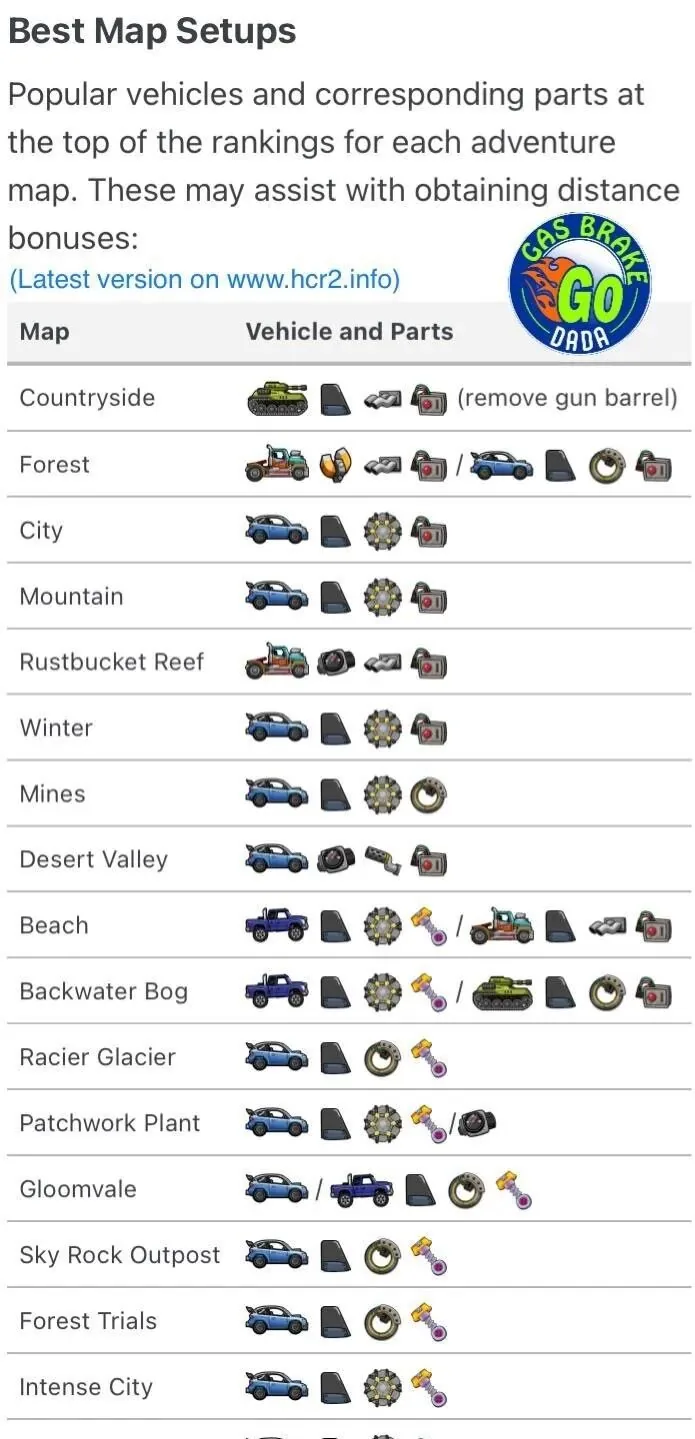
A rear wing keeps the vehicle in the air longer, for example, snow tires add grip, a wheelie boost helps it accelerate on one wheel, and so on. Every vehicle accepts more than 10 kinds of parts, each in different rarities, and players can swap them to suit their own taste or what a map needs.
It is a bit like World of Warcraft: covering the warrior, mage and priest roles used to mean switching between three accounts; now one druid can do it all, and when a different role is needed, you swap gear and talents (the parts) instead of accounts.
Upgrades and tuning along more and finer lines for every vehicle greatly increased how much players can spend in HCR2 and how many ways there are to spend it. Combined with the randomness of parts dropping from chests, that raised the spending ceiling of HCR2 several notches above the first game, which is why HCR2 earns far more per player than HCR1.
But the tuning system in HCR2 also created plenty of balance problems. Because each vehicle can now be tuned in many more ways and much further, players have far less need to build up several vehicles. In HCR2, the best strategy is to use one vehicle, max out all of its parts, and mix and match parts to clear every mode.
That took a toll on the balance between vehicles in HCR2 and on the variety of driving many different vehicles, one of the things that made the series special.
As a result, building up several vehicles means less to players and is worth less to them.
But the extra revenue was simply too good to give up, so Fingersoft did not go back to the HCR1 approach and rebalance the vehicles.
Instead, it kept the parts-tuning system as it was and tackled the problem by adding new game modes that give players an extra need for more than one vehicle.
2. Team mode: team pride as a push to build up more vehicles
As mentioned, the first game has a single mode, while the sequel has four.
Endless mode plays just like the first game, while Cup mode is the main track: it drives how far players build up a single vehicle, and it is where the chests come from.
Team mode and Event mode, on the other hand, exist specifically to make players need more vehicles.
In these two modes, the strong social and competitive pull of team-versus-team (GVG) and player-versus-player (PVP) play gives players extra pride when they win and extra pressure not to lose.
Each mode asks players to enter a specific vehicle in a specific challenge, so anyone who wants a high score has to upgrade whichever vehicle each event calls for.
Team mode uses team pride and outside pressure to push players into upgrading several vehicles. Two teams are matched against each other, and every player on both teams has to enter the mode’s set challenges with various vehicles and score high (the more vehicles you have and the more they’re upgraded, the easier that gets). Then the two teams face off, with big rewards at stake.
So unless you are happy to be a “lone wolf” coasting along on your own, joining a team means building up and upgrading several vehicles.
3. Event mode: showing off what is special and fun about each vehicle to draw players into building up more of them
Event mode, meanwhile, highlights what is distinctive about the game. Each event has one theme, and players compete on their own for high scores on a PVP leaderboard. The themes tend to be over the top and goofy: everyone racing moon rovers, everyone racing with unlimited boost, everyone playing soccer, delivery races and more.
Event mode stretches and amplifies what is special about the game’s vehicles and maps, and it tells players “this is a fun way to play.” It relies on relatively mild pride and competitive pressure and leans more on a relaxed, casual format to encourage players to build up more vehicles. The feeling it leaves is “this special mode is especially fun with this vehicle.”
Put together: HCR2 moved away from the painstaking attention HCR1 paid to map and vehicle detail. It turned instead to a tuning system that deepens how far a single vehicle can be built up, which raises spending, and to Team mode and Event mode, which create demand for building up and tuning several vehicles. That is a studio standing on its own shoulders to design something new.
And the success of each Hill Climb Racing game shows that players and the market both embraced each of these two design approaches.
A last word
The success of Hill Climb Racing 1 and 2 is a win for great core gameplay and a win for great systems design. But great systems design really needs a great core to stand on and support it, and its job is to round out what players want around that core and draw out the needs within it.
You could say HCR1 pared its core gameplay down to the essentials, while HCR2 refined and dressed up that foundation with excellent systems design. The two hits each show a different design approach done well, and both are worth studying closely and thinking over.
The end
References
“The five-year journey of Hill Climb 2 and how Fingersoft is already prepping for a third”; “Hill Climb Racing series surpasses €180 million in lifetime revenue on mobile”
Running a Profitable Game with Organic Installs for 7 years
Thanks for reading.