Tile Match Tanghulu: Triple Matches on Candy Skewers
A tile match tanghulu game strings colored pieces on skewers like candied fruit; take them one at a time from either end and match three.
In this article3 sections
Following the method for game innovation laid out earlier on this site, this series regularly picks out well-made new ideas on the market, so the method is easier to grasp through real examples. Today’s pick is a tile match tanghulu game.
The combination this time: Tile Match + tanghulu (tanghulu is candied fruit threaded on a stick, a classic Chinese street snack).
How the game works
First, a screenshot of a level:
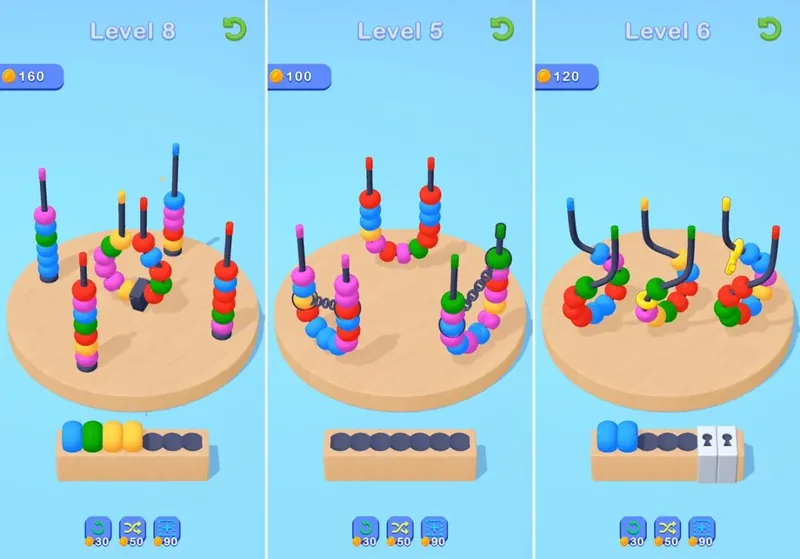
Here is how it plays:
- It’s a new spin on tile match games, and the core goal is still matching three of a kind. The difference is that the pieces to clear at the top of the screen are strung on skewers, like tanghulu.
- Matches are made by color. Pieces can be taken from either end of a skewer, but only one at a time.
- The game controls difficulty in several ways:
- The game offers three boosters:
And another level in play:
Picking Beads Off Bent Wires
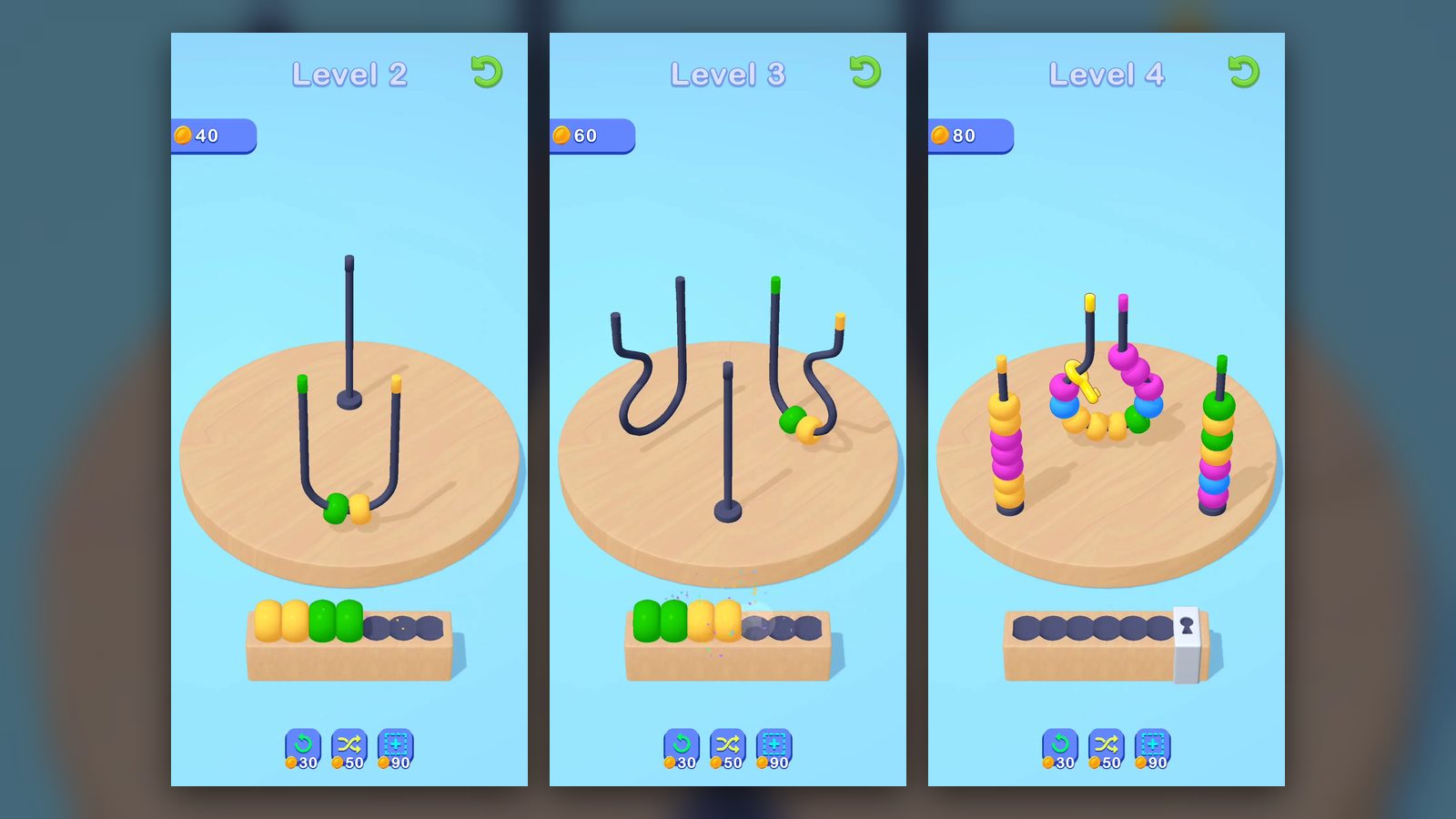
Play takes place in a 3D scene: a round, light wooden board on a plain light-blue background, seen from a fixed camera angled down from above. Dark navy wires and rods stand on the board with glossy beads threaded along them, and a wooden tray with seven dark round slots sits underneath. The level label is at the top center, with a green circular-arrow button at the top right. We cleared the Tutorial and Levels 1 to 8 and reached the start of Level 9.
The only control is tapping. The Tutorial opens on a single U-shaped wire with both ends pointing up and beads strung around its bend and partway up both arms. A hand pointer marks the top of its left end while the hint “Tap to pick a bead” is shown. Each tap takes one bead: the outermost bead at the tapped end slides off and flies down into the tray, leaving a pale trail.
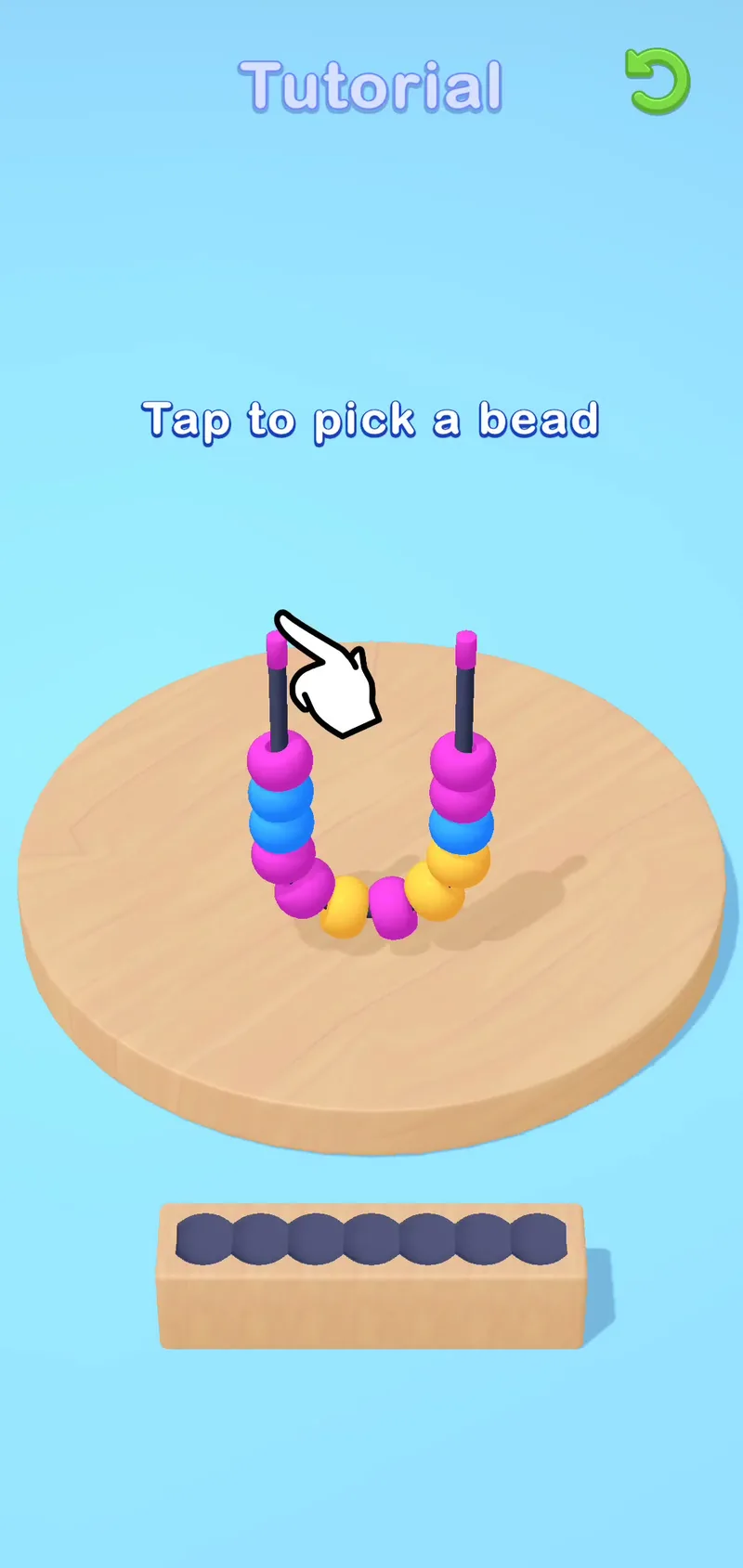
The Tutorial’s beads are magenta, blue and yellow. The next hint reads “Match 3” as three magenta beads side by side in the tray burst into confetti and leave it. Three blue beads clear the same way a few seconds later, and soon only two yellow beads are left at the bottom of the wire.
Level 1 widens the board to two U-shaped wires side by side, all four ends pointing up. As the level begins, magenta, yellow and blue beads fall from above onto the empty wires and fill both arms of each. Any open end can be tapped, including both ends of one wire: a yellow bead leaves the left end of the left wire, and a few seconds later another yellow bead leaves the right end of the same wire. Beads left on a curved wire settle toward the bottom of the bend.
Level 1 also adds a coin counter at the top left, showing 20. It goes up by 20 with each new level, reading 40 in Level 2, 100 in Level 5 and 180 in Level 9. Three booster buttons sit in a row below the tray, each with a coin price: a green circular-arrow icon for 30, yellow crossed arrows for 50 and a dashed square with a plus for 90.
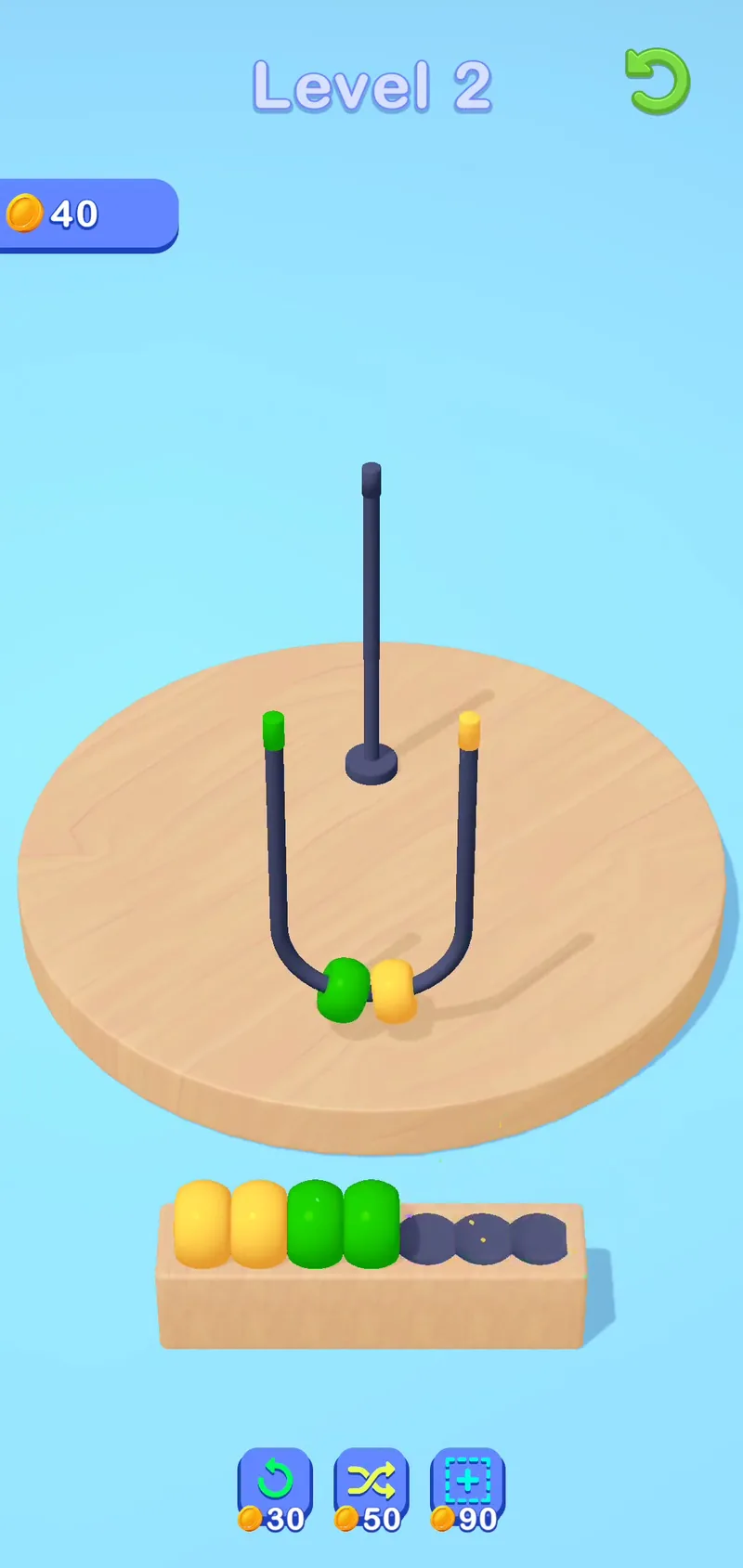
Level 2 brings the first straight rod, standing on a round base behind a U-shaped wire. Rods like this are open only at the top, so their beads come off from the top down. Green beads join blue, magenta and yellow here. In one moment, a gap stays open in the tray right after two blue beads while a third blue bead is still in the air.
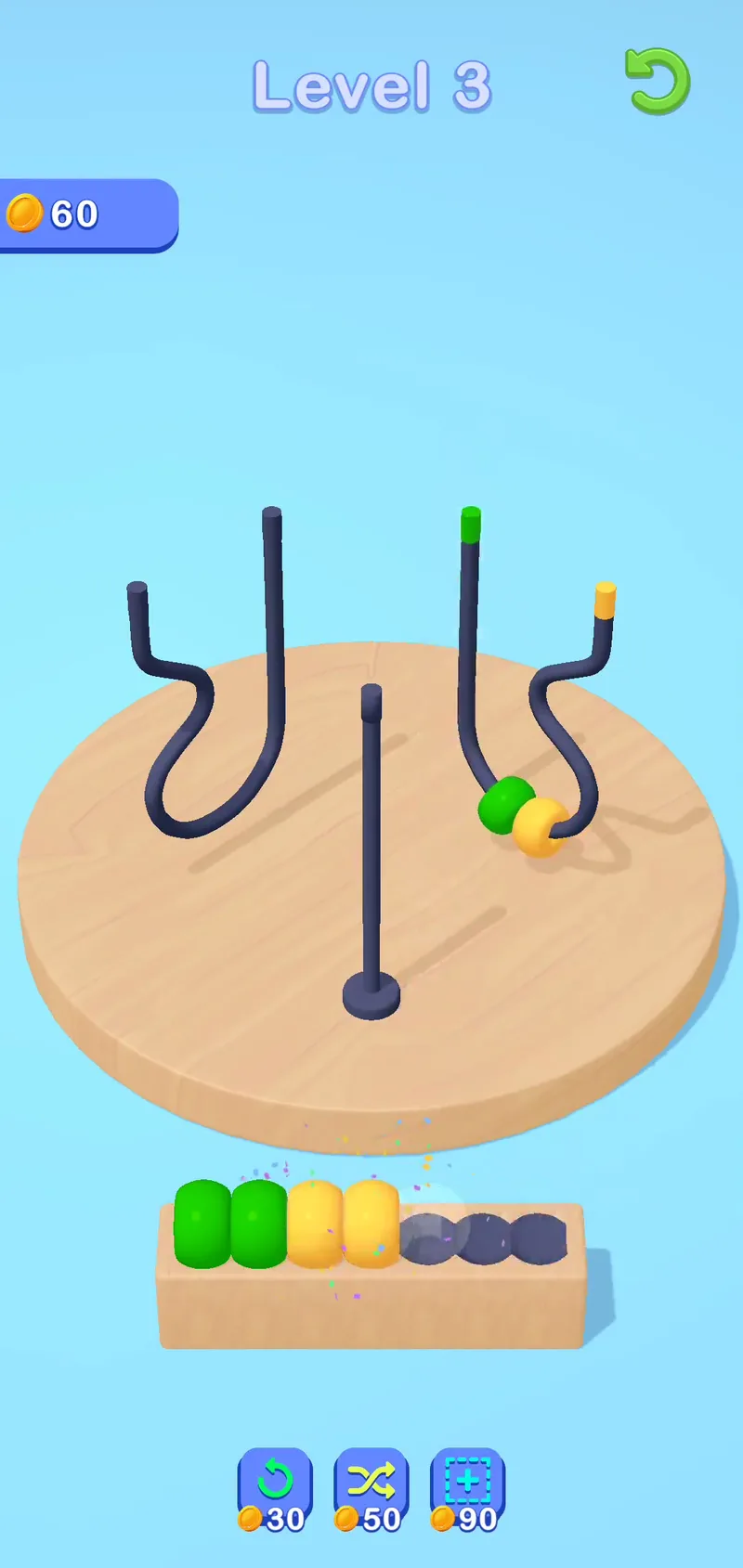
Level 3 bends its two side wires into hooks, each with one end curled outward and the other straight, on either side of a straight center rod. Its beads are yellow, green and blue.
Every open end of a wire or rod has a cap in the color of the bead that will come off there next. An end with nothing left shows a dark gray cap. In one Level 3 moment, the left wire and the center rod have gray caps, while the right wire’s caps are green and yellow, matching the beads at its ends.
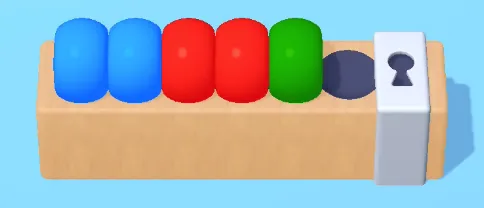
Level 4 puts a straight rod at the left and another at the right, with a teardrop-shaped loop wire between them, both of its ends pointing up. The tray shows six open slots, and the seventh is covered by a white block with a keyhole. A yellow key sits on the loop wire like a bead, and the cap at an end turns yellow when a key is the next piece there.
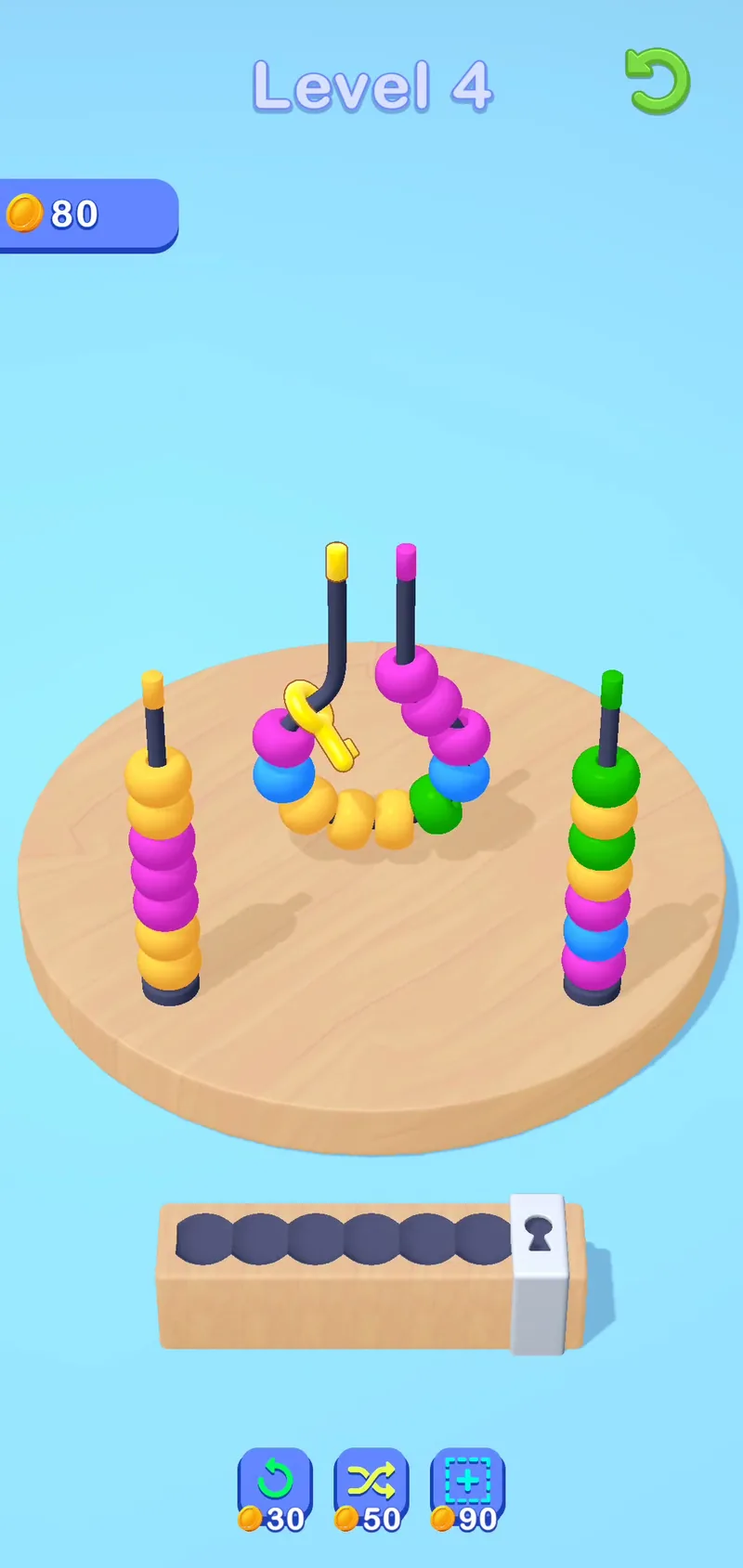
Taking a key sends it to a lock, and that lock disappears. In Level 4 the key is the last piece taken, and it lands on the lock as the board empties.
Level 5 sets out three U-shaped wires, at the left, back center and right, and all seven tray slots are open. Red beads appear for the first time, making five colors with blue, magenta, yellow and green. The left and right wires each carry a metal chain linking a bead on one arm to a bead on the other arm. Chained beads are ringed with a dark outline, and an end cap gets the same outline when a chained bead is next at that end.
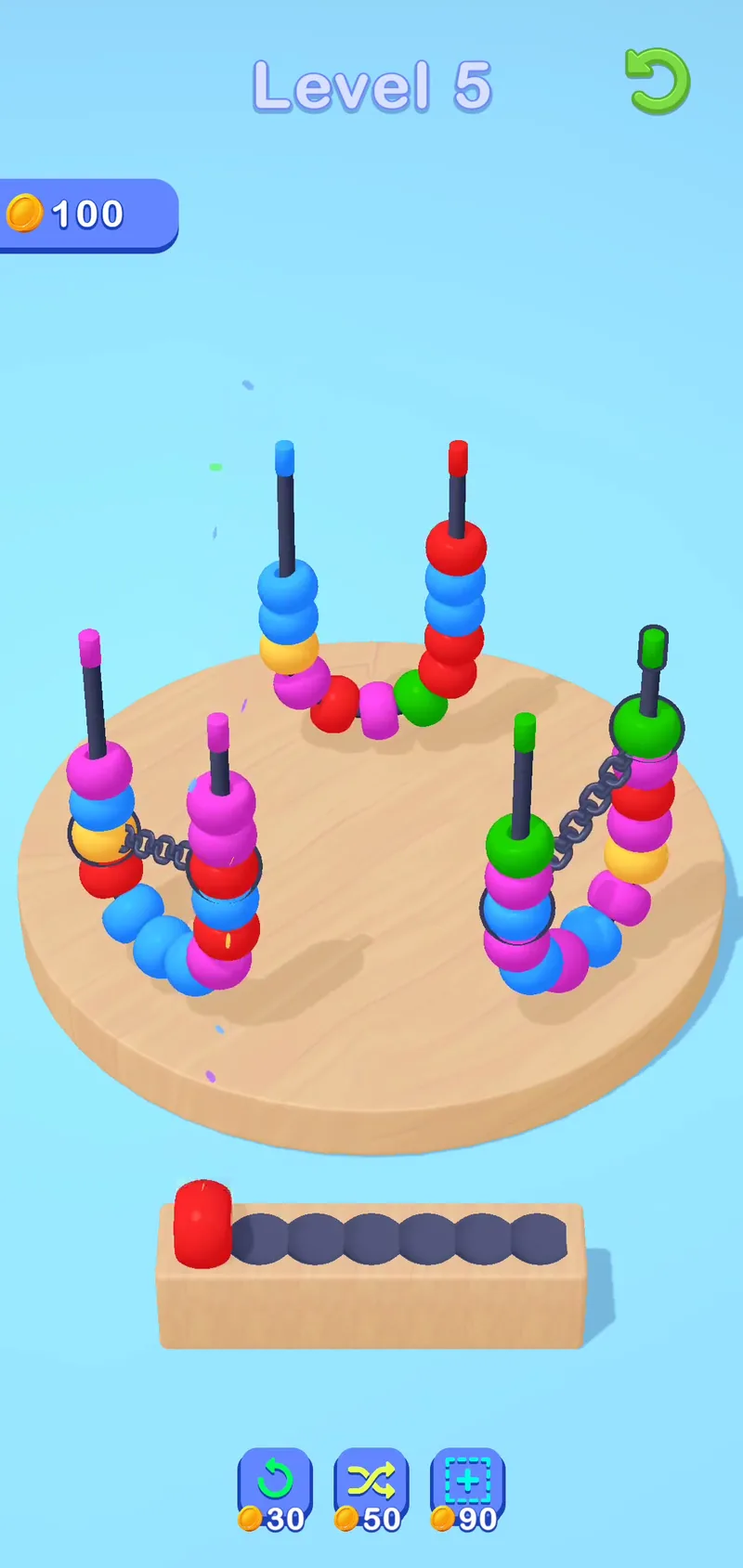
The right wire’s chain is gone after its chained green bead, at the end of the wire, has been taken. The left wire’s chain stays in place until late in the level. In another moment, a gap stays open in the tray after two red beads as another red bead flies in.
Level 6 lines up three wires, each bent so it crosses over itself in a loop, with both ends pointing up. Two tray slots are locked, leaving five open, and two keys sit among the beads, one on the middle wire and one on the right wire. The locks open one at a time.
Once the right wire’s key has left and one lock is gone, the six open slots fill with two blue, two red and two green beads while the last lock still stands. The middle wire’s key then flies onto that lock. Moments later all seven slots are open and the green beads are gone.
When Level 6 is cleared, the board dims under a white banner reading “YOU WON” and “Congratulations!” with a winged gold trophy and confetti. “EXTRA COINS” appears above a green “NEXT” button, with a stack of coins at the right. When Level 7 comes up, the coin counter reads 140.
Level 7’s board is five straight rods on bases with tall stacks of green, blue, yellow and red beads. Two tray slots are locked again. One key is at the top of the front-left rod, and the other is in the middle of the back rod’s stack, under four beads. One lock is gone shortly after the level starts and the other later on.
Level 8 sets four straight rods around a curved two-ended wire in the center, with all seven tray slots open and five bead colors: blue, red, green, magenta and yellow. A dark gray hexagonal block is threaded on the center wire between the beads.
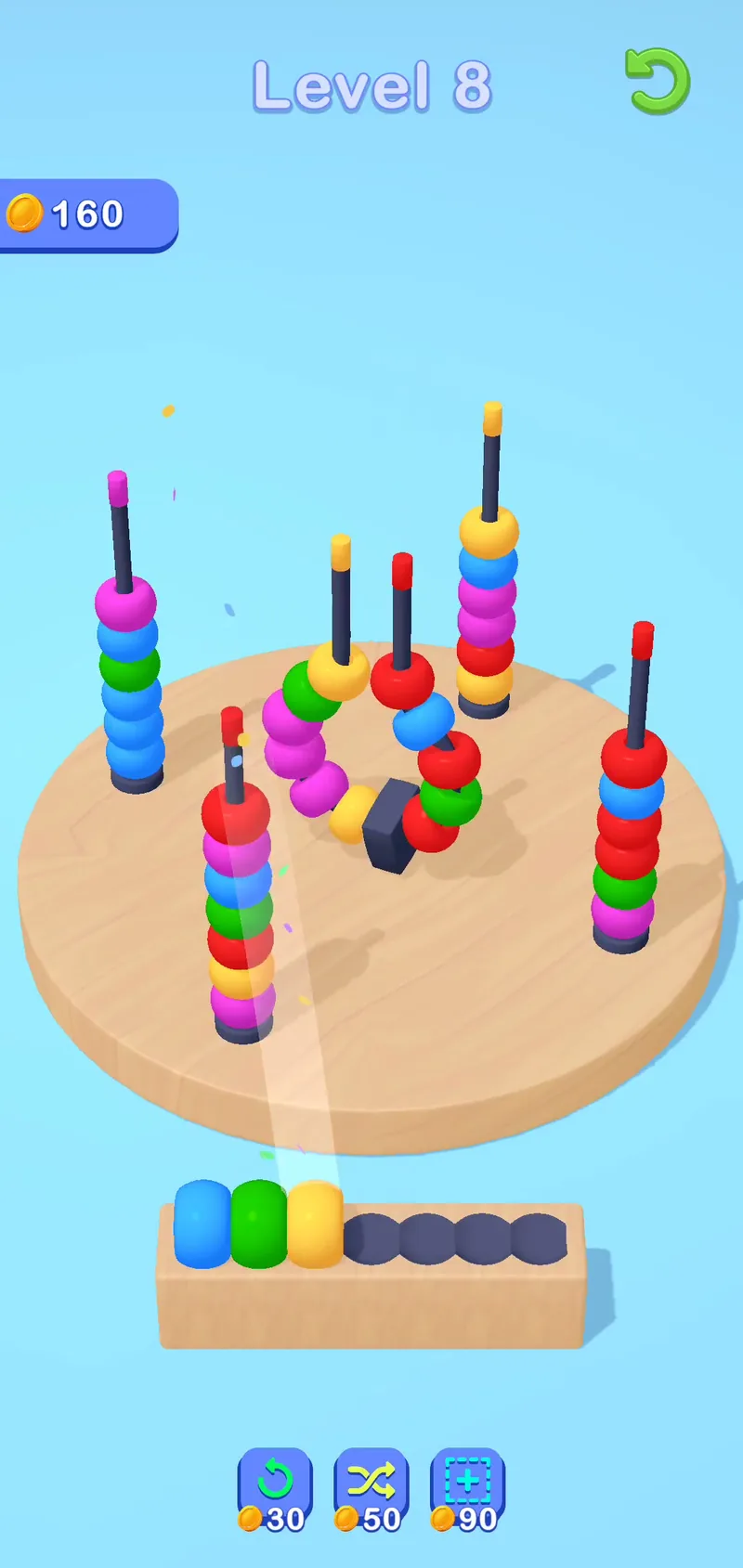
In Level 8, the beads on each side of the block came off from the end on their own side. In one moment a yellow bead sits to its left, with red, green, red and blue beads to its right; later a single red bead is left on its right. When that red bead slides out of the right end, the block is still on the wire, and Level 9 begins.
Level 9 opens with beads dropping onto two mirrored wires, each with a straight outer arm and a bent inner arm and both ends pointing up. Dark teal beads, a new color, fall in with magenta, green, blue and yellow ones. All seven tray slots are open at this point.
How it rates
Here is how it scores in each area:
| Category | Score | Comments |
|---|---|---|
| Core fun | 7 | Very fun, with a fair amount to enjoy |
| Originality | 8 | A very good creative angle |
| Art style | 6 | Fairly basic art, likely made for testing |
Overall:
- The idea is very good, and the combination works well. Overall score: 8.
- The difficulty settings and level design are also fairly reasonable, and nothing feels contrived.
- The game is still in testing. Difficulty is fairly low, the pace is fairly slow, and no levels are built to stall players on purpose; more tuning will likely follow.
- We have high hopes for this idea and look forward to seeing how it performs and where it goes next.
More from this series:
Tetris-style blocks in live PvP against real players: a block puzzle Match Masters
A claw machine, chain reactions and matching in one: a very creative mix
A fresh idea for jigsaw puzzles
Tile matching with stacked rubber bands
A new spin on word puzzles: crossword plus RPG, believe it or not
Tile matching crossed with 2048 feels fantastic in the hand: five stars