Ball Party Review: Pachinko Pegs Beneath Slot Reels
Five cups, a sliding SPIN gate and a 40-second bonus board: a Ball Party review of a neon pachinko cabinet with three slot reels on top.
Game at a glance
Ball Party
6.5/ 10
Our score
What would pinball play look like with Coin Master mixed in?
In this article6 sections
A purple pop-up dropped over the cabinet. It showed a pink-and-gold treasure chest ringed by glowing star coins, the words “Are you ready ?” and a deadline: “You have 40s to get what you want.” After the green GO button, a round target board drawn in neon rings took over the cabinet, with a countdown at the top.
That timed round is a side game in Ball Party, a slots-and-pachinko hybrid from the coin-chasing family of games like monopoly go. Gold balls bounce down a peg board into five cups while a three-reel slot window turns above them. All of it sits inside one arcade cabinet drawn in a Western neon cartoon visual style.
What it does with pachinko is the good part: it gives the machine a cartoon treatment and folds slots into it. Against that, the overall craft is not good, the play is too casual, and it doesn’t grip.
Gold balls through the peg board
The single session we played stayed on one machine, apart from one bonus round in the middle. In that session the main machine showed no levels to clear, no win screen and no fail or game-over screen. It pays out in coins, which show up in a “Total Win” box at the bottom of the cabinet and in a running coin total in the upper-right corner.
The controls stay out of sight. The only instruction on the main board is “Tap to Play !”, printed under the reels, and nothing on the board marks where to tap. Around the bonus round, a green GO button sits on its intro pop-up, and a white pointing-hand icon rests on the round board as it begins.
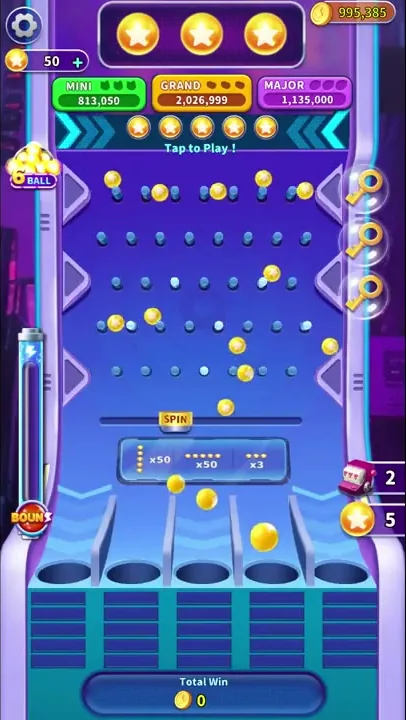
Most Ball Party gameplay happens on this board. Gold balls fall from the top of the cabinet, often several at once, and bounce down the pegs. They pass a sliding gate marked SPIN on the way and drop into one of five cups. A cup lights up with a yellow beam when a ball lands in it, and the coin total climbs, while the slot window above shows a new line of symbols every so often.
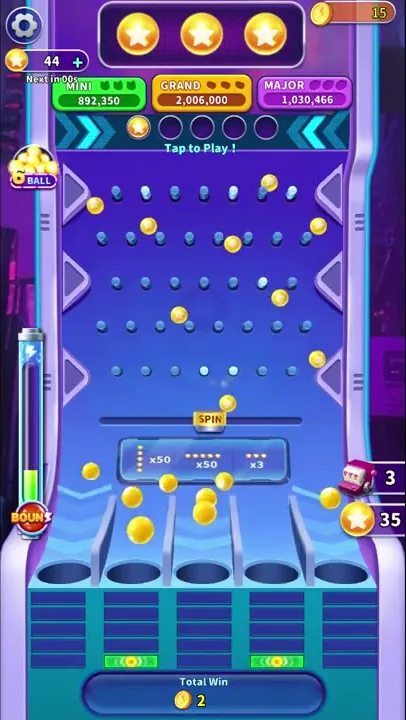
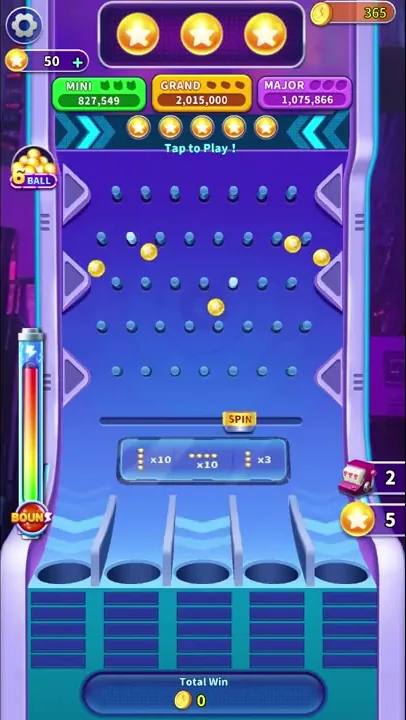
The peg field fills the middle of the cabinet in five staggered rows, long and short in turn. Three triangular bumpers jut out from each side wall and point inward, and the balls bounce off pegs and bumpers alike on their way down.
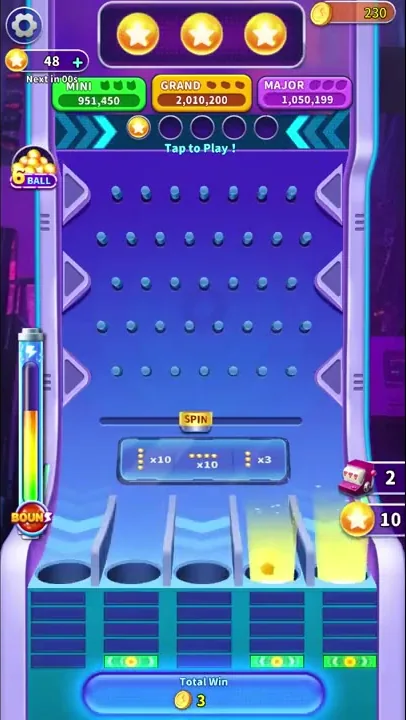
Each of the five cups sits above its own column of cells. Green coin tokens turn up at the foot of these columns, and they can stack: at one point two tokens sit one above the other under the fourth cup. They clear away too, and a bottom row holding four tokens is down to one moments later.
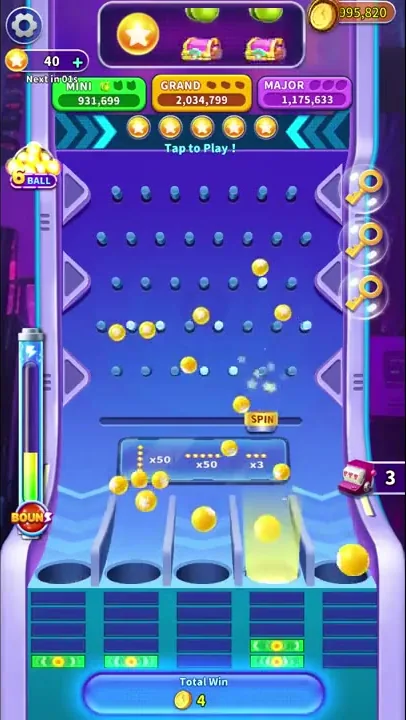
Between the pegs and the cups runs a horizontal rail with a small gold gate labeled SPIN. The gate moves along it: at the left end at one point, at the right end at another, later in the center.
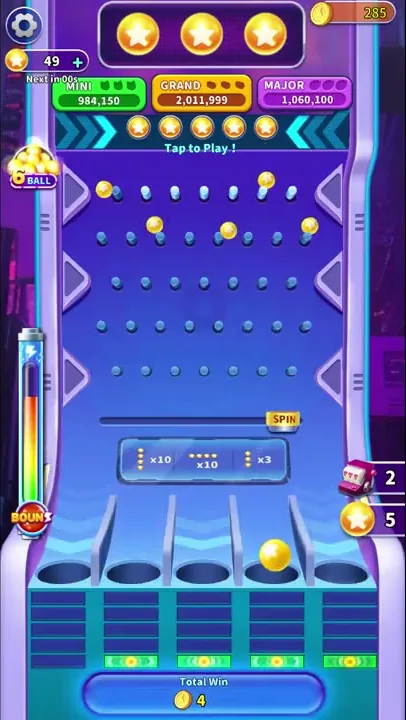
The top of the cabinet holds a three-reel slot window that cycles through its symbols: gold stars, treasure chests, keys, a green pear, an orange and a purple plum-like fruit. Below the jackpot bars, a row of five star slots lights up one star at a time above the “Tap to Play !” line. The row does not only climb. Four lit stars can be down to one shortly after, and later all five are lit.
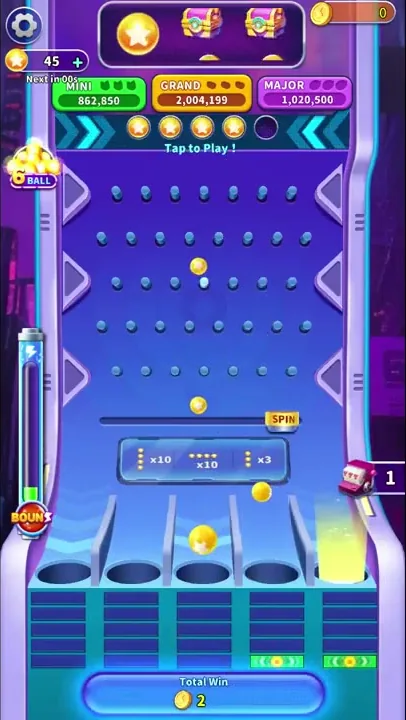
A small panel under the SPIN rail shows three tiny dot patterns, each with a multiplier. It switches between two readouts: x50, x50, x3 at one point and x10, x10, x3 at another. Every so often a larger neon panel covers the token cells, showing three coin tokens linked in a row or stacked in a column, then double arrows and a pink x3 badge with flames on it.
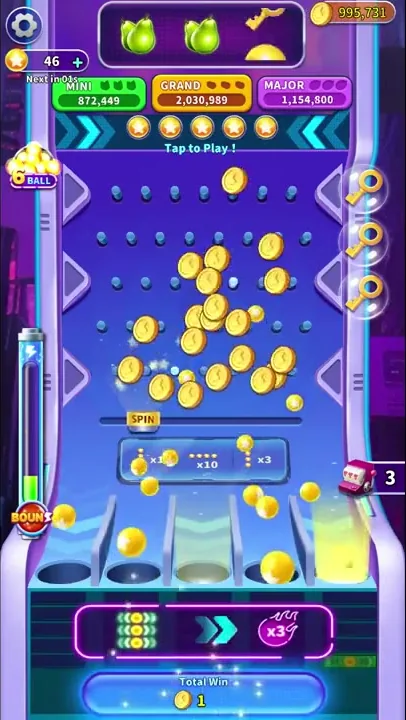
At times, large gold coins pour through the peg field alongside the balls. They spread across the pegs and stream up toward the coin total, which climbs while they pass.
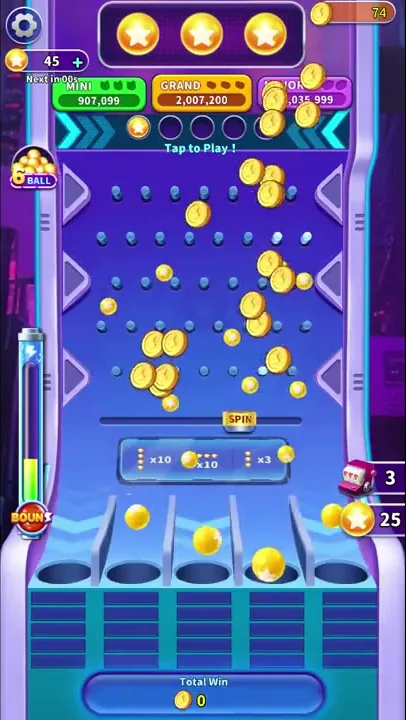
The left wall holds the bonus meter, a vertical tube with a lightning-battery cap and a red badge at its foot. It fills from the bottom, shifting from green through yellow and orange to red, and once it is nearly full the bonus round opens. Afterward it starts again from close to empty.
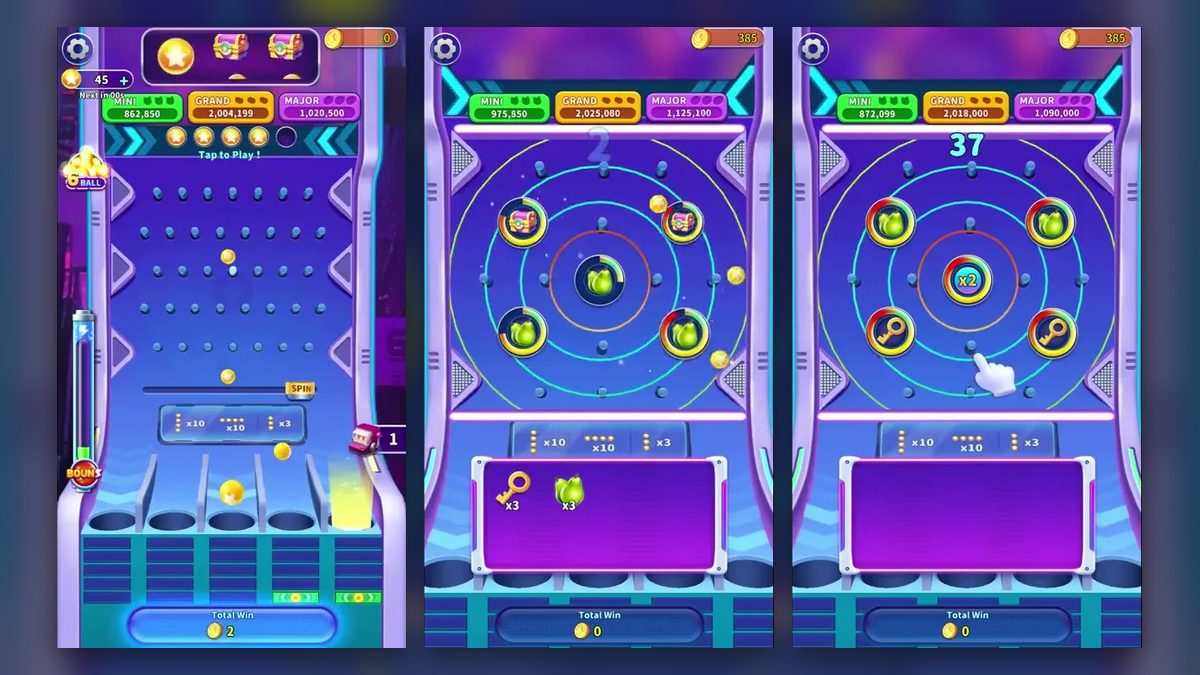
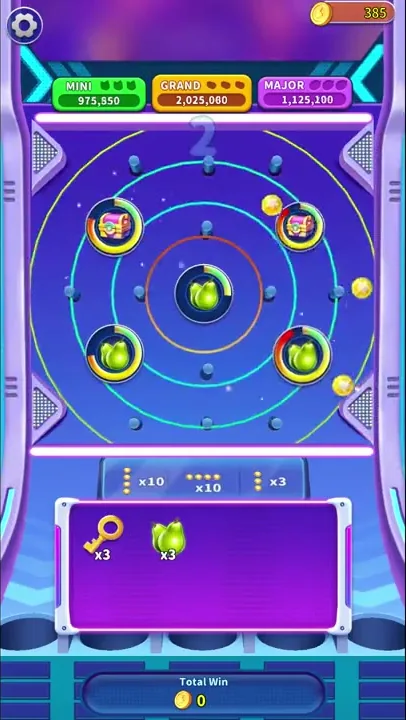
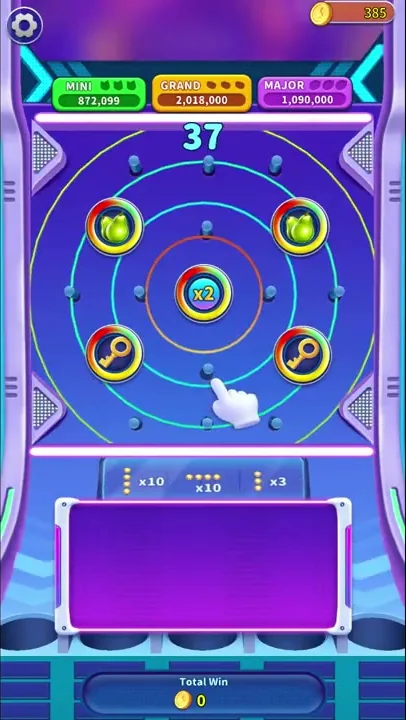
The bonus round lasts 40 seconds on a round board. Five round targets sit on it, four in a square and one in the center, and each shows an item. A colored ring around each target keeps changing, full at one moment and broken into arcs at another. The items the targets give collect in a purple tray below, each with a count.
When the board first came up, with 37 seconds left, green pears sat on the top two targets and keys on the bottom two, with x2 in the middle. The center soon switched to a pear, and when a key became the first item in the tray, one of the key targets was already showing a pear instead. With 12 seconds left the tray held two keys. Then the top-left target flashed x2 in a burst of confetti, and as the countdown faded out the tray read three keys and three pears, with chests on both top targets.
From a full meter to three checked keys
The session changes shape once, when the bonus meter tops out. The screen dims behind the chest pop-up and its green GO button, with the 40-second deadline spelled out under the chest.

Then the layout changes: the peg rows give way to a round board of concentric neon rings in orange, cyan and yellow, and a purple tray covers the cups. Pegs are set on the rings, and gold balls bounce around among them. The five targets sit on the board under a countdown that already reads 37 as the round begins. The multiplier panel and the still-empty tray wait below the board, and a white pointing hand rests on the board’s lower part.
When the clock runs out, a large glowing star with a megaphone on each side fills the screen. The main board then returns with something new: three key icons with check marks lining the right wall. At the same moment the coin total leaps by close to a million, and no results screen appears to say where those coins came from.
A banner whose visible letters read “BIG W” flashes among glowing balls soon after. From there play carries on as before, with the bonus meter refilling from near empty.
The cabinet is ringed with counters. Gold coins collect in the tally in the upper-right corner, which rises through play. In the opposite corner, a star counter has a “+” button with a “Next in 00s” timer underneath. Its number drops and climbs during play, and the timer text disappears whenever the number sits at 50, coming back once it slips below, as in “Next in 01s”.
Above the peg board, three jackpot bars run side by side: green MINI, orange GRAND and purple MAJOR, each with a large figure and three small dot icons. The figures tick upward through the session, though the MINI figure sometimes falls back before climbing again.
At the bottom, the Total Win box shows a coin icon and a small number that changes during play. Near the top of the left wall, a pile of gold balls labeled “6 BALL” looks the same in every view of the main board. On the right edge, a small pink slot-machine icon carries a number between 1 and 3, and at times a star coin below it shows a number that drops while it stays on screen.
Keys turn up both in the bonus round and after it. The tray ends with three of them, and the three checked key icons stay on the main board’s right wall for the rest of the session. Every screen also carries a gear button for settings in its upper-left corner.
Cartoon pachinko with reels built in
We liked what Ball Party does with pachinko. It gives the machine a cartoon treatment, from the neon purple-and-cyan cabinet to the pink-and-gold chest on the bonus pop-up, and fits more than one kind of play around the peg board. The meter on the left wall leads into a separate round board with its own targets and tray. The mix includes some pinball mini-games, and that round board is the one that came up in our session.
The slots play also counts in its favor. A three-reel window sits over the jackpot bars and shows new symbols while balls are still falling below.
Weak craft and a machine that doesn’t grip
The overall craft is not good. It is also too casual, and it did not grip us.
A taste for pachinko and slot cabinets
Most of the screen is taken up by the action itself. Balls drop through the pegs into the cups beneath the slot reels. Meanwhile the meter on the left wall climbs toward the next bonus and the counters keep moving.
These mechanics fit a liking for pachinko parlors and slot cabinets, where the interest lies in where the balls land and what the reels show. The timed bonus fits a taste for short collection rounds: 40 seconds of items piling into a tray, with targets that keep switching what they offer.
Verdict
Ball Party does well by pachinko, redrawing it as a cartoon and fitting slots and a timed bonus round into one machine. Its craft falls short, though, and the play is too casual and doesn’t take hold, which leaves it middling.
It also left us wondering about a game that combines pinball play with the Coin Master formula, where spins earn coins to build villages and raid friends. Ball Party has slot reels and a coin counter, but no village or raid screen came up in our session.