Pinball Army Review: Flippers Versus Marching Soldiers
Two flippers and a sling-launched ball take on soldiers marching out of striped tents: a Pinball Army review of a camp built as a pinball table.
Game at a glance
Pinball Army
6.5/ 10
Our score
The formula: simple core rules plus fighting enemies, leveling up and clearing stages.
In this article6 sections
Pinball Army is a ball bounce game whose highlight is the way it combines aim-and-ricochet pinball with tower defense, while its art is only average and its growth systems outside the levels are not well developed. Two flippers guard the bottom of a table laid out as a medieval army camp, and soldiers march down at them from striped tents at the top. A stronger upgrade system could lift its ceiling a long way.
We covered this kind of ultra-simple pick-up-and-play pinball defense long ago, and Pinball Army is another take on it. It also gives a bit of déjà vu, recalling a zombie-themed pinball game.
Flippers and a sling against the tents
We played two levels, numbered Level 1 and Level 2 here in the order they came up. Each one is a battle on a pinball table. Soldiers file out of red-and-white striped tents at the top and march down the field, and two flippers at the bottom fend them off with one ball.
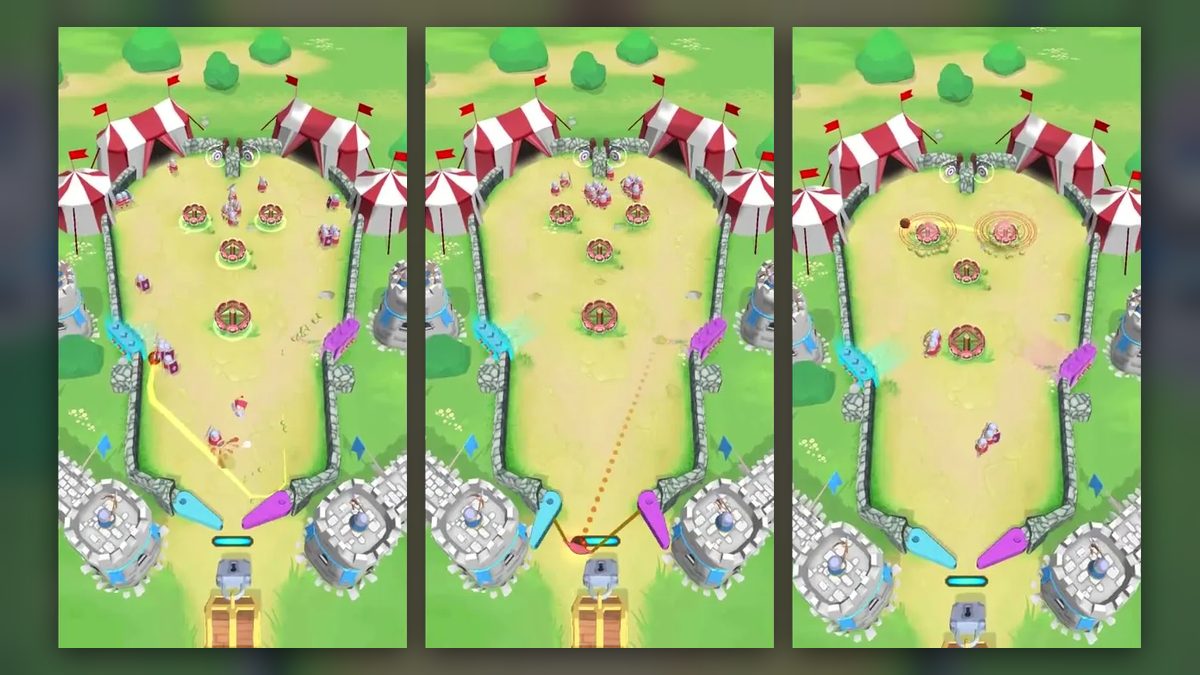
Pinball Army gameplay runs on a launch-and-rebound loop. The small red-orange ball leaves a sling between the flippers and bounces off round bumpers, colored wall bars and wall targets. Its yellow streak runs right through the soldiers on the field, and when the ball comes back down, the flippers send it up again to keep it in play.
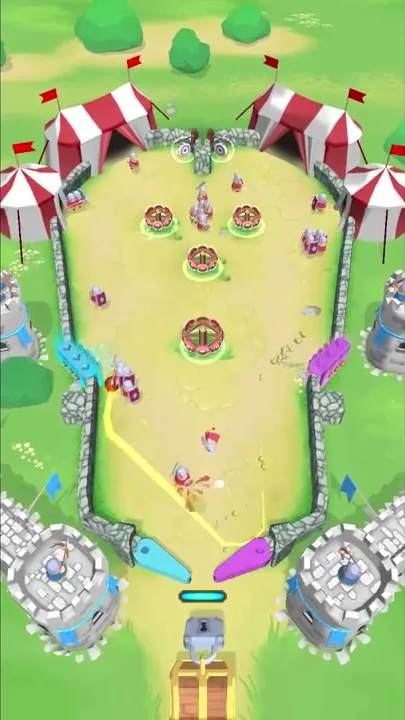
The flippers are cyan on the left and magenta on the right. They move independently. Both can be lowered or raised at once, or one can swing up while the other stays down, as when the ball lands on the raised right flipper.
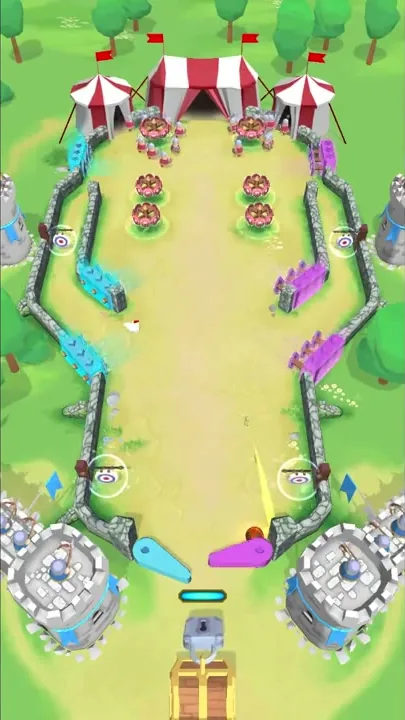
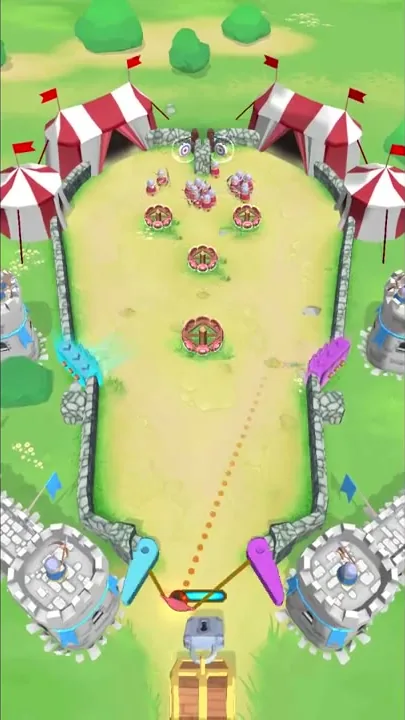
A red sling stretched between the flipper pivots holds the ball at rest. Drawn back, it shows a dotted orange line running up the field. On some launches the line angles toward the upper right, and on another it points straight up.
Round bumpers with red rims sit on glowing green bases in the upper half of the field. Golden or red rings spread around them during play, and the top pair show golden rings as the ball passes right beside them.
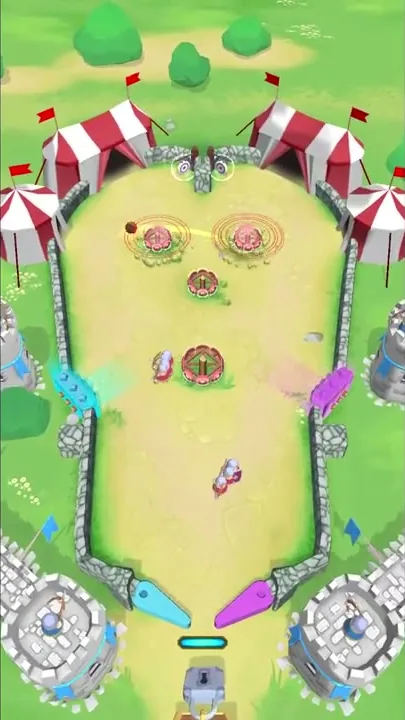
The attackers are small soldiers in red and white with silver helmets. They keep streaming out of the tents and spreading down toward the flippers, and some reach the lower half of the table. We can’t say what happens when they get to the bottom, or when the ball slips past the flippers.
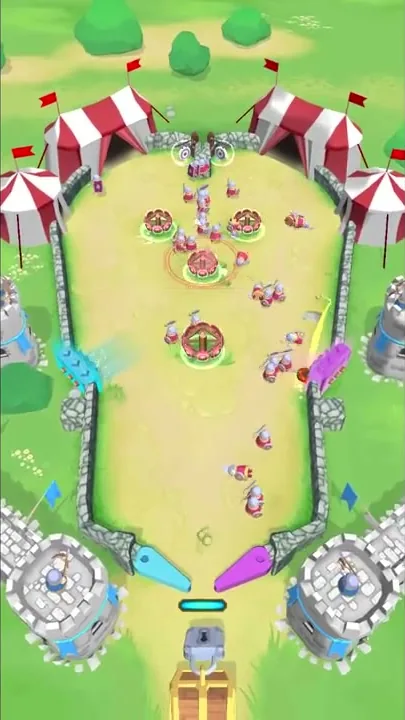
Some soldiers carry pinkish-purple shields. In Level 1 they move in small groups, and in Level 2 a tight block of them forms near the tents.
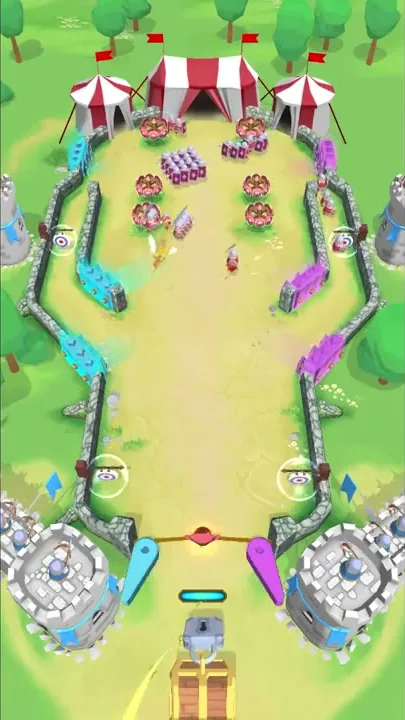
Studded bars sit on the side walls, cyan on the left and magenta on the right, each with a haze of its own color in front of it. At one point an orange streak crosses the field right at the cyan bar.
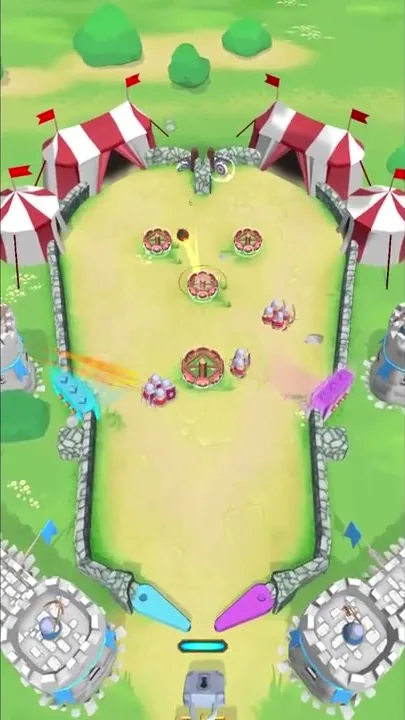
Round white bullseye targets stand on posts, and in Level 1 two of them sit on a stone gate between the top tents. In Level 2, a pink ‘FIRE!’ tag appears beside the lower-right target while the ball is right next to it, and an orange fiery streak flies near the soldiers. Later, another ‘FIRE!’ tag shows up by the tower at the upper left.
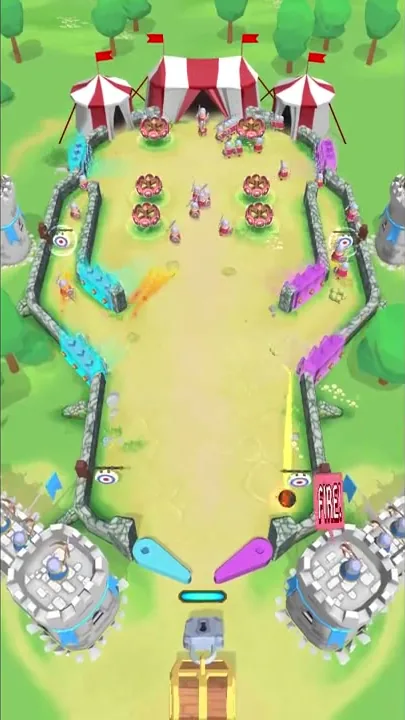
Four striped tents with red flags line the top of the Level 1 table: two above the field and one on each side, with the stone gate between the upper pair. Below them, four bumpers form a Y: two side by side, one below and between them, and one lower in the center. The cyan and magenta bars sit at mid height on the walls, and more stone towers peek in from beyond them. At the bottom, the sling with the ball in it sits above a cyan capsule-shaped bar and a gray block on a wooden gate, and two round stone towers with blue trim fill the corners.
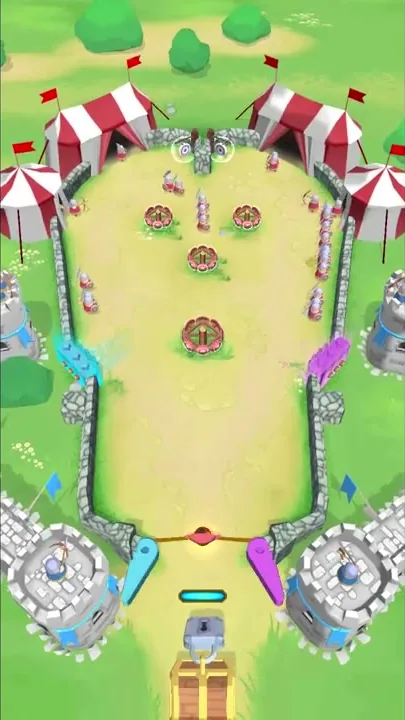
As Level 1 plays out, marchers and shielded groups fill the field, then the crowd thins to a few soldiers. The ‘YOU WIN’ sign follows soon after.
From an open camp to walled side lanes
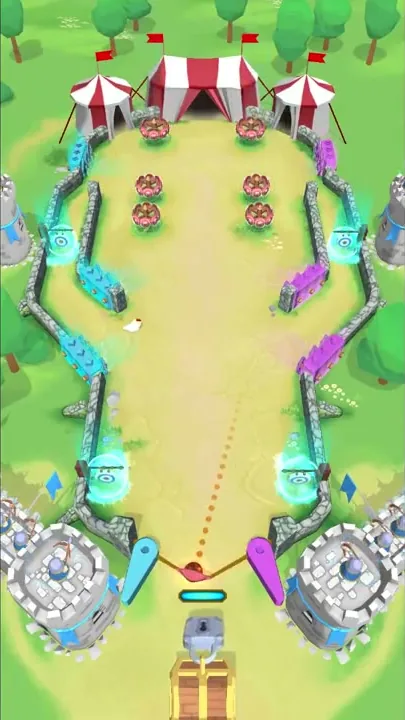
The board changes from the first table to the second. The Level 2 table has three tents at the top, a larger one in the center between two smaller ones, with tall trees behind them and a small white bird figure on the left of the field. Inner stone walls form a lane down each side, and the bumpers stand in two columns of three instead of a Y.
The targets move as well. In place of the gate pair, four targets stand on the walls, one high in each side lane and one low on each wall above the flippers, and all four glow teal while the field is still empty. Each side also gets three colored pieces instead of one, cyan on the left and magenta on the right: a small piece at the top corner, a studded bar at the foot of the inner wall and another on the outer wall.
The fight on the second table comes in waves. A red ‘Wave 3’ banner appears over it as a new crowd gathers by the tents, and soon after a dense column of soldiers pours out of the center tent.
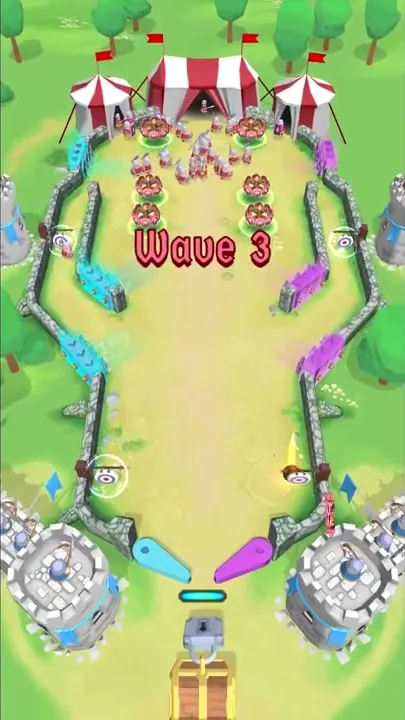
During play there is no score or level number on screen, and no coin count or pause button: the table fills the whole screen, from the tents at the top down to the wooden gate at the bottom edge.
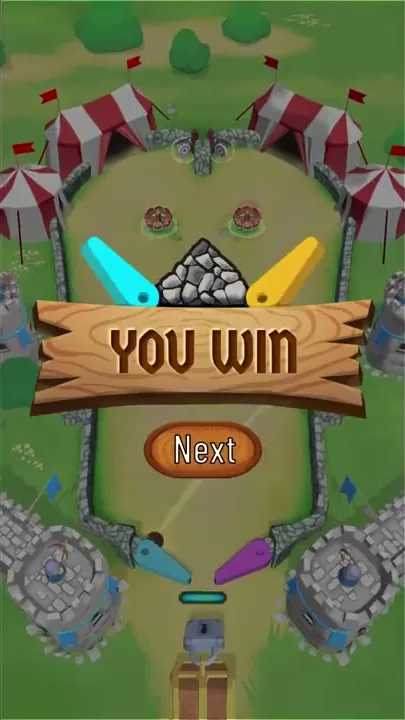
Winning Level 1 dims the board behind a wooden ‘YOU WIN’ sign, topped by a pile of gray stones between a cyan flipper and a yellow one. Below the sign is a single orange ‘Next’ button, and the next table appeared shortly after.
Pinball parts doing a defender’s job
The game’s highlight is the way it turns pinball parts into hold-the-line defense. The tents at the top supply the attackers and the flippers at the bottom guard against them, while the ball cuts its yellow trail through the marching ranks in between. Guiding the ball into the matching target also sets off the camp’s defenses, such as arrow towers, cannons and mines. In Level 2, pink ‘FIRE!’ tags and orange fiery streaks appear beside a wall target and a tower while soldiers crowd the field.
Under that theme sits a formula that combines a simple core rule, keeping one ball moving with two flippers, with fighting enemies and clearing levels. The fighting is the flow of soldiers out of the tents. The clearing is the ‘YOU WIN’ sign and its ‘Next’ button.
Average art and thin growth between levels
Growth outside the levels is not well developed. Survivor.io, Archero and Clash Royale all have growth systems. In our view, an upgrade path like the ones in games like survivor.io that raises attack power, or upgrades for the defenses themselves, would give Pinball Army a much higher ceiling.
The art is average. The tables are low-poly 3D cartoon camps seen from a high, tilted camera, with striped tents and gray stone walls set on green grass. The effects are colored hazes at the wall bars and golden rings at the bumpers, plus orange streaks, with pink ‘FIRE!’ tags in Level 2.
Keeping a ball alive among marching soldiers
These mechanics fit a taste for flipper play with a defensive job attached. A launch begins with the sling pulled back and the dotted line pointing up the field. From there the work is sending the ball back into the soldiers with two flippers that move independently.
The other half is watching the camp. Crowds keep leaving the tents, and shielded soldiers sometimes bunch together near the top.
Verdict
The strongest part of Pinball Army is its central idea: a pinball table that doubles as a defensive line against an army. Two things around that idea are less developed. The art is average and growth between levels is weak, and a deeper upgrade system for attack power or the defenses would give it much more room to grow.