Basket Clash Review: NBA 2K-Style Shot Timing in Portrait
Short one-on-one street matches and a curved shot meter at the shooter's feet: a Basket Clash review of NBA 2K-style shooting in portrait.
Game at a glance
Basket Clash
6/ 10
Our score
NBA 2K for your phone, played upright with one hand.
In this article6 sections
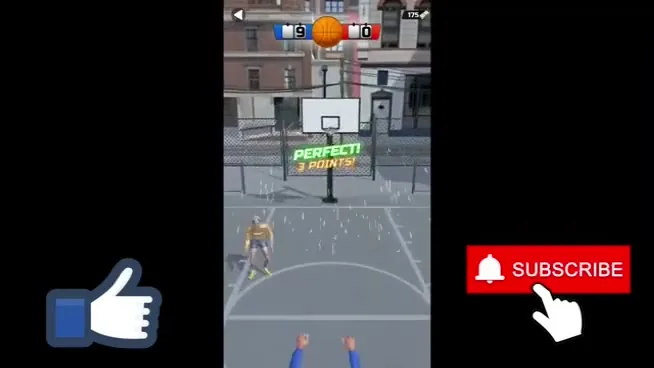
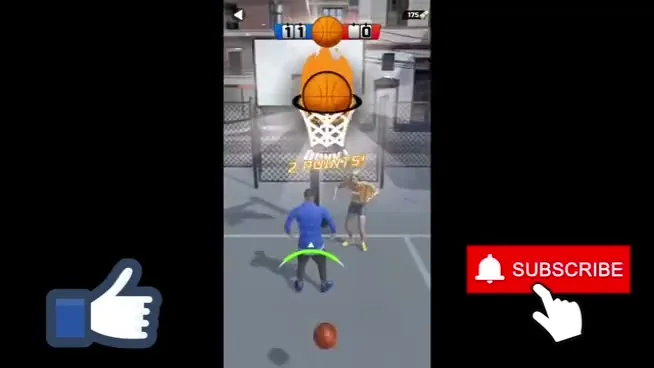
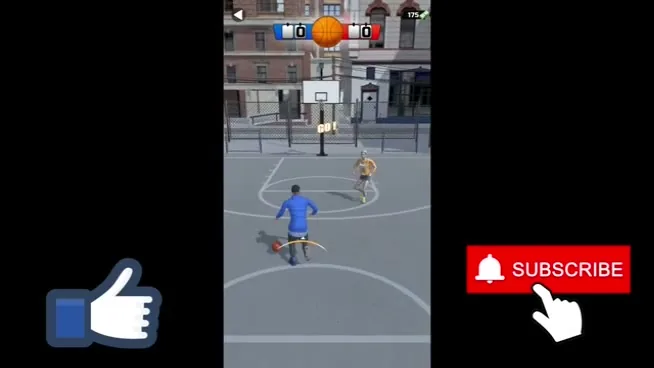
Level 8 of Basket Clash, a portrait 3D basketball game, puts a blue-jacketed shooter against an opponent in a yellow top on an asphalt street court. We put up shot after shot from a curved meter lying on the court under the shooter. By the time a green “PERFECT!” flashes over a yellow “3 POINTS!” beside the hoop, the blue side leads 9-0.
Think of it as NBA 2K, the big-budget basketball series, cut down to one hoop and one opponent on a phone held upright. We played an indoor shooting drill and then Levels 8 and 9, with a city map in between. The shot timing at its core is the highlight, and the parts around the matches are where the game comes up short.
A curved meter under the shooter’s feet
Every match is one-on-one at a single hoop. The scoreboard at the top puts the blue score on the left and the red score on the right, with a basketball between them, and each made basket adds its points to the blue side. No target score is printed; Level 8 ended once blue reached 11 with red still at 0. Neither match showed a clock of any kind or a lives counter, and no defeat or retry screen came up.
There is no joystick or shoot button on screen, only a back arrow in the top left, and the character carries the ball around the court. The camera follows from behind, looking up the court at the hoop, and moves in for shots. It either sits close behind the jumping shooter or drops so low that only the raised arms show at the bottom of the screen.
Basket Clash gameplay runs in a loop. A yellow “PLAY” button on the city map starts a level, and on a street court the character dribbles and rises for jump shots. A win ends on a “VICTORY” screen with a cash reward before the map returns. A shooting drill with no opponent and a fixed supply of balls came before the first match.
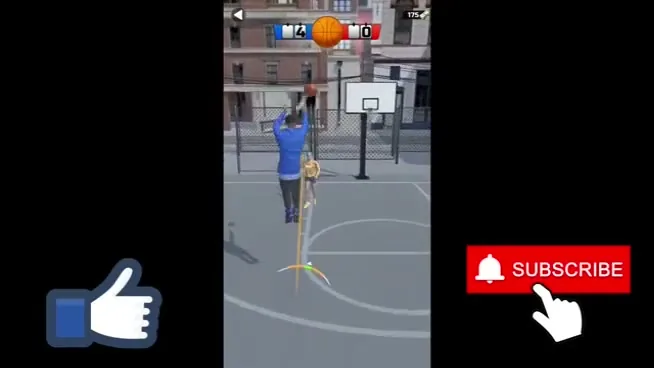
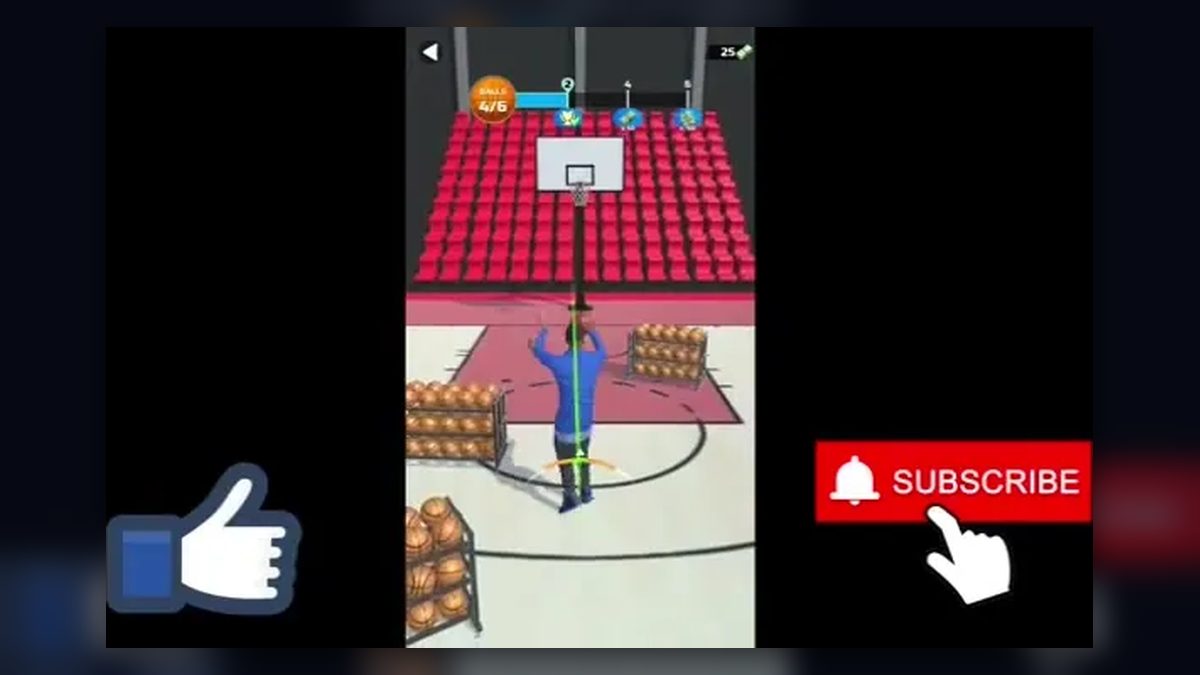
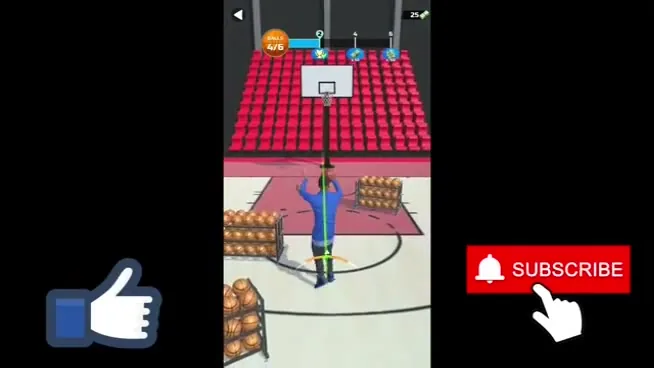
The meter is a curved arc on the court under the shooter’s feet, with a small white pointer in its middle and a straight line running from that pointer to the hoop. The line is green in the drill and turns yellow during a jump shot in Level 8. The arc changes color too: green at some moments, yellow or orange at others.
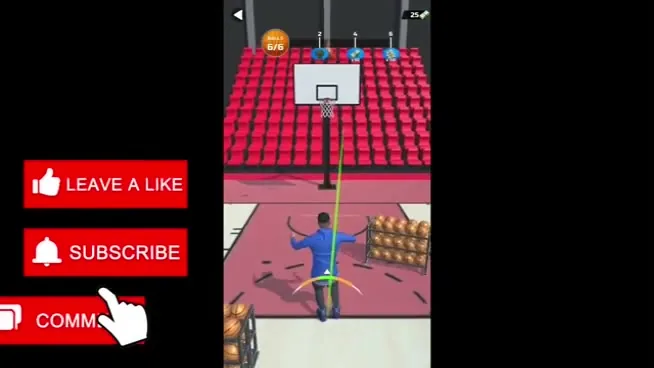
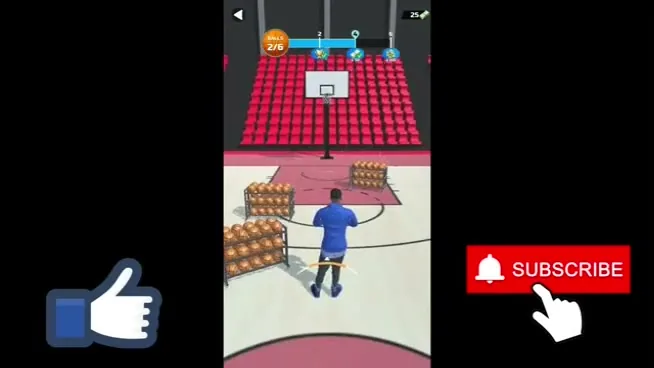
The drill takes place in an indoor arena with rows of red seats and a light court with red paint. Metal racks loaded with basketballs stand on the floor, three of them in view at once. A “BALLS” counter in the top left counts down from 6/6 as the shooter takes aim from different spots. Before long the counter disappears, along with a bar across the top of the screen, and sparkles fall around the hoop.
Made baskets put a callout beside the hoop with the points they earned. One reads a green “PERFECT!” stacked over a yellow “3 POINTS!” while sparkles fall around the rim; another shows “2 POINTS!” beneath a second word.
Fire shows up as well. Near the end of Level 8 the ball drops through the net wrapped in orange flames, with “2 POINTS!” just below the hoop. In Level 9 a burst of fire lights the backboard while the blue-clad character is at the rim.
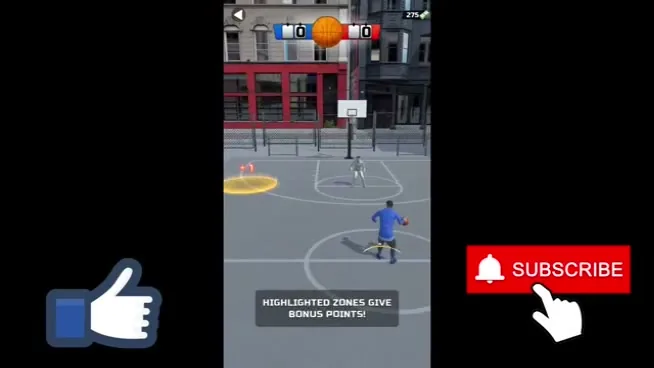
Bonus zones, which first appear in Level 9, are glowing yellow circles on the asphalt, each tagged with a red “+2” or “+1”. They change place and size during the match. One sits by the left sideline and another right under the character. Elsewhere a large disk sits in the middle of the court, and a smaller ring appears on the left side of the lane, farther up the court.
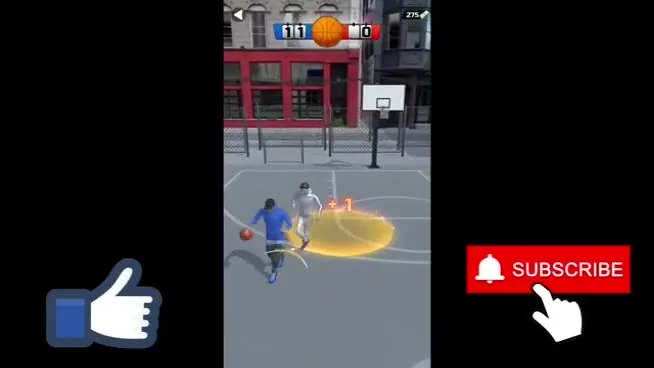
Each match has a single opponent: a player in a yellow top in Level 8, and one in white and gray in Level 9. The red score stayed at 0 whenever the scoreboard was on screen in either match. At one point in Level 9 the ball sits beside the opponent out by the free-throw circle while the blue-jacketed player stands by the hoop.
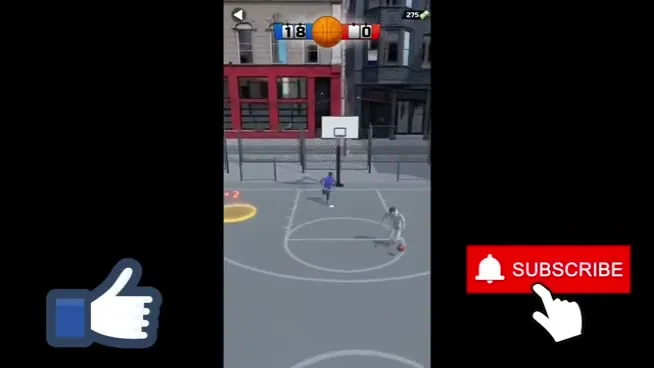
A court backed by a red storefront hosts the Level 9 match, which starts at 0-0. Blue sits at 3 for a stretch, then climbs through 7 and 11 to 14, and it stands at 18-0 the last time the scoreboard shows.
From an indoor drill to bonus-zone street courts
The venues and opponents change from level to level. The drill is held indoors with no one to beat. A bar across the top of the screen fills from the left toward marks labeled 2, 4 and 6, each with a small icon beneath it.
The matches then move outside, to gray asphalt street courts with white lines and chain-link fences in front of brick and stone apartment buildings. The first, Level 8, opens at 0-0 with “GO!” beside the hoop and an opponent in a yellow top waiting near the free-throw circle.
New pieces arrive along with the new scenery. Level 9 moves to another street court and swaps in an opponent in white and gray. It opens with the first bonus zone glowing by the left sideline and a tip box reading “HIGHLIGHTED ZONES GIVE BONUS POINTS!” No zone appeared in Level 8.
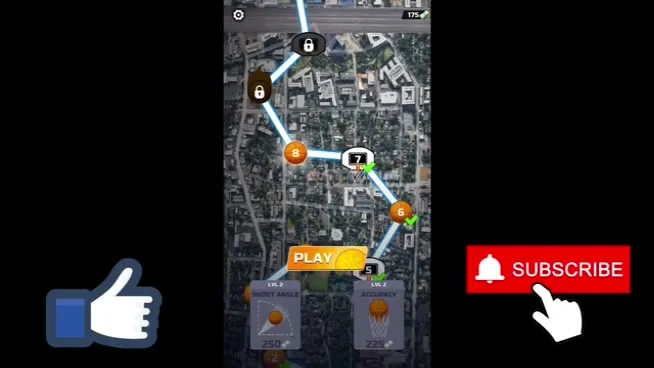
Between matches the game returns to a level map laid over a satellite photo of a city, with numbered nodes joined by glowing lines. Nodes 5 and 7 are hoop icons, as is node 10 further up; nodes 6 and 8 are orange balls, and node 9 is a ball wrapped in flames. Finished nodes carry a green tick, and before Level 8 the ticks already ran from node 5 to node 7. Nodes further along show a padlock instead of a number, and a gear icon sits in the top left.
Two upgrade cards sit under the map. “SHOOT ANGLE” shows a ball with a dotted angle drawing and “ACCURACY” a ball over a hoop. Both are labeled “LVL 2” and priced at 250 and 225 cash, and neither card had changed when the map came back after Level 9.
Winning Level 8 brings up a screen that dims the court behind a gold winged crest, with a basketball at its center and a crown on top. “Level 8 COMPLETED” sits above the crest, and a “VICTORY” banner runs across its base. A blue button below carries the reward of 100 cash.
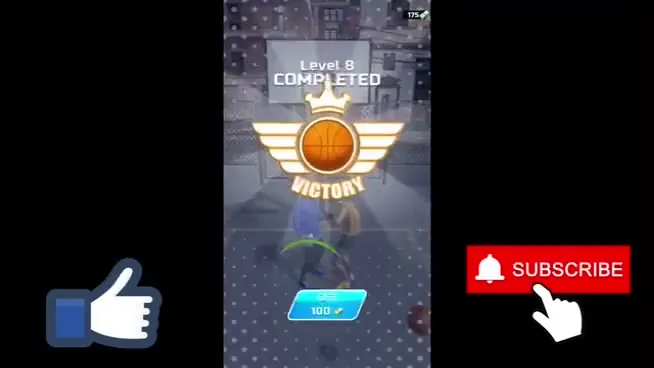
Cash is the only currency in sight: a green banknote icon with a balance in the top right corner. The same icon marks the upgrade prices, and the 100 from the victory screen is already in the balance when Level 9 begins. No ad showed up in the drill or in either match, after the Level 8 win, or back on the map once Level 9 was done.
NBA 2K shot timing, pared down to casual
We think Basket Clash recreates NBA 2K’s shot-timing mechanic with real flair, along with the way the timing meter shifts during one-on-one play. The pieces sit right on the court: the curved meter with its white pointer under the shooter, the line to the rim, and the “PERFECT!” grade on a three-pointer in Level 8. In that same match the line shows yellow during a jump shot, and the arc is green as the flaming ball drops through.
As a whole, the game is a very good case of pulling a blockbuster’s core play apart and simplifying it into something casual. The meter that carries NBA 2K’s timing sits under the shooter in the drill and in both street matches. Its basketball also plays closer to hyper-casual than the series it borrows from.
Sloppy screens around the matches
It’s a pity the rest doesn’t live up to that shooting. We found the layer around the matches fairly sloppy. That layer is the city map and its two upgrade cards, plus the victory screen with its cash button. The artwork is an awkward mix as well.
Timing shots one opponent at a time
Each match centers on the jump shot. The curved meter and its line to the rim appear during shots, and a callout announces the points once the ball drops. That loop suits a taste for repeating one timed action over running plays with teammates. Anyone who knows the shot meter from NBA 2K will recognize the idea on a screen held upright.
The “+2” and “+1” zones of Level 9 give the court something extra to go after. Between matches the choices are a “PLAY” button and two upgrades bought with cash.
Verdict
The idea at the heart of Basket Clash works. NBA 2K’s timed jump shot comes through with its spark intact, and slimming a heavyweight series into a casual game is something it gets right. Around that, the map and upgrade cards are fairly rough and the art style is an awkward mix, which is a pity next to shooting this good.