Collors Review: Color Pairs That Shove, Link and Nest
This Collors review looks at a physics-based color puzzle where tiles, bent frames and rod-linked pieces shove each other across a 3D tray.
Game at a glance
Collors
7.5/ 10
Our score
Physics-based color blocks you clear by dragging them into each other. Fresh to play.
In this article6 sections
Pull a glossy colored tile across a white tray and into another tile of the same color. Both burst into specks of that color, and a word such as GREAT pops up above the board. Collors builds a physics-based puzzle on that one move. Its pieces have bodies that take up space, so a drag can shove whatever sits nearby into a new angle.
We played Levels 1–9, which move from plain square tiles to frames holding tiles, gray rods that tie pieces together, long bars and rings nested three deep. It is clear-the-board puzzling in a hyper-casual, one-mechanic package, and it feels fresh to play.
Dragging Pieces Into Their Own Color
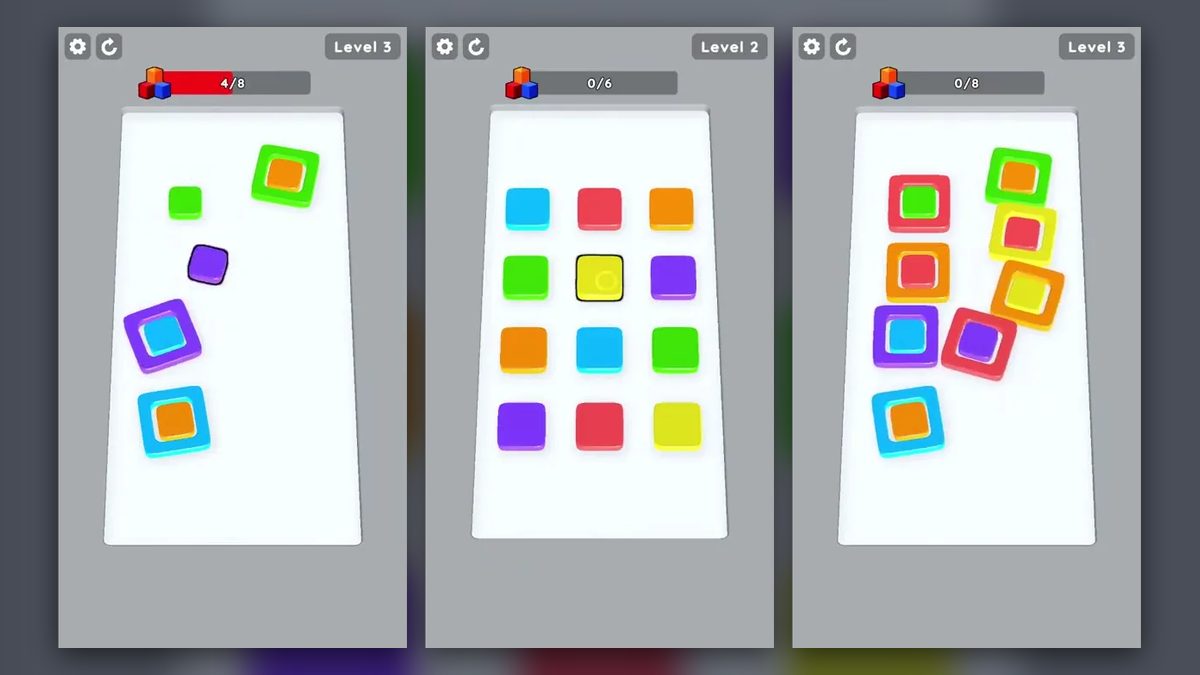
A goal counter sits in a bar at the top of the screen beside a small cube icon. Pieces clear when one is dragged into another of the same color: both vanish in a burst of particles in that color, a slanted praise word pops up above the tray and the counter goes up by one. Frames and the tiles inside them count as separate colors. A level is won when the bar fills, and by then the tray is empty.
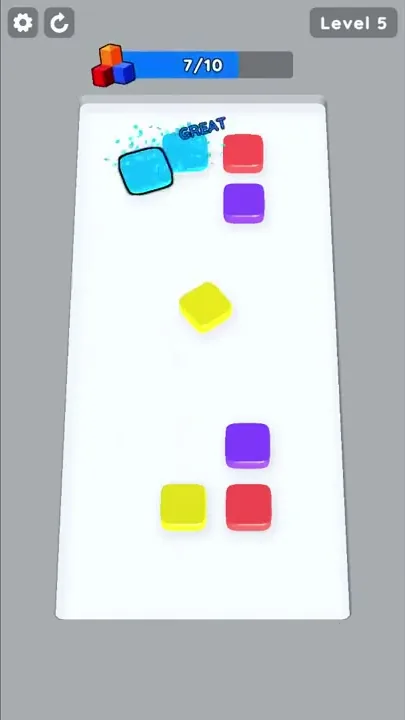
The tray is seen at a slight tilt, narrower at the top than at the bottom, against a plain light-gray background. Pieces are thick, glossy blocks with rounded edges and soft shadows, and the frames and bars stand up as raised 3D shapes.
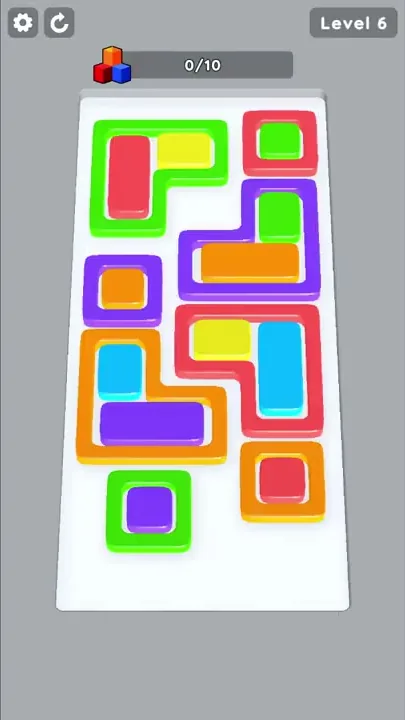
Collors gameplay runs on touch and drag. The piece in hand gets a black outline and turns and tilts as it moves. A frame travels together with the tile inside it: in Level 6 a red frame is dragged with its green tile still in place, rotated about 45 degrees.
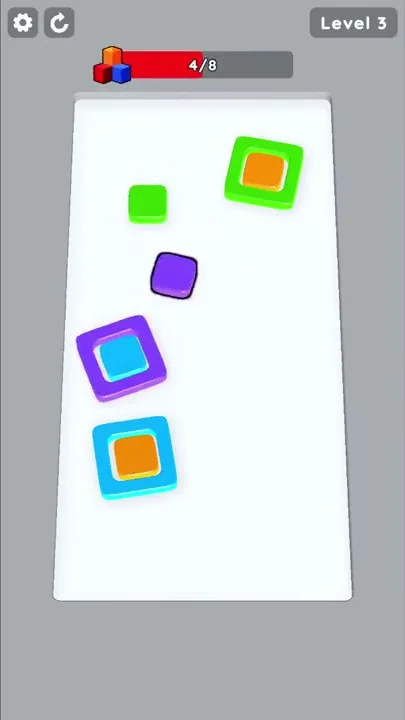
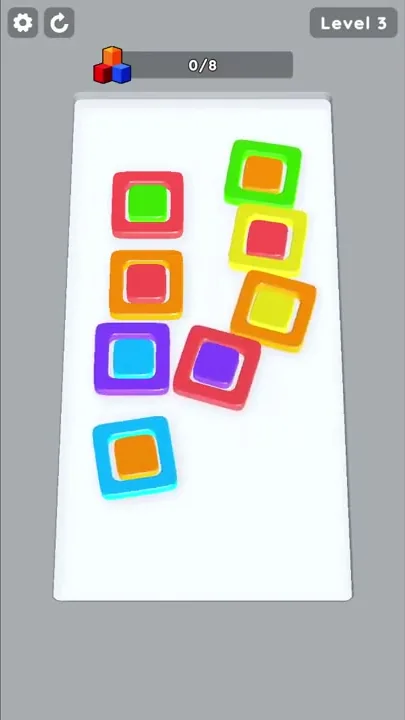
Frames first turn up in Level 3. Each is a hollow square ring with a smaller tile of a different color inside, and the ring and the tile are matched separately. Once the frame is cleared, its tile stays on the tray as a loose piece that can be paired in turn, like the green and purple tiles lying free partway through Level 3.
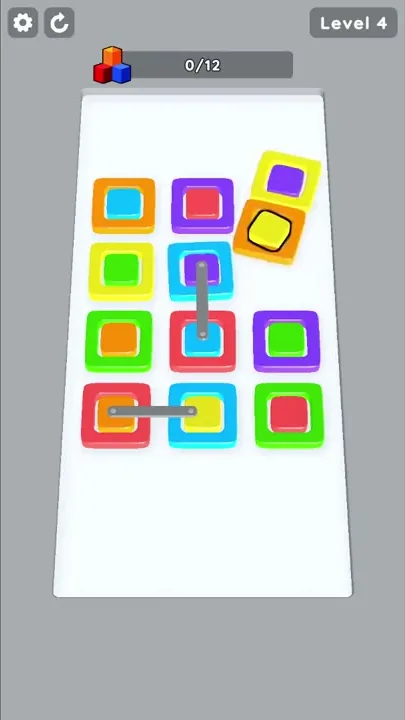
Gray rods with round ends show up in Level 4, each joining two pieces. Early in that level, one rod links the purple tile in a cyan frame to the cyan tile in the red frame below it. Another links the orange tile in a red frame to the yellow tile in the cyan frame next to it. Joined pieces stay together: once both frames around them are gone, the orange and yellow tiles are still on their rod, lying at an angle as a pair.
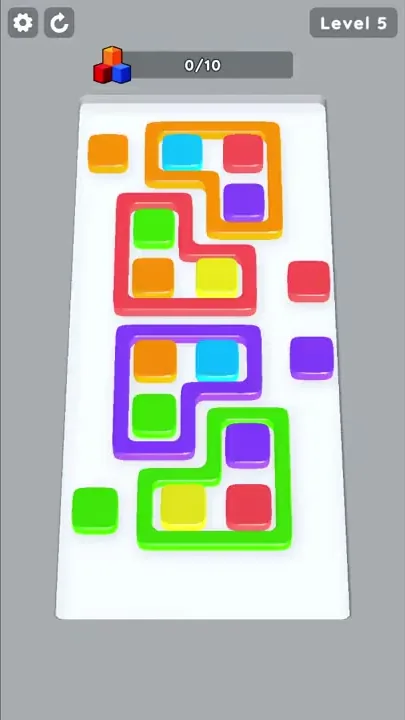
Four large bent frames fill most of the Level 5 tray, each enclosing three small tiles, with four loose tiles around them and a goal of 10. A bent frame pairs off with a loose tile of its own color. When the purple and green frames go, along with the loose purple and green tiles, the tiles they enclosed stay exactly where they sat, now free pieces of their own.
Long bars appear in Level 6, set inside a mix of square and bent frames. They are about two tiles long, some horizontal and some vertical. A bar freed from its frame moves like any tile: the red one, once loose, is dragged near the top of the tray with its outline showing, turned at a steep angle.
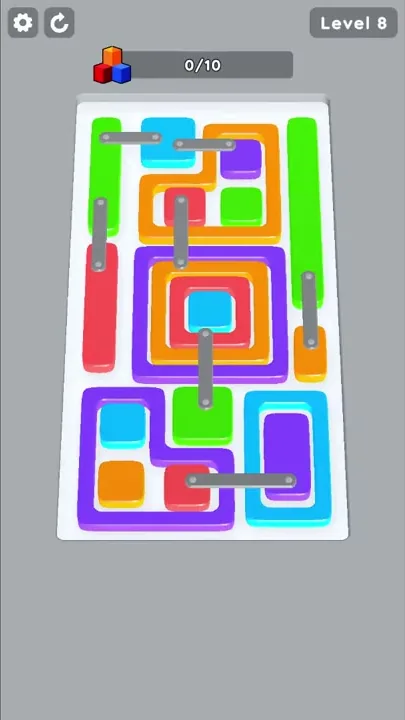
Rings nested inside one another appear in Level 8: a purple square ring around an orange one around a red one, with a cyan tile at the center. They came off from the outside in, purple first and orange next, until only the red ring and its cyan tile were left. The purple ring and the bent purple frame in the lower left corner disappeared together, so two frames of one color can also clear each other.
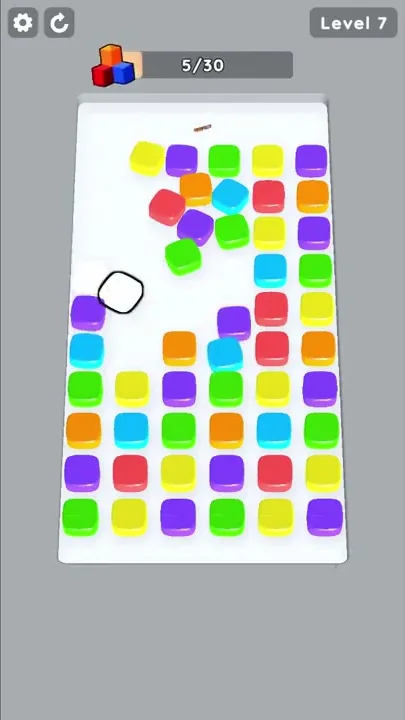
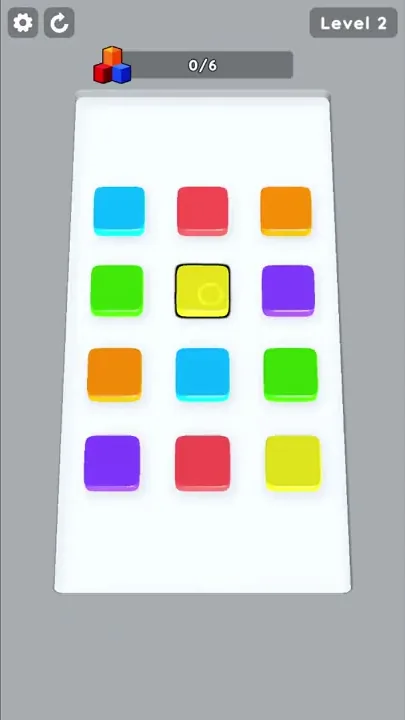
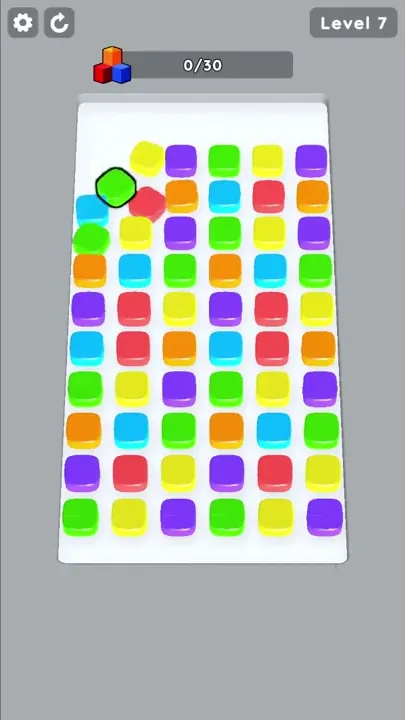
Under all of this, the pieces behave as solid objects. Dragging one shoves its neighbors, which slide, rotate and pile up at angles. Pulling tiles out of the big Level 7 grid knocks a cluster at the top left into a tilted heap while the rest of the grid keeps its rows. The same thing happens in Level 2, where a red tile ends up turned and a green one slides to the right after the cyan and yellow pairs are gone.
From a Plain Grid to Rings Within Rings
Plain square tiles are all that Levels 1 and 2 put on the tray. The first board sits on a smaller, shorter tray than later ones and has a goal of 3, while the second lays out plain tiles in three columns of four, two in each of six colors, with a goal of 6.
From there up to Level 6, each board puts one new kind of piece on the tray. Square frames holding tiles come first, against a goal of 8, and the gray rods follow with a goal of 12. After them come the big bent frames and then the long bars, both on boards with a goal of 10.
After that, the count grows instead of the variety. The tiles go back to plain squares in Level 7, but early on a tall, tightly packed grid of them fills the tray, and the goal climbs to 30, the highest yet.
The last two boards pile the earlier pieces together. Rods and bars crowd onto the Level 8 tray along with bent frames and the triple rings, under a goal of 10. The goal rises to 12 in Level 9, where, early on, a red square frame surrounds a yellow frame and a tall orange frame holds three tiles stacked in a column.
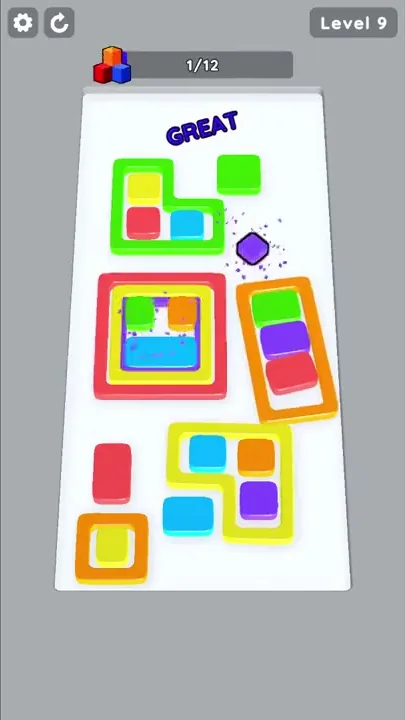
The goal bar and its cube icon run across the top of the screen. The level number is printed in the upper right corner, opposite a gear icon and a circular-arrow icon in the upper left. The bar’s fill color shifts from one moment to the next. On the big tile grid it turns red alongside a red AWESOME and red particles, and near the end of Level 9 it is green beside a green FABULOUS.
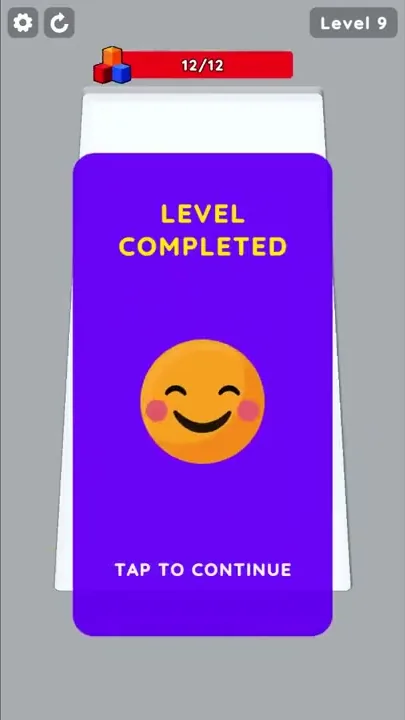
A finished level closes on a purple card that rises over the tray. LEVEL COMPLETED sits at the top in yellow above a smiling emoji, and TAP TO CONTINUE runs along the bottom.
Odd Shapes Pulled Across the Tray
We like this kind of hyper-casual, one-gesture clearing game a lot, and the highlight of Collors is physics-based dragging of colored pieces in many shapes and orientations. Clearing runs through that same motion: one piece is pulled until it collides with its partner, as the two cyan tiles do near the top of the Level 5 tray. Small squares are moved the same way as a square frame carrying its tile or a bar about two tiles long. Each one turns as it travels, like the red frame turned about 45 degrees in Level 6.
Every block also has a body on the tray, and many are linked or come in odd shapes, which makes Collors feel fresh in play. Pulling tiles from the Level 7 grid tips one corner of it into a heap. The Level 4 rods keep an orange and a yellow tile paired after their frames are gone, and Level 6 packs bars and bent frames tightly together.
Collors also takes the flat puzzle of pieces covering other pieces into 3D, and that changes both the experience and the gameplay a great deal. Its pieces are thick blocks on a tilted tray. Frames and rings wrap around other pieces that come free as the outer layers clear, as when the purple and orange rings of Level 8 drop away and leave the red ring around its cyan tile.
Open Questions About Fail States and Icons
There is no criticism of Collors to report, so what follows are limits of the boards described here, not faults. Two questions stay open: whether a board can be lost, and what the gear and circular-arrow icons do. The boards stop at Level 9. No coins, shop, boosters or ads appeared in those levels, and the LEVEL COMPLETED cards that appeared led straight to the next board, but we can’t say whether the game shows ads or sells anything later.
Hands-On Dragging on a Crowded Tray
Every turn here is done by hand: pick one piece out of the crowd and pull it into its color, while the neighbors it bumps slide out of the way. On the busier boards that turns into untangling, since rods tie pairs that travel as one and frames hand over their tiles once they clear.
The tray also rearranges itself under the hand, which matters to anyone who would rather react to a shifting layout than work through a fixed one. In a grid like Level 7’s, the tilted heap a pull leaves behind is the layout the next move starts from, and the nested rings of Level 8 come off one layer at a time.
Verdict
Collors runs on one gesture, pulling a colored block into its twin, and finds its variety in blocks that bump into one another, travel in linked pairs or arrive in very different shapes. It comes across as fresh in the hand, and small one-mechanic clearing games like this are a style we are very fond of. Lifting a puzzle about covered pieces into three dimensions changes a great deal about how it plays and how it feels.