Snake vs Block Archero: A Simple Dodger Gets RPG Gear
Snake vs Block Archero, from Korea's 111%, turns the snake into a character and the blocks into monsters, then adds Archero-style skills and gear.
In this article3 sections
This Snake vs Block Archero game is the latest pick in a regular series on well-made inventive games already out there. The series follows the method for building new game ideas covered earlier, and each pick shows that method at work in a real game.
This time the pairing is Snake vs Block + Archero. Archero is the action game where you dodge to move and stop to shoot. This mix of the two comes from the Korean studio 111%, and it is the first to cross a bite-size, pick-up-and-play game with a deeper midcore one.
How it plays
First, a look at the gameplay:
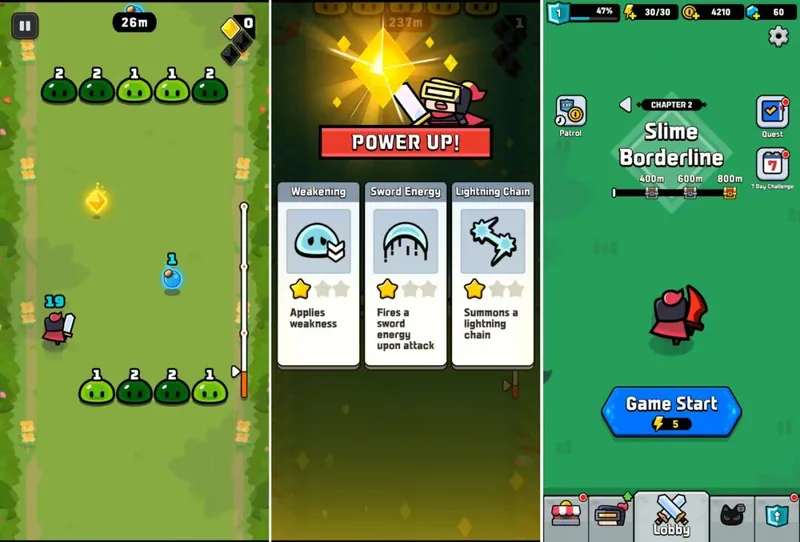
Here’s how it works:
- The core play comes from Snake vs Block, the ultra-simple pick-up-and-play game that was a big hit for Voodoo a few years ago. You steer a snake around blocks. When the snake touches a block, the block disappears and the snake loses as much health as the block had. Hit a block with more health than the snake has left, and the game is over.
- On top of that, everything gets a new look: the snake becomes a character and the blocks become monsters. Around the core sits the whole progression layer of the Archero games, with stages to clear and levels to gain, skill upgrades, and weapons and gear.
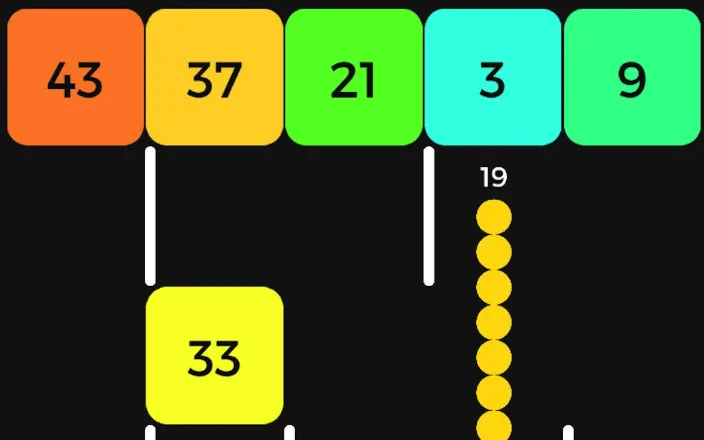
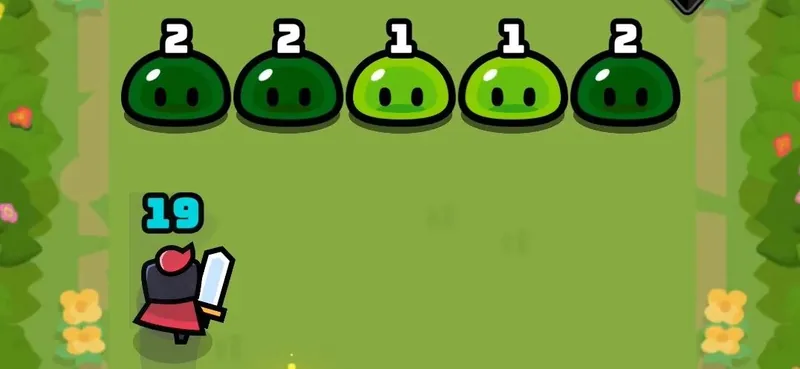
Another look at the game:
Cutting Through Rows of Numbered Slimes
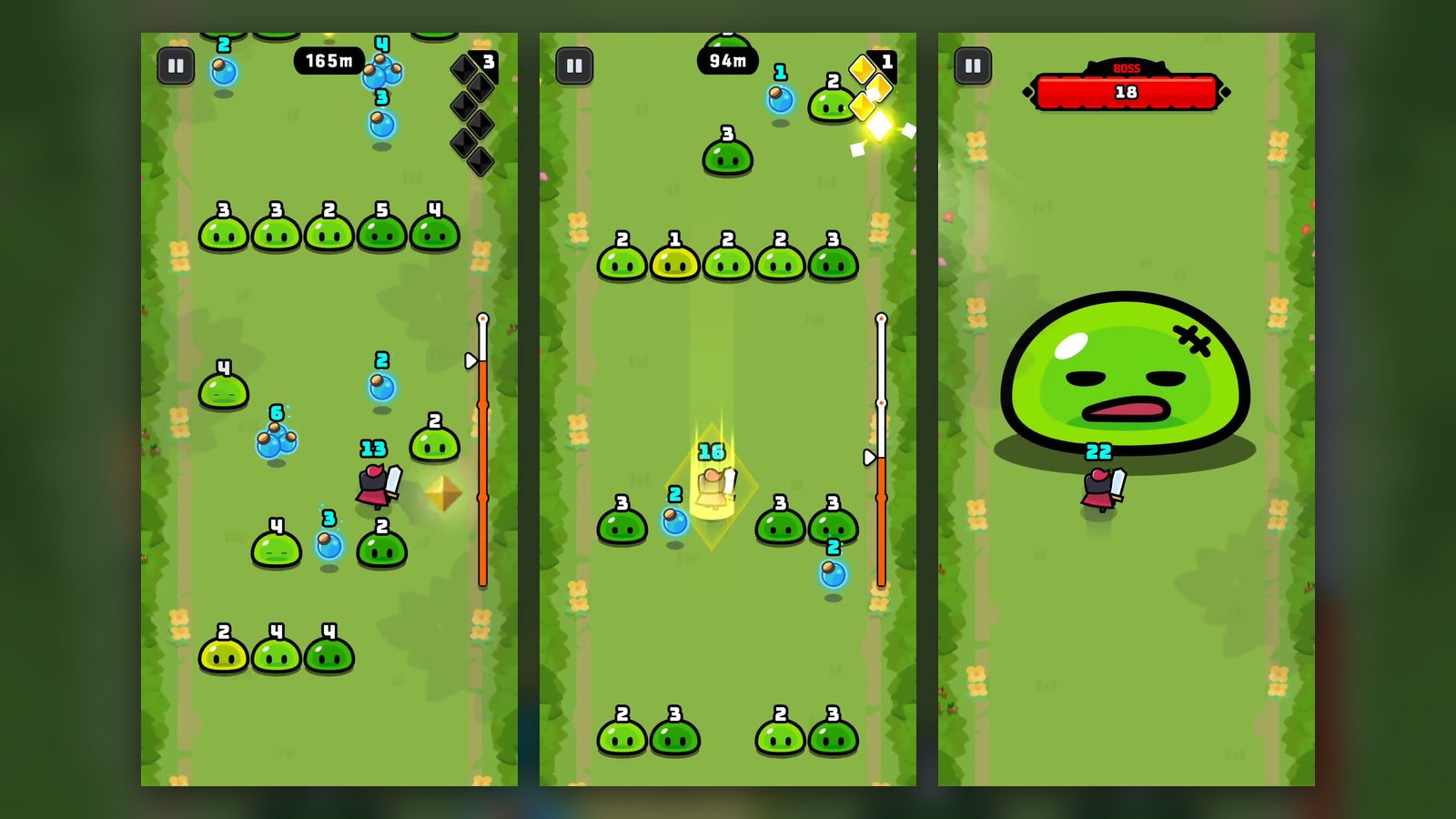
The hero is a small knight with a dark helmet, a red plume, a cape and a white sword, drawn in flat cartoon art with thick black outlines. The screen is portrait and the camera stays fixed. The knight holds the lower middle while the path moves past and a distance counter at the top center climbs in meters. The player steers the knight left and right, it swings its weapon at the slimes it meets, and a pause button sits in the top-left corner.
The first run we played, Chapter 1, “Slime Borderline,” opens on an empty grassy path between leafy hedges with orange flowers at 5m. The knight stands alone with a cyan 20 over its head. That cyan number is the limit shown on screen: it falls as the knight cuts through slimes and rises again, and in the following run it drops as low as 4 at 295m.
Slimes stand in rows of five across the path, some rows with gaps, and others sit on their own, each with a white number above it. At 19m the first hint, “Counter the weakest enemy,” appears under a white up arrow as the knight reaches a row of small slimes.
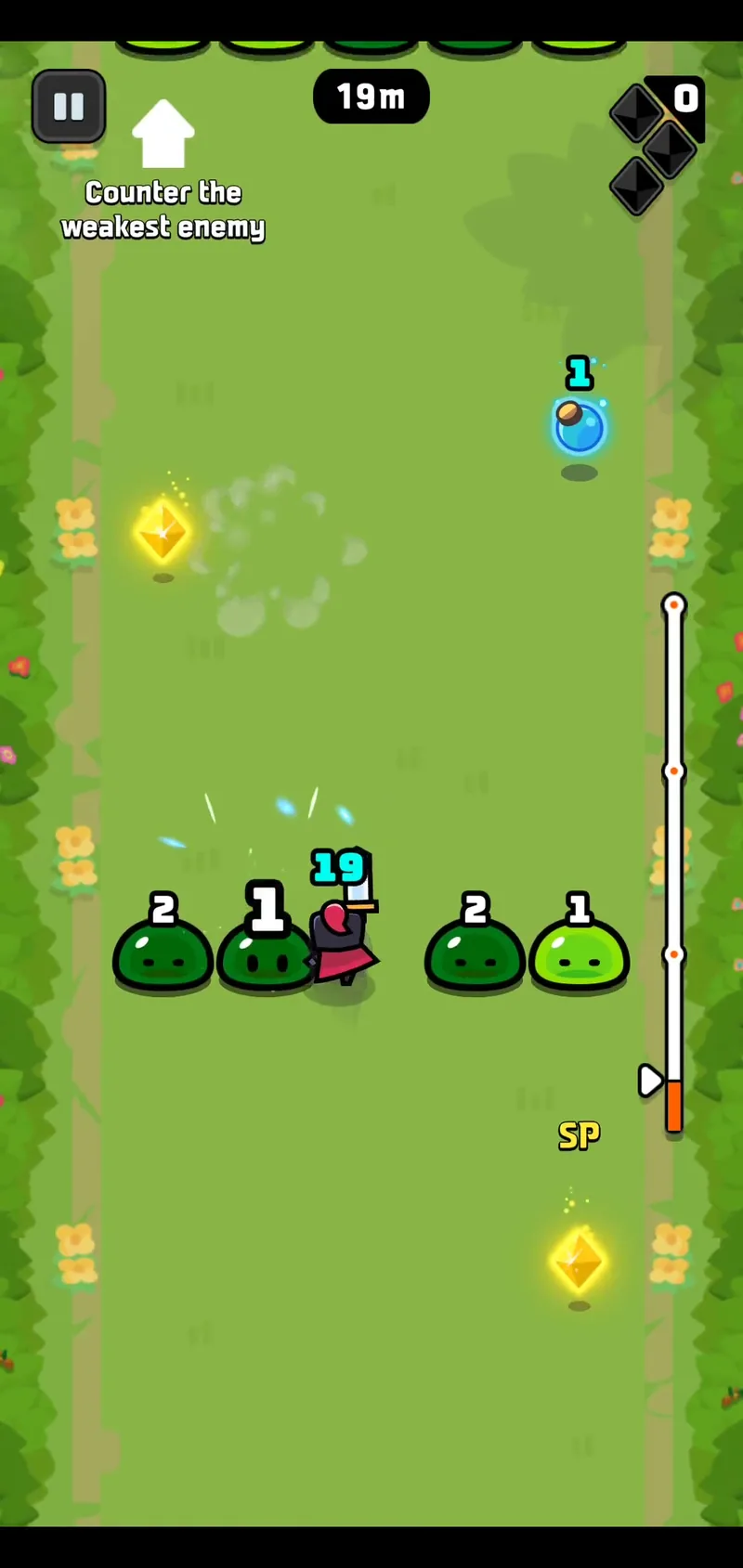
Hits throw blue slash streaks and white sparks, and the numbers on struck slimes grow larger, some turning yellow. Knocked-out slimes flip over with X eyes. The slimes range from yellow-green to dark green. On a single stretch of path the higher numbers are usually on the darker slimes, though the same number can show up in a different shade further along.
The numbers climb with distance. The highest on the path is 2 at 34m, then 3 at 80m, 4 at 115m, 5 at 159m, 6 at 178m and 7 at 188m. By 199m most slimes carry 6 to 8.
Round blue flasks with corks lie between the rows, each with a cyan number from 1 to 3, the same color as the knight’s number. From 115m, bundles of three flasks appear under a single number, 4 or 6. The knight’s number goes up after these potion stretches: 12 at 66m with five potions ahead, then 19 by 80m, and 13 at 165m beside bundles of 6 and 4, then 27 by 178m.
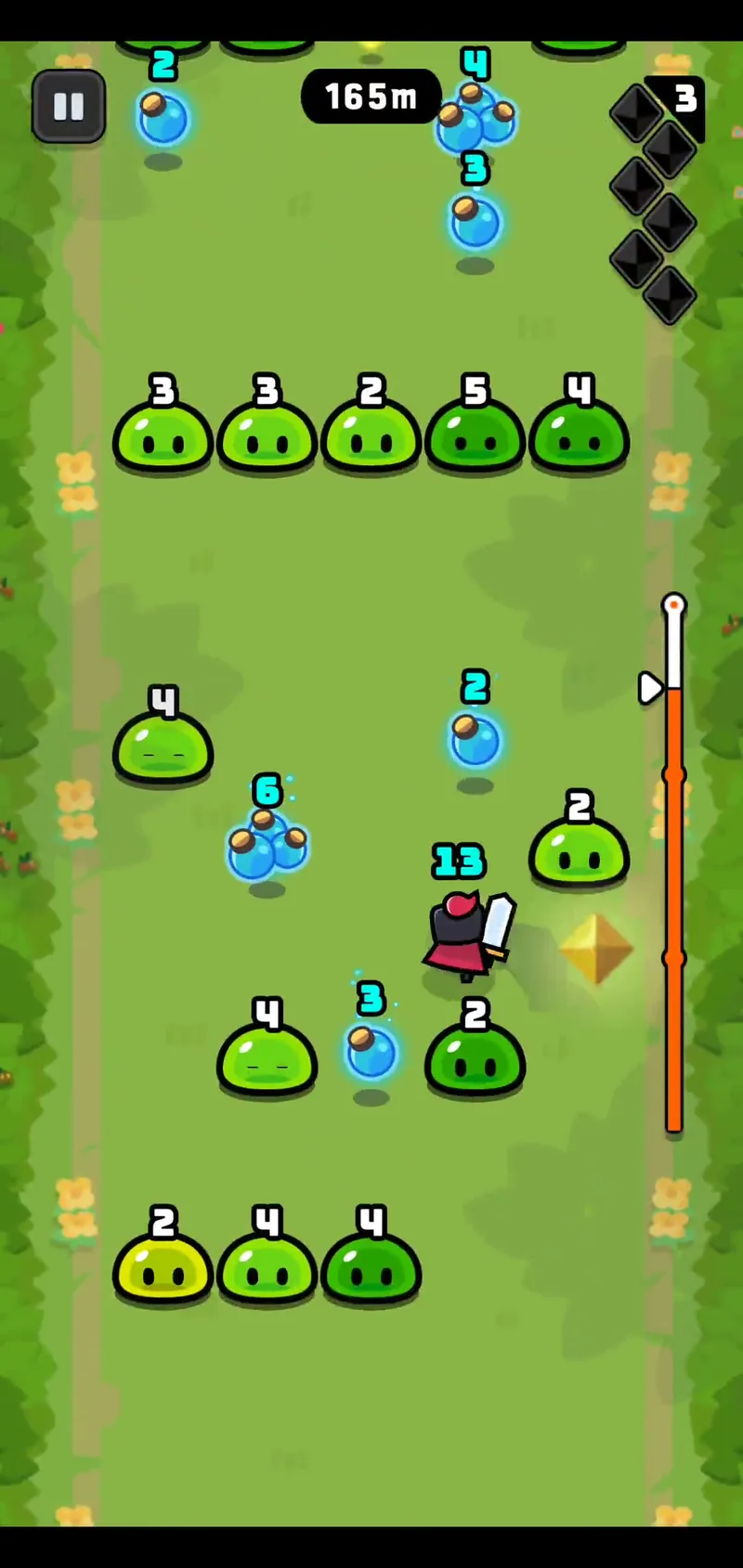
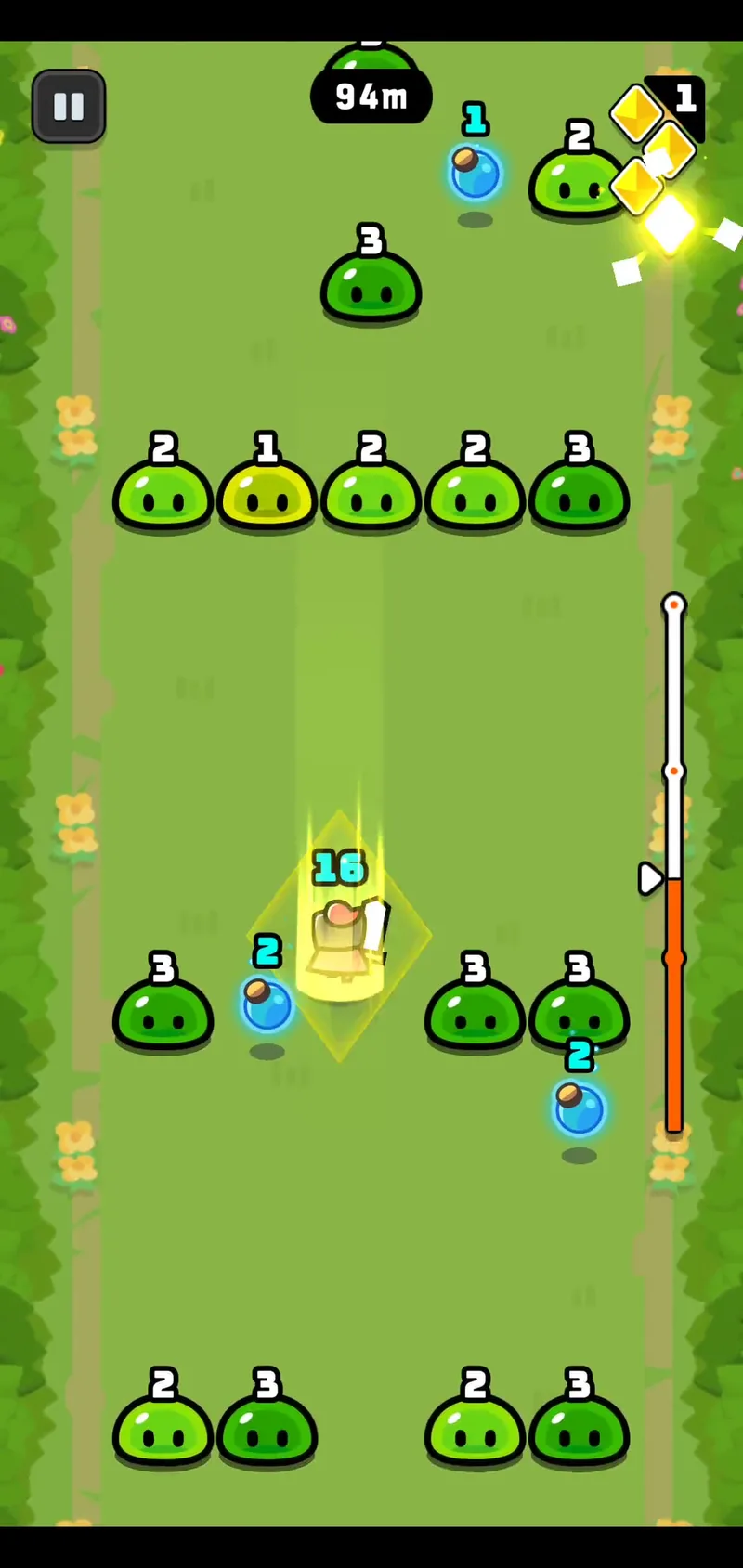
Glowing yellow gems with no number also lie on the path. When the knight picks one up, a yellow diamond flashes over it and a slot in the diamond gauge at the top right lights up yellow. The gauge has a number beside it and gains a slot as that number rises: three slots at 0, four at 1, five at 2 and six at 3 by 165m.
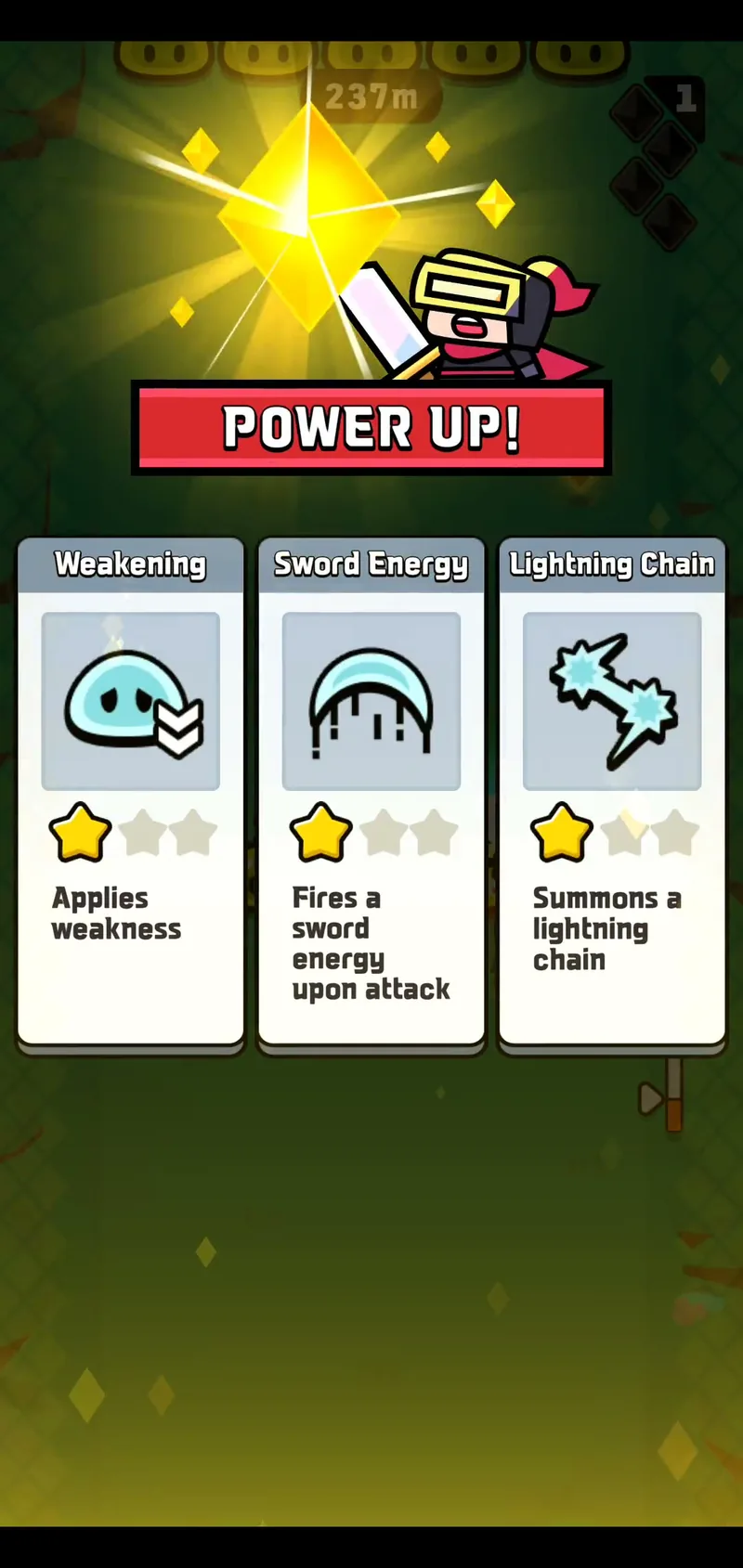
A POWER UP! banner breaks into the first run at 41m, 66m and 132m. It dims the field behind a large glowing yellow gem and a cartoon knight with a yellow visor, then shows three cards, each with a name, an icon, a one-line effect and one of three stars filled. On the early screens only the left card is face-up while the other two are gray or narrow, as if still turning. At 237m in the next run all three are face-up.
The cards seen are Back Attack (“Deals additional damage to 1 tile after 3 attacks”), CRIT + (“CRIT RATE Increase”), Sword Energy (“Fires a sword energy upon attack”), Weakening (“Applies weakness”) and Lightning Chain (“Summons a lightning chain”). At 299m a blue crescent slash shaped like the Sword Energy icon hits a slime ahead of the knight.
The path holds a few obstacles as well. At 66m two log halves lie across it on either side of the knight, which stands in the gap between them. At 129m a large gray rock labeled 10 covers most of the path just ahead of the knight, which then shows 18. Right after, broken chunks lie behind the next POWER UP! cards.
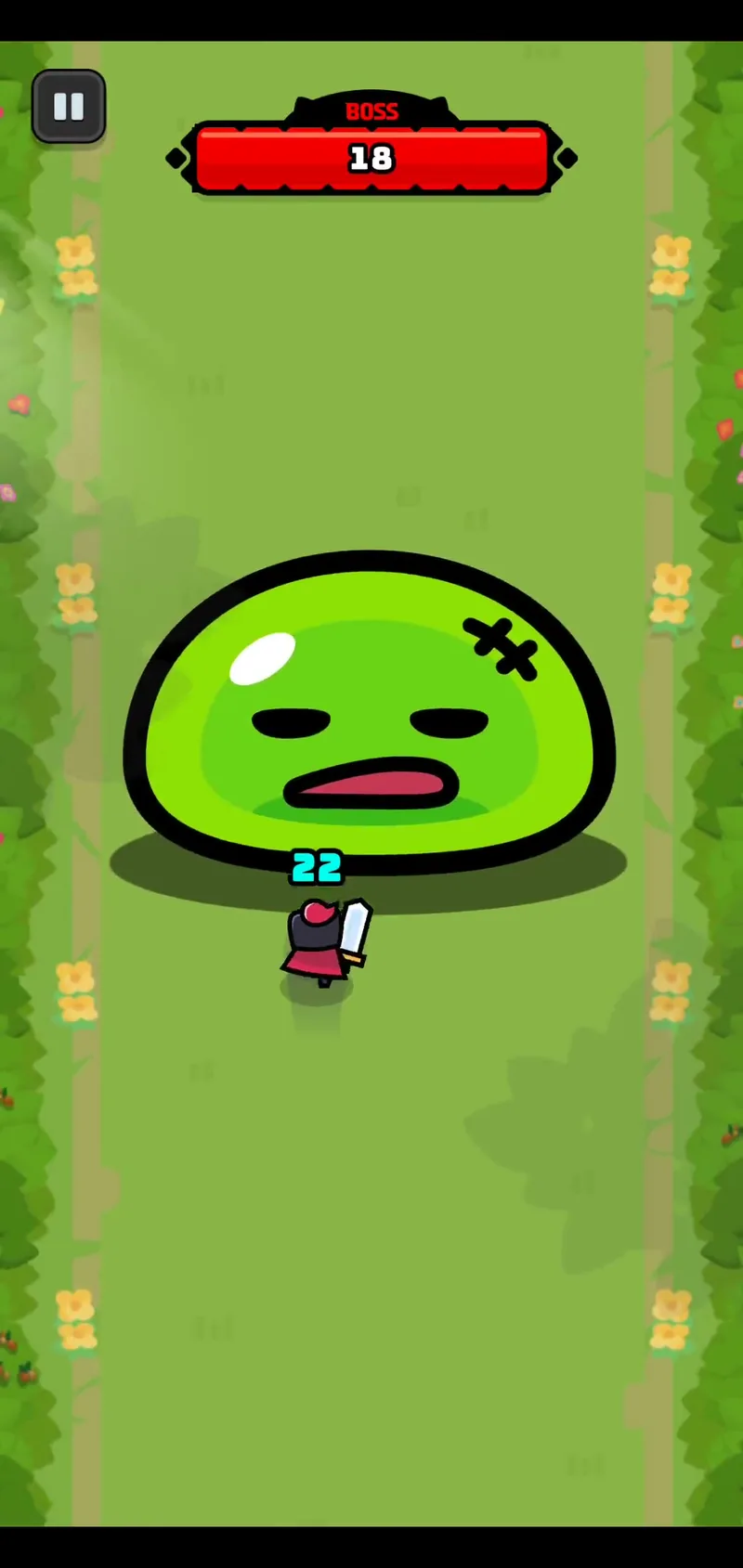
A progress bar with three dots on it runs along the right edge. It fills along with the distance counter and is full at 199m. A giant green slime with a stitched scar and a sleepy face then fills the path, and a red BOSS bar reading 18 replaces the counter while the knight shows 22.
Moments later the boss lies flattened with X eyes as gold coins and green blobs fly up the path, and the knight’s number reads 7. A results screen follows, with the slime crowned on a blue zigzag background with confetti. Below it sit a red banner over “BEST SCORE” and a bar with a pink BEST tag, gray chests at 67m and 134m, and a gold-and-red chest at 200m.
The next run moves to a darker green path with rocky ledges, small trees and teal bushes. At 211m the knight shows 28, the progress bar is nearly empty and the gem gauge is back to three slots and 0. The slimes there are yellow-green and numbered 1 and 2, and the numbers climb again to 4 at 266m, 5 at 272m and 6 at 295m, with green slimes back among the higher ones.
In this run the knight carries a red curved blade in place of the white sword. The POWER UP! banner comes up at 237m and again at 266m, and at 299m the progress bar is still only partly filled.
Between runs, a top bar shows a teal shield badge with a 1 and a progress bar at 47%, a lightning-bolt meter at 30/30, and coin and diamond counts, each with a plus sign. Five tabs run along the bottom: Shop, Equipment, a crossed-swords tab, a black cat with a padlock, and Growth.
The Equipment tab places six gear slots around the knight, three on each side. A blade, a helmet and body armor are on the left, and a glove, a hexagon and a necklace are on the right. Below them are Rarity and Merge buttons and an inventory holding one red curved blade marked Lv. 1.
The Shop tab opens with a one-time pack tagged “200m Clear!” and “Limited Once” that reads “Are you stuck? Break through!” and “50 Weapon Scrolls for All Types!” It shows an ALL scroll marked 50 and 12.0K coins, with a “500% Worth!” badge and $12.45 crossed out next to $2.49. The Daily Shop, which “Resets in: 15h 47m,” lists 30 free diamonds, Armor Scroll x3 and Gloves Scroll x3 at 6000 coins each, Necklace Scroll x5 at 10000 coins, and Lightning Swords at 200 and 300 diamonds.
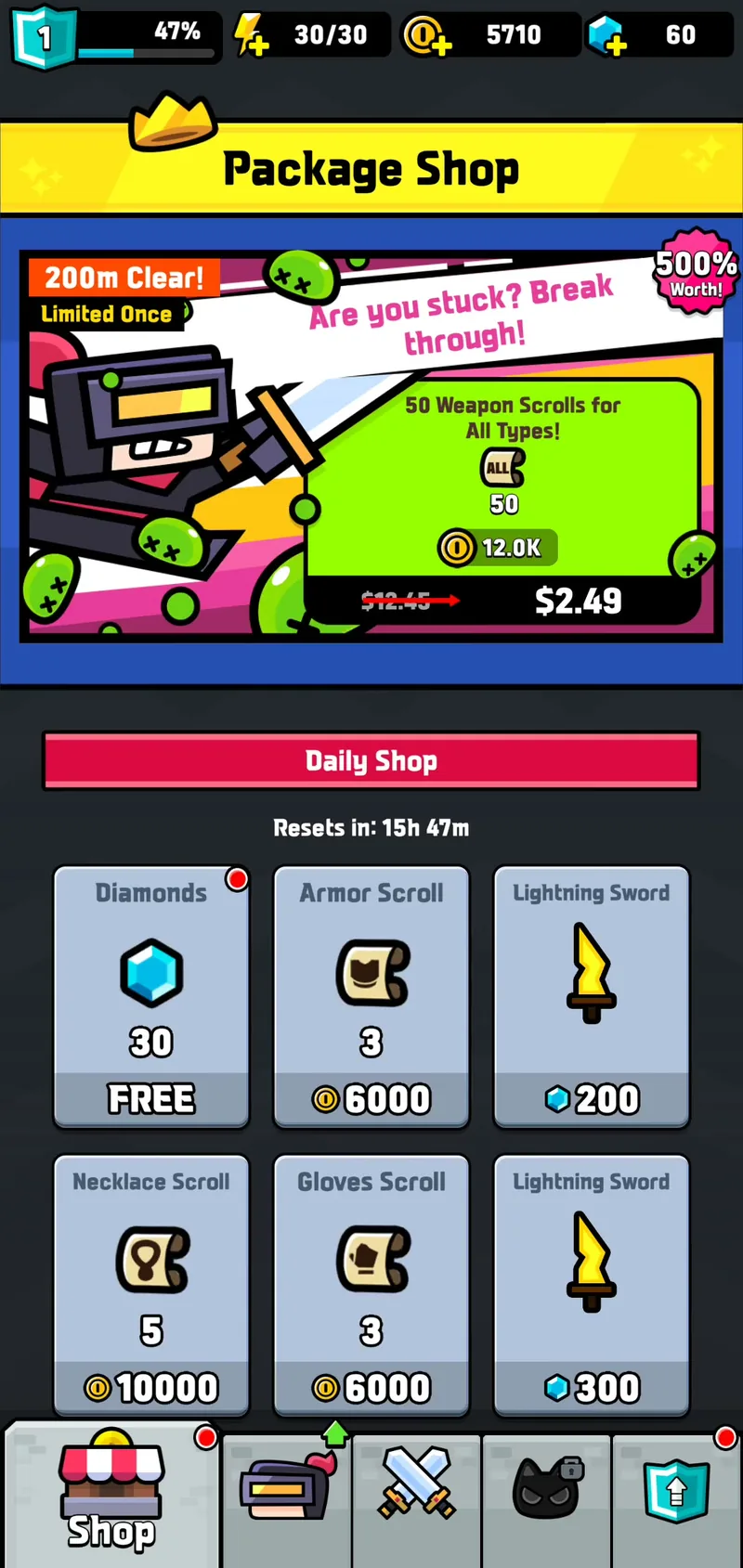
Further down the shop, a blue-and-gray chest and a gold-and-red chest each have a green AD button and a key counter at 0/1. The Diamond Shop sells diamonds for real money: 80 for $2.49, 500 for $4.99, 1.2K for $8.99, 2.5K for $18.99, 6.5K for $49.99 and 14.0K for $99.99. In the Gold Shop, 2h Patrol Gold gives 1.0K coins marked FREE with an AD icon, 6h Patrol Gold gives 3.0K for 90 diamonds and 24h Patrol Gold gives 12.0K for 288 diamonds. The AD marks on the chests and the free Patrol Gold are optional reward buttons.
The Growth tab lays out square upgrade nodes on a vertical track. It runs from a lit blue heart at the bottom up through gray nodes with potion icons to a gray heart, with teal shields numbered 1, 2 and 3 beside it. On this tab a purple orb at 0 takes the lightning meter’s place, and the coin count reads 4210, down from 5710 on the Shop tab just before.
How it rates
It’s rated on three counts:
| Aspect | Score | Comment |
|---|---|---|
| Core gameplay fun | 7 | Fun, but not much fun to control |
| Originality | 8 | A very good angle for a fresh idea |
| Art style | 7 | Similar to Archero’s look |
Overall:
- Overall score: 8.
- The play is a pretty good new spin. Crossing a bite-size, pick-up-and-play game with a midcore one is a very good starting point.
- The main problem right now is the way combat works, which limits how much fun the controls can be. The sense of control that Archero has is missing. It comes down to sharp eyes and quick fingers, and the core isn’t quite fun enough.
- New skills or new mechanics built on this base would give the core play more variety.
More from this series:
Pipe maze puzzles + matching: an idea with real potential
Tomb-style mazes + RPG monster fights: puzzle fun blended with roguelite runs
Ball sorting in measuring cups + mazes: a good idea with plenty of puzzling and lasting appeal