Calculate Cannon Review: Six Calculators, One Color War
Six colors fight over a pixel board, and a ball landing on R fires that color's cannon: a Calculate Cannon review of a battle run by sums.
Game at a glance
Calculate Cannon
4/ 10
Our score
Plenty of logic, not enough fun. Turns out math really does make you rational.
In this article6 sections
Watch a single ball drop through rows of gray pegs into a numbered slot, and a running equation grows by one step: ‘90 + 72 = 162’. When the ball lands on a slot marked R instead, that color’s cannon fires a stream of balls across a pixel board. That is the engine of Calculate Cannon, a 2D battle royale between six colors that runs on arithmetic, which puts it with the logic puzzles rather than the shooters.
The calculator itself, with math rules that shift from row to row, is the highlight. Across the single eight-minute match we played, though, those rules gave plenty of logic and not enough fun.
How a peg panel feeds each cannon
A black card opens the match with ‘Who will win?’ above ‘Red VS Orange VS Yellow VS Green VS Blue VS Purple’, each name printed in its own color. No other goal appears, and there is no timer, move counter or fail screen. Each color starts with one block of the board and one cannon, and it loses that cannon, together with its side panel, when another color’s area covers the cannon’s spot. The match ends with a win for the color that holds every cannon.
Nothing on screen asks for a tap, and no button or menu ever appears. The panels and cannons run on their own from the opening card to the end, and whether a player can pick a side or sway the result is never shown.
Stripped down, Calculate Cannon gameplay is a short loop. Each landing grows an equation until an R sends that color’s cannon firing, and the stream turns other colors’ cells into its own until its color covers an enemy cannon’s spot, which makes that cannon switch sides. By mid-match several streams cross the board at once while the panels keep calculating.
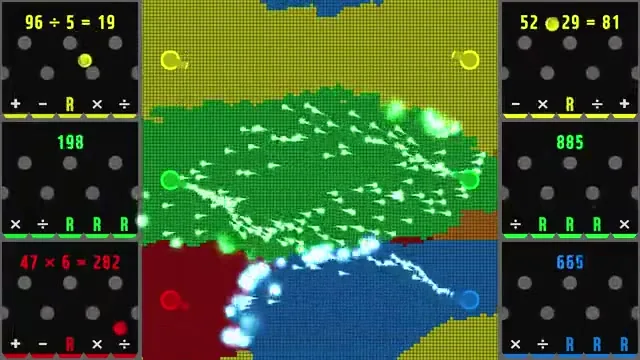
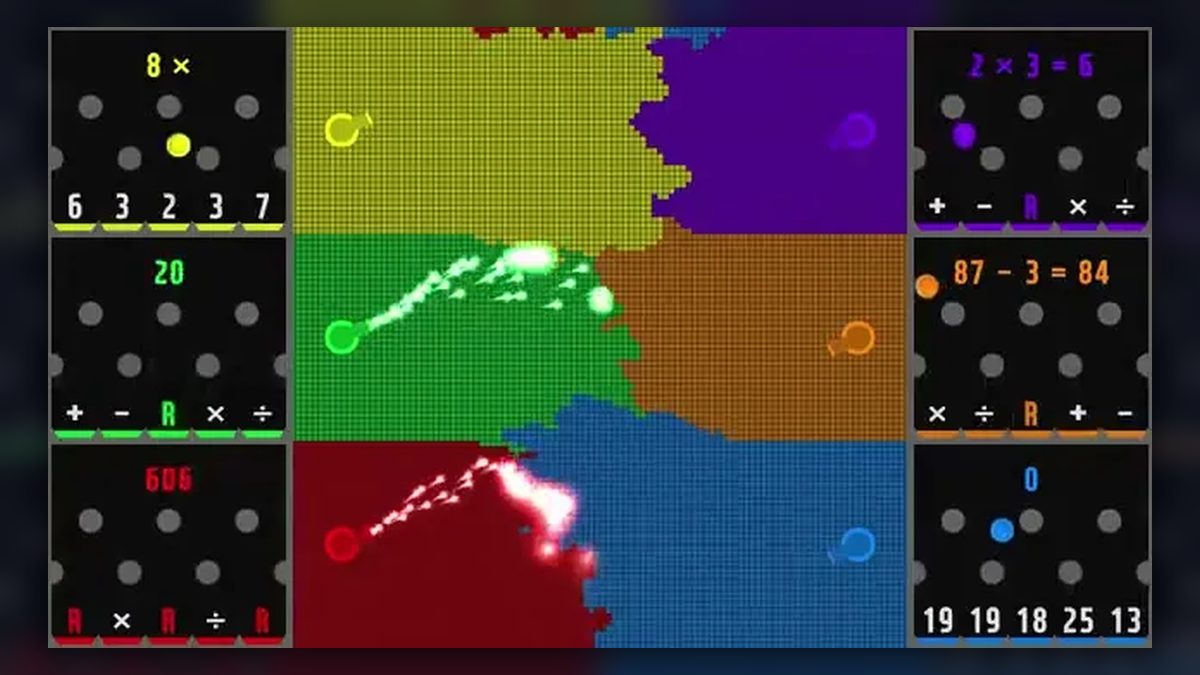
Each color has its own black panel beside its block, three down the left of the board and three down the right, with numbers printed in that color. Staggered rows of gray pegs sit above a row of five slots, and a single ball in the panel’s color works its way down through the pegs. The slot it reaches lights up and its value joins the equation at the top, as when purple’s ball lands on 32 and the panel gives ‘2 + 32 = 34’.
The slot row switches between numbers and operators such as ‘+ − R × ÷’, and each result becomes the first number of the next equation. The values change from row to row. Rows that follow ‘×’ or ‘÷’ hold small numbers like ‘4 4 6 5 3’, while rows after ‘+’ or ‘−’ mostly hold two-digit ones.
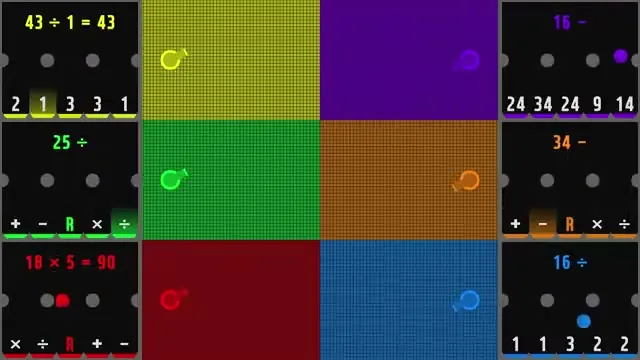
The R slot is the trigger. When a panel’s ball lands on it, that color’s cannon fires a stream of balls, and the number on the panel counts down while the firing lasts. Once a cannon has fired, its panel starts over from a fresh number, the way purple’s drops to 0 and then begins again at 24.
Red’s panel runs through a full cycle. It opens at 18, and its first equations are ‘18 × 5 = 90’ and ‘90 + 72 = 162’. Two subtractions later it sits at 141; an addition takes it to 184, and a multiplication by 4 follows. Then the ball finds R, and while red’s cannon fires, red’s number falls from 722 to 606 and keeps dropping until it hits 0, with red’s stream biting deep into blue’s block.
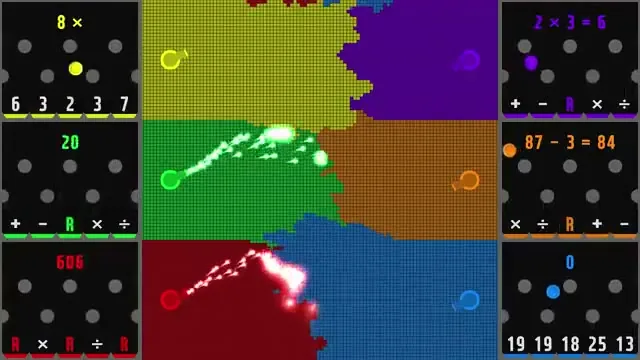
Early operator rows carry one R among their five slots, but later rows can carry two or three. Red’s row is ‘R × R ÷ R’ while it fires, and once yellow reaches ‘280 × 8 = 2240’, the operator row below shows ‘÷ R R R ×’. Yellow’s number then drains through 1788 and 1097 down to 85, and yellow streams keep crossing the board as it falls.
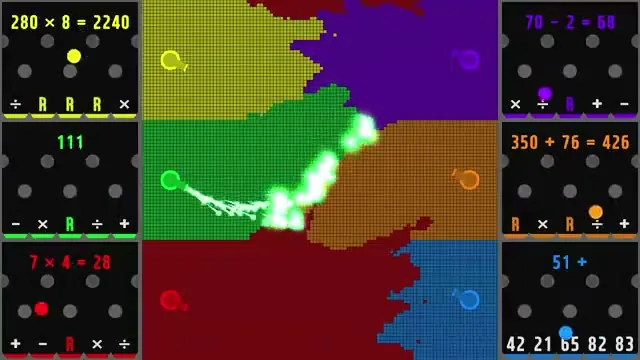
Results always come out as whole numbers, so ‘25 ÷ 2’ gives 12. Subtraction can also dip below zero: the top-right panel at one point gives ‘46 − 49 = −3’, and blue’s later reaches ‘13 − 50 = −37’.
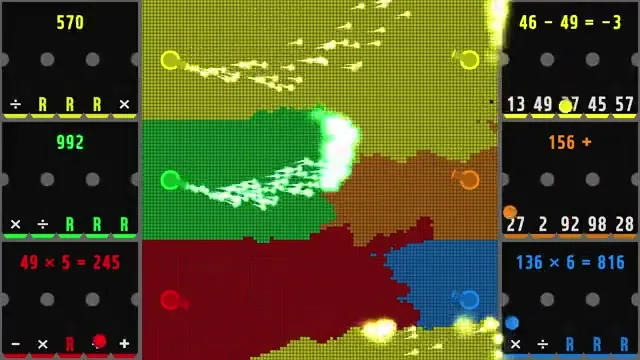
Every cannon is a plain ring with a short barrel near the outer side of its block. The barrel points a different way from one moment to the next, and the streams, dense runs of balls with white trails, leave at different angles, sometimes several fanning across the board at once. Where one meets another color on the flat 2D grid of fine square cells, there is a bright flash and the border moves; early on, purple bites a jagged notch out of yellow’s block.
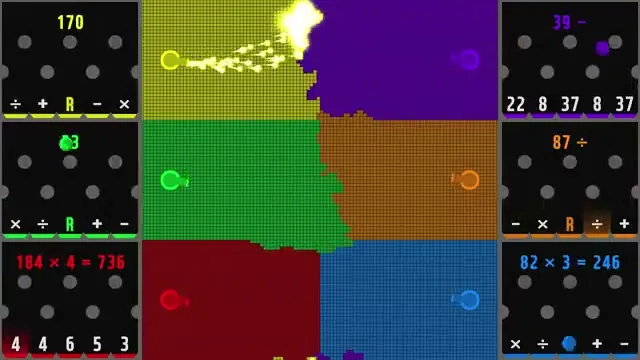
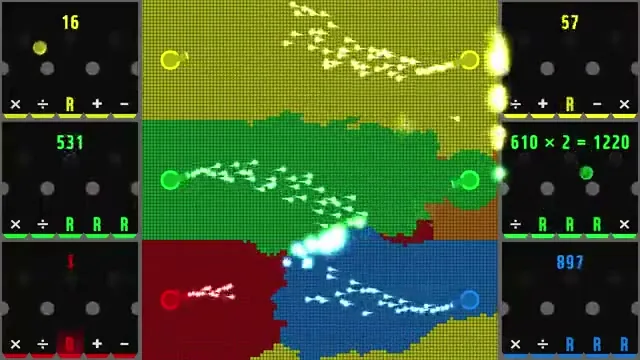
When a color’s area covers an enemy cannon’s spot, that cannon and its side panel switch to the new color, and the panel carries on from its old number. Orange’s panel ends on ‘1830 ÷ 3 = 610’ just before green takes it, and its next equation, now in green, is ‘610 × 2 = 1220’. A cannon can change hands more than once, as the top-left one goes from yellow to green and back. Cells can also outlast their cannon, leaving small patches in a color that no longer holds one.
From six even blocks to a yellow sweep
The board starts as six equal rectangles in a two-by-three grid. Yellow and purple share the top row, with green and orange below them and red and blue at the bottom. Every block holds one cannon, and every panel sits beside its own block.
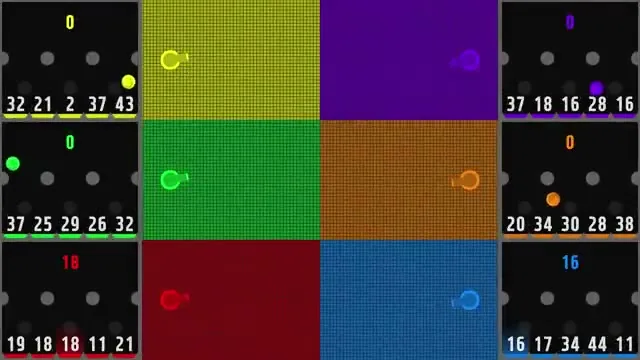
For roughly the first two minutes, the fight is all about borders. All six colors fire and the straight edges between blocks turn ragged, and red pushes deep into blue’s block, but no cannon changes hands. The first takeover comes at the top right, where purple’s cannon and panel turn yellow and a small purple patch is left at the right edge.
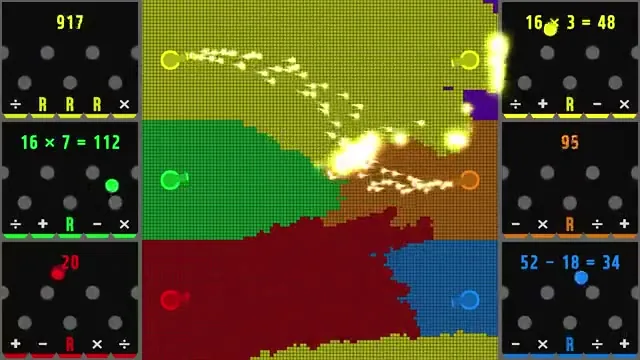
After that, the takeovers start. Green takes orange’s cannon and blue takes red’s, and when green also wins the top-left cannon from yellow, only three colors still hold any. Green now has half of them, while blue keeps both bottom cannons and yellow is down to the top-right one.
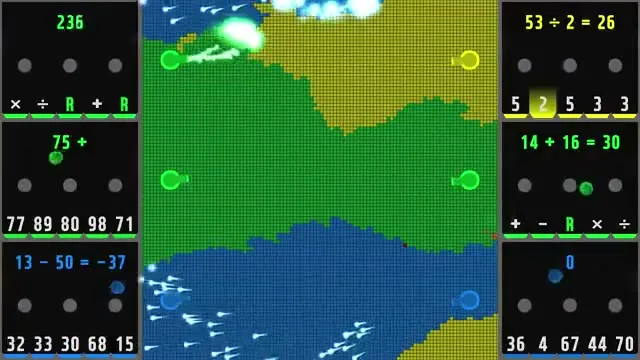
Yellow then turns the match around. It wins back the top-left cannon and works its way down the board, taking the middle-left and bottom-right cannons before the middle-right one falls too. That leaves blue holding only the bottom-left cannon.
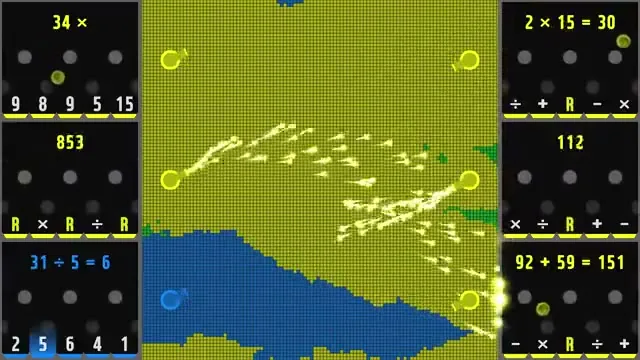
In the closing stretch yellow pushes into blue’s last corner, with moments when no balls are in the air at all. Then the bottom-left cannon turns yellow, and ‘Yellow Win’ appears over the board in yellow and white, with ‘Thank you for watching :D’ beneath it, though a small blue patch is still there.
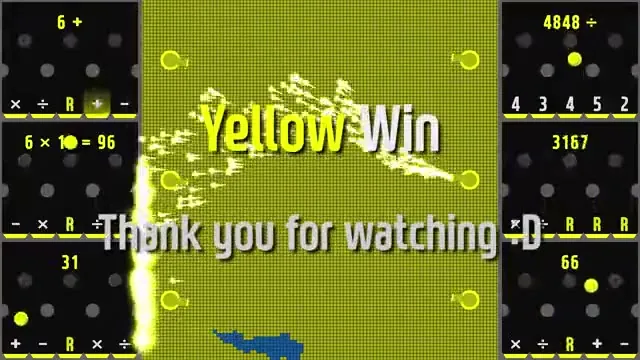
Around the match itself, nothing else appears: no menu, shop, currency counter or ad offer turns up between the opening card and the closing words. There is no sign of other matches or settings either.
Math rules that change on every row
A calculator that keeps rewriting its own math was new to us. Every row hands a panel a fresh set of numbers or operators, so red multiplies by 5 and, two equations later, subtracts 12, while yellow jumps from 280 to 2240 with a single ‘× 8’. Each panel builds its own chain this way, six running equations side by side.
Calculator logic to spare, fun in short supply
There is more than enough logic in the calculator play, and not enough fun. The logic is on show to the very end: with yellow covering nearly the whole board, the panels are still turning out equations such as ‘24 − 68 = −44’. Math, it seems, really does make things rational.
Running totals on six side panels
These mechanics line up with a taste for following arithmetic as it happens: tracking each panel’s running result and spotting a row stacked with R slots before a number in the thousands starts to fall. On the board, those numbers play out as a color war, with streams pushing borders back and forth and cannons switching owners. The ‘Who will win?’ card invites a guess before the first ball drops, and the match plays out to its answer without asking for any input.
Verdict
As an idea, a calculator steering a six-color war is a first for us, and it is Calculate Cannon’s bright spot. The arithmetic, though, carries more logic than it needs and less fun than it should, and the game lands on the low side overall.