Color Tile Connect Review: Matching Fruit Across Links
Color Tile Connect review: ready-made fruit tile bars fill outlined frames, and each thin link must join two cells holding the same fruit.
Game at a glance
Color Tile Connect
6/ 10
Our score
A familiar tile look turns out to fit a new set of puzzle rules.
In this article6 sections
Color Tile Connect is a puzzle game built around a reasonably fresh idea. It still has the size and look of a small casual game, and it seems better placed as an occasional daily or challenge stage than as a long run of main levels.
Its fruit blocks borrow the chunky style of tile match games, the kind built on tile matching with a small tray, but here they do a different job. Ready-made bars of tiles go into empty outlined frames, and thin links between the frames call for the same fruit at both ends. Over the stretch we played, Levels 4 to 10, the boards grow from two small frames to long chains that reach about halfway down the screen.
Fruit bars fitted into linked frames
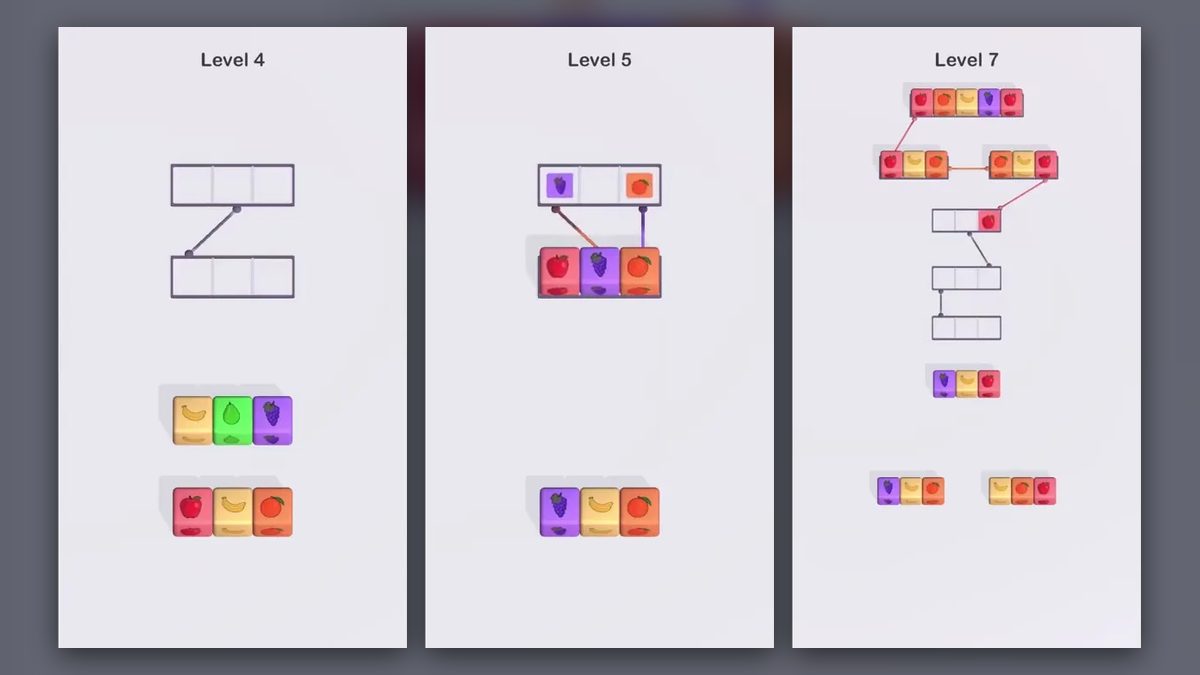
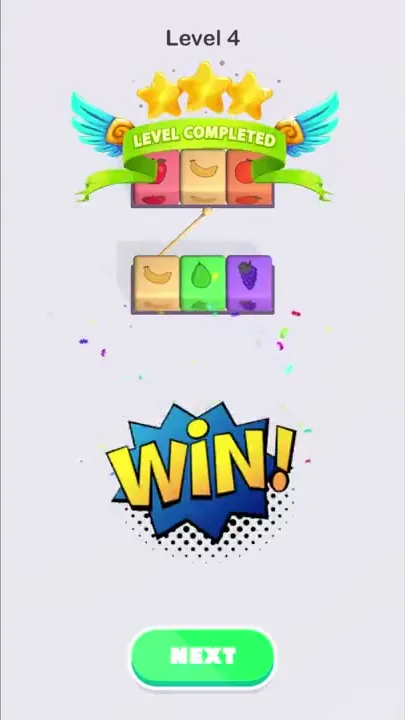
Every level puts a few empty frames on a pale lavender-gray screen in a fixed portrait view, with bars of fruit tiles waiting below them. A level is won when every frame holds a bar and each link has the same fruit at both ends. Level 4 has a single link and finishes with a banana at both of its ends.
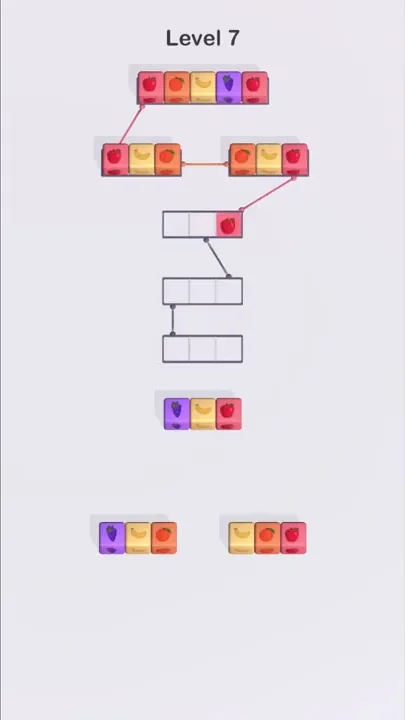
The frames are thin dark-gray outlines divided into cells, and each one takes a single bar. Most hold three cells. Level 7 has a five-cell frame, and Level 10 mixes five-cell and four-cell frames. The whole puzzle fits on one screen and reaches further down it as levels add frames.
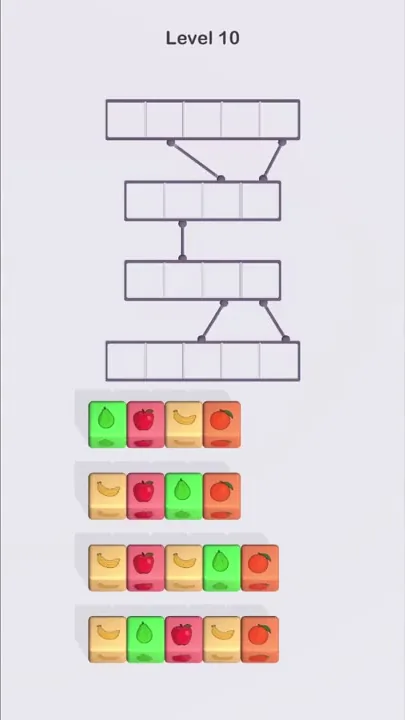
The pieces are ready-made rows of three, four or five glossy blocks that move as one, and each bar rests on a soft shadow. Every tile shows a cartoon fruit on its own color: banana on pale yellow, pear on green, grape on purple, apple on pinkish red and orange on orange.
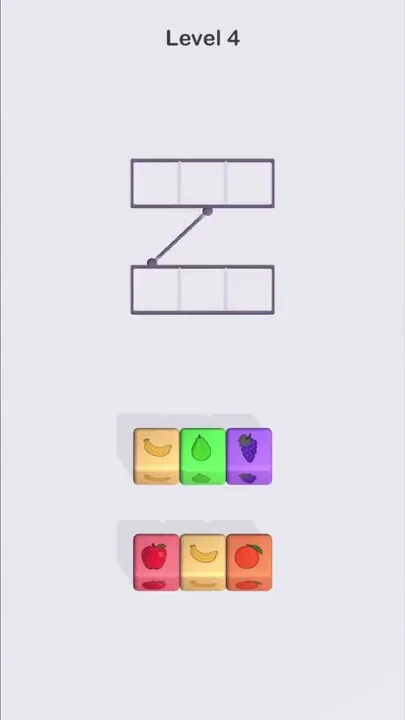
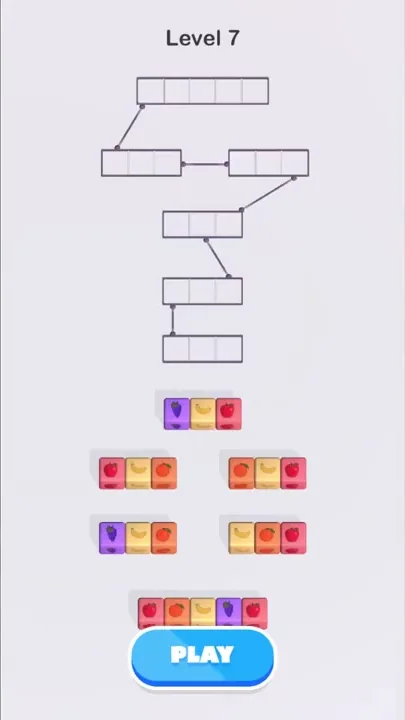
Bars move up from the area below the board into the frames as whole pieces. Each bar seen on the board sat in a frame of its own length, as the five-tile bar in Level 7 did when it went into the five-cell frame.
Links are thin gray lines with a round pin at each end, and each one joins a cell of one frame to a cell of another. Once a bar is in place, the empty cells linked to it show a flat copy of that fruit tile. The copy is sometimes small and sometimes fills the whole cell, and the remaining bars go in so that the linked fruits match. In Level 5, an apple, grape, orange bar in the lower frame puts a grape preview in the upper frame’s left cell and an orange in its right cell. The middle cell stays blank.
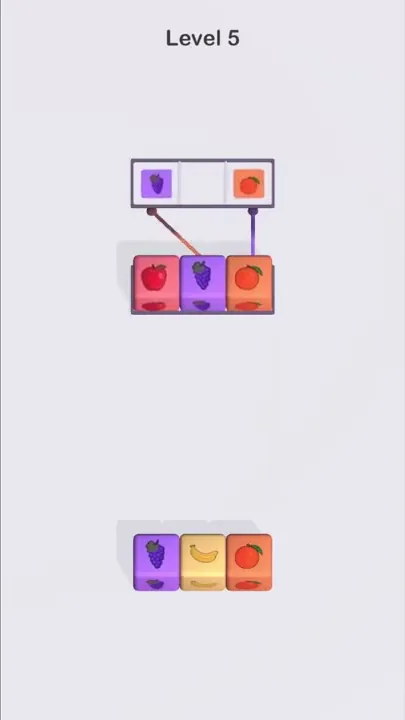
As tiles go in, the links swap their gray for color. Most links run between frames stacked above and below each other. In Levels 7 and 9 some join the end of one frame to a frame beside it, like the short horizontal link between Level 7’s two side-by-side frames.
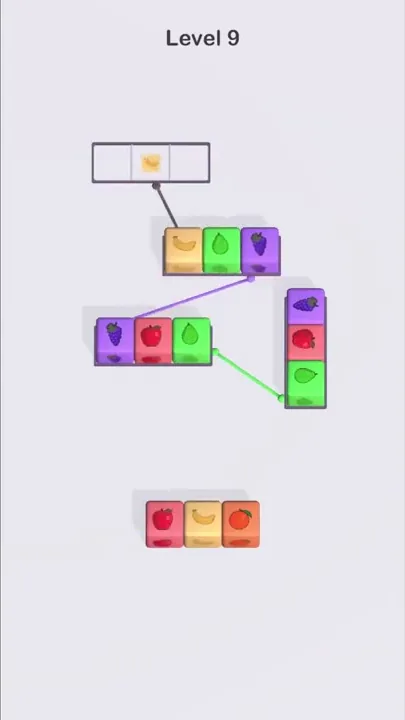
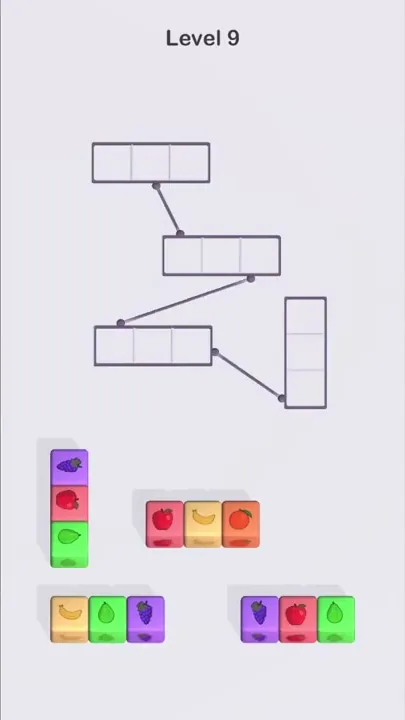
Level 9 stands a three-cell frame on end and pairs it with a vertical bar of grape, apple, pear from top to bottom, with the grape and the pear drawn turned sideways. Once the vertical bar sits in the upright frame, its bottom cell is linked to the pear at the end of the horizontal bar beside it.
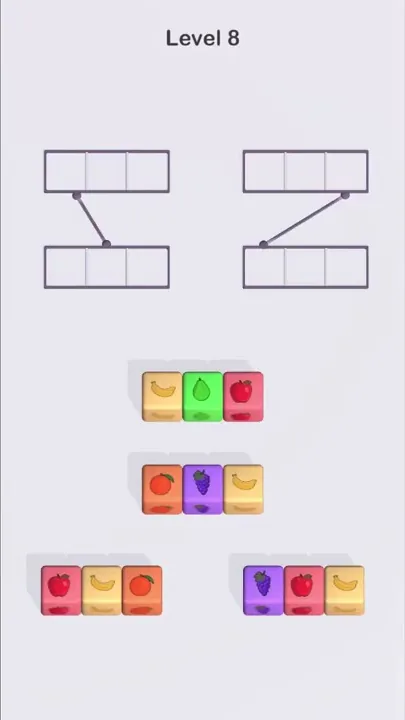
Four three-tile bars wait under two pairs of frames in Level 8, with one link in each pair. The first order tried puts banana, pear, apple over apple, banana, orange on the left, then orange, grape, banana in the upper-right frame. That leaves a banana preview in the left cell of the frame below it, but the only bar still waiting starts with a grape.
The bars then come back off the board and the opening layout returns. On the second attempt, grape, apple, banana goes over orange, grape, banana on the left, and banana, pear, apple takes the upper-right frame with an apple preview beneath it. The bar left over, apple, banana, orange, begins with an apple.
A placed bar can leave its frame and return below the board, and the previews it made fade. Level 10 shows the same reset as Level 8: one bar comes back out, and later the whole board is back at its opening layout with every bar in its starting spot. One bar was also seen resting between the tray area and the board, away from where it started.
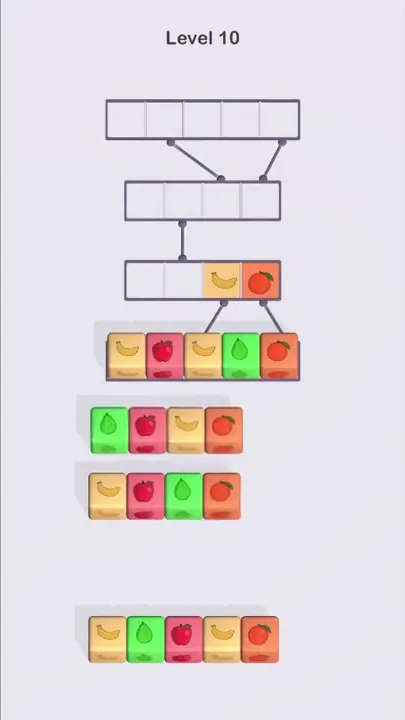
Boards that grow from two frames to long chains
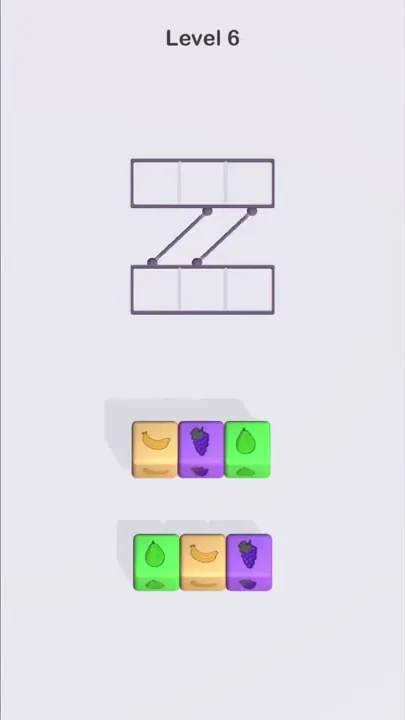
The earliest boards have two stacked three-cell frames and two three-tile bars. The first of them, Level 4, joins its frames with a single link. The next two use two links in different positions, and on the Level 6 board that pair runs as parallel diagonals.
Board size jumps with Level 7, where the frames form a chain joined by five links: a five-cell frame on top, two three-cell frames side by side below it and a column of three more. That brings the first five-cell frame and the first side-by-side link. Its bars are five three-tile bars and one five-tile bar. Of the level starts seen, only this one has a blue PLAY button under the board. By the time its win screen appears, all five links join matching fruits.
Layouts also split apart. Instead of one linked group, the frames on the Level 8 board form two unconnected pairs side by side.
Piece shapes change too, as Level 9 sets an upright frame to the right of three horizontal frames in a zigzag. Its vertical bar waits among the horizontal ones below.
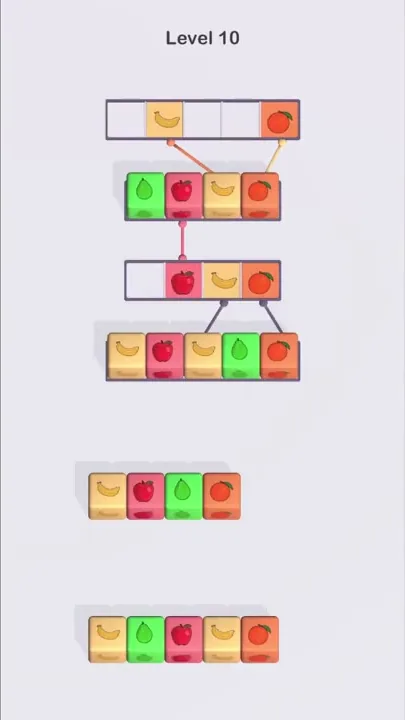
Bar length grows as well. Four-cell frames and four-tile bars first show up in Level 10, where every bar is four or five tiles long. Its four frames are five cells wide at the top and bottom and four cells wide in between, and its two four-tile and two five-tile bars carry no grapes. The two middle frames link both up and down. At one point the third frame shows previews from both sides at once: an apple from the link above, plus a banana and an orange from the links below. The two five-tile bars each took a turn in the bottom frame, and the board was left unsolved.
On the play screens seen, the only label is the level number at the top. A finished level brings up a win screen with a green LEVEL COMPLETED ribbon with wings and three gold stars over the board. Below the ribbon, a comic-style WIN! burst and confetti fill the middle of the screen, and a green NEXT button sits at the bottom. Each of the three win screens seen shows three stars.
Familiar fruit tiles carrying a new rule
The linking rule gives the design something new for the genre, to a fair extent. The task is ordering whole bars so that each link meets the same fruit at both ends. In Level 6 both bars hold the same three fruits in different orders. The finished board has pear, banana, grape above banana, grape, pear, which puts a banana pair and a grape pair on the two links, now drawn in yellow and purple.
The game also shows how an existing look and animation, wrapped in tile-style packaging, can carry new rules. Its glossy fruit blocks resemble the pieces of tile matching, yet here they are fixed rows that slot into a diagram of outlines and pins. On the Level 4 board, that diagram is just two empty frames and a single link, with two three-tile bars waiting below.
A small puzzle stretched into main levels
Played back to back as main levels, it gets a bit dull for us. In our view it would sit better as a daily level or a challenge stage inside a tile matching game, where a board like Level 8’s two linked pairs could vary the usual play.
Beyond that, it keeps the scope and look of a small casual puzzle game. Each board seen fits on one screen, from a pair of bars at the start to a spread of them in Level 7, set on a plain background with a level label above.
Lining up fruit across thin links
The play here is reading a small diagram. The player spots which cells are linked, places a bar, then checks the previews it leaves before picking the next one. The mechanics fit a taste for short logic boards built on a single rule. That includes trying an order that leaves a bar with nowhere to fit and then going again from the opening layout, as in Level 8. Fans of tile match games will recognize the chunky fruit blocks, put to a different use.
Verdict
A moderately original rule sits at the center of Color Tile Connect, inside a game that stays small and casual in scale. As an occasional extra mode within a tile matching game it could freshen the routine. As the main path, played level after level, it loses some of its interest. The overall result is middling.