Fingertip Raid Review: Card Squads on a Bigger War Map
Cruise missiles, smoke grenades and riflemen sent in with energy cards: a Fingertip Raid review of Clash Royale rules on a scrolling jungle map.
Game at a glance
Fingertip Raid
6.5/ 10
Our score
It has ideas. It just can't hold them up.
In this article6 sections
Set Fingertip Raid beside Clash Royale and the rules line up: unit cards cost energy from a bar that refills mid-fight, and each card sends blue soldiers into battle, which puts it among the games like clash royale. The biggest difference is the map. It is bigger, a jungle road that scrolls upward past enemy riflemen to a bunker, and each battle strings two or three of these stretches together.
The setting is modern war, with cruise missiles and smoke grenades dealt out three cards at a time as support. In the two battles we played, a two-stage opener and part of Level 2-1, the bigger map gave the fighting more room for strategy and more of a sense of commanding a war. The game still leans a bit too close to Clash Royale, though, and it has ideas it doesn’t carry through.
Energy cards and bunkers up a jungle road
Each battle is a chain of “Capture base” stages counted at the top of the screen, and destroying the enemy bunker at the end of the road clears one. When the last bunker falls, a “Battle victory” banner appears. A countdown in the top right corner runs through every stage; it read just under three minutes early in the first battle’s second stage and again early in Level 2-1. No stage ran out of time and no defeat screen appeared, so what an empty clock does is still unknown.
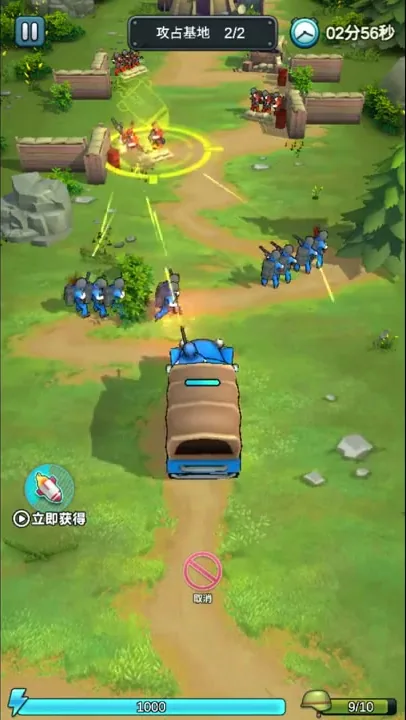
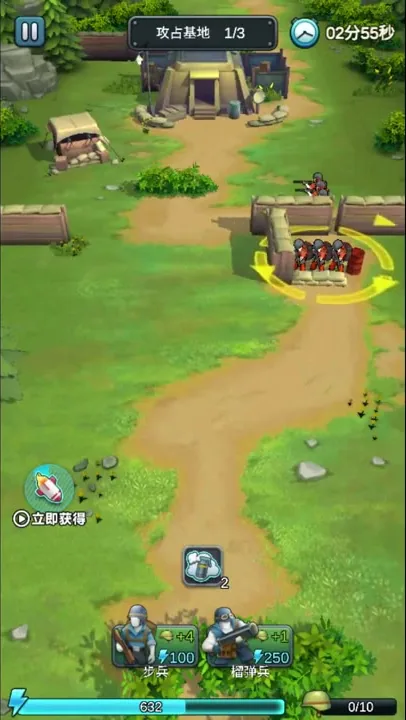
The unit cards sit at the bottom center above the long energy bar, with a helmet counter in the bottom right corner. The upper left corner holds a pause button, and support items wait in a slot just above the cards. Twice a yellow targeting ring appeared on the field with a “Cancel” icon near the bottom of the screen, the second time over a bunker, and rings of yellow arrows circle some enemy positions with no cancel icon at all. In the menus, a tutorial hand points at what to tap.
The core of Fingertip Raid gameplay is a one-way push. The player spends energy on cards that send squads of blue soldiers up a winding dirt road, with a blue supply truck rolling behind. They shoot it out with red-uniformed soldiers, tents and sandbag walls, then fire on the bunker at the top of the map until it goes up in flames and smoke, and the next stage begins on a fresh stretch of map.
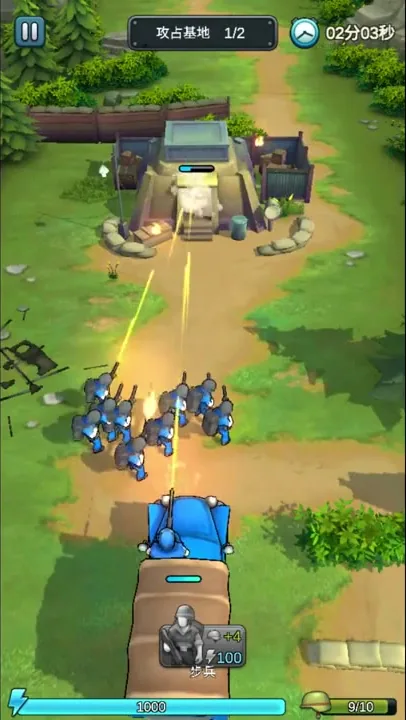
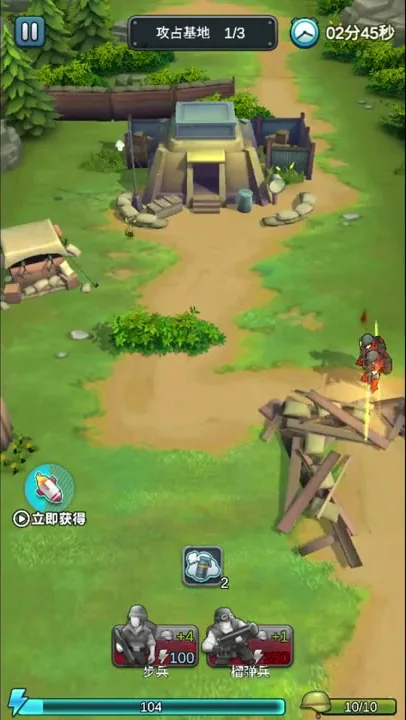
The Infantry card shows “+4” beside a helmet icon and an energy cost of 100 beside a lightning icon, while the Grenadier card shows “+1” and 250; the units screen lists the same pairs. The energy bar counts up during a fight, and in the first battle it climbed to 1000 and held there while the riflemen kept shooting. The helmet counter always reads out of 10. In Level 2-1 both card portraits were in color at 0/10 and gray by 10/10.
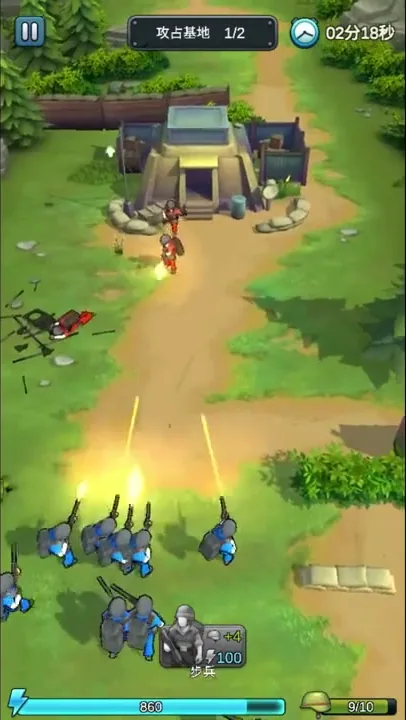
A blue truck with a tan canvas cover and a gunner on the cab roof follows the squad up the road, showing a small cyan health bar of its own. It follows the advance through the first battle. Outside battle, the same truck parks by a campfire in the lobby and marks the player’s spot on the battle map.
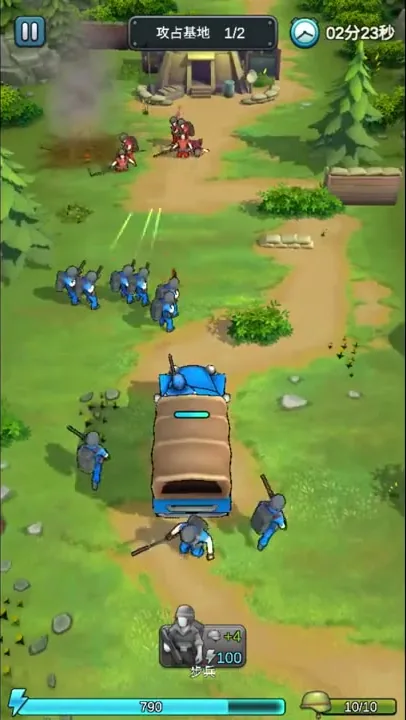
Red-uniformed riflemen hold the road in small groups, alongside tents with health bars that later burn and sandbag-and-log walls with soldiers behind them. A concrete bunker waits at the top of each stage and shows its own health bar once it comes under fire. In Level 2-1 a walled sandbag post on the right burst apart in an explosion, leaving broken planks and sandbags while a red soldier kept the path above it.
Support arrives on a pick screen that deals three item cards over the dimmed battlefield. Between the first battle’s two stages, its header read “Please choose one support” above three cruise-missile cards and a “Take them all” button with a play icon, while a cartoon signal officer spoke for HQ in a dialog box. Before Level 2-1 it read “Please accept all support” over two smoke grenades and a cruise missile, with a “Swap batch” button carrying a play icon beside a “Take supplies” button.
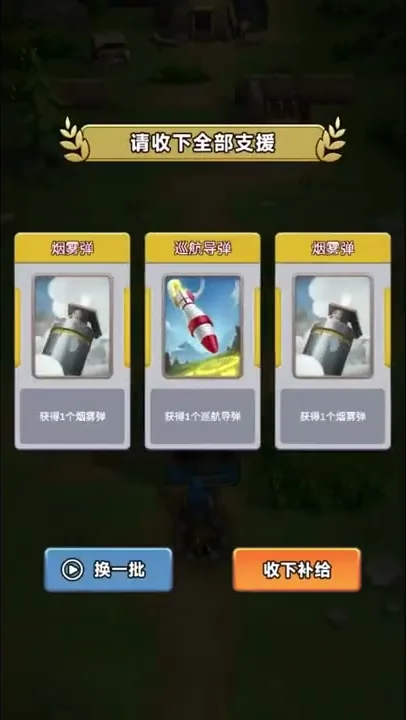
The cruise missile is a one-use item whose card reads “Get 1 cruise missile.” After the first pick the item slot showed a missile marked 1. Moments later the slot was empty and a yellow hatched targeting ring sat over red soldiers behind a wall, with the “Cancel” icon below.
Smoke grenades are the other one-use item, each card reading “Get 1 smoke grenade.” In Level 2-1 the slot held a smoke canister marked 2. When one was used, a wide gray cloud spread across the field in front of the bunker and the count fell to 1.
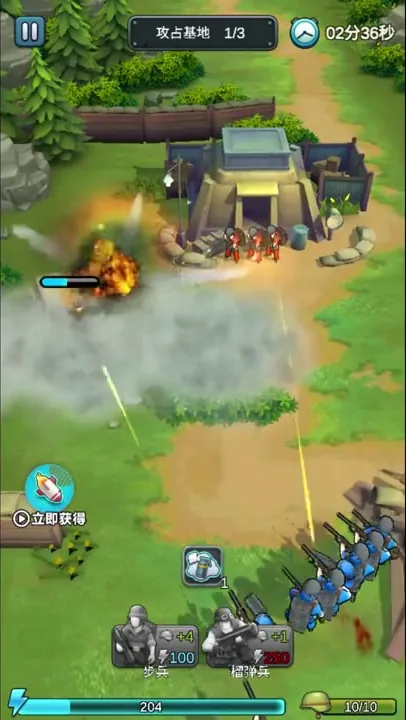
The Grenadier is the second unit, awarded at Level 1 on a “Congratulations, you got” panel after the first battle; its description says it fires grenades that leave enemies dazed. The units screen shows a single heavy soldier with a large launcher. In Level 2-1 its card, “+1” at 250 energy, joined the Infantry card, and in the same fight a shell flew from the blue squad toward the bunker on a high white arc.
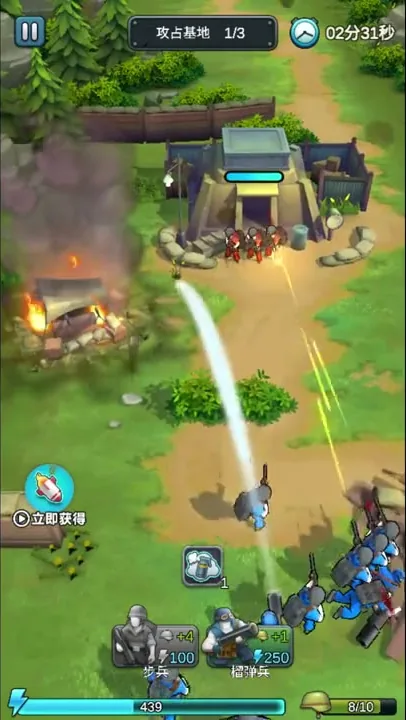
Two bunkers stand between the squad and the “Battle victory” banner in the first battle. Under “Capture base 1/2”, riflemen and truck push up one road past a tent and a few sandbag piles until the first bunker goes up in flames and dark smoke. A support pick of three cruise missiles follows. The counter then switches to “Capture base 2/2” on a new stretch lined with walls, where the fight goes on until the second bunker explodes.
Soldiers and buildings are chunky, stylized 3D cartoon models in a bright jungle, seen from a high, tilted camera in portrait mode. The player’s side wears blue and the enemy red. Gunfire shows as yellow-green tracers, and wrecked structures burst into orange flames and dark smoke.
From one Infantry card to three-stage raids
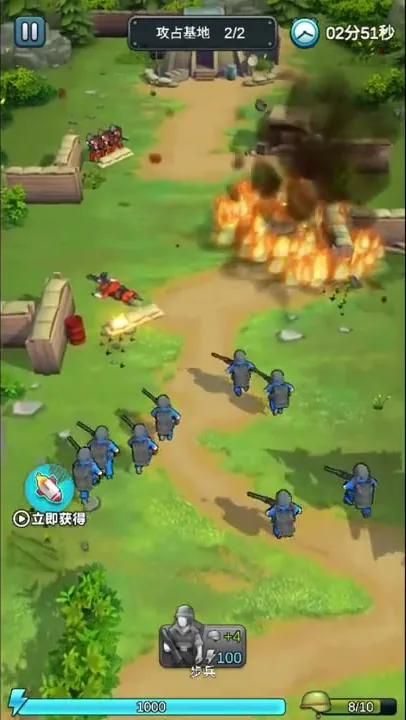
The first battle’s second stretch is busier than its first. In the first battle’s opening stage the road winds up past a tent and scattered sandbag piles, with a side path running off to the right. Its second stage forks around sandbag-and-log walls with red soldiers dug in behind them. The blue troops split to take both branches there, and a large fireball burned along the enemy walls on the right.
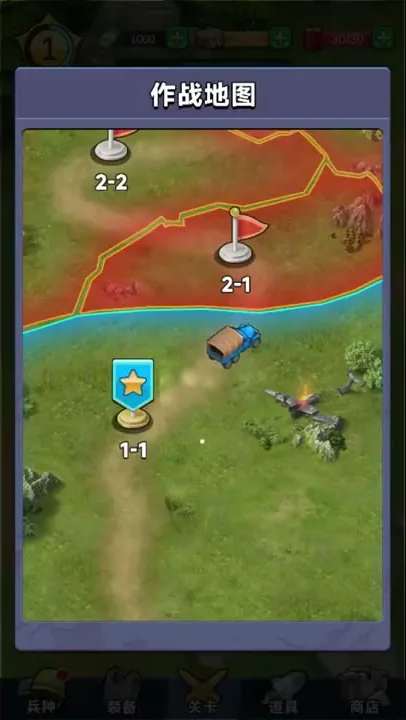
Winning that battle moves the campaign along. A chapter badge titled “Jungle Edge” gets a “Completed” stamp, and the battle map shows node 1-1 under a blue star banner, with nodes 2-1 and 2-2 in red-shaded enemy ground beyond a blue border line. The lobby then offers “2-1 Deep in the Jungle”, and the Grenadier joins the roster.
Level 2-1 raises the goal to three stages (“Capture base 1/3”) and puts the Infantry and the Grenadier in the hand, with two smoke grenades in the item slot. Early in its first stage the road winds up to a bunker at the top center, past a tent behind sandbags and a log wall on the left. On the right, a walled sandbag post holds a small group of red soldiers inside a ring of yellow arrows.
Between battles, the lobby’s top bar shows a star badge with the player’s level, green cash, a supply-crate meter and a red-canister meter, the last three each with a green “+” button, and the units screen adds purple gems with a “+” of their own. The orange “Start battle!” button carries a crate icon and a 5, next to a “Formation” button. Above the level name, a “Chapter rewards” strip shows three small reward icons, while a clipboard-shaped “Tasks” button marked with a red notification dot occupies the lobby’s upper left and was never opened.
The lobby’s navigation bar offers five tabs: Units, Gear, Stages, Items and Shop. Only Units and Stages were opened, so we can’t speak to the other three or to any shop prices.
The units screen pairs the selected soldier’s 3D model and one-line description (“Large in number, the backbone of the army” for the Infantry) with a stat sheet of ten values marked only by icons. Its orange “Upgrade” button is priced at 1000 cash, beside a unit-card icon with a count out of 5. Following a tutorial prompt that reads “Tap a soldier that can be upgraded,” the Infantry went from Level 1 to Level 2 and the cash total fell by that 1000.
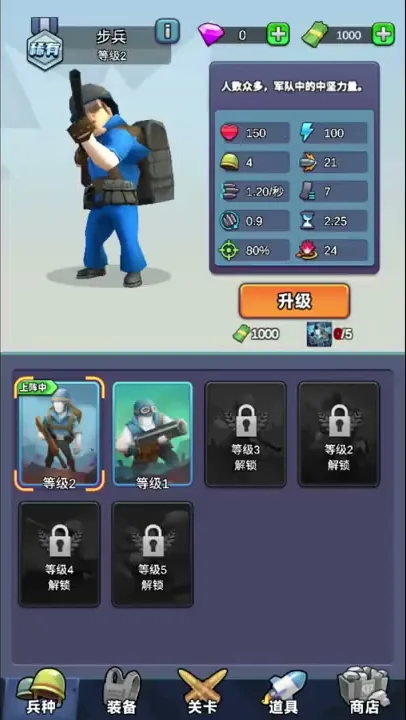
The same screen holds a roster grid of six slots. The Infantry sits there tagged “In lineup” beside the Grenadier, and the other four slots are padlocked, their labels pairing “Unlock” with a level number from 2 to 5. On the “Adjust lineup” screen, the “Current lineup” row of four slots holds the Level 2 Infantry beside an empty “+” slot with a red dot and two padlocked ones, with one more slot half hidden under a tutorial hint. The Grenadier at 250 and the Infantry at 100 wait under “Available units,” and a note says a long press on a card shows its stats.
Three buttons carry a play-triangle icon. “Take them all” and “Swap batch” sit on the two support screens, while “Get it now” sits under a missile icon at the left edge of the battlefield, an icon that later in Level 2-1 changed to a red airplane. None was pressed, and no ad played at any point.
Room to command on a longer road
We think the bigger map raises both the strategy and the playability a lot. The battlefield runs longer than one screen and scrolls with the squad, and each battle is cut into stages on fresh ground, two in the first battle and three in Level 2-1. The terrain is richer too, from the forked path in the first battle’s second stage to the walled sandbag post of Level 2-1.
That map also gives more of a sense of commanding a war. At the fork the blue troops split across both branches.
Card rules that stay close to Clash Royale
Fingertip Raid has ideas, but it doesn’t manage to hold them up. Underneath, it still leans a little too far toward Clash Royale. Warcraft Rumble, Blizzard’s take on the Clash Royale format, has more design in it than Fingertip Raid.
Spending energy and support items
The player’s part here is spending: energy on Infantry or Grenadier squads as the bar fills, a cruise missile on the spot its targeting ring marks, and cash on unit upgrades between battles. In both battles the enemy played no cards of its own. Its riflemen and walls waited for the push, with a bunker at the top of each stage.
That shape lines up with a taste for Clash Royale’s card-and-energy rhythm laid out as a campaign. Here it runs stage after stage up a jungle road and node after node across a chapter map, all in a modern-war setting.
Verdict
Stretching card-and-energy battles over a longer, multi-stage battlefield is an idea with something to it, and the extra room raises the strategy and playability a lot and gives Fingertip Raid more of the air of running a war. Still, it leans a little too close to Clash Royale, has less design in it than Warcraft Rumble, and its ideas aren’t carried through.
We expect strong casual real-time strategy games for phones to grow out of the Clash Royale format soon. With Warcraft Rumble already coming on strong, the open question is what fresh ideas other studios will find.