Trap Warfare TD Review: Orcs Must Die! Traps on a Tall Map
Dart traps at 500 gems, arrow blocks and a rail track: a Trap Warfare TD review of a portrait take on Orcs Must Die!-style defense.
Game at a glance
Trap Warfare TD
7.5/ 10
Our score
Orcs Must Die!, reimagined as a portrait 2D cartoon.
In this article6 sections
A dart trap in Trap Warfare TD costs 500 red gems to build, and so does the orange arrow block offered next to it. Both go on the grass beside a winding path, while brown floor grates sit on the path itself. Gem pop-ups rise when enemies burst among them.
It is one of the tower defense mobile games built around traps: a portrait cartoon take on hold-the-line defense, where waves of zombie-like creatures walk from a gate to a base. The design is a bit like Orcs Must Die!, the trap-and-fight defense game, but without a playable hero. The production is very complete, with a level campaign and card upgrades between battles.
Darts, pistons and grates along the path
We played two battles: a five-wave battle joined at wave 2/5, and a six-wave battle up to wave 5/6. The first map is a tall grass island in blue water. A sunken, darker path runs from a gate building near the top, past a narrow water channel, down to a base pad at the bottom right. The pad shows a portrait of a cartoon character above a heart bar.
Enemies leave the gate in groups, some wearing red helmets and some green and zombie-like, and walk the path toward the pad. The player spends red gems from the counter at the top of the screen to build traps on the tiles beside the path. Enemies caught among the traps burst in red splashes, with gem pop-ups such as +5 and +100 rising where they fall, while the wave counter climbs toward the last wave.
At wave 2/5 of the first battle, a single dart trap stood beside the path and a floor grate sat on it. An arrow block then went in next to the dart, and the gem counter dropped by 500. By wave 5/5, four dart traps and two arrow blocks lined the path, and after that the game moved on to the world screen.
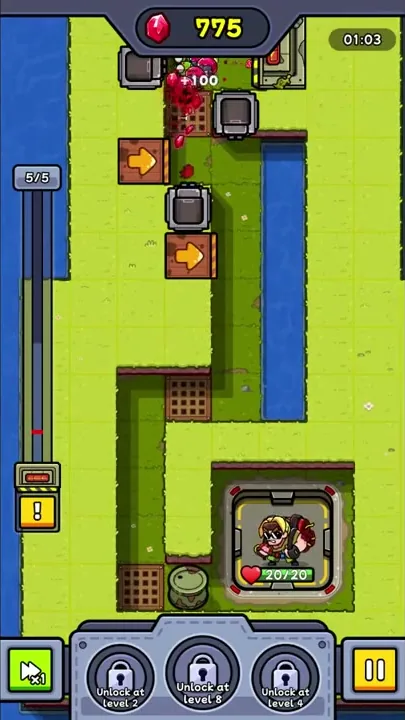
Selecting an empty grass tile beside the path dims the board and puts a bright ring around the tile, with the two traps on offer placed around it, each tagged LV.1 and 500 gems. On some tiles the ring shows white triangle arrows in place of traps. One tile in the second battle had arrows pointing up, right and down, and another had only left and down; a new dart trap stood on that second spot soon after. The view moves up and down the tall map as a battle goes on.
The dart trap is a gray box whose card reads “Fire deadly darts to damage the enemies.” Enemies next to dart traps burst in red splashes. Late in the first battle a red-helmeted enemy was caught between two of them in a red splash as a +100 pop-up rose over it.
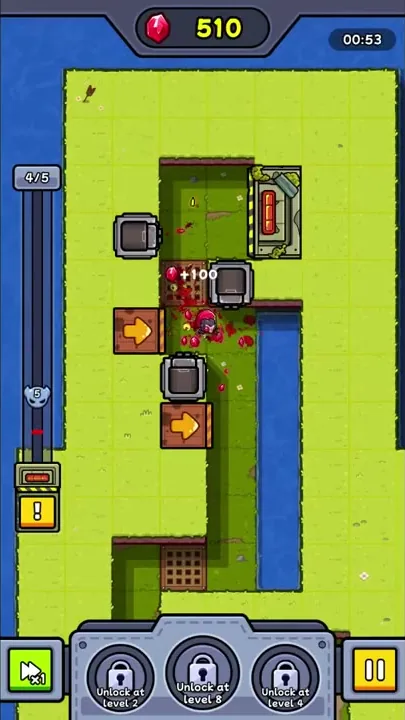
The arrow block is an orange block with a yellow arrow. It is built beside the path with the arrow facing the path, at the same LV.1 price of 500 gems. Near the end of the first battle, a metal piston stuck out of one arrow block into the path, right where a group of enemies was walking.
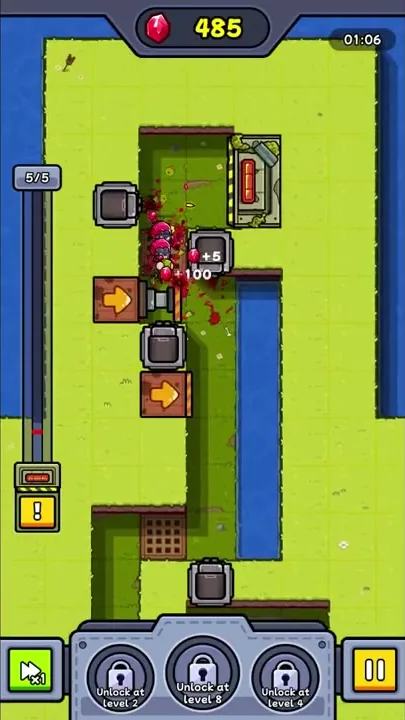
Floor grates are brown square grates set into the path tiles, and enemies walk over them on their way down. The grate is the third trap card in the loadout, after the dart and the arrow block. At wave 2/5, three of them sat on the path on the way down to the base pad.
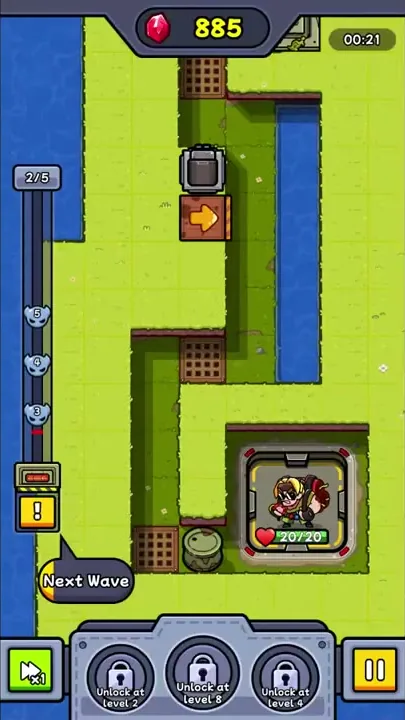
The wave bar runs down the left edge. A counter sits on top with numbered skull markers for the coming waves below it, and at its foot is a yellow “!” button with a “Next Wave” bubble pointing to it. Beside the next marker, a bubble previews the coming enemy types as small icons. Just after the counter advanced, a burst of red gems sometimes appeared beside the bar.
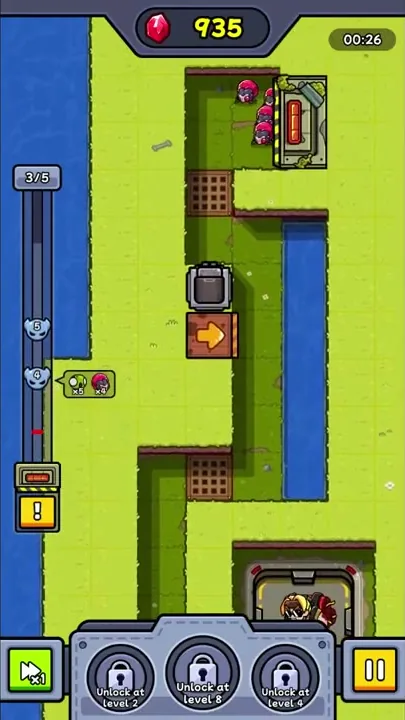
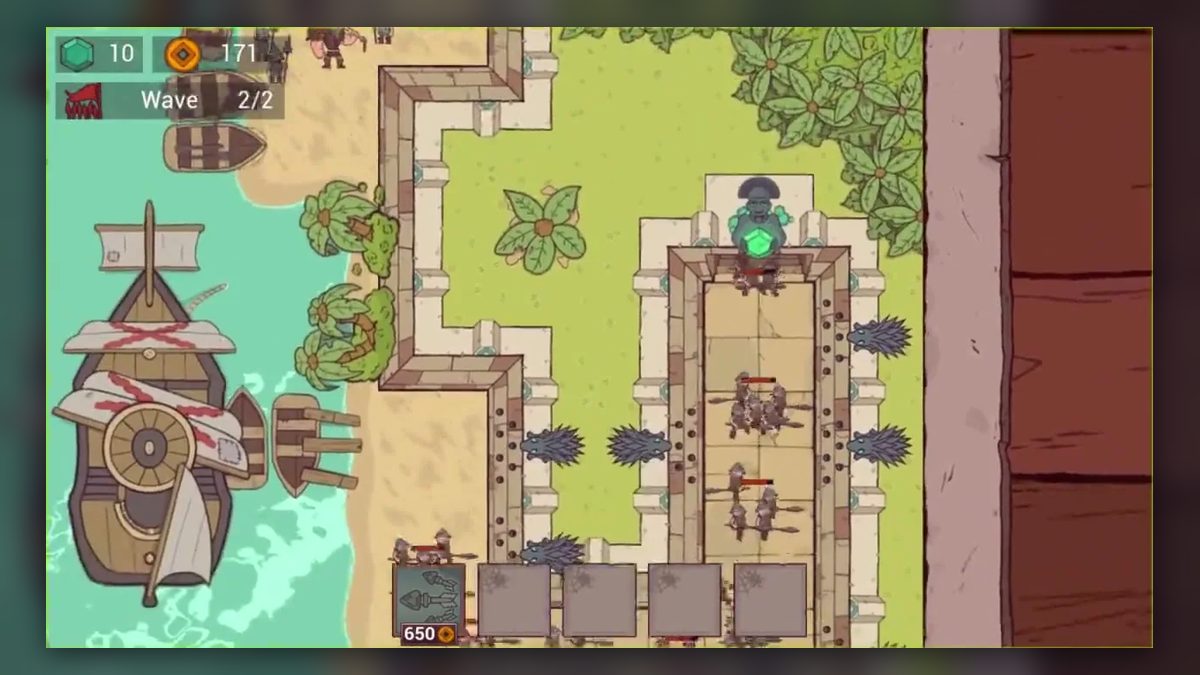
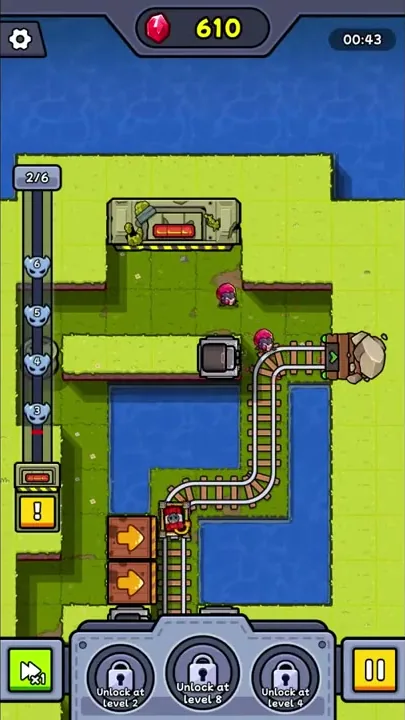
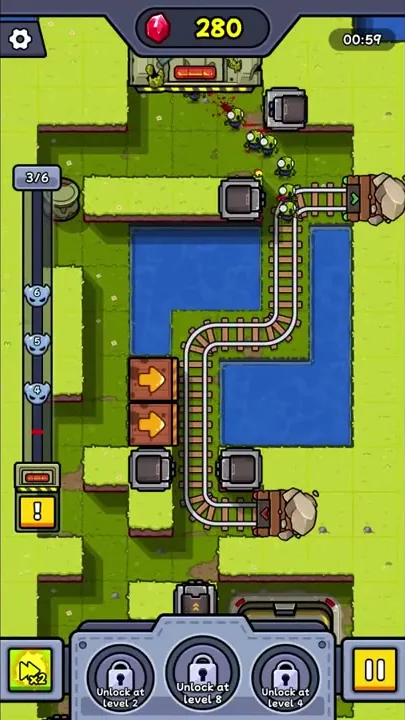
The second map runs a rail track along part of the enemy path, winding from the upper right between two pools down to a lower end. Each end has a wooden buffer loaded with a large rock: the upper one carries a small green marker and the lower one a small red marker. Enemies walk along the rails, and a small cart turns up at different points on the track. It sat empty beside the arrow blocks, carried something red low on the track, and at one bend was heaped with something yellow.
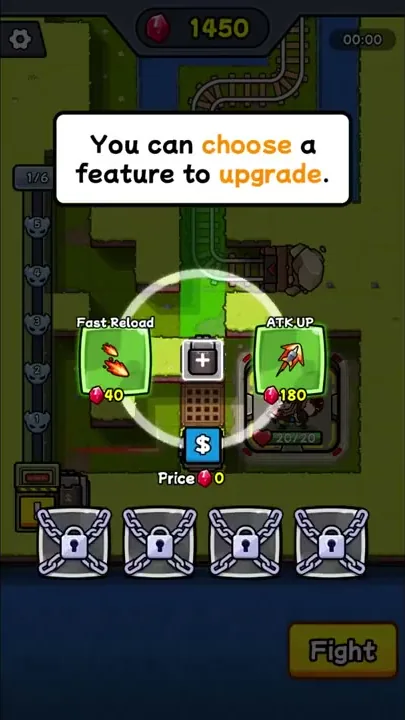
Selecting a placed trap dims the board and opens an upgrade ring instead. It offers “Fast Reload” for 40 gems and “ATK UP” for 180. Below them is a blue “$” button marked “Price” with a gem amount, and under that a row of four padlocked slots wrapped in chains.
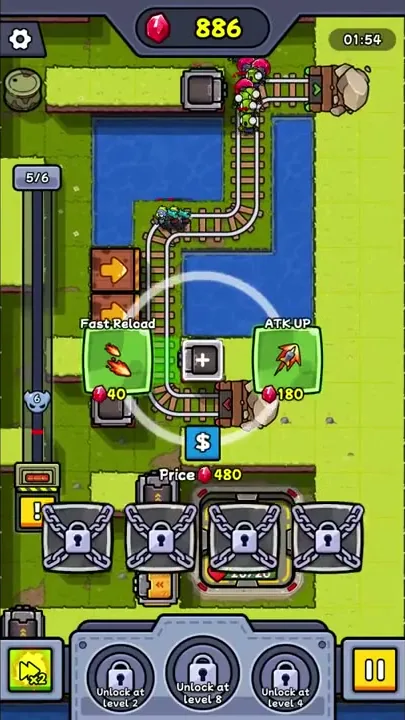
The bottom bar holds a green speed button on the left and a yellow pause button on the right. Between them are three padlocked round slots, each carrying an “Unlock at level” label with its own number. The speed button read x1 in the first battle and x2 partway through the second, and all three slots were still locked late in that battle. A timer in the top-right corner counts up during a fight and restarted from 00:00 in the second battle.
From a five-wave map to a six-wave one
The second battle runs to six waves instead of five. It opens on a pre-fight screen with the timer at 00:00 and the wave counter at 1/6. A hint box reads “You can choose a feature to upgrade.” over an upgrade ring, and a highlighted “Fight” button waits at the bottom right.
The map changes shape too. Two blue pools and raised grass blocks break it up, the rail track and its cart run between the pools, and the base pad again sits at the bottom right with the gate at the top. As the fight began, the board already held two arrow blocks beside the rails, dart traps marked with yellow chevrons near the base and at the lower left, a floor grate, an orange block marked “<<” and a green barrel at the top left. More dart traps went in later, two near the lower pool and one beside the gate, and a settings gear sits in the top-left corner of this battle’s screen.
Between the battles the game shows its world screen. “1.Windy Steppe” is written above a floating island with mountains. A yellow “Battle” button sits below the island and a “Challenge” button with a purple swirl icon to its left, while a star icon and a coin icon with a plus sign sit on the right edge. Rewards come in “You get” panels with “Continue” underneath: 100 gold coins first, then 2 green cubes.
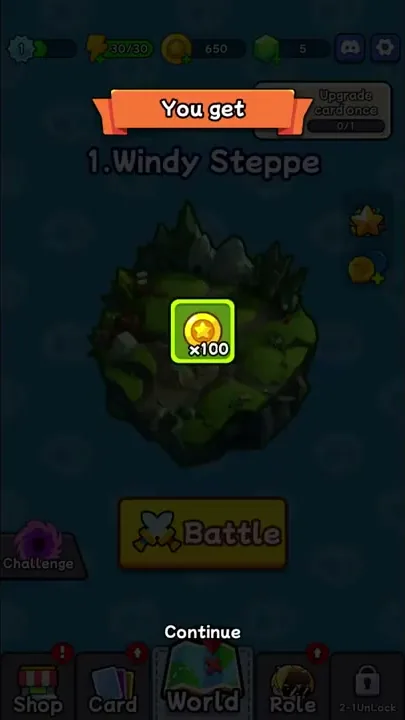
Outside the fights the money changes: red gems belong to the battle screen, and the world screen’s top bar shows gold coins and green cubes. The same bar holds a player badge with a green bar, an energy meter with a lightning icon, a Discord icon and a settings gear. A task panel at the top right asked for “Upgrade card once”, and after the card upgrade it showed a new task, its first word cut off, for a normal-mode stage numbered 1-2. Along the bottom are five tabs: “Shop” with a red “!” badge, “Card” and “Role” with red up-arrow badges, “World” selected, and a padlocked fifth tab.
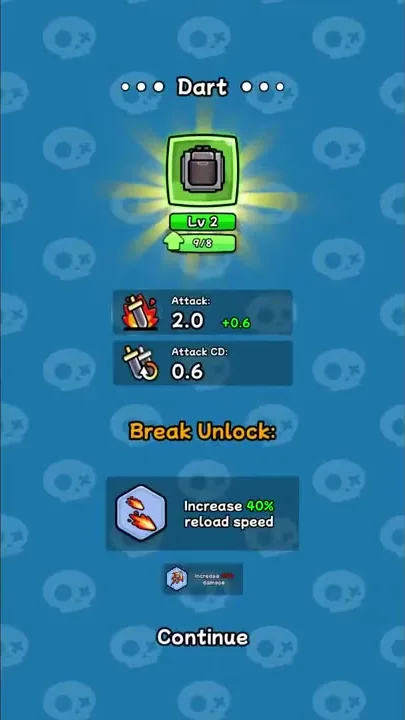
The card upgrade is a “Dart” screen on a blue background patterned with skulls. It shows the card at Lv 2, with “Attack: 2.0” and a green “+0.6” beside it, and “Attack CD: 0.6” below. Under “Break Unlock:” a perk reads “Increase 40% reload speed”, with a smaller dimmed perk under it.
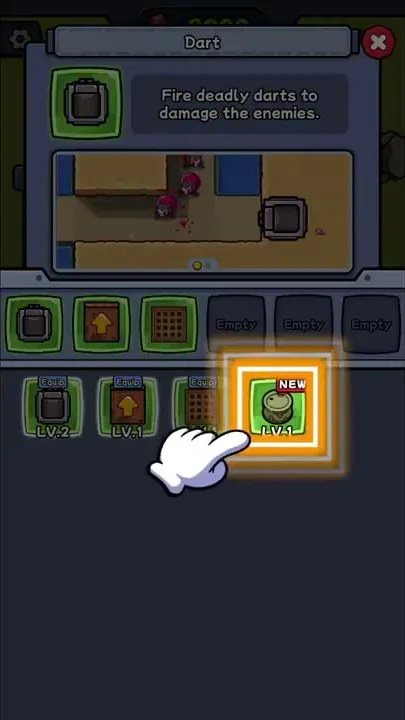
The loadout screen comes next. A “Dart” panel at the top shows the card’s text and a small preview of a dart trap beside enemies. Below it is a row of six slots, with the dart trap, the arrow block and the floor grate equipped and three marked “Empty”. Underneath are the owned cards: the dart trap at LV.2, the arrow block at LV.1, the floor grate, and a “NEW” LV.1 card with a green barrel-like icon in a glowing orange frame, a white cartoon hand from the tutorial reaching for it.
A PC and console trap game, rebuilt upright
We see Trap Warfare TD as Orcs Must Die! redrawn as a portrait 2D cartoon. It pulls a classic PC and console game apart and rebuilds it for phones, an innovative direction that small studios around the world have been taking lately. The traps carry over: dart traps and arrow blocks go on the tiles beside the route, floor grates go on the route itself, and all three share the first battle’s board. There is no playable hero, though; a cartoon character’s portrait sits on the base pad.
The production is very complete, the casual artwork is consistent, and the screens hang together very well. The battle maps use flat top-down art with thick dark outlines, with bright grass laid on a visible grid beside blue water. The build and upgrade rings dim that same board, and the upgrade and loading screens share one blue skull pattern, down to a small green zombie standing on the loading bar with a speech bubble.
Around the level campaign sits a card-upgrade layer, the progression between levels. After the first battle the Dart card went up to Lv 2, and a “NEW” card was waiting among the owned cards on the loadout screen. The setting appears to be humans holding off waves of biochemical monsters: green zombie-like creatures and red-helmeted ones march on a base whose portrait shows a cartoon human.
The base hearts and the world screen tabs
We have no criticism of Trap Warfare TD to report. We can’t say what happens when the heart bar on the base pad runs out. The “Shop”, “Card” and “Role” tabs and the “Challenge” button lie outside what is covered here, as does the way new cards such as that “NEW” LV.1 card are obtained.
Spending gems on tiles and card slots
During a fight the choices are about placement and spending. The player picks which grass tile gets a trap and whether it becomes a dart trap or an arrow block. A trap already on the board can then take “Fast Reload” or “ATK UP”, paid from the same pile of red gems, while the wave bar’s preview bubble shows which enemy types come next.
Between fights the work moves to cards: raising the Dart card’s level and choosing which owned cards go in the loadout’s six slots. The split serves a liking for laying traps along one fixed route and tuning them one at a time, with no hero of one’s own to steer on either map.
Verdict
Trap Warfare TD lifts the trap-laying of Orcs Must Die! off PC and console and onto phones, standing the screen upright and leaving the hero out. Drawn in cartoon art with one consistent look, it is a very complete production, its fights strung along a campaign of levels with cards to upgrade in between.