Jelly Field Review: Split Tiles That Clear by Color
Drag split jelly tiles onto a board as small as 11 cells and touch matching colors to clear them: a Jelly Field review of a brand-new puzzle idea.
Game at a glance
Jelly Field
7/ 10
Our score
Never seen this kind of puzzle before, and it really catches the eye.
In this article6 sections
Jelly Field is a block puzzle built on a brand-new idea, and it was a pleasant surprise. Square jelly tiles, each split into colored sections, go onto a small board one at a time, and any section that touches the same color in the next cell clears away along with it.
The game has two halves: block-puzzle placement on one side, jelly pieces that squash and swell on the other. We played Levels 1 to 4, and the fourth was still under way when play stopped.
Split jelly tiles and same-color clears
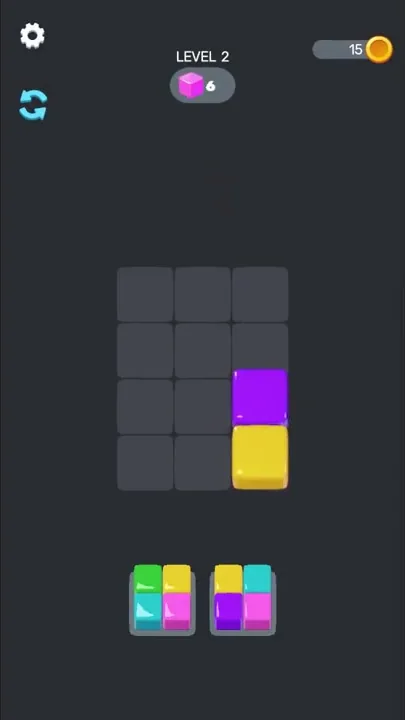
Every level sets one or two goal colors in a pill under the level label. Each goal is a small 3D cube in its color with a number beside it. The number falls as sections of that color clear, and a finished goal’s number turns into a green check mark. When every goal is checked, a “YOU WIN” panel appears.
No move counter, timer or fail screen shows up on these boards. The only visible limit is space, with boards of 11 to 16 cells and one or two pieces offered at a time.
Each piece fills exactly one cell and is divided into colored sections. It may be cut into two halves or into four quarters, and some pieces mix a half with two quarters. Single-color tiles sit on the board as well.
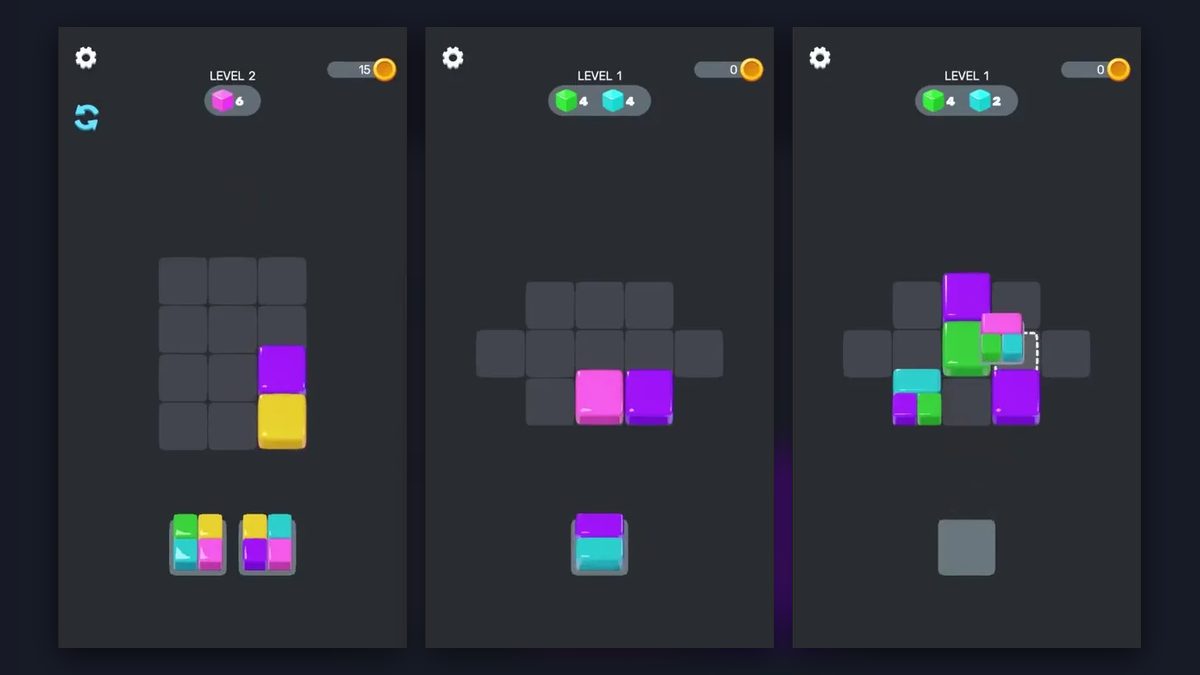
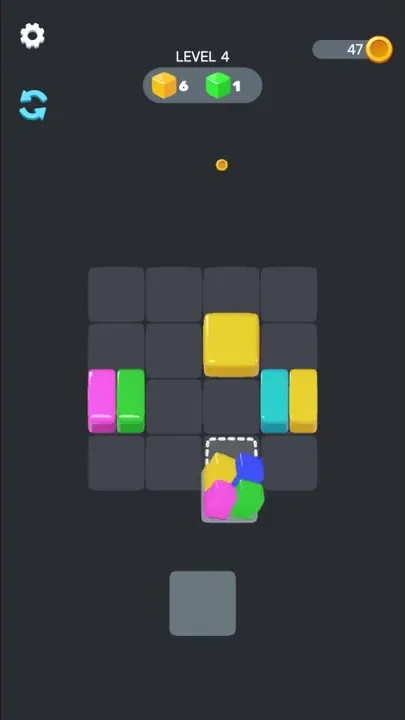
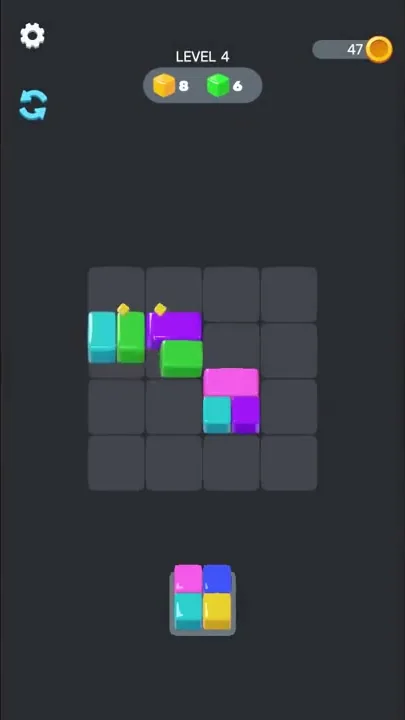
The only control is a one-finger drag. Lifting a piece out of its tray slot leaves the slot plain gray, and while the piece is carried over the board, a white dashed outline frames the cell beneath it. The outline moves with the piece: in Level 4, a four-quarter piece hovers over an outlined bottom-row cell and moments later rests in the second row. No other input appears, and neither button at the top left is ever seen being pressed.
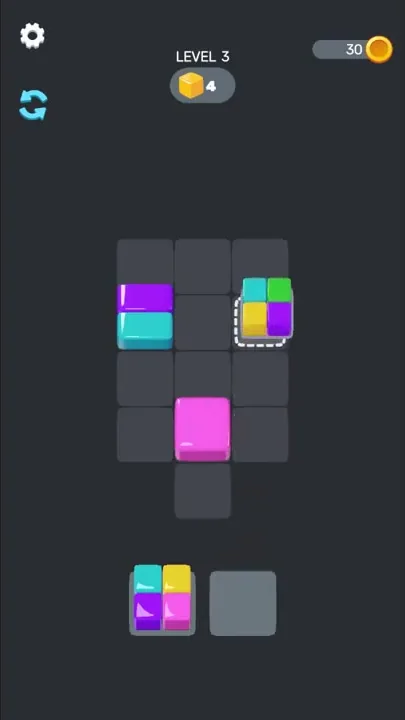
Clearing works by contact. When a section touches a section of the same color across a shared edge, both shrink away and break into small colored particles. Colors outside the goals clear the same way, so purple vanishes in Level 2 even though that level’s only goal is pink. A tile that loses every section leaves its cell empty. That is how an all-pink tile drops out of the opening board’s bottom row and an all-blue one leaves the 4-by-4 grid.
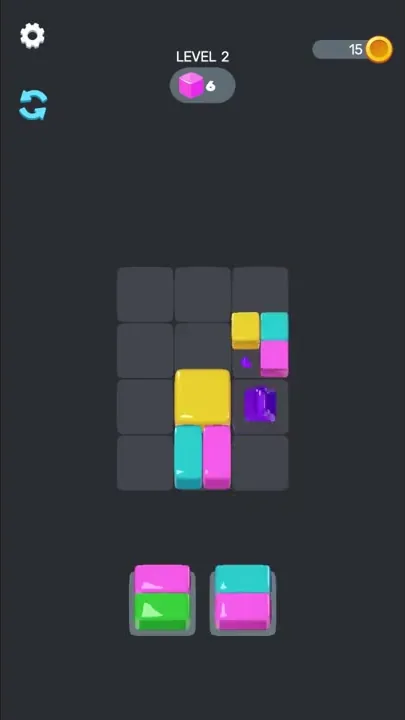
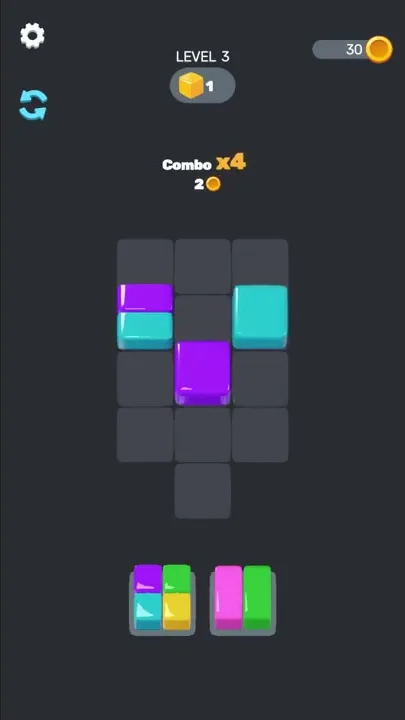
After a section clears, what remains of its tile spreads into the freed space. A tile split four ways can end up a single color: in Level 3, a four-quarter tile in the right column turns entirely cyan once its other three quarters have cleared.
The first board has 11 cells, laid out as a five-cell middle row with three cells above it and three below. At the start, an all-pink tile and an all-purple tile sit in the bottom row. The single tray slot holds a piece of purple over cyan, and the goals ask for 4 green and 4 cyan.
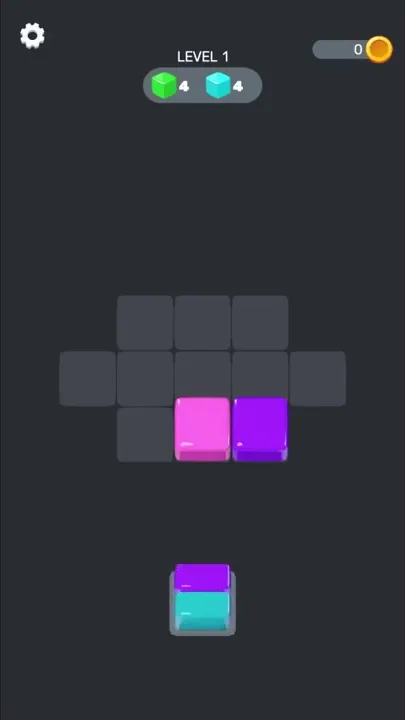
That purple-over-cyan piece goes into the top-center cell. Once its cyan half meets a cyan neighbor, both clear and the cyan counter drops from 4 to 2. The purple half then swells until the whole tile is purple. Green earns its check mark while cyan still reads 2, and clearing the remaining cyan opens the win panel with 15 coins.
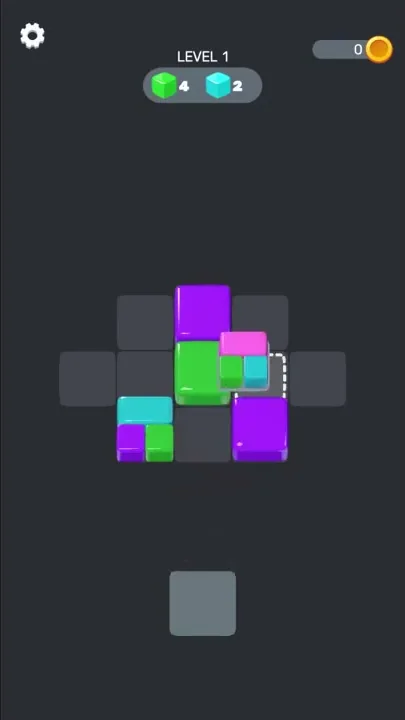
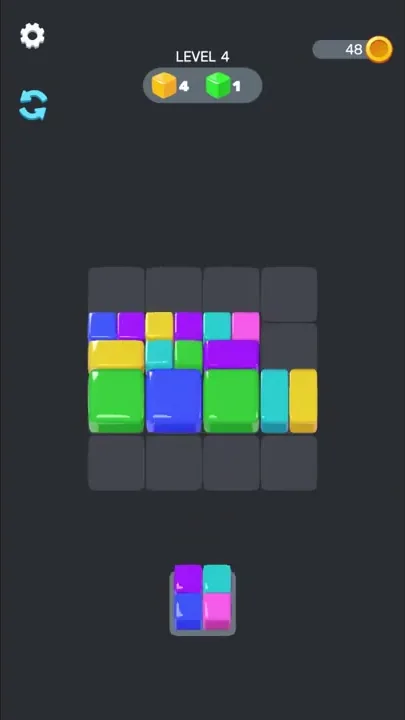
Jelly Field gameplay is that cycle on repeat. After each drop a new piece fills the empty tray slot, and sections that found no match stay where they are. Tiles pile up as a result: late in Level 4, the two middle rows are nearly packed with mixed tiles while 4 yellow and 1 green remain on the counters.
Combos pay coins. In Level 3, a “Combo x4” label appears above the board with a 2 and a coin icon beneath it as the yellow counter falls from 4 to 1, and the coin total rises by two right after. It is the only combo label seen on these boards. During Level 4, a lone coin icon also floats above the board without a label, and the total ticks up by one.
The background is dark charcoal and the cells are flat dark-gray squares. The view stays fixed and straight-on in portrait, with the board mid-screen and the tray below it. A slim bar along the top puts the gear on the left and the coin counter on the right, with the level label and goal pill between them.
Against that backdrop the pieces are glossy, saturated jelly blocks with rounded edges and white highlights, and they change shape. The four quarters of a dragged piece in Level 4 tilt and bulge out of square on the way to a bottom-row cell.
From 11 cells to a 4-by-4 grid
The board grows with each new level. The 11-cell opening layout gives way to a 3-by-4 grid of 12 cells, then to that grid with one extra cell hanging below its middle column, and finally to a 4-by-4 square of 16. The 13-cell board asks for 8 yellow, and it is also where the first combo label appears.
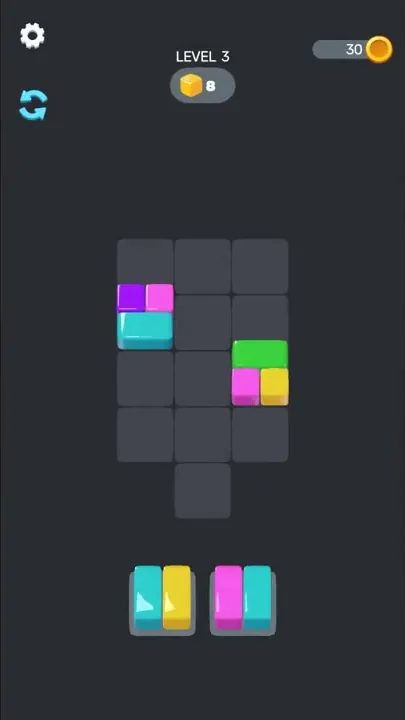
The tray follows its own pattern. It holds one piece on the opening board and two side by side on the next two boards, then drops back to one on the 4-by-4 grid. Goals start as green and cyan, narrow to a single color at 8 for the middle pair (pink, then yellow), and widen again to yellow at 8 plus green at 6. The blue circular-arrows button under the gear first appears together with the second tray slot.
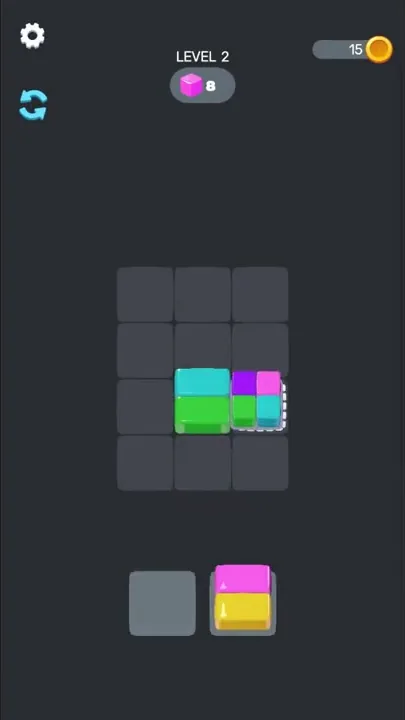
Colors widen too. The first board starts with four, and yellow turns up in a piece before it ends. Blue arrives on the 4-by-4 grid, where the tray piece shown at the start already carries a blue quarter.
Beyond the boards, gold coins are the only currency on screen. Their tally, at the right end of the top bar, climbs with level rewards and combo bonuses. Each win opens a “YOU WIN” panel over falling confetti, with the board dimmed behind it and “REWARD” showing 15 coins. On the panels after Levels 2 and 3, a green “GET” button sits under the reward. No second option such as a multiplier or an ad button is offered.

The gear at the top left is there on every board, but its menu is never opened. The blue button with two circular arrows beneath it is present from the second level on. It shows no count or price, and it is never seen being pressed. No ad, shop, lives counter, booster bar or offer shows up on any screen of these levels, and the next board follows each win panel within seconds.
A brand-new twist on block placement
We had not come across anything like Jelly Field’s central idea before, and it stood out at once. Placement follows block-puzzle habits, one tile into one empty cell, but clearing happens section by section and color by color. In Level 2, a purple quarter touching an all-purple tile is enough for both to shrink away, while the tile it came from keeps its other colors.
The idea pairs those two parts. Next to the grid and tray of a block puzzle sits jelly with physical feedback. A dragged piece on the 4-by-4 grid bulges out of square. Cleared sections shrink into a scatter of particles, and the sections that survive swell to fill their cell.
We have been putting together an approach to finding new ultra-simple pick-up-and-play game ideas, and Jelly Field gave us a lot of confidence in it. Everything in the game runs on one drag of one tile at a time, onto boards that had grown to a 4-by-4 grid by Level 4.
Full grids and a mystery arrows button
There were no complaints to record about Jelly Field. The limits are about what these boards leave unseen. No fail or retry screen appears, even as the 4-by-4 grid crowds up, so what happens when every cell is taken is never shown.
Nothing on screen shows the circular-arrows button being pressed after it first appears. With no count or price printed on it, its purpose remains unknown. Coins keep arriving from rewards and combos, but no shop or spending screen turns up to use them.
Color matching one tile at a time
Every decision in Jelly Field comes down to edges. Each turn is one drag of one tile, and the question is which colors border an empty cell and which side of the tray piece carries a match for them. When the tray holds two pieces, there is also the choice of which one to place first.
These mechanics suit a taste for small adjacency puzzles, where a move is judged by the neighbors it touches. They also suit an eye for jelly in motion: a piece bending as it is dragged, sections shrinking on contact, leftovers swelling into place.
Verdict
Jelly Field is a good game built on a fresh concept. Its rule stood out as new: colored sections vanish on contact while the rest of a piece fills the space. It also gave us a lot of confidence in that work-in-progress approach to finding new ultra-simple pick-up-and-play ideas.