Merge Monopoly Review: A Merge Grid Inside the Dice Ring
This Merge Monopoly review looks at a board where 75-coin houses merge into purple hotels while two dice send a token around the ring.
Game at a glance
Merge Monopoly
5/ 10
Our score
Merge meets Monopoly without clashing; the hybrid wave still lacks a standout.
In this article6 sections
Merge Monopoly sits among the games like monopoly go: two dice, a token walking a square ring of tiles, and corners that pay out coins or take them away. What’s different is the middle of the board. A gray grid fills the space inside the ring, and houses bought there combine into bigger buildings that then move out to plots beside the tiles.
The game is a mashup of merging and Monopoly-style board play, and the two halves don’t clash. Like the other Monopoly hybrids released so far, though, it isn’t especially outstanding.
Dice on the ring, houses in the grid
A red banner states the goal: “Place hotels on all your tiles to win!” A bar at the top of the screen, capped with a purple hotel icon, counts the hotels as they go up. No move limit or fail screen appeared, and there was no timer apart from the jail countdown. Coins are the only limit on screen, and more than once the counter dipped below the 75 that a house costs.
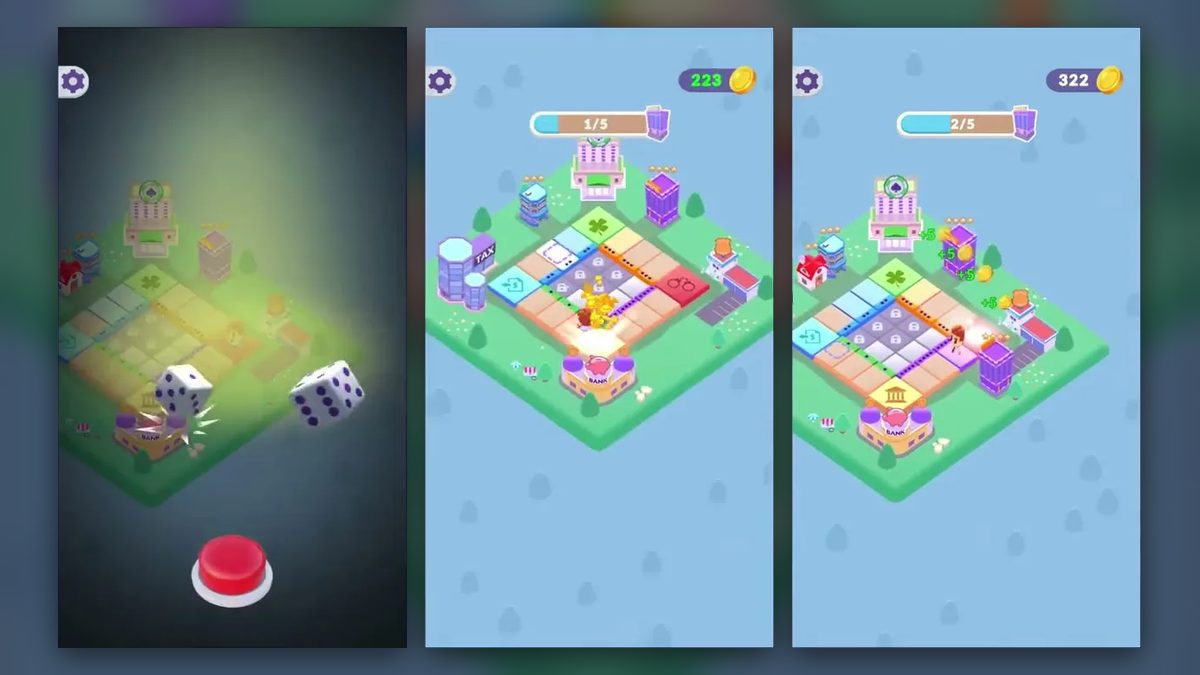
Two buttons at the bottom of the screen run the game. A red push button with two dice on it rolls, and a green button showing a house icon and “75” buys a house. Finished buildings are moved from the grid to plots beside the board, and a hotel is drawn larger and lifted above the board’s edge on its way out. The jail pop-up has a green button of its own for paying.
The board is an isometric 3D square on a floating green island dotted with round trees, set against a pale blue background. A ring of peach tiles runs around the grid, and a rounded, toy-like building stands by each of its four corners. The camera pans and tilts to follow the token, so the board slides toward one side of the screen during a move.
Merge Monopoly gameplay runs in a loop. Each roll walks the token around the ring, where stops on corners and tiles raise or lower the coin counter, and coins buy houses at 75 apiece. Matching houses merge into bigger buildings, from red-roofed houses to blue buildings to purple hotels, and finished buildings leave the grid for fenced plots beside the board. A blue building that sat in the grid one moment stands on a plot by the top-left side the next.
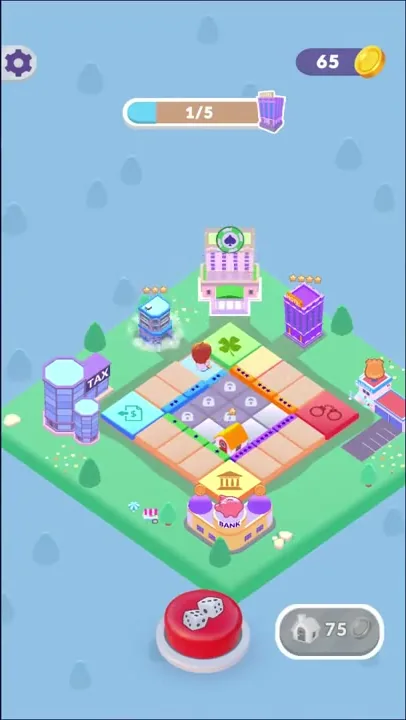
The one board we played shows no level number. In the first seconds, before any hotel has gone up, a purchase is already under way: a -75 pop-up rises over the grid, which soon holds red-roofed houses and a blue building. During the tutorial a purple hotel is lifted out of the grid onto the plot on the top-right side, and that single placement moves the bar to 1/5 just as the win-condition banner appears. Every house costs 75 coins, paid from whatever the counter holds, which the ring and the wheel keep topping up.
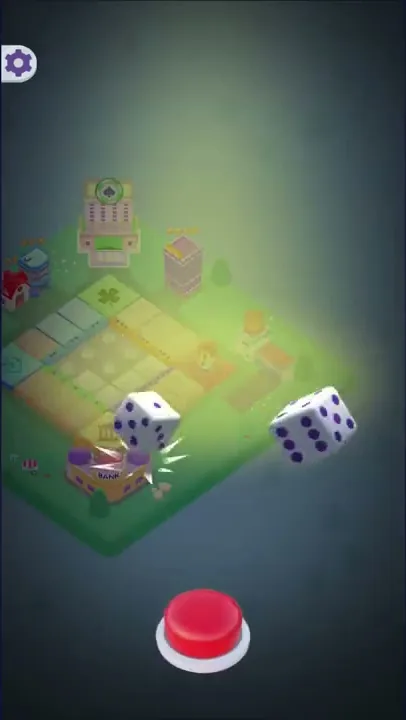
Pressing the red button dims the screen under a green spotlight while two large white dice with purple pips tumble across the board. The token, a small figure with red-brown hair, then walks the ring toward a tile marked with a white dashed square.
Inside the ring sits the merge grid. Several of its gray squares carry padlocks while a few are plain white, and dashed lines in four colors run along its edges. Houses bought with the 75-coin button appear here, and the grid stands empty again once its buildings have been moved out.
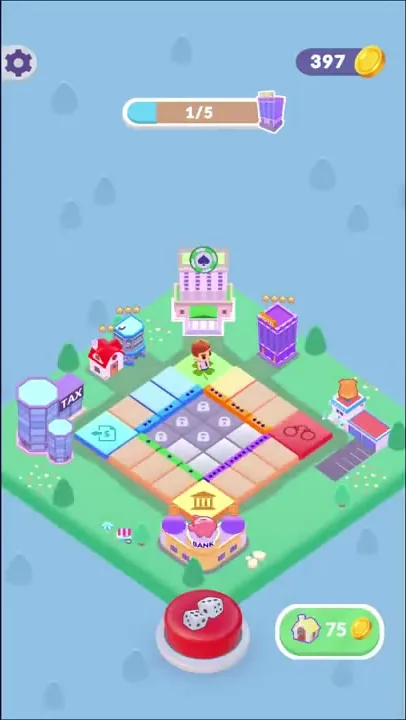
Bought houses first appear in the grid as small orange pieces. After one batch of purchases the grid holds red-roofed houses with small stars over them. A few seconds later it holds blue buildings, and soon after it is clear again while a new purple hotel stands beside the board. Placed buildings carry rows of small gold stars: three over the blue building on the top-left side and four over the first purple hotel.
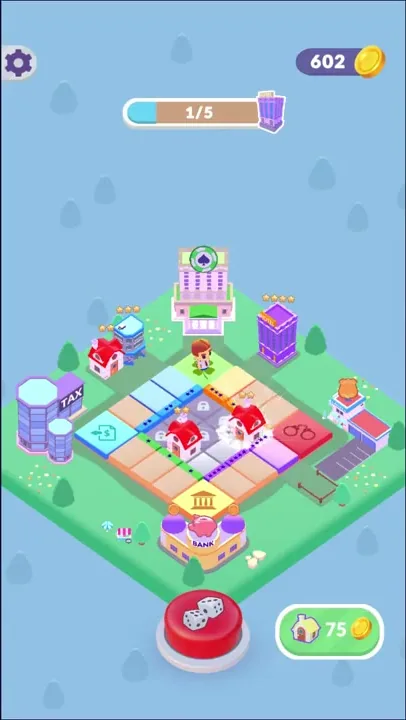
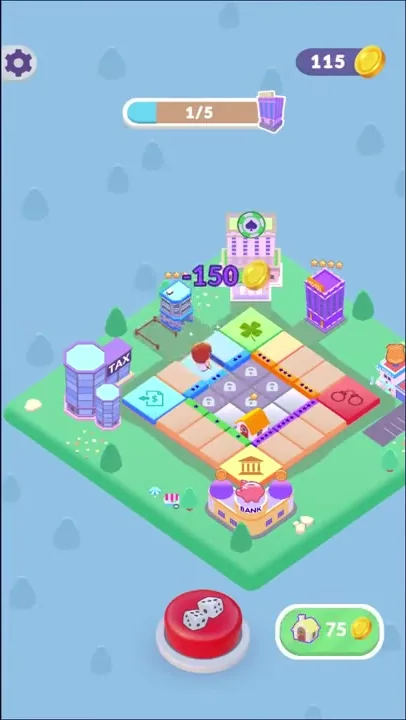
The plain ring tiles are peach. When the token stops on one, a negative coin pop-up rises over it. The tile then takes on a color, and a small fenced plot, empty at first, appears on the grass beside that side of the board. On the top-left side a -150 pop-up rose over the token. That tile turned light blue, and the new plot showed up right next to the blue building.
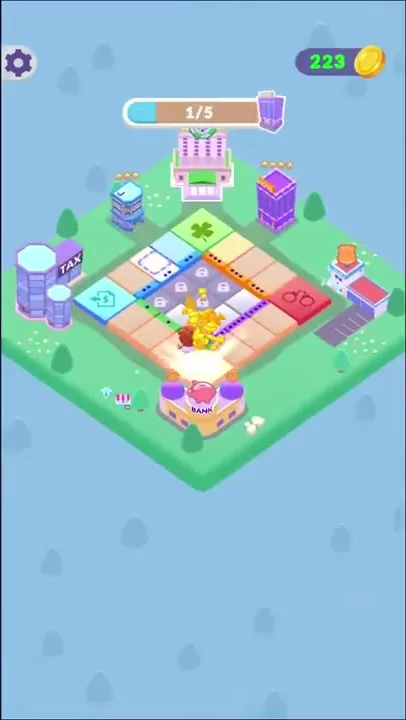
The yellow corner at the bottom, marked with a bank icon, sits in front of a building signed BANK with a piggy bank on top. With the token there, a burst of coins rises over the corner and the coin counter turns green as it climbs.
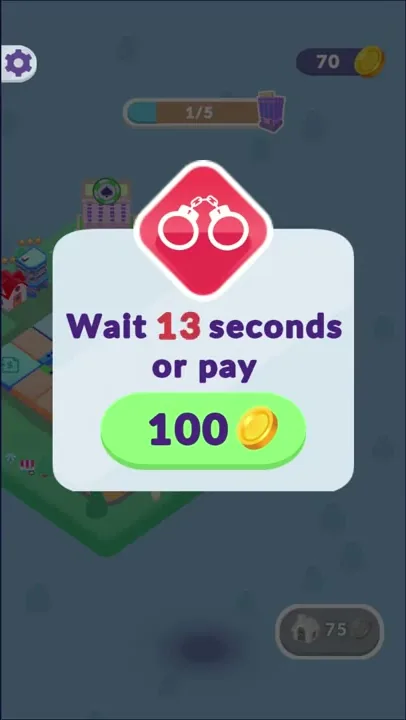
At the red handcuff corner on the right, beside a small station, a pop-up holds the token in place. It reads “Wait 18 seconds or pay” above a green 100-coin button while sad-face emojis fall down the screen. The countdown ran from 18 all the way down to 3 seconds, and the next roll followed right after.
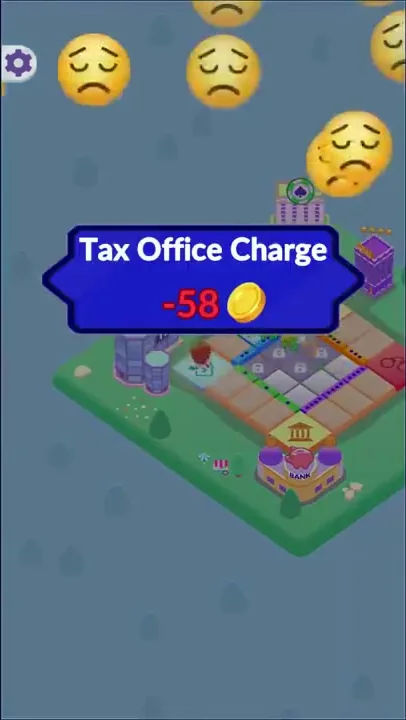
The cyan corner on the left, marked with a dollar bill, sits beside a glass tower signed TAX. With the token on it, a blue banner reads “Tax Office Charge” with -58 in red next to a coin, and more sad-face emojis rain down.
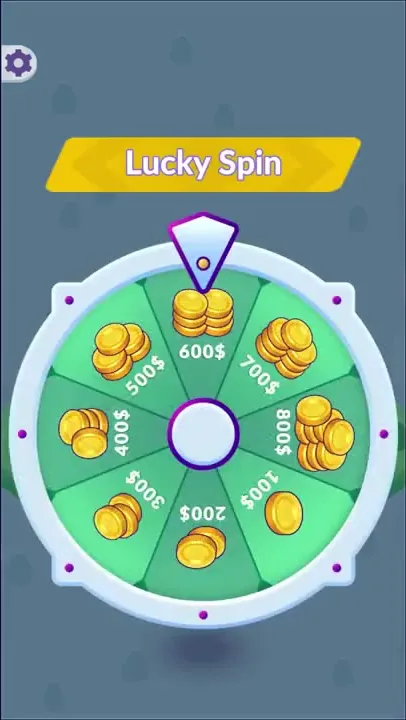
The green clover corner at the top sits in front of a pink building with a spade emblem. Twice a Lucky Spin wheel filled the screen, with a pointer at the top and eight green segments, each holding a pile of coins labeled from 100$ up to 800$. Each time the wheel appeared, the token was next seen on the clover corner.
Fenced plots fill as the hotel bar climbs
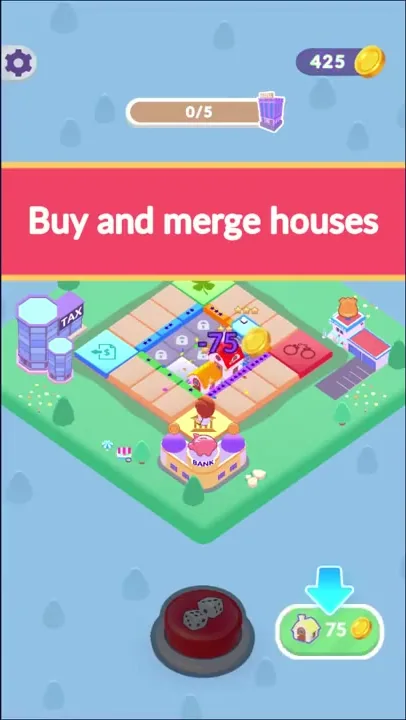
The opening teaches the game through wide red banners with white text. “Buy and merge houses” comes first, with a blue arrow on the 75-coin button. Next the screen dims while an arrow points at the dice button. Then come “Place buildings on your tiles to earn more money!” and the win condition. No further banners show up after those.
Past the tutorial, what changes is the board itself. A blue building and then a red-roofed house take plots on the top-left side. A fresh fenced plot opens by the handcuff corner and receives the second purple hotel, at which point the bar flashes green to 2/5 and the hotel icon glows. Another empty plot then appears by the TAX tower, but the board wasn’t finished, so no win screen came up.
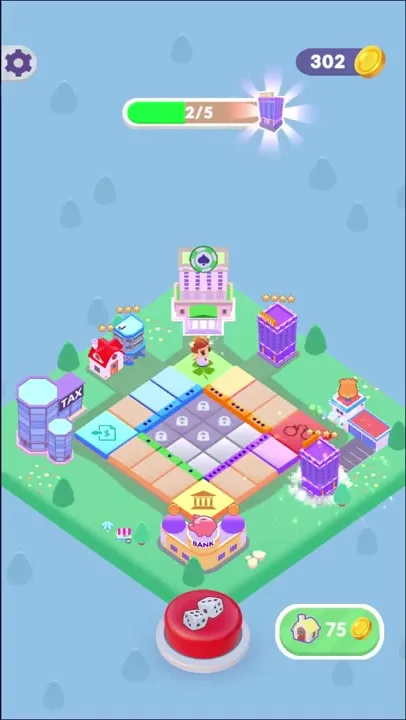
Coins are the only currency on screen, counted at the top right beside a gold coin. Houses take 75 each and the jail asks 100 as the alternative to waiting, while the tile pop-ups (-150 and -50) and the tax office (-58) also take coins away. Coins come back in at the bank corner, through small +5 pop-ups and from the wheel.
The green house button at the bottom right shows “75” next to a house icon, and each purchase sends up a -75 pop-up. The button turns gray at times, including moments when the counter holds more than 75.
While the token moves, rows of green +5 pop-ups rise over the ring tiles and over the buildings beside the board. Each one carries a small gold coin.

The wheel pays in the same coins: one spin ended with a green “+ 700” banner as gold coins showered across the board.
No ad, shop, booster or second currency appeared at any point. Besides the hotel bar and the coin counter, the top of the screen holds only a settings gear.
Coins from the ring pay for grid houses
We found that the merge half and the board half sit together without feeling forced, and at minimum, putting them together takes nothing away from the game. They meet on a single screen: coins picked up around the ring pay for houses in the grid, and the hotels merged there go out to plots that opened beside the ring tiles.
The game also shows one direction for Monopoly-plus designs: keep the dice ring and its corners, and set a second kind of play in the middle of the board. Monopoly-style board play may yet grow into a broad family of games, the way match-3 and other matching puzzles did, and a merge grid is one way of building on it.
One more mashup in a crowded Monopoly field
Monopoly’s popularity, and how cheaply a playable demo of it can be built, have pulled a large number of studios into the genre. Many have started bolting it onto other genres with little thought. None of the hybrids out so far is especially outstanding or especially carefully made.
Merge Monopoly is one of these hybrids. Its board pairs a dice ring, complete with jail and tax corners, with a merge grid in the middle, and like the rest of the current hybrids, it doesn’t stand out from the crowd.
Rolling for coins, merging for hotels
Play splits between the dice and the grid. On the dice side, the red button does the work: the roll decides where the token stops, and the stop decides whether coins pour in at the bank corner or drain away at the tax corner, while the jail asks for 100 coins or a wait. On the grid side, coins become houses and houses become hotels that move out to the plots.
That pairing speaks to a taste for watching a coin counter swing with each roll while newly bought houses work their way up through red roofs and blue buildings to a purple hotel. Stops on plain tiles open new fenced plots beside the ring, so the grass around the board fills in as play goes on. A token sent to the handcuff corner can sit out the countdown instead of paying 100 coins.
Verdict
Pairing a merge grid with a Monopoly-style board works without friction, and the result marks out one route that Monopoly hybrids can take. Beyond that, like the rest of the current wave of Monopoly hybrids, it is not especially outstanding or carefully made.