Tile Match Number Merge Car Repair: Screws for Every Tire
Tile match number merge car repair is a puzzle where three matching screws merge into the next number and each tire needs specific screws.
In this article3 sections
Building on our framework for game innovation, this series regularly picks out standout genre mashups on the market to show how the ideas work in practice. This one is a tile match number merge car repair game.
The combination this time: Tile Match + Number Merge + Car Repair
How It Plays
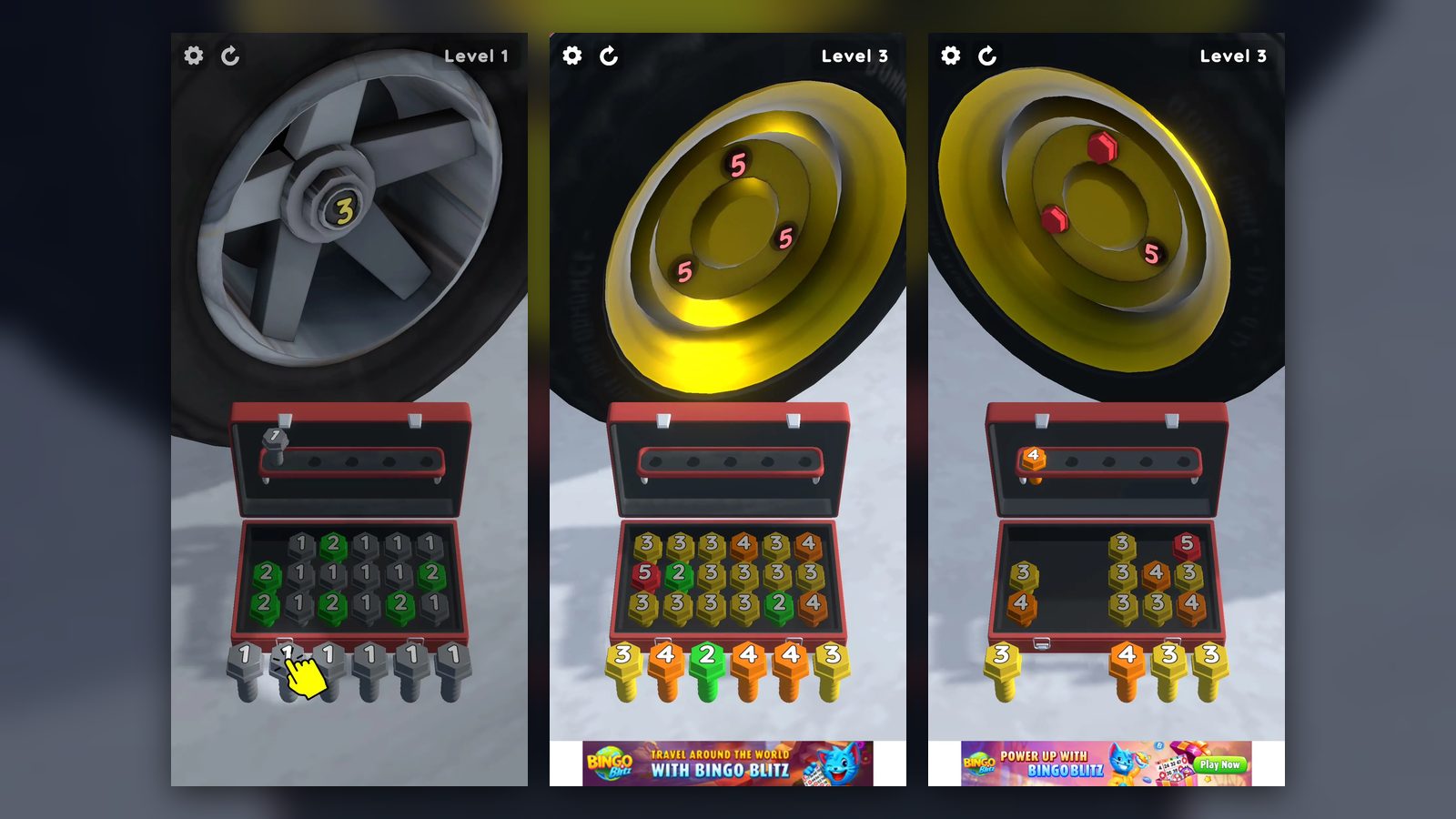
Here is what a level looks like:
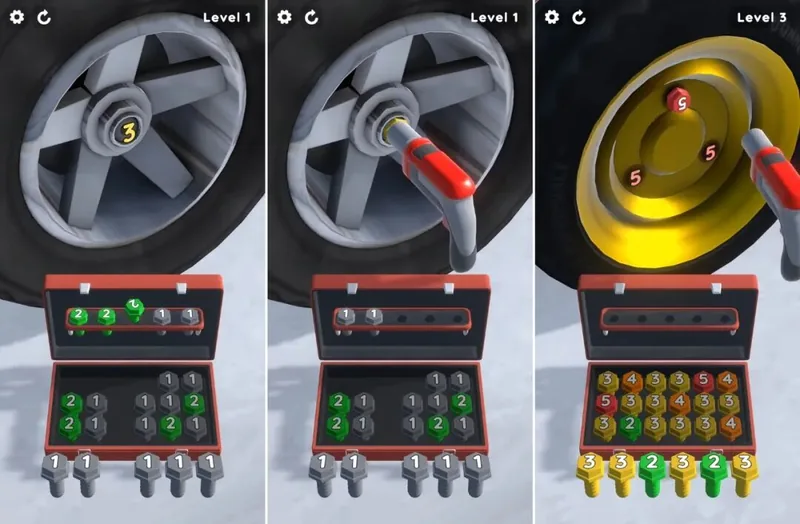
The rules work like this:
- The whole game uses the layout of tile match games, where you tap pieces down into a small tray, only the tiles have become numbers. On top of that come number merging and a finishing touch where screws are tightened to fit the tires.
- The toolbox holds lots of screws marked with different numbers. Each tire needs screws with specific numbers before it can go on, so you merge screws from the toolbox to get the ones you need.
- Below the toolbox sit six columns, while the placement area has only five. Three identical numbers merge automatically into one number that is one higher: three 1s become a 2, and three 2s become a 3.
- The core skill is planning the order of your taps and merges. If the placement area runs out of room, you fail the level.
Put together, every level runs on that loop: tap screws down, let matching threes merge, and bolt the right numbers onto each tire.
Tapping, Merging and Drilling Numbered Bolts
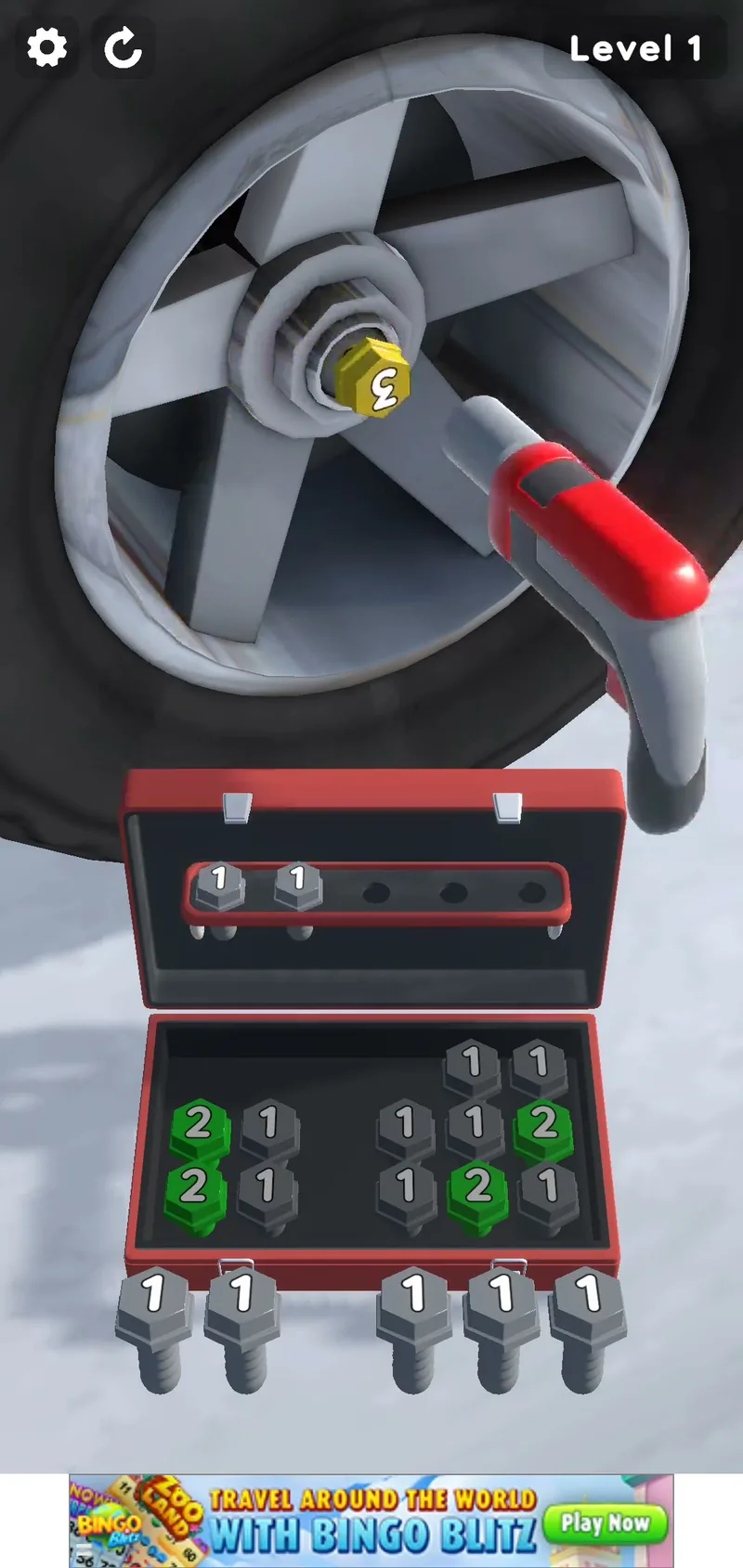
The screen splits in two: a close-up car wheel fills the top half, and an open red toolbox sits below it on a pale gray floor. A gear button and a circular-arrow button sit at the top left, with a “Level 1” label at the top right. You play by tapping single bolts. Early in Level 1, a tutorial hand taps a gray 1 in the front row.
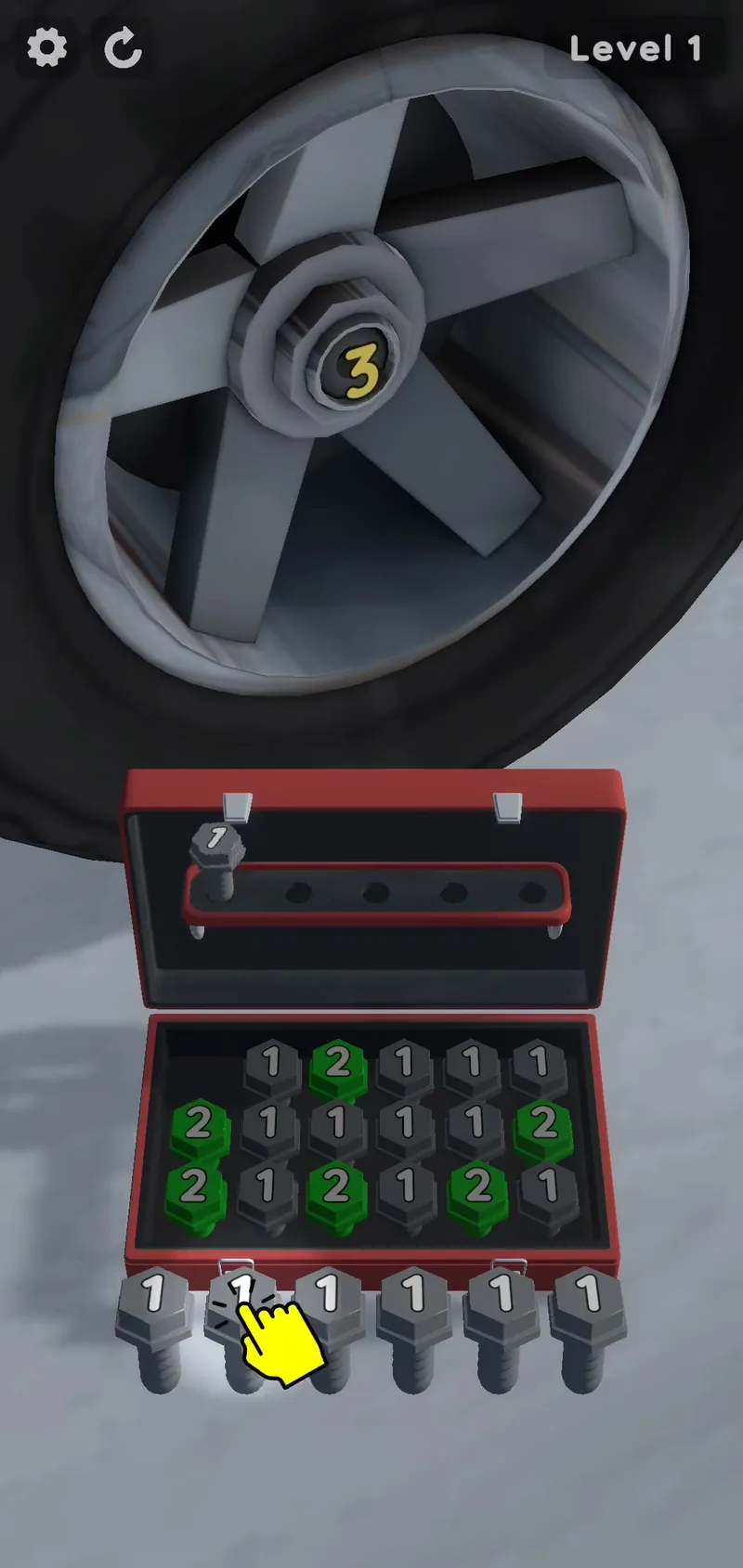
Each bolt has a chunky hexagonal head on a thick threaded shank. A white number outlined in dark gray sits on the head, and each number has its own color: gray for 1, green for 2, yellow for 3, orange for 4 and red for 5. Bolts inside the toolbox are drawn darker than the row standing along its front edge. Early in Level 1, the toolbox holds three rows of six columns behind a front row of six gray 1s, with green 2s scattered among the gray 1s inside.
The toolbox lid holds a rack with five holes in a row. A tapped bolt drops into the next free hole, so the rack fills from left to right. Different numbers can sit side by side, such as a 3, 3, 2 and 1 in Level 2. When a front bolt leaves, the bolts behind it in that column move forward.
In Level 1, a third gray 1 drops into the rack next to two others. Soon after, a yellow 3 is on its way to the hub.
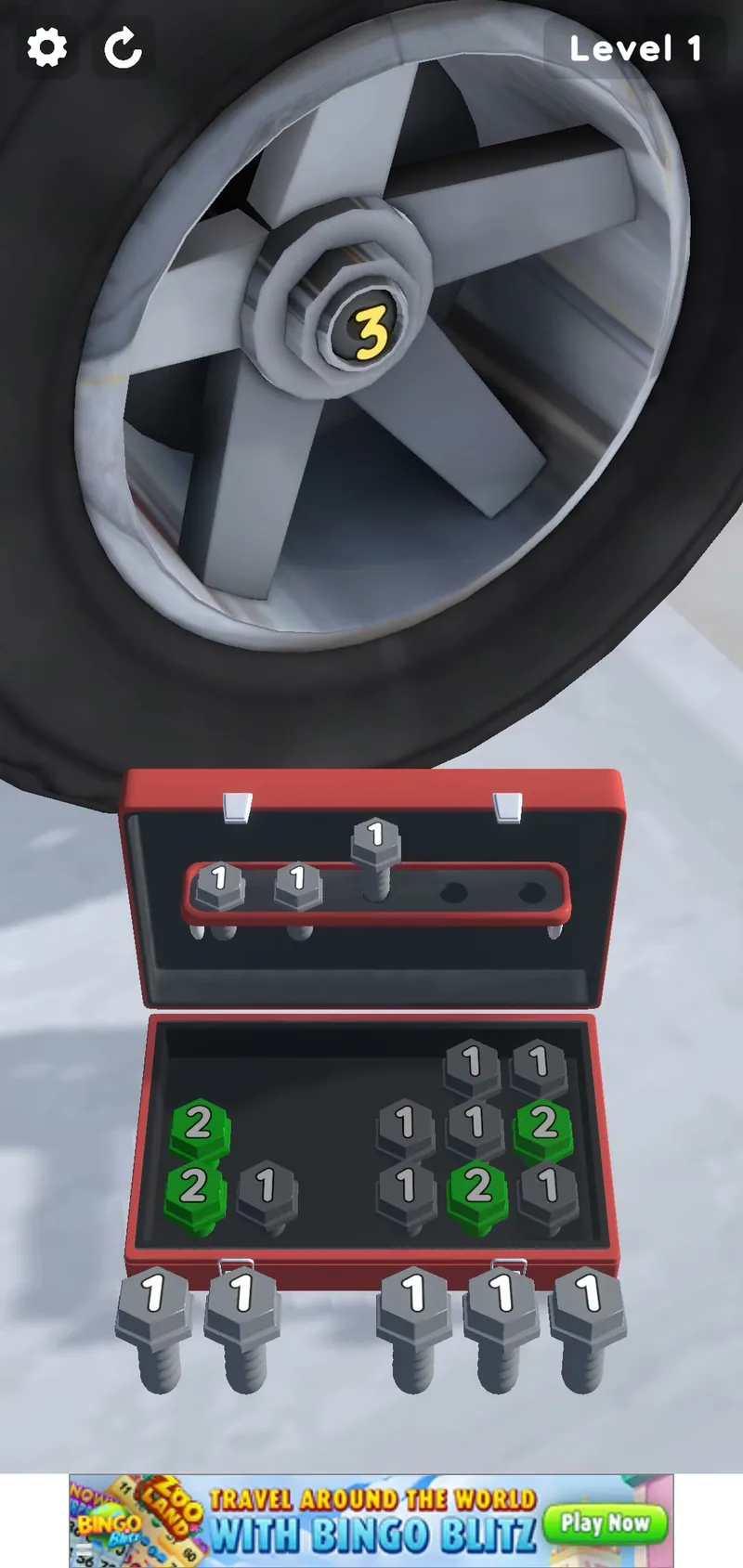
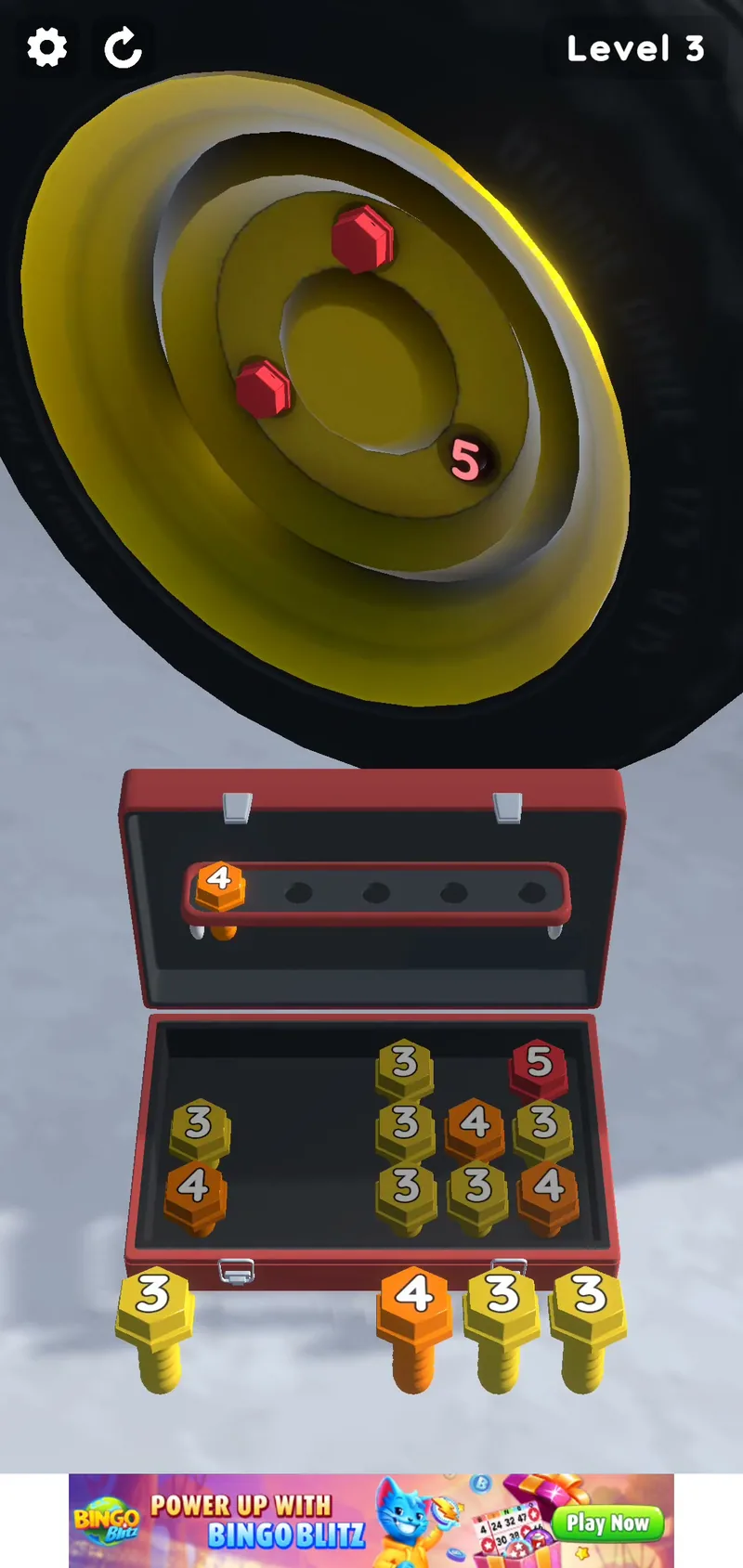
When three bolts in the rack show the same number, they are replaced by one bolt with the next number. In Level 2, three yellow 3s give way to an orange 4 that rises out of the rack. The bolts left over, a green 2 and a gray 1, shift to the left end. In Level 3, three orange 4s taken from the front row become a red 5.
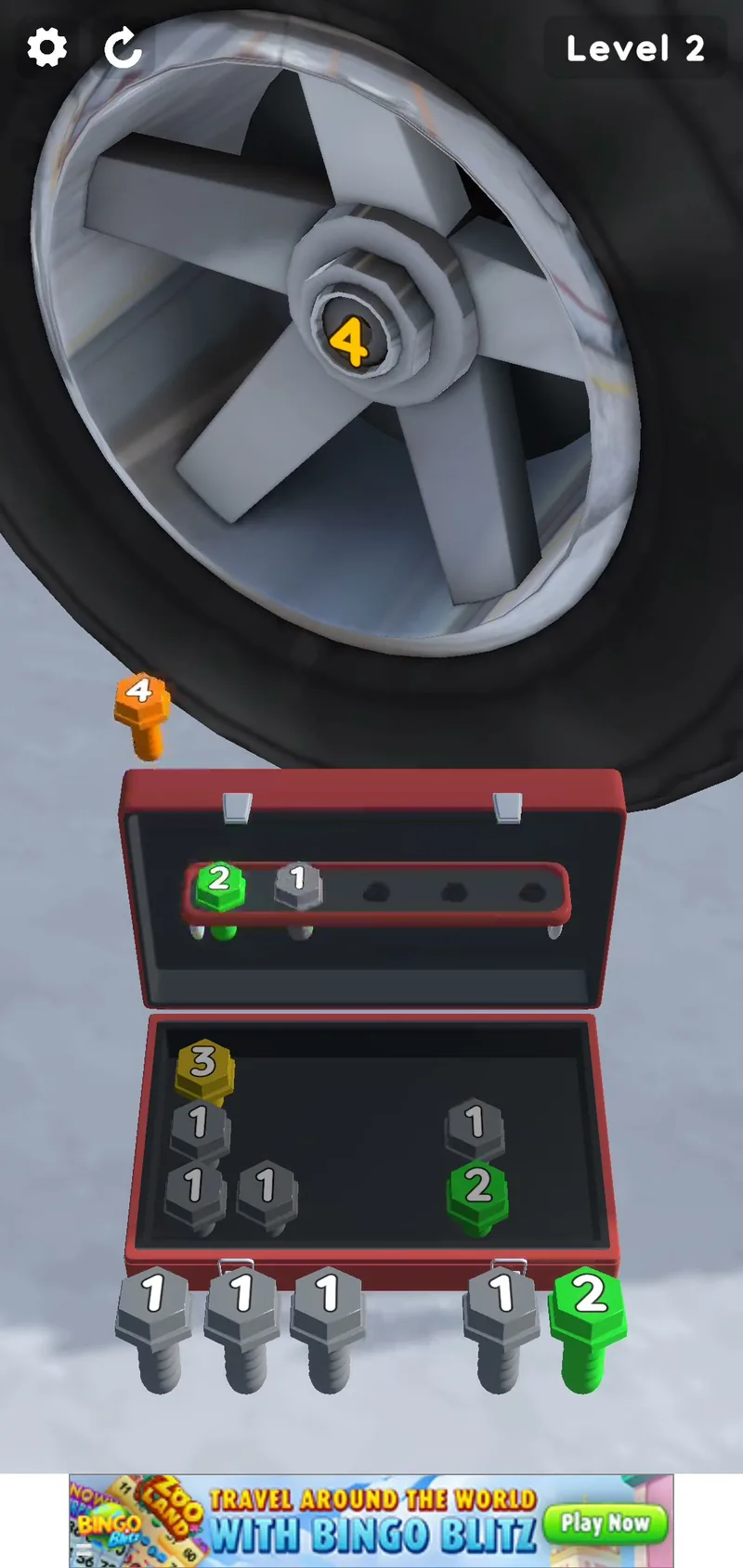
The target is printed on the wheel. The hub is labeled with the number it takes: 3 in Level 1 and 4 in Level 2. A bolt with that number flies to the hub, and a red-and-gray power drill screws it in. Shortly after, the hub is empty again and shows its label, and in Level 1 another yellow 3 then flies to it.
Each of the three levels we played ended with the toolbox empty just as the last matching bolt went in. Level 1 ended with a 3 in the hub, Level 2 with a final orange 4 in the rack, and Level 3 with the drill on the third lug. After Level 3, a translucent purple card appears over the garage scene. It shows yellow “LEVEL COMPLETED” text, a large smiling face and “TAP TO CONTINUE.”
Level 2 opens on a parking-garage scene labeled with the level number, with concrete pillars, graffiti and yellow floor lines. Yellow 3s join the gray 1s and green 2s. Early in play the toolbox is full, with three rows of six plus a front row that reads 3, 2, 2, 3, 3, 2. The columns hold more bolts than fit in view, because new bolts appear at the back of a column as it moves forward.
Between board views, the camera sometimes cuts to a side view of a white car with red trim. Its wheel is mounted, with an orange nut at the center.
Level 2 took three attempts. At one point in the first attempt, the rack held a 3, 3, 2 and 1, with a 1, a 1 and a 2 left in the toolbox. After that, the Level 2 garage intro came back. The garage intro also came back late in the second attempt, and board positions from earlier attempts came back exactly on later ones.
Soon after the Level 3 intro, the rack is empty and the toolbox is full. The wheel above is now a glossy yellow rim with lettering on the tire sidewall. Instead of a single hub, the rim has three lug holes around its center, each labeled 5 in pink inside a dark circle. The toolbox holds mostly yellow 3s, plus orange 4s, three green 2s and one red 5.
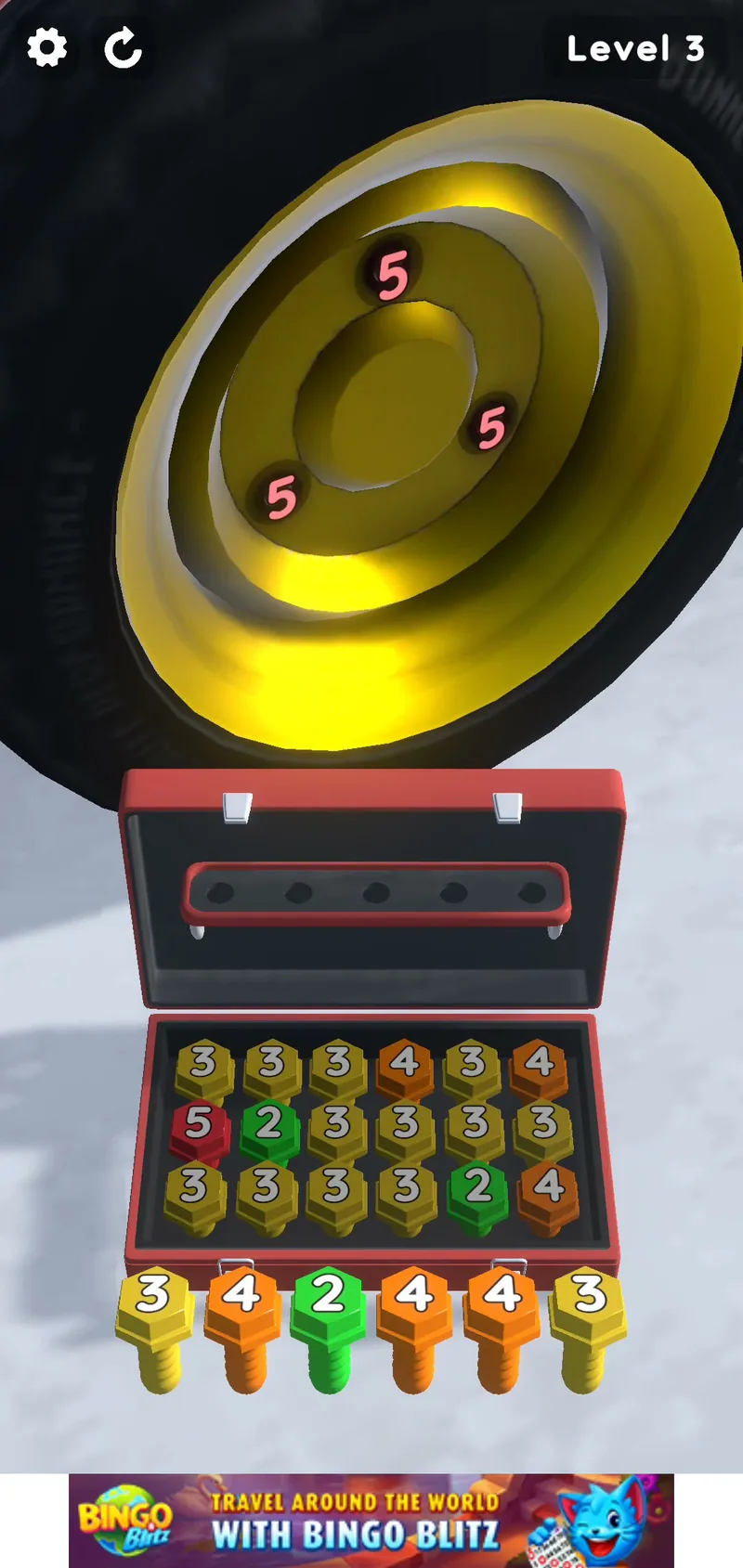
The Level 3 toolbox already contains red 5s, the number the rim asks for, and at one point three of them stand in the front row. At another point, two orange 4s sit in the rack waiting for a third while one red nut is already on the wheel. Bolts that go into the rim appear as plain red hex nuts. At one point, after a rim has all three nuts, the game shows a wheel from another angle with three empty lugs labeled 5, and play continues from the same toolbox as those lugs fill one by one.
A banner ad, mostly for Bingo Blitz, runs along the bottom of the screen from early in Level 1, and late in Level 3 banners for other apps take its place. After the toolbox empties at the end of Level 2, a full-screen ad for a block-puzzle game plays before the Level 3 intro. A number at its top left reads 24 and then 19, and a close (X) button appears.
How It Scores
Here is how it rates on each count:
| Category | Score | Comment |
|---|---|---|
| Core fun | 7 | Some fun, but not much depth |
| Originality | 7 | A very good creative angle |
| Art style | 7 | Standard casual-game art |
Overall:
- Overall score: 7.
- As a fresh idea, it does quite well: it works in number merging and layers car repair on top, the pieces fit together fairly naturally, it plays smoothly, and it is fun to a point.
- Number merging itself sets a ceiling, so the game lacks depth. Later levels get fairly repetitive and can wear you out.
- More varied levels built on this idea would keep it fresh and make for a better experience.
More in this series:
A new twist on word puzzles: guess real objects from a picture and a description
Tile Match + 2048: a great idea
Pipe maze puzzles + matching and clearing: a very promising idea