Monster Hunter Now Review: Great Jagras on a Street Map
Great Jagras on a GPS street map, flick-to-dodge 3D hunts and Iron Ore upgrades fill this Monster Hunter Now review.
Game at a glance
Monster Hunter Now
8.5/ 10
Our score
Monster Hunter GO: the hunting series played the Pokémon GO way.
In this article6 sections
A Great Jagras is standing on a pale blue street map, right beside the hunter, while the bottom bar shows the current quest: “Slay monster…” Before the fight can start, a prompt reads “Please move to a safe place before beginning.” Then a “Start Hunting…” banner appears, the street gives way to a 3D arena, and the monster waits under a city skyline at night.
That switch from map to arena runs through all of Monster Hunter Now, a location-based monster-hunting game that sets the Monster Hunter series’ creatures on a street map tied to GPS and settles each encounter in a short 3D fight played in portrait. In the opening tutorial and the four prologue chapters we played, the hunts sit inside a loop of gathering and weapon upgrades, with a Hunter Rank climbing toward HR 11. Put simply, it is the Monster Hunter brand with Pokémon GO-style play.
From the street map into a 3D arena
Monster Hunter Now gameplay moves between two places, the street map and the arena, and one rule decides every hunt. The “Slaying Monsters” tip explains it: if the monster’s health is fully depleted within the time limit, the hunt ends in success, and if it can’t be brought to 0, the hunt fails. A cleared hunt ends with a large gold “CLEARED” crest over the fallen monster. Above the hunts sit story chapters, each a short list of quest tasks that get a green “QUEST CLEARED” stamp when done, until the screen announces “Chapter Completed.”
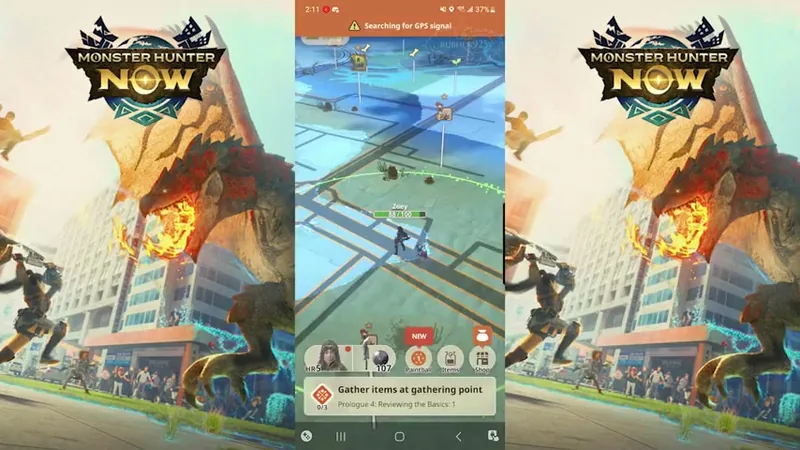
The map is a pale blue street grid with green patches and a ring drawn around the hunter, under a “Searching for GPS signal” banner. Monsters stand on it as small 3D models, some flagged with a red “TARGET” label. Dragging one finger looks around, and pinching with two fingers zooms out to a bird’s-eye view. The HUD along the bottom holds the hunter’s portrait with their Hunter Rank and buttons for the weapon, Paintball, Items and Shop, with the current quest in a bar underneath.
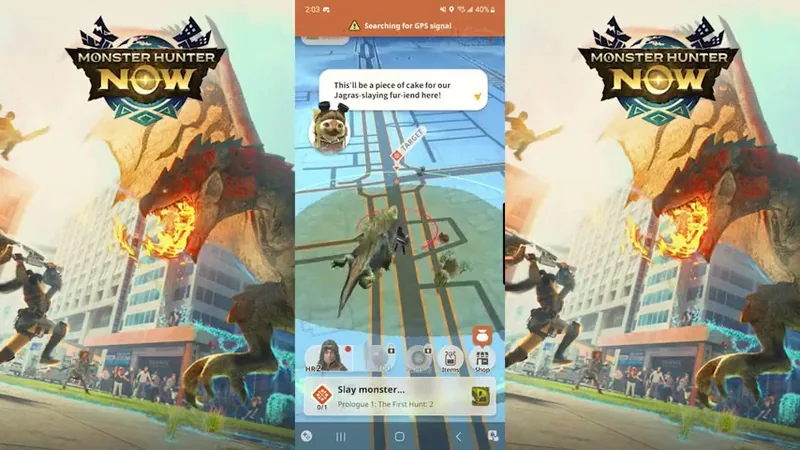
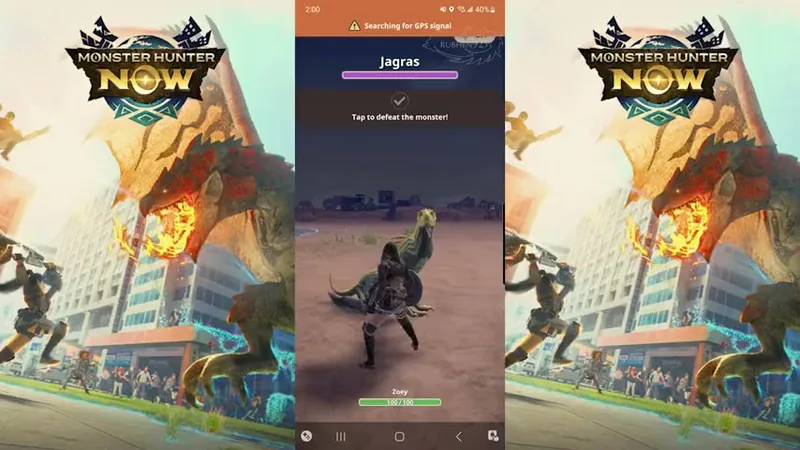
Small monsters come first. In the opening tutorial three of them stand near the hunter under “TARGET” tags, and the first fight, against a small Jagras with no star beside its name, comes with one instruction: “Tap to defeat the monster!” Each tap is an attack. A beaten Jagras leaves a “Sharp Claw +1” notice, and the Felyne asks for the rest to be dealt with too.
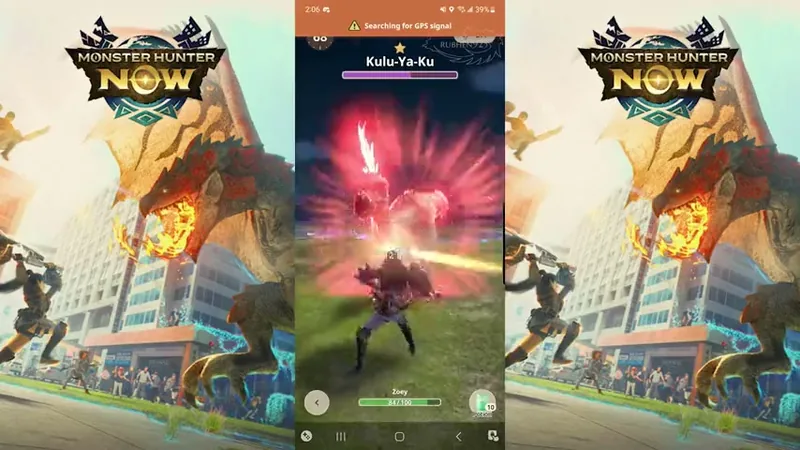
Large monsters carry a star next to their name, and Kulu-Ya-Ku and Pukei-Pukei get a close-up with that name before their fights. In the arena the camera sits just behind the hunter with the monster ahead, its name and health bar along the top and the hunter’s along the bottom. Hits throw up floating damage numbers and glowing weapon trails.
Those large monsters fight back, with a warning first. The “Evading Attacks” tip says they glow red before attacking, and that a flick right, left or down evades the attack. The hint “Flick to dodge!” appears during the first Great Jagras hunt, and Kulu-Ya-Ku is later wrapped in red light in the middle of its fight.
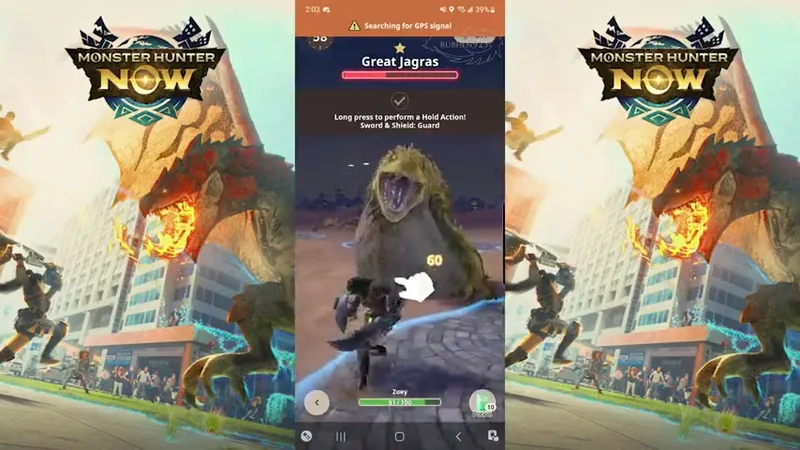
The third gesture is a long press, which performs the weapon’s Hold Action. The hunter carries a sword and a round shield, and the hint “Long press to perform a Hold Action! Sword & Shield: Guard” sets out what that means for this weapon, next to a pressing-hand icon. In large-monster hunts the lower-left corner holds a back-arrow button and the lower-right corner a Potion button with a count on it.
The hunter’s health bar sits under their name in a fight and above the avatar on the map, and damage carries over: after the first Great Jagras hunt, the bar above the avatar is still short of full. The “Restoring Health” tip says health refills by itself over time, while a Potion restores it quickly. Potions are handed out free once a day, and the “Reviving” tip says one lets the hunter continue a hunt even after health is fully depleted. On the map, the Felyne points to the Items button for using a Potion.
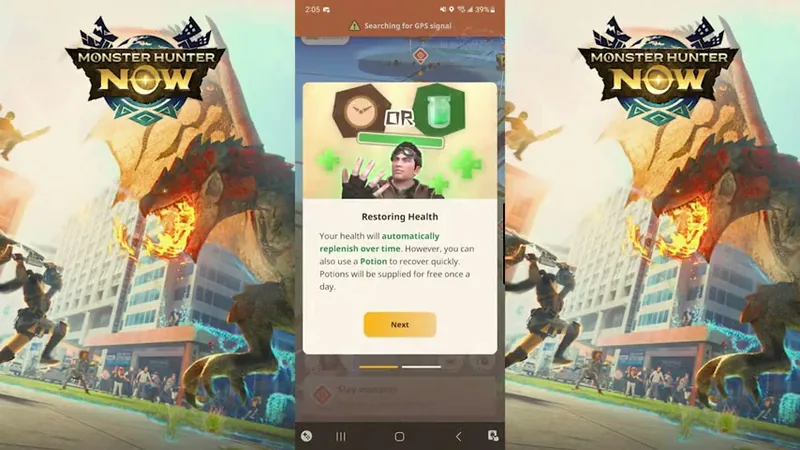
A card telling the rookie to “work your socks off till HR 11!” opens Prologue 2, “Aiming for Pro.” Its first task, “Slay monster,” asks for three kills against small monsters, and the health and Potion tips come up before the first of them. The chapter closes with the Urgent Quest “A Test of Skills” against Kulu-Ya-Ku, cleared in 00:21 for a B on the Hunt Report. Hunter Rank then moves from 3 to 4, and a “New content!” banner unlocks Equipment Upgrading.
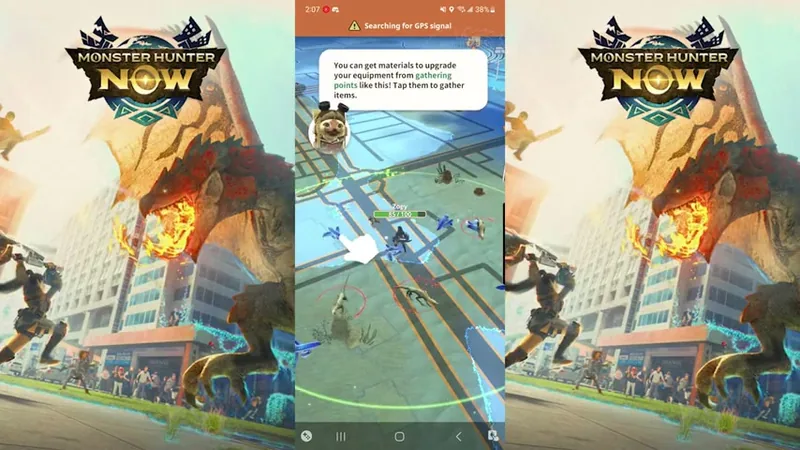
Gathering points arrive in Prologue 3. The Felyne points them out as pins on the map that give materials for upgrading equipment when tapped. It also offers to retrieve anything the hunter misses and tells them to watch for “big gathering points,” where a lot of items wait. Gathering also counts toward quests, through a task called “Gather items at gathering point” that asks for three. Materials drop in fights too: an “Iron Ore +1” notice pops up mid-fight against a small Jagras later in the chapter.
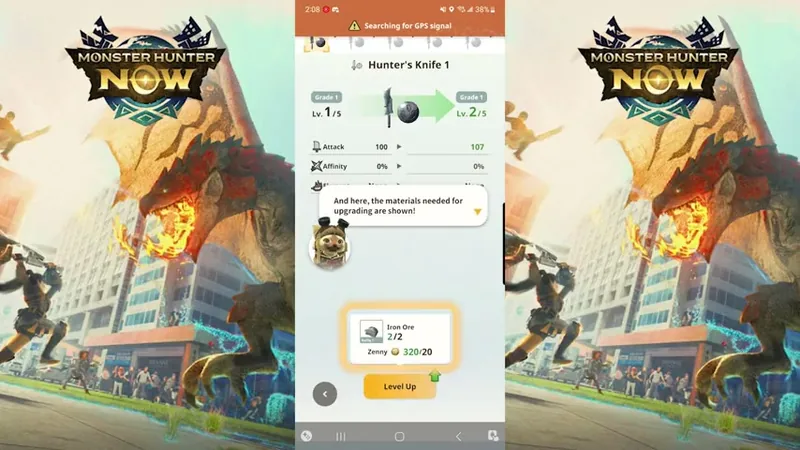
Those materials, along with the Zenny paid out after hunts, go into equipment. The Equipment screen shows the hunter’s Total Attack and Defense above six equipment slots in a row, with Weapon and Armor tabs below; the Armor tab lists a five-piece Leather Set, and a green arrow marks any piece that can be strengthened. Raising the hunter’s Sword & Shield weapon, Hunter’s Knife 1, from Lv.1 to Lv.2 of 5 previews Attack going from 100 to 107 and costs 2 Iron Ore and 20 Zenny. The next step would take Attack to 115 for another 2 Iron Ore and 30 Zenny, but with no ore left, its Level Up button stays gray.
The Paintball comes last. Its button on the bottom bar shows a padlock early on. A Paintball turns up as a reward after Pukei-Pukei, and in Prologue 4 the button unlocks with a NEW tag. The Paintball List that follows shows a marked Great Jagras beside a Hunt button and a countdown to when the mark expires, while a separate counter tallies marked monsters. The next hunt is against a Great Jagras.
Prologue chapters and the Hunt Report payout
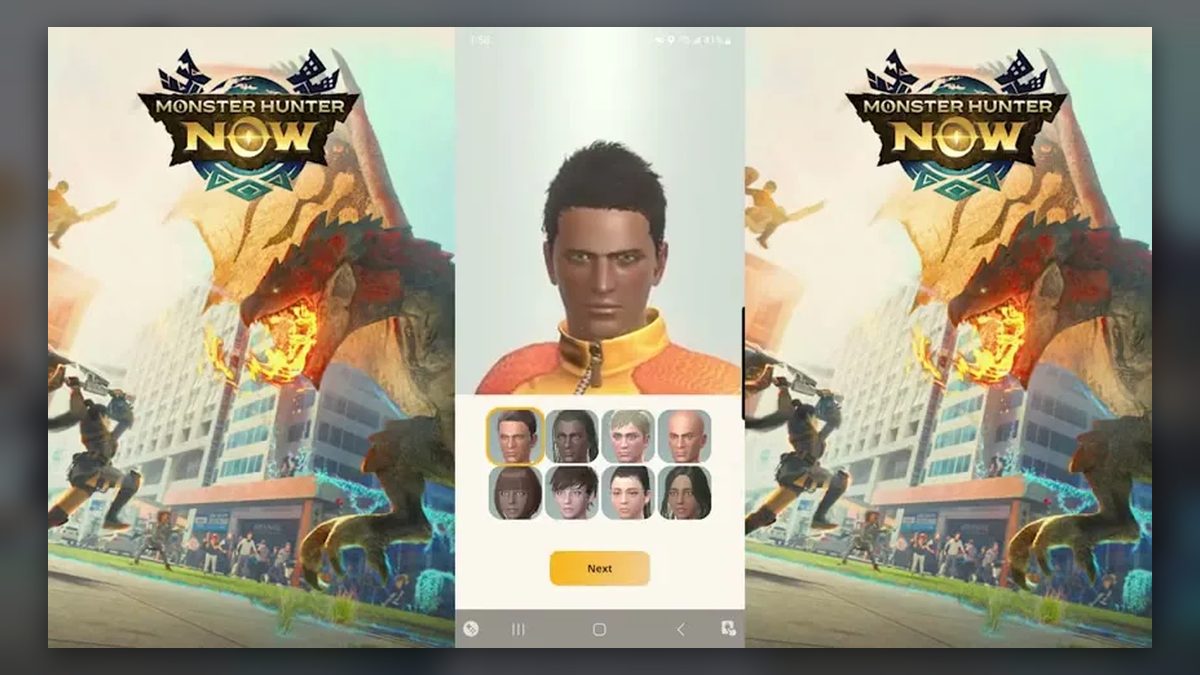
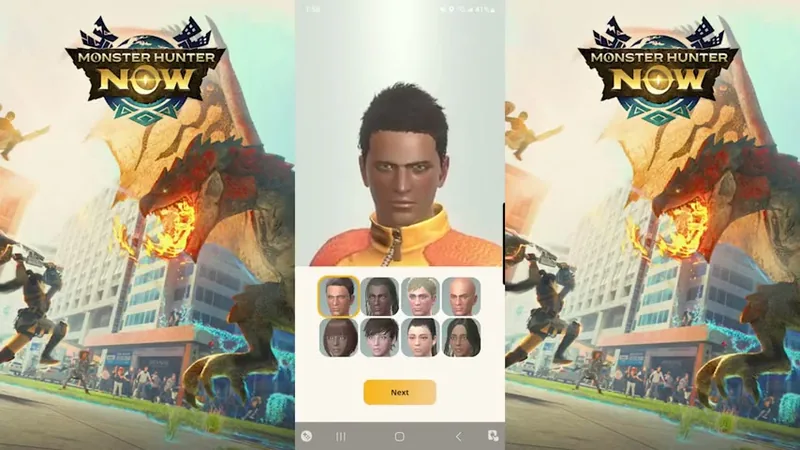
Before any monster appears, the game opens on hunter creation: a grid of eight face presets, a matching grid of eight color swatches, then a display name of 2 to 30 letters, alphanumeric only. Illustrated story cards follow, in which a cat-like creature surrounded by monsters begs for help. The voices of these cards are a goggled Felyne, also called a Palico, and Qualily, a woman in red armor who has fallen from the sky.
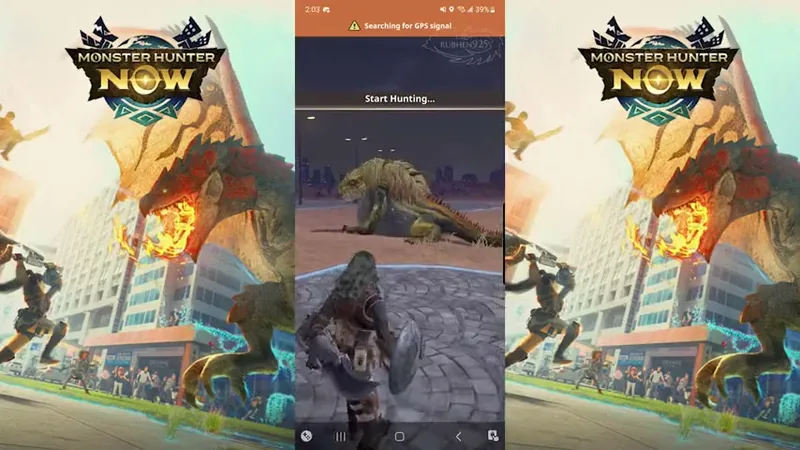
From there the monsters grow. Small Jagras fill the opening tutorial, and the first chapter builds to Great Jagras, the first large monster with a star by its name, after tips on dodging and the time limit. The arena changes from hunt to hunt: a dusty lot under a night skyline for that first Great Jagras, open grass for Kulu-Ya-Ku and the second Great Jagras, and dark, glossy ground for Pukei-Pukei.
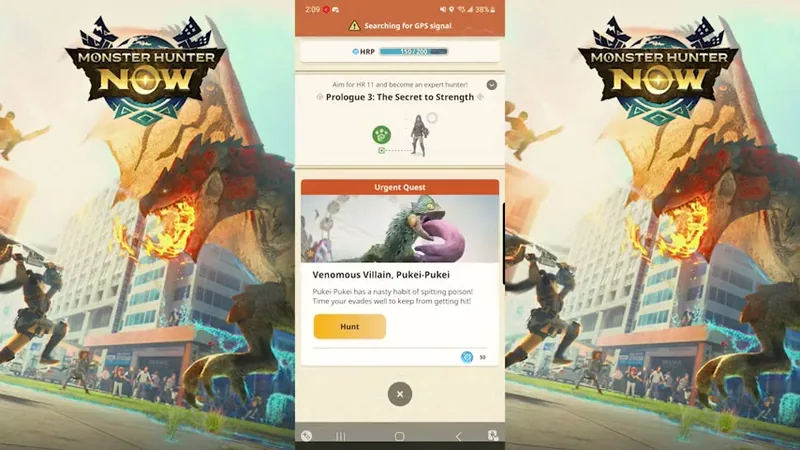
The middle chapters each close on an Urgent Quest, shown as a large illustrated card. Kulu-Ya-Ku’s “A Test of Skills” comes first, then “Venomous Villain, Pukei-Pukei,” whose card warns that the monster spits poison and tells the hunter to time evades well, above a Hunt button. The fourth chapter, “Reviewing the Basics,” sends the hunter back to Great Jagras after a card that says “Take everything you’ve learned and kick some monster hide!”
Quest tasks widen in the same way. The first two chapters ask only for kills, while the third mixes “Upgrade equipment - Weapon” and “Gather items at gathering point” in with “Slay monster,” and the fourth pairs gathering with “Slay monster - Large Monster.” Every task is marked with a reward of 50. New features announce themselves with a “New content!” banner or a red NEW tag on a HUD button, first on the weapon button and later on Paintball.
Those rewards feed Hunter Rank. “Hunter RANK UP” banners mark the climb from 1 to 2 and from 3 to 4, and the rank shows under the portrait on the map, from HR2 after the opening fights to HR5 by the fourth chapter. On the quest screen an HRP bar runs above the goal “Aim for HR 11 and become an expert hunter!” The log has two tabs, Quest and Daily, but the Daily tab stays padlocked.
Each large-monster hunt ends with a Hunt Report that grades the Completion Time with a letter. The first Great Jagras and Kulu-Ya-Ku (cleared in 00:21) both earned a B, and Pukei-Pukei and the second Great Jagras an A, both cleared in 00:15. The Kulu-Ya-Ku, Pukei-Pukei and second Great Jagras reports each list a Zenny reward and a row of four “Basic Rewards” material cards labeled by rarity, such as a Rarity 2 Pukei-Pukei Tail, and the Kulu-Ya-Ku report also shows a “Bonus Rewards” row.
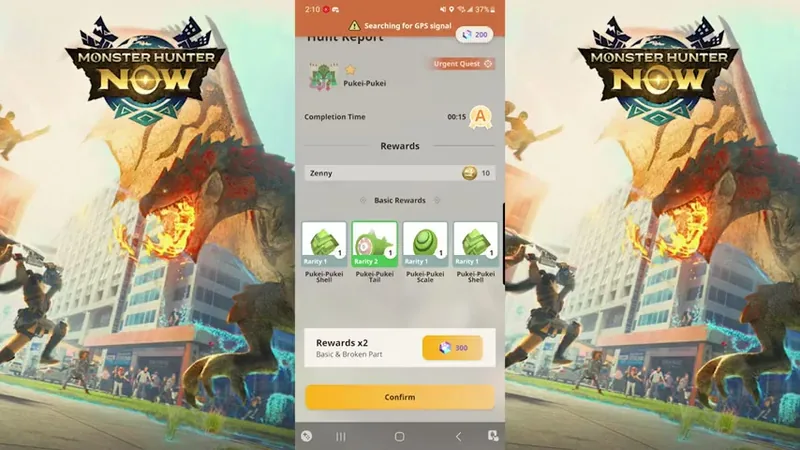
Zenny comes in on those reports and goes back out on upgrades, where the upgrade screen shows it as owned against needed. The “Double Rewards” tip says Gems can double the number of materials from a hunt and recommends doing so when rare or wanted materials drop. The Pukei-Pukei and second Great Jagras reports carry a “Rewards x2 / Basic & Broken Part” button marked 300 with a crystal icon, the same icon as a counter in the report’s top corner.
Other rewards come as items. A “REWARD” panel after Pukei-Pukei hands over a Paintball and a Wander Pebble, both Rarity 1, and the Felyne promises to keep the hunter stocked up on Potions while they’re a rookie. The Items and Shop buttons sit on the map’s bottom bar, with a pouch icon above Shop, but the Shop is not opened during the prologue.
Near the end comes an “Adventure Sync Settings” pop-up. It explains that Monster Hunter Now uses location data so the Palico can mark nearby monsters and gather items even when the app is closed, with “Enable” and “Not right now” buttons. A note on the Paintball List says background mode features are currently unavailable.
Star-marked giants and group hunts
With Pokémon GO’s success to learn from, we don’t expect Monster Hunter Now’s core quality to be weak. In the prologue that core shows up as a GPS street map that fills with monsters and gathering pins, and as a switch from that map into a full 3D arena for each of the four large-monster hunts.
Monster Hunter’s habit of building a hunt around one giant monster is also a very good fit for big group hunts, the kind where many players come together to bring down a dragon. Each large monster in the prologue is that kind of quarry, a single star-marked beast whose health bar spans the top of the screen, from Great Jagras to Pukei-Pukei. The prologue’s hunts are all solo, so group hunting itself does not come up in it.
Portrait controls and the gear grind
Two doubts keep the outlook open. One is whether portrait phone controls suit Monster Hunter’s style of combat. A whole fight here runs on three gestures, a tap to attack, a directional flick to dodge and a long press to guard, all made with the phone held upright. Whether these portrait controls suit a Monster Hunter fight is still an open question.
Doubt also hangs over the gear grind. Upgrades run on materials and Zenny, and Hunter’s Knife 1 asks for 2 Iron Ore at each of its first two level-ups; once the ore is spent, the Level Up button turns gray. Whether that material grind can keep players who come from Pokémon GO-style games around over the long run is uncertain.
From gathering pins to Level Up buttons
On the map, play means spotting monsters under red “TARGET” tags and tapping gathering pins along the streets. In the arena it narrows to a few inputs: reading a monster’s red glow in time to flick aside, holding a long press to guard, and tapping until its health bar runs dry.
Between fights the attention turns to the weapon. Zenny and Iron Ore are weighed against a Level Up button, and each Hunt Report hands out a letter grade. That loop lines up with a liking for short 3D fights that feed a weapon growing one upgrade at a time, with quest bars counting toward the next Hunter Rank.
Verdict
Monster Hunter Now puts Monster Hunter’s monsters into Pokémon GO’s way of playing, and it earns a high mark. Its fundamentals should hold up, and the series’ one-giant-at-a-time fights suit hunting together. What remains open is whether portrait controls fit the combat and how long the material grind can hold GO players. Going by results so far, its chances look a little better than those of the Warcraft mobile game, a prediction that may yet come back to bite us. We also wonder whether Tencent will bring it to China, a market that has waited a long time for its next location-based game.