Ole Ole Review: Block Puzzle Duels With Gem-Charged Skills
Our Ole Ole review covers a 3:00 block puzzle duel on a 9x9 grid, where gems from cleared lines charge a wand, a biplane and a rocket.
Game at a glance
Ole Ole - Play With Stars
7/ 10
Our score
Block puzzles easily lack a goal; PvP is one outside rule games add to fill that gap.
In this article6 sections
The round clock read 3:00 when the match of Ole Ole began. The sign hanging above the board had already named a rival, with ARIO’S SCORE on a pink half and YOUR SCORE on a green one.
This is a mobile block puzzle turned into a head-to-head contest, which files it with our games like clash royale, though here the contest is fought with blocks. Pieces go onto a 9x9 grid and full rows and columns empty, while your score climbs on the sign beside your opponent’s.
Gem cells built into some pieces charge a skill slot, and when it fills, a skill takes over the board while the score jumps. Those head-to-head rules and the skill system are its highlights.
Placing pieces on a 9x9 grid against Ario
In the one match we played, the screen tracked two scores and a clock: ARIO’S SCORE beside YOUR SCORE on the sign, and a round clock at the top right of the board counting down from 3:00. The grid is shaded into nine 3x3 boxes. Completing a row or a column empties it and raises YOUR SCORE, and placing pieces scores too: the total once went from 0 to 80 without a line clearing. Space is the other limit, since each piece has to fit somewhere on the grid.
Control is drag and drop. Up to three pieces wait side by side in a rounded tray under the board, and a piece is drawn at full size while it is dragged toward its spot. Single cells and two-cell pieces turned up alongside straight lines of three and four, and bends came as L and J shapes, next to S- and T-like pieces and a 2x2 square. Blocks are glossy, beveled squares in bright solid colors, from orange and cyan to pink and green.
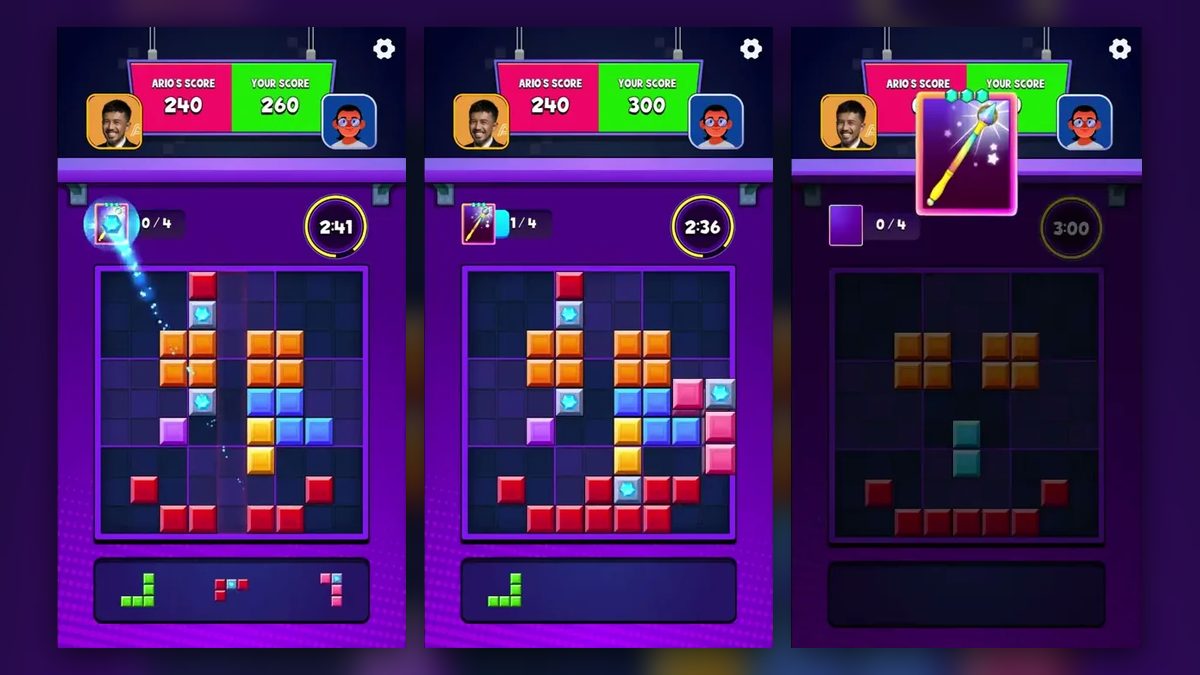
Early in the match, column 5 held a stack of cyan blocks. Moments later it was empty, and a gem from it was streaking up to the skill slot on a glowing trail. YOUR SCORE had gone from 120 to 260, and later on a row lined with blue cells emptied the same way. Dragging pieces in and emptying finished lines is the base of Ole Ole gameplay, while Ario’s score rises on the sign above.
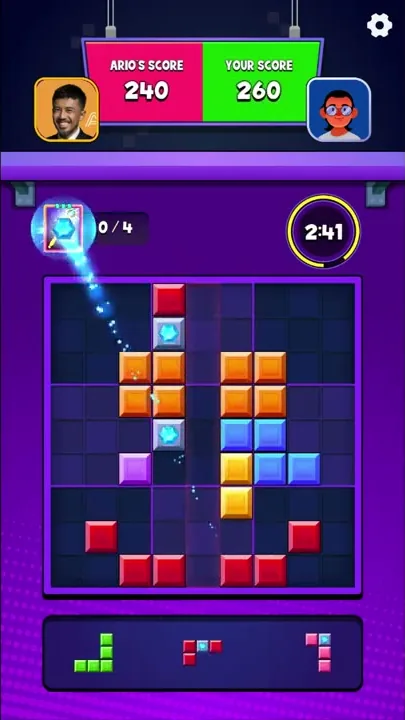
Gem cells are what fill the skill counter. Some tray pieces include a gray cell holding a blue gem, and once placed it stays on the board like any other block. When a line containing one clears, the gem flies up to the skill slot and the counter beside it rises: the first gem collected moved it from 0 / 4 to 1 / 4.
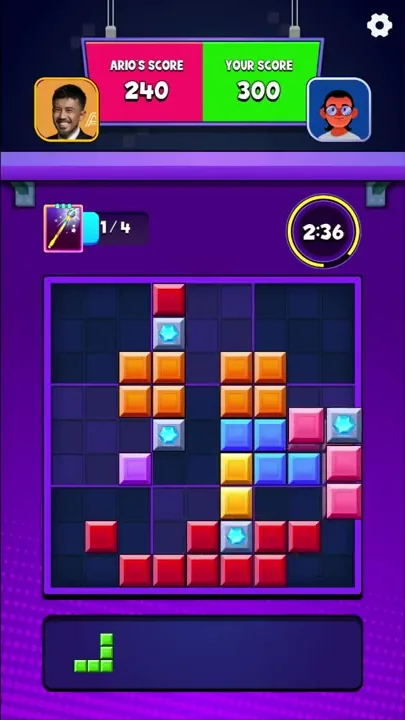
Above the grid’s left edge is the skill slot: a card showing the current skill’s picture, with a counter out of 4 over a cyan fill bar. At 4, the counter gives way to the word BOOST and the card glows. The skill then plays out on the board, and the counter drops back to 0 / 4. It can fill quickly: the rocket card went from 0 / 4 to BOOST within a few seconds.
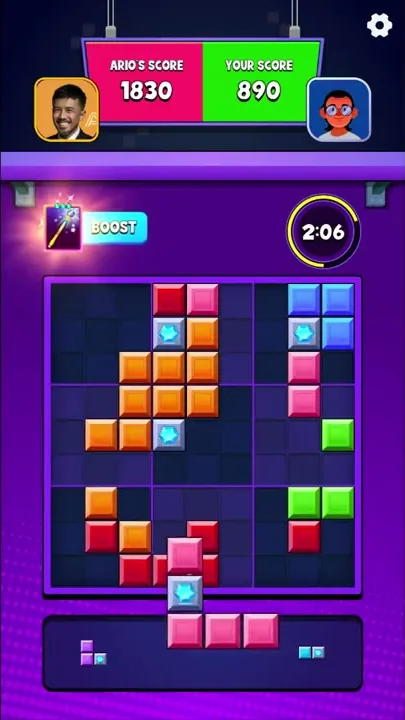
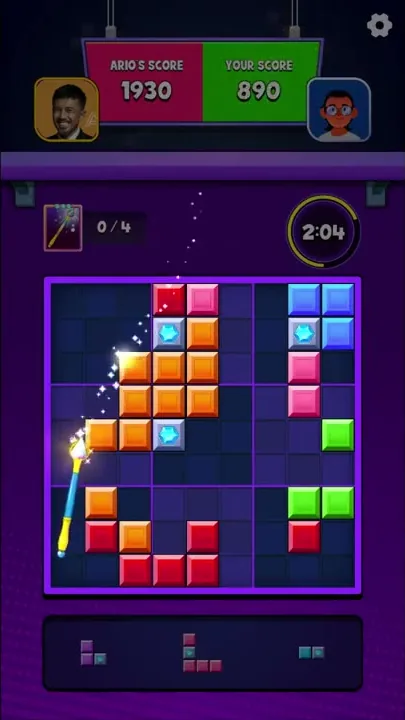
Three different skills went off. The magic wand was first, its picture in the slot from the opening seconds. Once the slot reached BOOST, the screen dimmed while a big wand swept over the left side of the board, leaving a diagonal trail of sparkles. When the board brightened again, YOUR SCORE had risen from 890 to 1290.
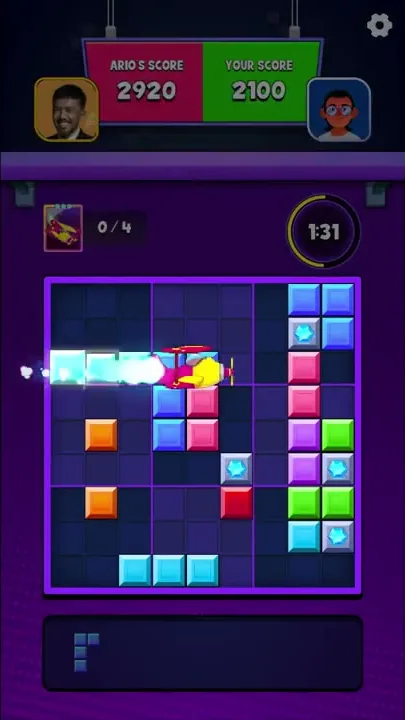
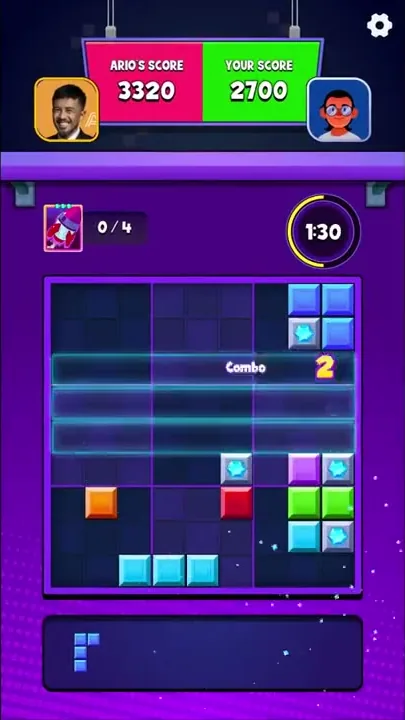
A yellow and pink biplane took the next card. When it went off, the screen dimmed and a large biplane appeared over the score sign, then flew left along a row of the grid, leaving glowing cyan-white cells in its wake. The clock read 1:31 both as the plane appeared and as it crossed the row. Afterward three rows lay empty and outlined in light, and YOUR SCORE stood at 2700, up from 1960 just before the skill.
Across those just-emptied rows, the word Combo appeared with a large yellow 2. By then a rocket card, at 0 / 4, had taken the slot.
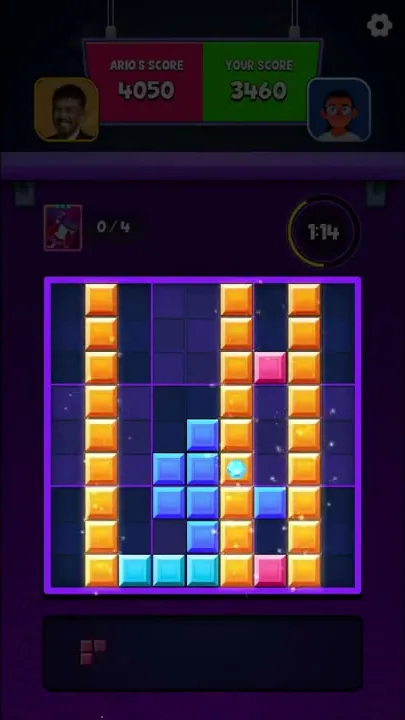
Once the rocket card glowed at BOOST, the screen dimmed, and three columns filled from top to bottom with glowing gold blocks, a gem cell sitting in one of them. Shortly after, two of those columns were empty while the third held only two pink cells at its foot. YOUR SCORE had climbed from 3460 to 4090.
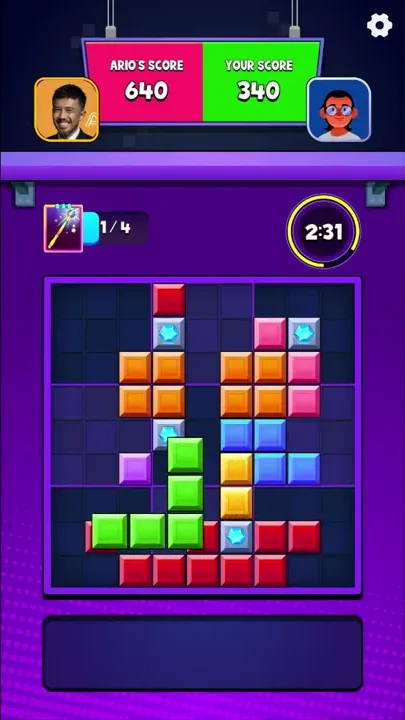
The opponent lives on the sign above the board, which hangs from two cables. ARIO’S SCORE fills the pink half beside a photo-style portrait of a man; YOUR SCORE fills the green half beside a cartoon avatar wearing glasses. Ario’s number climbs in steps while the player is busy placing pieces: 70 against 0 in the opening seconds, 640 against 340 not long after.
Rotating skill cards and a lead that swaps
The match began on a preset layout. Two orange 2x2 squares sat across rows 3 and 4, one on each side of the center column, with a vertical pair of teal blocks lower down in column 5. Row 8 had a red block near each edge, and five red blocks sat side by side in the middle of the bottom row. The whole screen was dimmed under a large magic wand card, and the skill slot showed an empty purple square at 0 / 4 before the wand picture filled it.
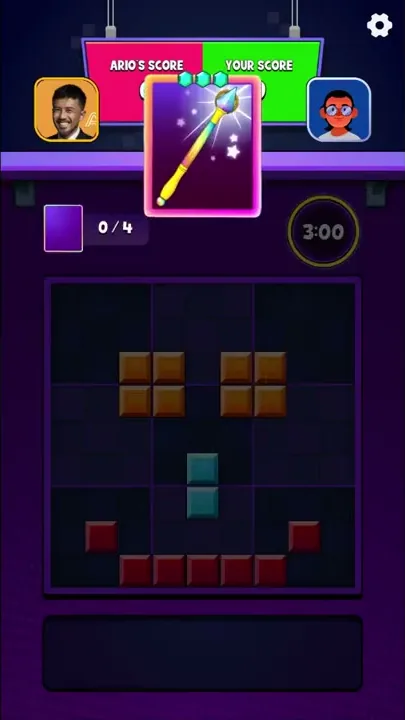
Each time a skill went off, a new card took the slot. The biplane followed the wand at 0 / 4, and the rocket followed the biplane. After the rocket, the biplane came back, already at 1 / 4.
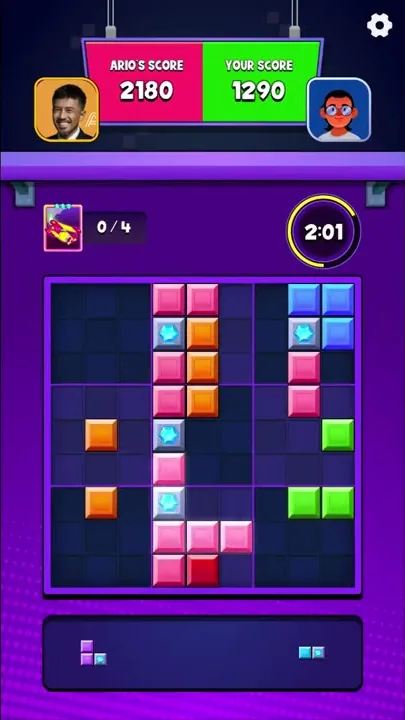
The lead swung back and forth. The player was ahead early, 260 to 240, then fell behind by 300 points soon after and by 620 once the biplane’s rows had emptied. Right after the rocket, YOUR SCORE was in front again at 4090 to 4050.
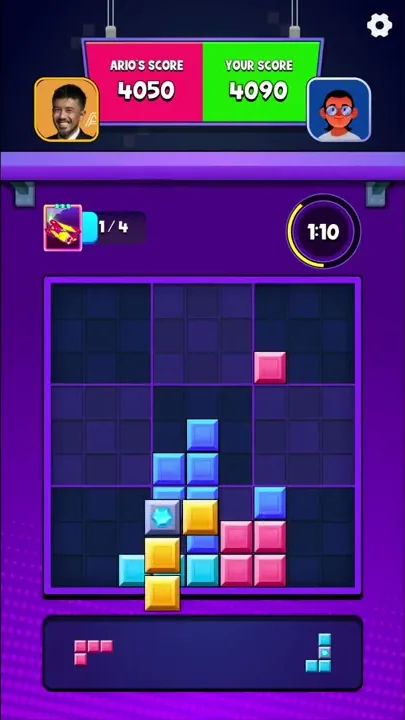
Ario had the edge again soon after, 4250 to 4230. With 0:45 left, the player led once more at 4490 to 4410, a red straight piece with a gem cell on its way to the grid.
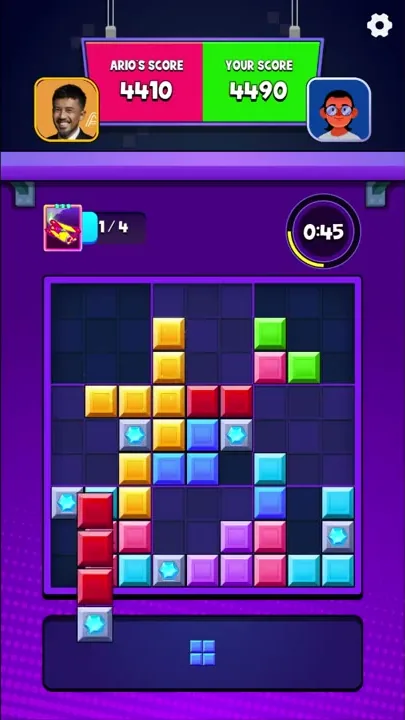
Away from the board, a gear icon is fixed in the top right corner of the screen. The rest of the screen is the match itself, from the hanging sign down to the piece tray.
Head-to-head scoring and a gem-charged skill slot
We liked the main idea: PvP rules set inside block puzzle play. Fitting pieces and emptying lines on the 9x9 grid is standard block puzzle play. The difference is that every point lands on a sign beside a rival’s total, under a clock that started at 3:00, and late in the match the lead changed hands more than once.
Then there is the skill system, fed by energy from the board. Gems in cleared lines charge the slot toward BOOST, and the three charges that went off produced a wand, then a biplane, then a rocket. Clearing lines stores up that energy, and each skill it paid for pushed YOUR SCORE up sharply, from 1960 to 2700 around the biplane.
Its setup also looks very much like Match Battle, the hit head-to-head matching-and-clearing game. Here the same kind of duel runs on a block puzzle grid instead of a matching board.
A rival and a clock supply the goal
The point we would raise concerns block puzzles as a genre. In actual play, a block puzzle easily lacks a sense of purpose, and an endless mode shows that too plainly. That is why so many recent games turn to level-based modes, new rules or PvP: rules from outside the core, used to make up for what the core experience lacks.
Ole Ole is one of them. Its target comes from the 3:00 clock and the number on Ario’s half of the sign, while on the board the job is still to fit pieces and empty lines.
Play stopped before the clock ran out, so how a match is won and whatever follows it lie outside what was seen, along with any menus or shop. Nor does the sign say whether Ario is a live player or the computer; it carries only a name, a portrait and a climbing score.
Steering gem cells into lines against the clock
The mechanics split attention between two places: the grid, with up to three pieces waiting to be dragged in, and the sign, where Ario’s number keeps moving. Pieces with a gem cell add a second job, getting that cell into a line that clears so the skill counter moves.
A taste for timed, head-to-head play fits the format, with three minutes on the clock and a rival’s total to chase. Anyone wanting an open-ended block puzzle board meets a countdown and an opponent here instead.
Verdict
Ole Ole looks very much like Match Battle with block placement underneath, and its skill system turns charged-up energy into points as the match runs. That makes it a decent game. Like many recent block puzzles, though, it draws its sense of purpose from rules wrapped around the core, an opponent and a countdown, rather than from fitting pieces and emptying lines.