Puzzle Block Buster Review: Gold Blocks That Furnish a Room
How gold question-mark blocks on an 8×8 grid turn into room furniture, in a Puzzle Block Buster review of block puzzling with a decorating layer.
Game at a glance
Puzzle Block Buster
6/ 10
Our score
Yet another block puzzle with a build-a-room game wrapped around it.
In this article6 sections
Drag a block piece onto an 8×8 grid until a row or column is full. Any gold “?” block in that line then releases a sticker, such as a houseplant or a desk, for a room that is waiting to be furnished. Puzzle Block Buster is a mobile game from the family of block puzzle games, and it pairs that board with a painted seaside room where the stickers fill empty outlines between levels.
The grid side follows the pattern of games like block blast: pieces are dragged from a tray onto a square board until full lines clear. It is one more block puzzle with a building layer around it. The combination is a new one, even if the join between the two halves comes across as slightly stiff.
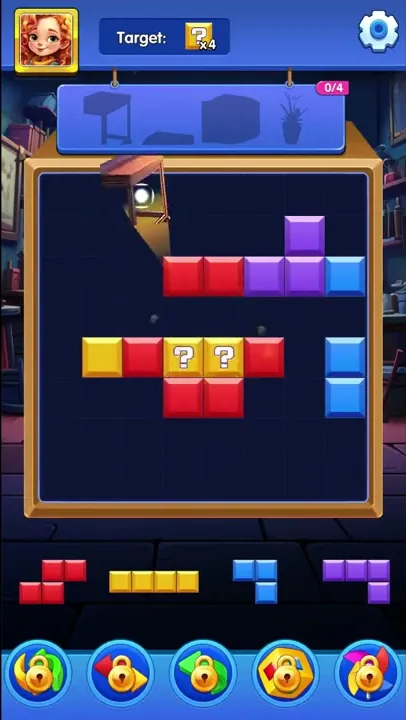
Gold question-mark blocks on an 8×8 grid
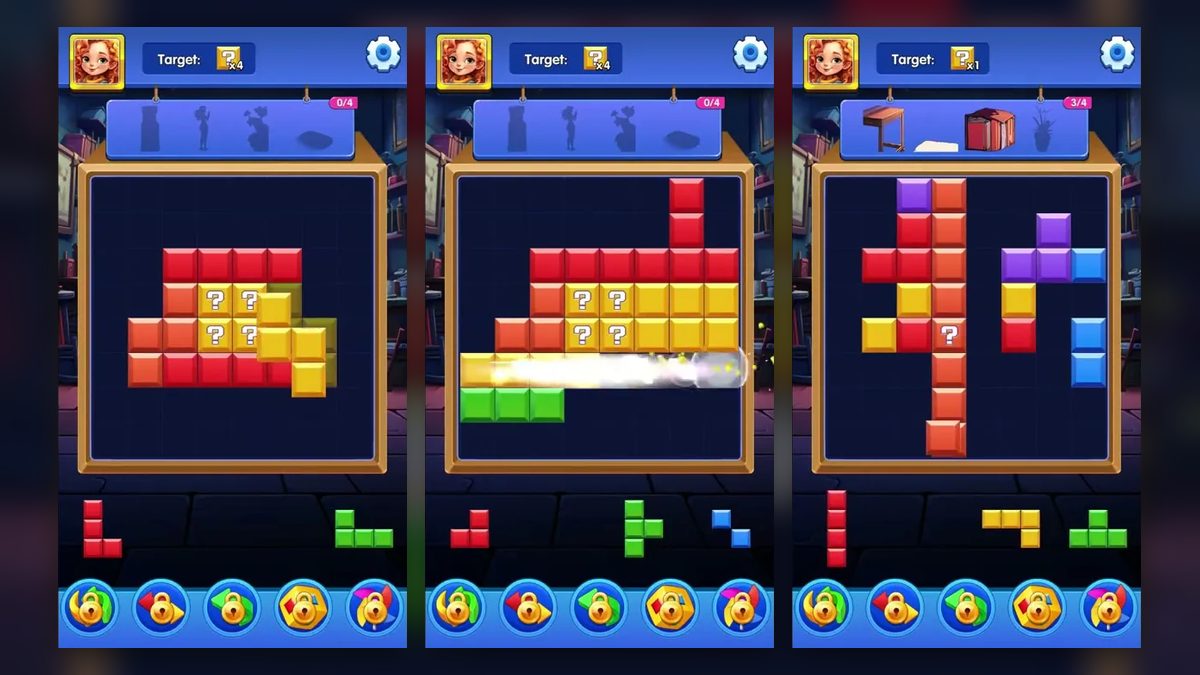
We played Levels 1 through 4 and left the fourth unfinished. The goal sits in a “Target:” box at the top of the screen: a gold “?” block icon with ×4 beside it. The count drops as those blocks are cleared, while a sticker panel above the board counts up from 0/4. When the Target box shows a green check mark and the panel reads 4/4, the level is won, and the board fills with full rows of colored blocks that burst in white flashes.
Pieces wait in a tray of four slots below the board, and dragging them onto the grid is the core of Puzzle Block Buster gameplay. Once lifted, a piece grows to the size of the board’s cells, and darker squares on the grid show where it will land. Pop-ups such as tutorial hints close with a Continue button.
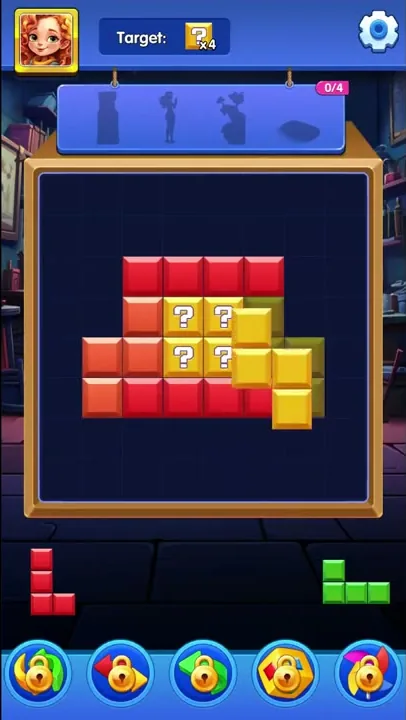
A full row or column clears whatever mix of colors it holds. Columns leave with a white streak and rows with a white sweep.
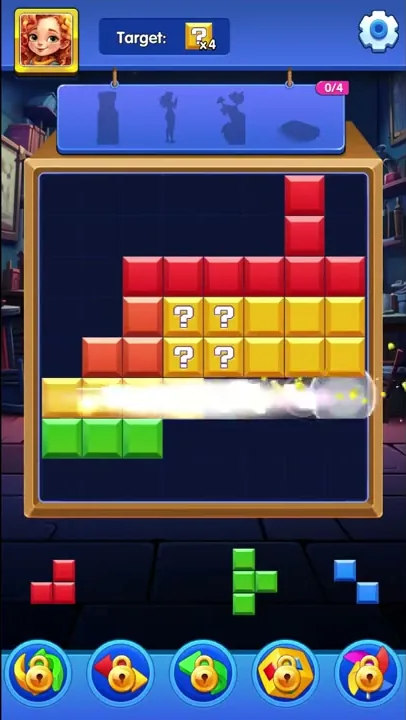
The gold blocks marked with a white “?” are what each level asks for. When a line holding one clears, the block becomes a large white question mark, and a sticker rises out of it and flies up to the panel. In the second level, a potted plant came out of one of the two “?” blocks at the right edge of the board. Between the second and third levels, a “Stickers” splash screen shows a “?” block with a green arrow pointing to a sticker marked with a question mark.
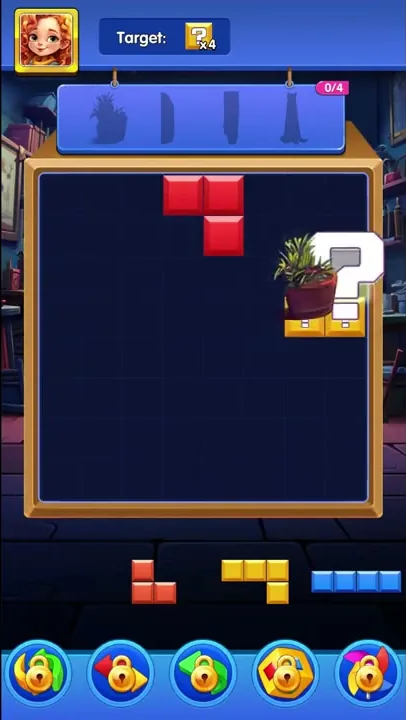
The sticker panel is a blue board hanging over the grid, which sits in a wooden frame against a dim room full of shelves. The panel shows the level’s four stickers as dark silhouettes with a pink counter in the corner. Each silhouette turns into the full-color item once its sticker arrives.
In the third level’s panel, a desk and a flat cloth sit as silhouettes beside a box and a potted plant. A row clears and the desk flies off the board. Soon the Target reads ×2 and the panel 2/4, with the desk and the cloth in color. The red box arrives at 3/4 with ×1 left, and when the last “?” block goes, the panel reaches 4/4 and the board bursts into confetti.
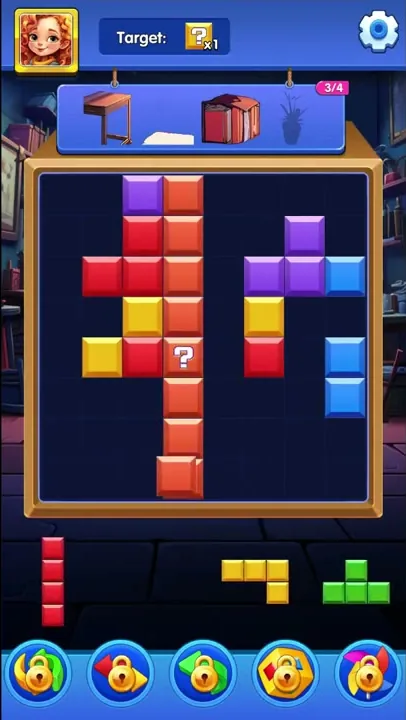
Tray pieces come in many shapes: single blocks, bars of two to four blocks, L and J shapes, S shapes, T shapes, a 2×2 square, and a piece of two blocks that touch only at their corners. In the tray they are drawn smaller than the grid’s cells. When the tray ran empty, a fresh set of pieces appeared in it. No move counter, timer or lives appeared in any level; the only limit was room on the 8×8 board, and no fail screen came up.
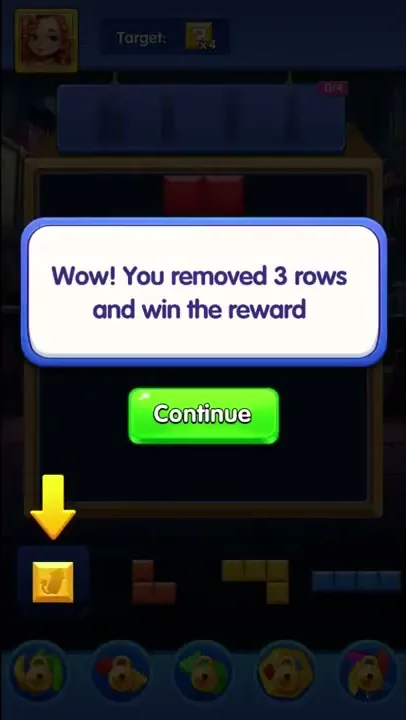
Clearing three rows in the second level earned a reward. A message reading “Wow! You removed 3 rows and win the reward” appeared, and a yellow arrow pointed at a gold single block with a small dark emblem in the first tray slot. Moments later that slot was empty.
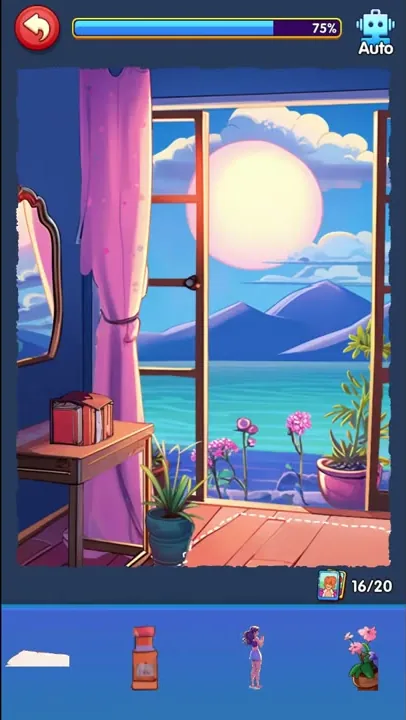
Between levels, the stickers go into a painted room with an open window over the sea, where dashed white outlines mark the spots the items belong in. The stickers wait in a tray along the bottom of the screen and move up into their outlines. After Level 1, the window frame and a potted plant went in. On a later visit came a pink curtain and a mirror, then a desk with a red box on it.
Fuller starting boards and a room to fill
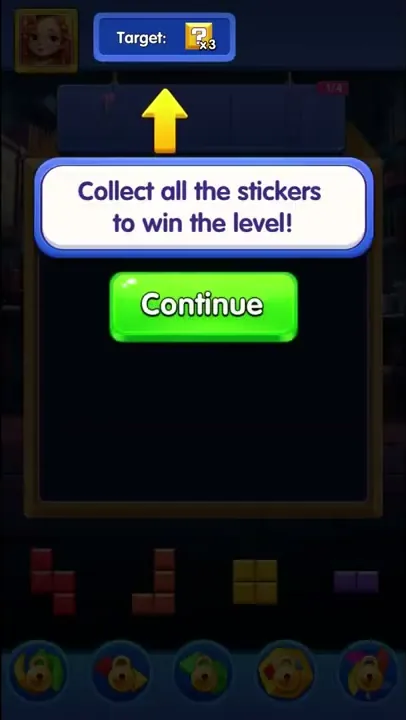
Level 1 is a tutorial. Early on, its board is empty apart from three “?” blocks in a row near the center, and a hint with an arrow pointing up at the panel reads “Collect all the stickers to win the level!”
The boards that followed the tutorial mixed the gold blocks with colored ones from early on. Early in the second level, red blocks already filled the two bottom rows except for one column, and two “?” blocks sat at the right edge. The third level opened on an otherwise empty board with four “?” blocks in a square, ringed by red blocks two to a side.
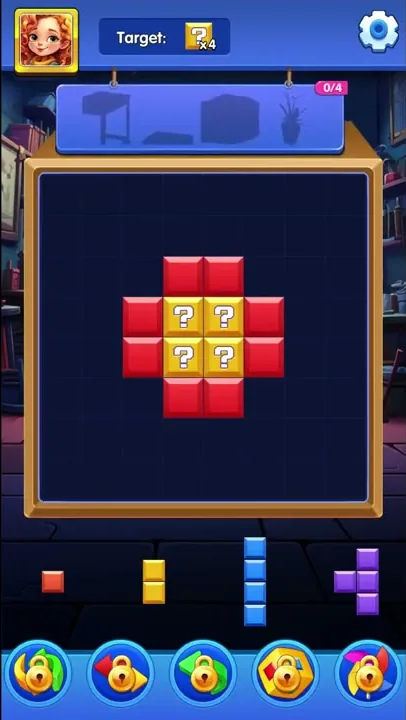
Another square of four “?” blocks turned up early in Level 4, under a row of four red blocks, with orange blocks to its left and a row of orange and red below. The four stickers also change from level to level, from a flower and a ladder-like frame in Level 1 to a mirror and pink curtains in the second.
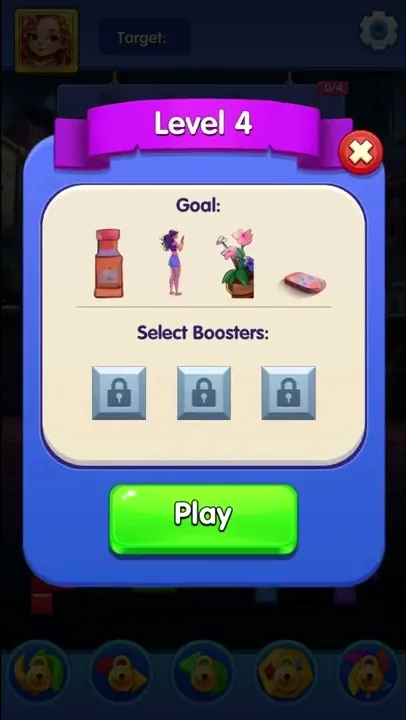
A settings gear sits at the top right from the third level on. A pre-level panel opens Level 4, listing its four goal stickers under “Goal:” (a bottle, a small figurine, a flowering potted plant and a pink item). Below them, a “Select Boosters:” row of three padlocked slots sits above a green Play button. During play, five round booster buttons sit below the tray, each with a padlock.
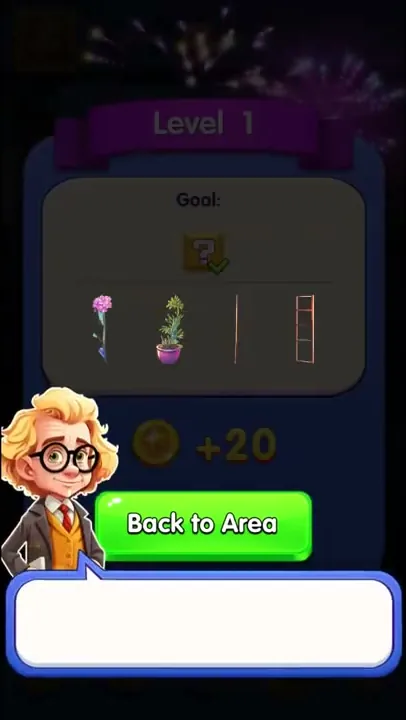
A results panel after Level 1 recaps the goal, with a checked “?” block above the four stickers won. It also shows a coin with “+20” and a “Back to Area” button, while a cartoon man in glasses stands beside it next to an empty speech box.
The room screen has its own controls: a red back-arrow button, a progress bar with a percentage across the top, an “Auto” button with a robot icon, and a card icon below the scene with a counter out of 20. The bar climbed while items went into place, and the counter stood higher on the second visit to the room than on the first.
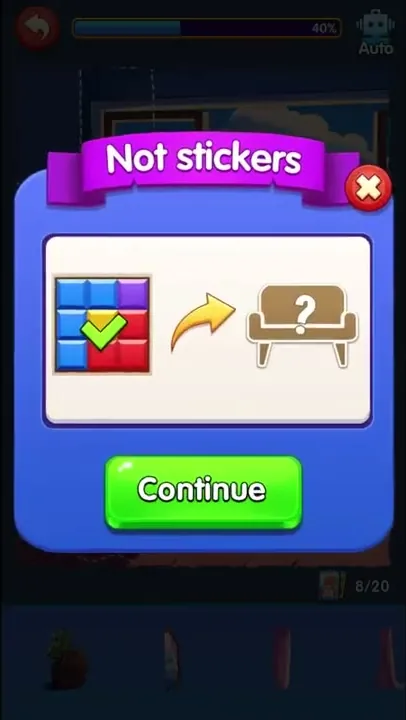
Twice, with the room partly finished, a pop-up titled “Not stickers” appeared over it. Its picture shows a block grid with a green check mark and an arrow leading to a sofa marked with a question mark, above a Continue button and a red close button. Both times, the next screen was a block level.
Line clears that pay out furniture
The new part is the combination. Puzzle Block Buster pairs block puzzling with jigsaw-style building, a fresh kind of long-term layer around the levels. The gold blocks on the grid are where the furniture comes from, and the furniture is what the room is built out of.
The mirror and pink curtain released in the second level, along with the desk and red box from the third, all reappear in the room scene, each filling its dashed outline. Line clears on the grid end up as a furnished corner by the window.
A stiff seam between grid and room
We found the pairing of grid and room a bit forced.
Shape fitting with a picture to complete
Inside a level, the work is spatial: fitting tray shapes around blocks already on the grid and finishing the rows and columns that run through the gold blocks. The board itself follows the standard block-puzzle setup.
Outside the level, the return is a picture. Dashed outlines in a seaside room fill in one by one, the curtain and the mirror among them. That matches a taste for line clearing that leaves something visible behind.
Verdict
At heart, Puzzle Block Buster is one more line-clearing grid. Its new contribution is the pairing with a scene assembled from the stickers those clears release, though the seam between the two is not quite smooth. The result is another block puzzle with one fresh idea on top.