Pixel Knight Review: Chest Drops for an Eight-Hero Squad
Chest drops fill eight team slots with heroes whose stats roll differently each time, and this Pixel Knight review follows that team into Story Mode.
Game at a glance
Pixel Knight:Chest Hero
7/ 10
Our score
The chest-opening formula, now with a full squad and far more to level up.
In this article6 sections
A Lv.2 Rogue comes out of the chest, and the Current Teammate panel sets it under the Lv.2 Rogue already on the team: Attack 50 against 51, Health 209 against 212, Defense 21 against 22, a red arrow beside each new number. Same hero, same level, slightly worse everywhere. In Pixel Knight, a team-based chest-opening RPG, that comparison comes up over and over, and it ends on one of two buttons, Equip or Sell.
It borrows the formula of a hit chest-opening game and spreads it across eight heroes, who then fight eight skeletons at a time in Story Mode card battles. We played four of those battles, up to Level 1-4, with chest runs on the home screen in between. What it adds is a far deeper progression layer than its model had, and that depth suits a game built on chest drops.
From the chest to the skeleton card grid
Heroes are collected to build a team that wins Story Mode battles. They come out of a big gold chest on the home screen, and each new one either fills an empty slot or competes with the hero already in it. A battle is won once every enemy card has turned into a skull.
The controls are on-screen buttons. At the very start, a pointing hand and a “Tap to claim rewards” tooltip lead to the quest panel. After that, the comparison panel offers Equip and Sell, and the win screen offers Claim and Next. The Story Mode panel has a Challenge button, and a bar of three buttons runs along the bottom: Box in the middle for the chest screen, Adventure on the right for the mode list. The battle screen has no buttons at all.
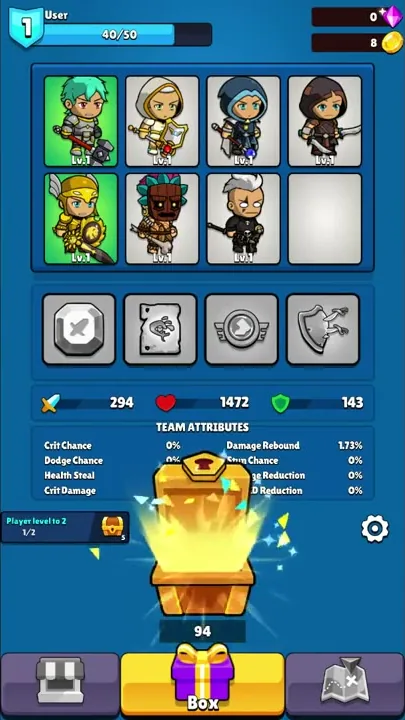
The loop has two halves. On the home screen, chests turn into heroes, and better copies push the team’s sword, heart and shield totals up. Between chest runs, the eight heroes take on a Story Mode battle. A win pays out another chest plus a second item, and the opening starts again.
The chest sits at the center of the home screen with a number beneath it. Opening it sets off a burst of golden light and sparks, and the hero it produces either lands in the grid above or comes up in a panel for a decision.
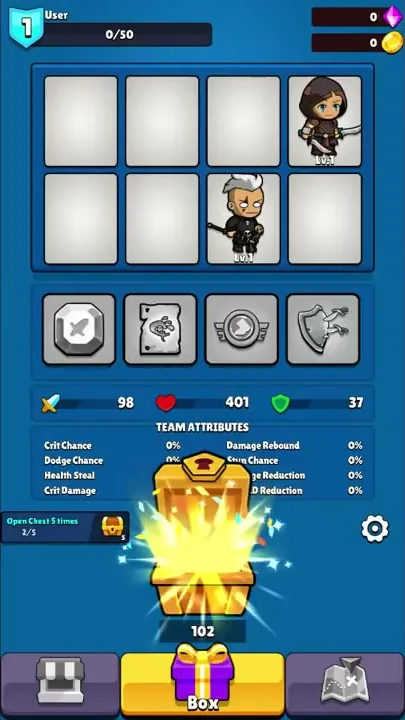
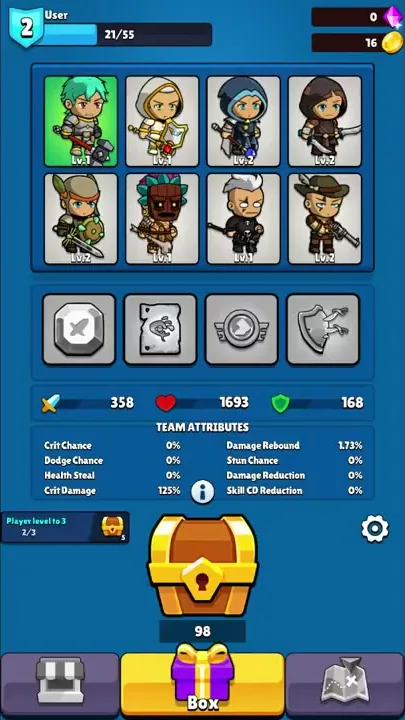
The grid holds eight slots in two rows of four, and each slot keeps one type of hero. A drop is measured against the hero of the same class: Mage against Mage, Rogue against Rogue, Warrior against Warrior. Seven class names appear on the cards (Warrior, Priest, Mage, Rogue, Shaman, Warlock, Hunter); the eighth hero, an orange-haired fighter with a round shield, never shows a name. No screen for arranging the team or choosing classes comes up, and the team choice shown is which copy holds each slot.
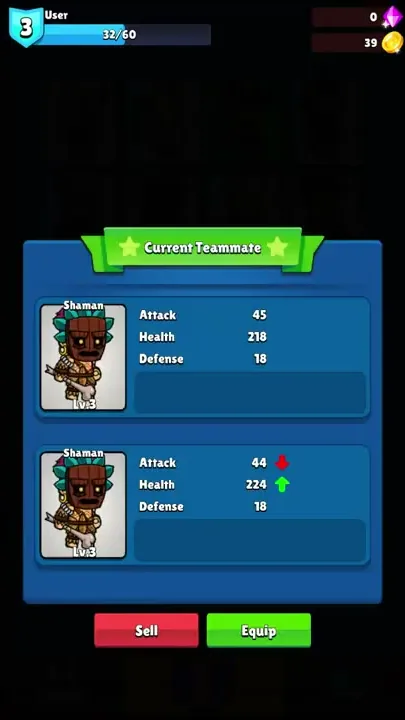
A drop for a filled slot opens the Current Teammate panel, with the hero on the team at the top and the new copy underneath. Both cards list Attack, Health and Defense. Green up arrows and red down arrows mark where the new copy is higher or lower, and a stat that matches gets no arrow. Below sit a red Sell button and a green Equip button. A hero for an empty slot, like the first Priest or the Hunter, gets a shorter panel: the new card alone, green arrows, one Equip button.
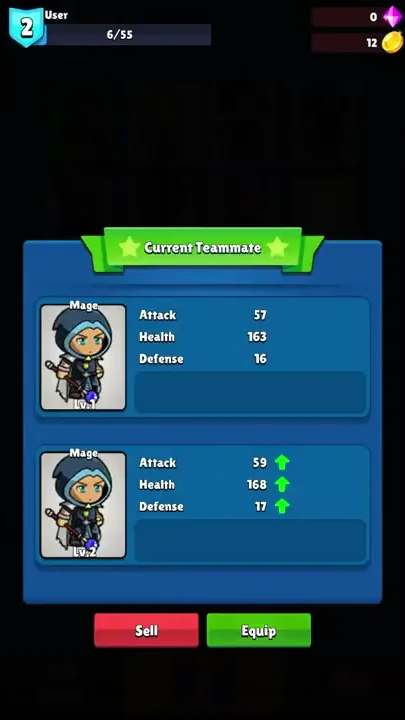
Copies of a hero at the same level don’t match, because each one rolls its own numbers. A second Lv.3 Warrior came out at 44 Attack and 263 Health against the 45 and 266 of the one in the slot, with Defense tied. A second Lv.3 Shaman was a trade-off instead: one point less Attack, six more Health. The bigger gains come from higher-level copies, such as a Lv.4 Rogue that replaced a Lv.2 one with all three stats up.
Some heroes arrive on a green card instead of a gray one, each with art of its own: a golden-armored fighter and a teal-haired knight early on, a witch in a purple hat later. The game never says what the green means. While the teal-haired knight held the first slot, the Damage Rebound line under TEAM ATTRIBUTES read 1.73%; after a gray Lv.3 Warrior took that slot, it went back to 0%.
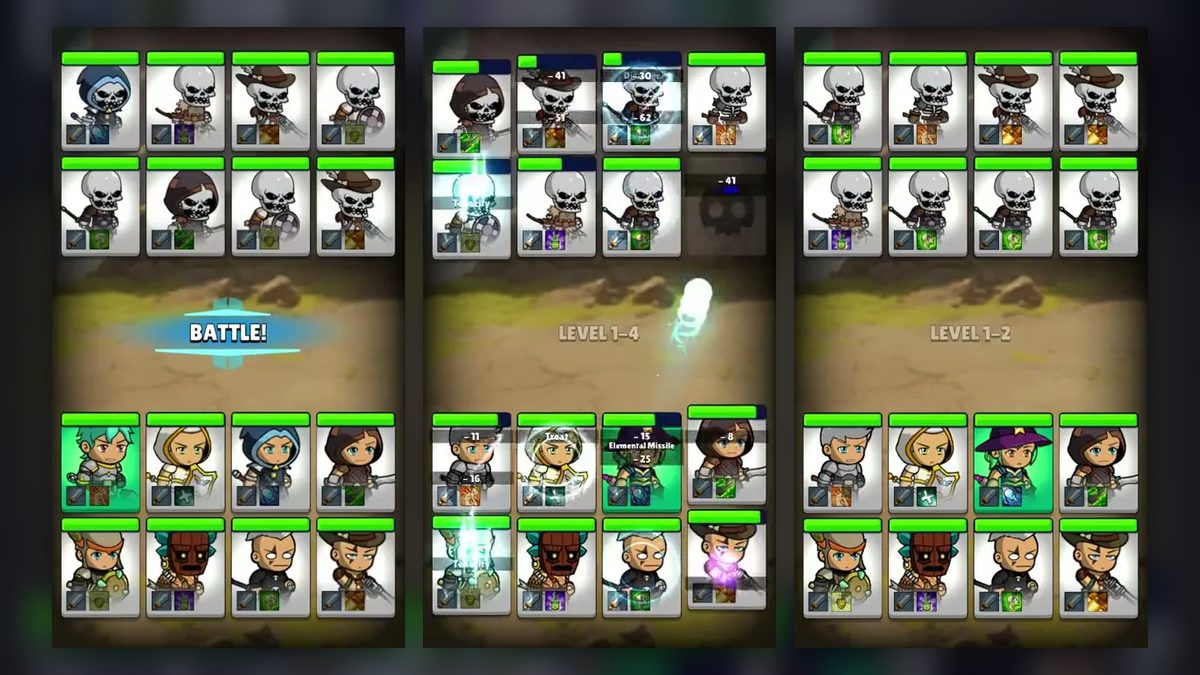
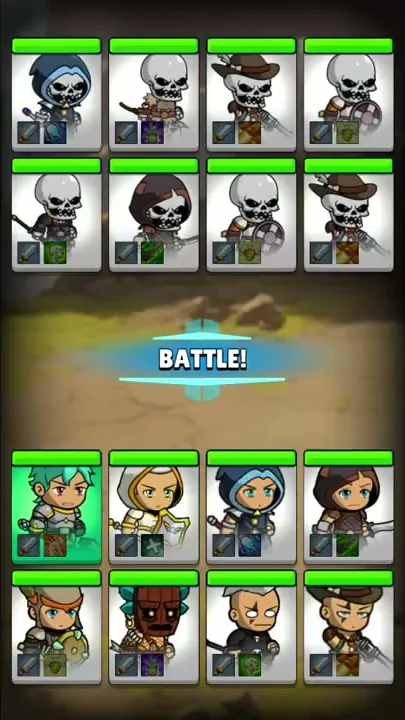
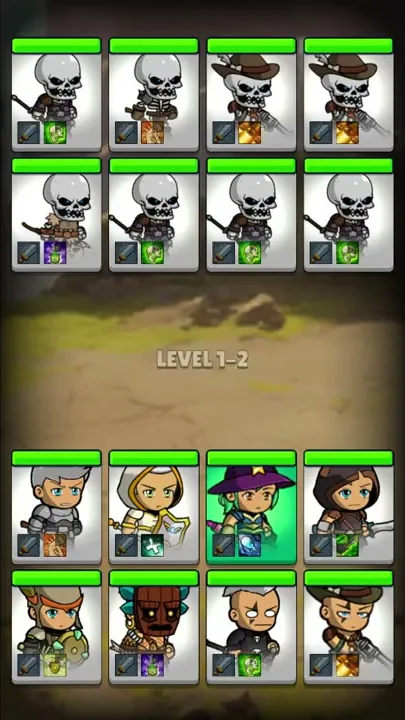
Battles happen on a screen of their own. Eight skeleton cards fill a two-by-four grid at the top, some hooded, some in cowboy hats, some carrying round shields. The eight heroes fill a matching grid at the bottom, and the dirt-and-grass field between them shows a BATTLE! banner or the stage name. Each card has a green health bar on top and two small icons at the bottom: a sword, plus a colored square that differs from hero to hero.
As hits land, damage numbers float over the cards and health bars shrink. Critical hits get their own label: in Level 1-3, “Crit!” pops up over an enemy card and over one of the heroes, and the TEAM ATTRIBUTES table on the home screen puts Crit Damage at 125%. Skills are named too. In Level 1-4 the witch’s card displays Elemental Missile while a glowing white projectile streaks across the field.
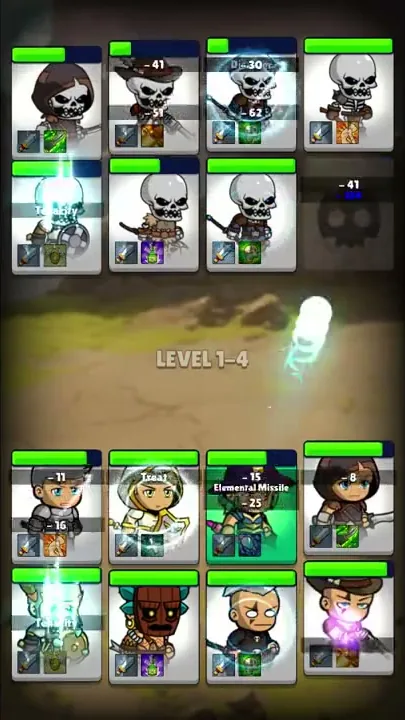
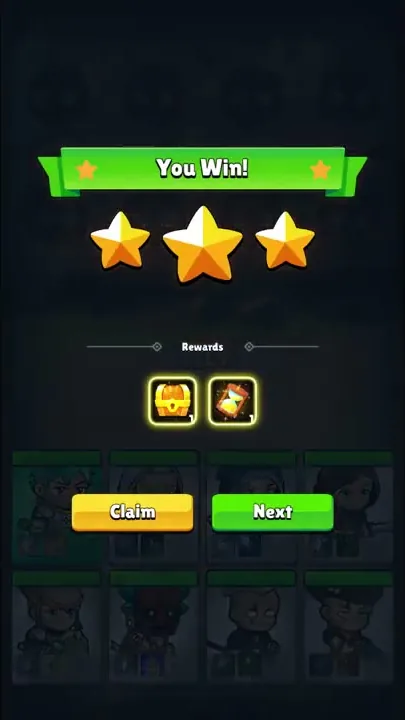
Eight skeletons, two of them in cowboy hats, line up against the team in the second battle, with Level 1-2 printed across the field and the witch now in the third slot of the heroes’ top row. By the end, all eight enemy cards are skull silhouettes with damage numbers of -60 and -45 still hanging over them. Every hero still shows a health bar, though purple flames rise over some of them. Emptying the enemy grid like this wins the battle. A won battle ends on a You Win! banner with three stars and a Rewards row holding a chest and an hourglass-style item, then a yellow Claim button next to a green Next button.
Lv.4 heroes and three padlocked modes
The team starts close to empty: a single Lv.1 Warlock in the bottom row and a pointing hand aimed at the quest panel. The first quests ask for one chest opening and then five, and drops fill the remaining slots; all eight were taken before the first battle.
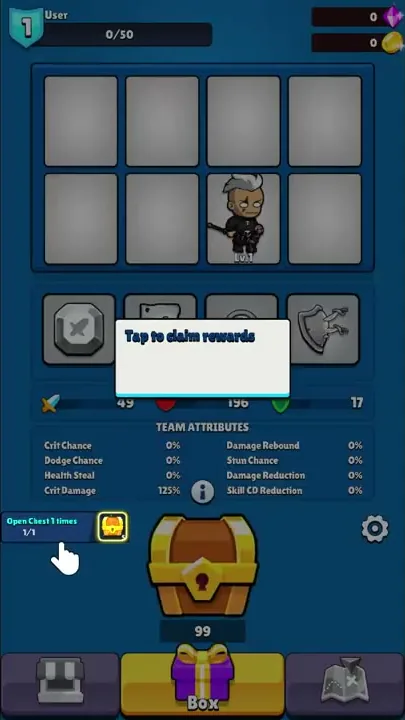
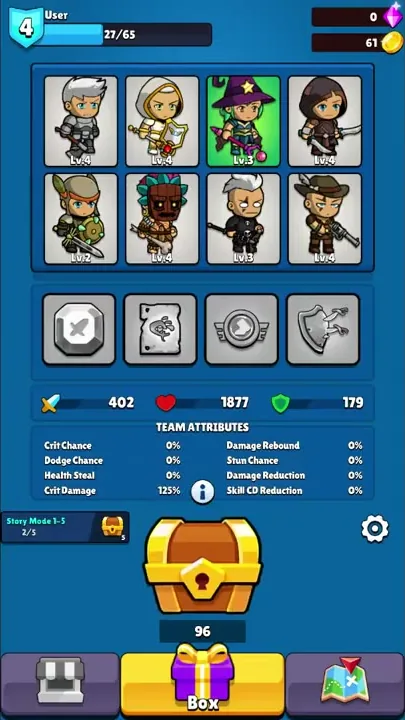
Hero levels climb as higher-level copies come out of the chest. With seven of the eight slots filled, every hero was still Lv.1. Once all eight slots were full, half showed Lv.2, and Lv.3 and Lv.4 copies followed. By the time five heroes had reached Lv.4, the team totals under the grid had gone from 49/196/17 at the start to 402/1877/179.
Story Mode is split into numbered chapters and stages. We didn’t catch the first battle’s stage label; the ones after it count up from Level 1-2 to Level 1-4. Every enemy side was eight skeletons, in varying mixes of hoods and hats. On the bottom bar, the map button stays gray until the first win and then shows in color with a red marker.
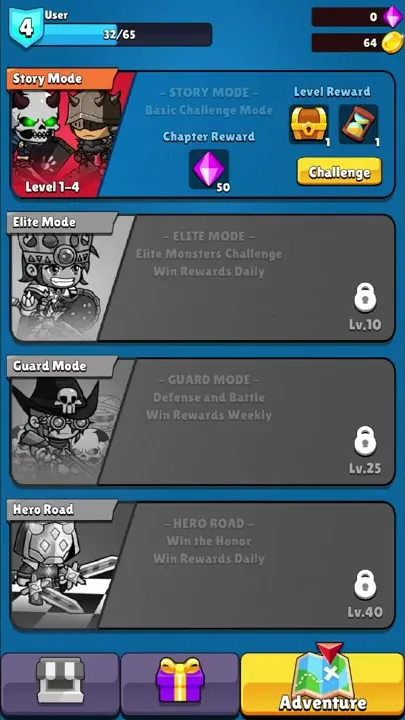
That map button, labeled Adventure, opens a list of modes. Story Mode, subtitled Basic Challenge Mode, sits at the top at Level 1-4 with a Challenge button; its Level Reward is one chest and one hourglass-style item, and its Chapter Reward is 50 gems. Below it, three gray panels carry padlocks. Elite Mode (Elite Monsters Challenge, rewards daily) is marked Lv.10 and Guard Mode (Defense and Battle, rewards weekly) Lv.25, while Hero Road (Win the Honor, rewards daily) is marked Lv.40.
The quest panel to the left of the chest shows one task at a time, each paying a chest. The chain runs from “Open Chest 1 times” and “Open Chest 5 times” through the player-level goals (with another “Open Chest 5 times” in between), then on to “Story Mode 1-5”. A finished task gets a check mark and the “Tap to claim rewards” tooltip, and claiming it shows an Obtain banner with a chest icon.
The number under the chest has no label. It drops while chests are being opened and jumps back up after a quest reward is claimed; it never came close to zero.
A shield at the top left shows the player level beside the name User, above an XP bar that fills as chests are opened. The shield went from 1 to 4, and each new level asked for five more points than the last, from 50 up to 65.
Two counters sit at the top right. Gold climbs as chests are opened, though nothing on screen is bought with it. The pink gem counter stays empty, and the only gem source on display is that 50-gem Chapter Reward.
Below the three team totals (sword, heart, shield), a TEAM ATTRIBUTES table with an info button lists eight entries: Crit Chance, Dodge Chance, Health Steal, Crit Damage, Damage Rebound, Stun Chance, Damage Reduction, Skill CD Reduction. Apart from Crit Damage at 125% and the 1.73% Damage Rebound seen while the teal-haired knight was on the team, every entry stays at 0%.
Between the grid and the totals, a row of four gray tiles (badge, scroll, winged emblem, shield) stays gray and unopened, as does the gray button on the left of the bottom bar. A gear icon sits to the right of the chest.
A much bigger layer of growth around the chest
Pixel Knight takes the fairly thin middle and late game of the hit it borrows from and builds it into something much bigger. The chest feeds eight separate slots, each hero climbing through levels on its own, and three totals plus an eight-line attribute table track the team’s strength. Past Story Mode, the Adventure screen already lists three more modes behind padlocks, the last of them marked Lv.40.
We also think a progression layer this deep suits a chest drop system very well. In the chest drops themselves, a higher-level copy brings bigger numbers, like the Lv.4 Rogue that beat its Lv.2 predecessor on all three stats, while a same-level copy can come out worse, like the second Lv.2 Rogue, or swap Attack for Health, like the Shaman. Whenever the slot is already filled, the Equip-or-Sell panel puts that call in front of the player.
The hit’s underlying formula starts from two things: drawing from chests, and the sense of growth that random stats give. Both sit at the center here, from the golden burst on the home screen to the red and green arrows on each comparison.
What stays locked after Level 1-4
We had no complaints about Pixel Knight. What follows are limits of an early stretch, not faults.
Heroes only reached Lv.4 and the player shield only reached 4, so how deep the progression runs later is not shown. The three padlocked modes stayed shut, and so did the four gray tiles and the left-hand button on the bottom bar.
We never saw a lost battle or a timer on a stage; every win screen that came up showed three stars. What Sell pays out is never shown either, and neither is what the hourglass-style item does.
Weighing every drop against its slot
Through Level 1-4, most Pixel Knight gameplay happened on the home screen rather than in battle. The work is reading two stat cards side by side and deciding whether six more Health is worth a point of Attack, then seeing the team totals move after the swap. It fits a taste for small numeric choices and for long goals like the padlocked modes on the Adventure screen.
The battle screen has no buttons while the cards trade hits, so every decision shown is made before a fight, on the comparison panel. On the battle screen, damage numbers, Crit! labels and named skills play out across two grids of cards.
Verdict
Turning a chest-opening hit into a team game let Pixel Knight grow the middle and late game its model left thin, and that extra depth fits a game run on random drops. Taken apart and rebuilt alongside other forms of play, the underlying formula of chest draws and random-stat growth should give rise to some very good new kinds of gameplay. The combat in Habby’s games is one style we think this kind of chest progression could blend with.