Slime Hunter Review: Ball Blast Gets Survivor.io Skills
Our Slime Hunter review covers the upward slime shooting, the three-card SKILL CARD picks and helpers like cactus turrets and a shadow clone.
Game at a glance
Slime Hunter
8.5/ 10
Our score
Swap Ball Blast for a virus shooter and this might be even better.
In this article6 sections
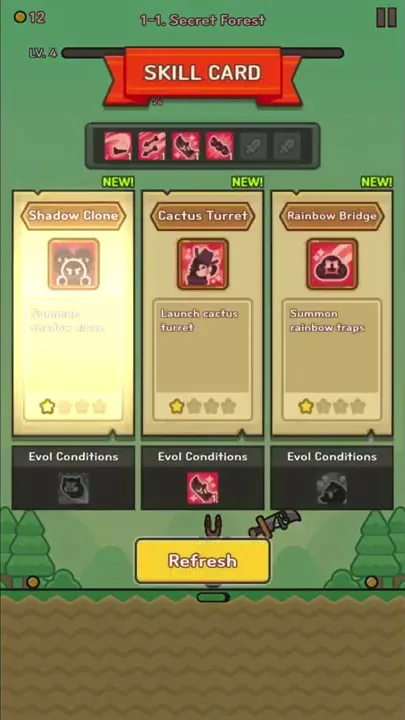
At LV. 4 in stage 1-1, Secret Forest, the battlefield dims behind a red SKILL CARD banner and three cards tagged “NEW!” line up: Shadow Clone, Cactus Turret and Rainbow Bridge. The Shadow Clone card glows brighter than the other two. A few seconds after the screen fades, a dark gray copy of the small hooded hero stands beside it on the grass, with pellets still rising toward the slimes overhead.
Slime Hunter, a portrait arcade shooter, is built from two other games. Its core is the Ball Blast setup of a shooter at the bottom of the screen firing straight up at round targets, restyled here with slimes as those targets, each with a face. Its outer layer comes from Survivor.io, where you move through endless swarms while your weapons fire on their own. That layer means skill picks during a run, plus an equipment system. The result is a roguelite run with a fresh upgrade choice every time the level bar fills, which puts Slime Hunter among games like survivor.io.
We rate it an excellent blend that pairs a core known for pulling players in with an outer layer that has already proven itself. It has strong hit potential and is made to a high standard.
Firing up at slimes from the grass strip
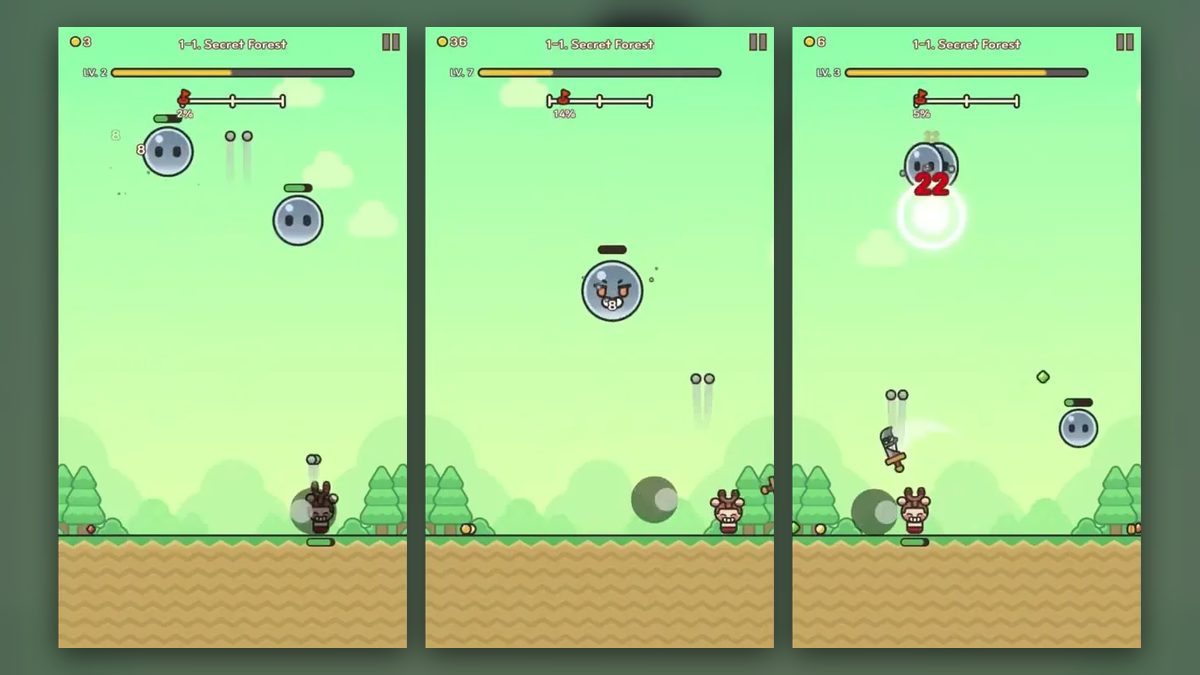
We played one run of stage 1-1, Secret Forest, from the LV. 2 label up to LV. 10, and stopped before the stage was cleared. Under the level bar runs a stage progress bar with a red marker and a tick at its middle, and over the run the marker crept from the left end to just past that tick. The hero carries a short green health bar under its feet, like the small bars over the slimes.
The hero only moves left and right along the grass strip, reaching both edges of the screen, while gray pellets rise from it in a steady stream. During play, the upper right corner holds a pause button drawn as two bars. On the SKILL CARD screens, three cards line up above a yellow Refresh button.
Shooting drives the loop. Pellets climb toward round slimes, and each hit throws out a damage number, mostly small and white, with a white ring flash where it lands, while coins and colored gems fall to the grass. When the yellow LV bar at the top fills, the fight dims and a SKILL CARD screen offers three skills, which grant weapons and helpers that fight beside the hero.
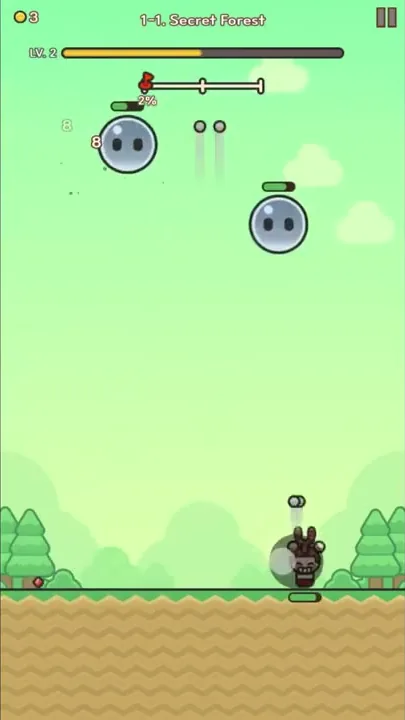
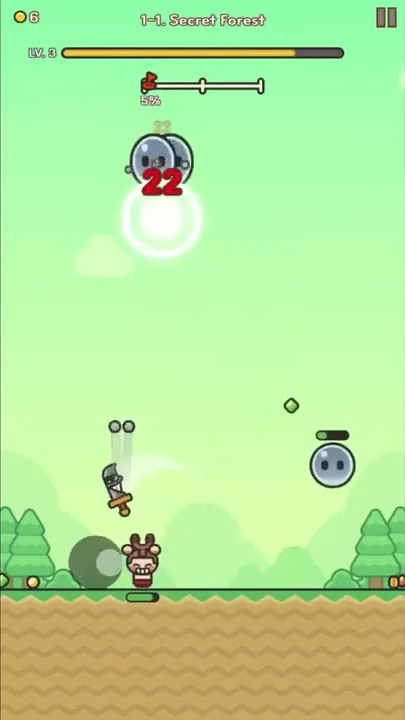
Early in the stretch, at LV. 2, a single large angry slime hangs near the top of a pale green sky while the hero, alone on the grass, sends up pellets in pairs. By LV. 3 a spinning blade hovers near the hero, and a big red “22” bursts from a hit near the top of the screen. The LV. 4 card screen arrives with four of the six skill slots already holding red icons, and more card screens follow as the label climbs toward LV. 10.
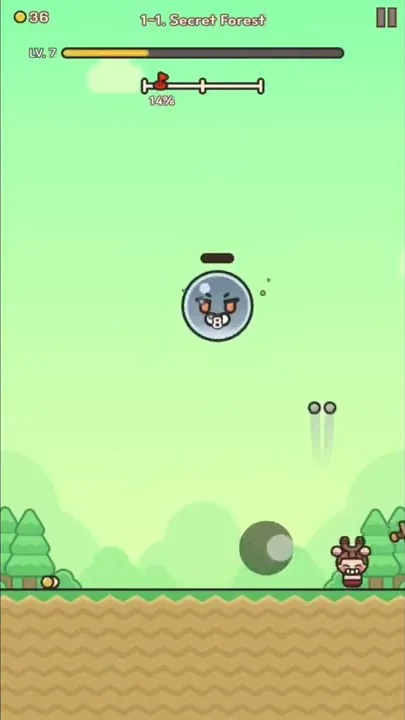
Gray-blue slimes are the most common enemy. They are glossy round bubbles in several sizes, each with two dot eyes and a small green health bar. They hang at every height from the top of the screen down to the grass, and small ones sometimes float side by side in pairs. A slime that has just been hit pulls a “>_<” face or squashes flat.
Angry slimes share the gray-blue body but have orange eyes and bared teeth, under the same kind of health bar. When hit, some open a wide mouth crammed with teeth, with red streaks flaring around it.
A SKILL CARD screen lays three cards over the dimmed battlefield under a red ribbon banner, with a bar of six skill slots above them. Each card carries a skill name and icon over a short description, with a row of four stars below it and an Evol Conditions panel under the card. Cards for skills not yet in the slot bar wear a green “NEW!” tag with one star filled. On the LV. 4 screen, Rainbow Bridge promises to “Summon rainbow traps,” and the LV. 5 screen offers Cactus Turret again beside Hamster Cogs (“Add a hamster cog which can remove projectiles”) and Coin Shot (“Shoot coin bullets”).
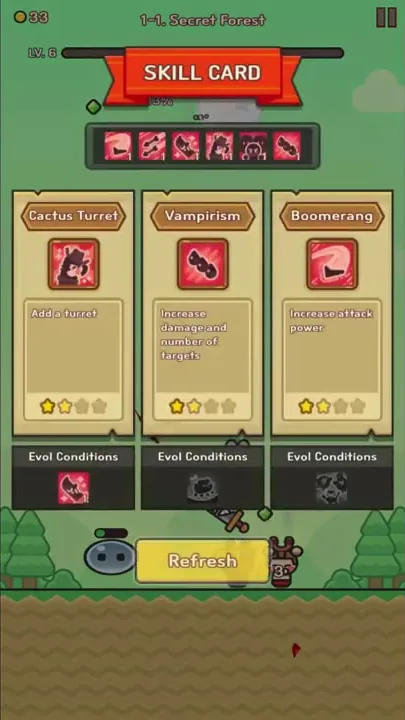
Cards without the “NEW!” tag show two of four stars filled and an upgrade line instead. On the LV. 6 screen, with all six slots full, Cactus Turret offers “Add a turret,” Vampirism “Increase damage and number of targets” and Boomerang “Increase attack power.” Each Evol Conditions panel holds a single icon, red on some cards and gray on others.
A gray blade with a wooden handle spins in the air close to the hero. Sometimes it hangs above the hero’s head and sometimes just to one side, and it moves along with the hero.
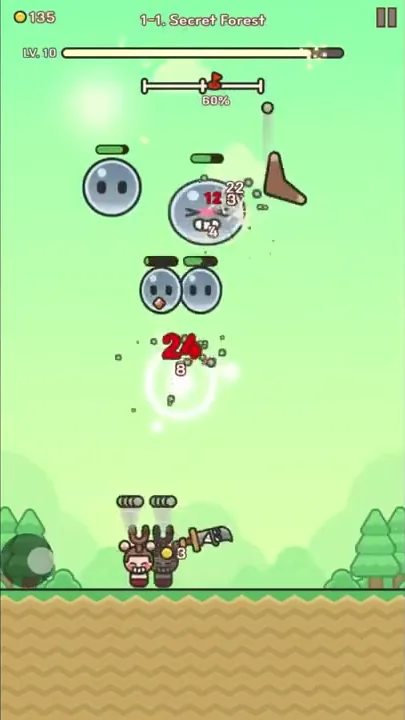
The dark gray clone that appears after the LV. 4 screen stays at the hero’s side in later moments of the run. Late on, the hero and the clone each send up their own cluster of pellets.
After the LV. 5 screen that offers Cactus Turret (“Launch cactus turret”), a potted cactus wearing a cowboy hat stands on the ground; after the LV. 6 screen with “Add a turret,” there are two. Yellow streaks rise from above the cacti. Empty pots turn up too, two of them stacked at the left edge at one point and two floating in mid-air at another. Late in the run a pair of empty pots sits on the ground.
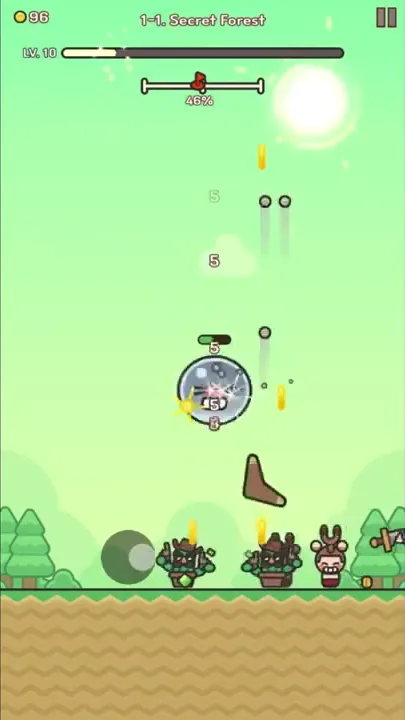
A brown boomerang flies around the sky among the slimes, high and low and on both sides of the screen. Now and then a “22” damage number pops up right next to it.
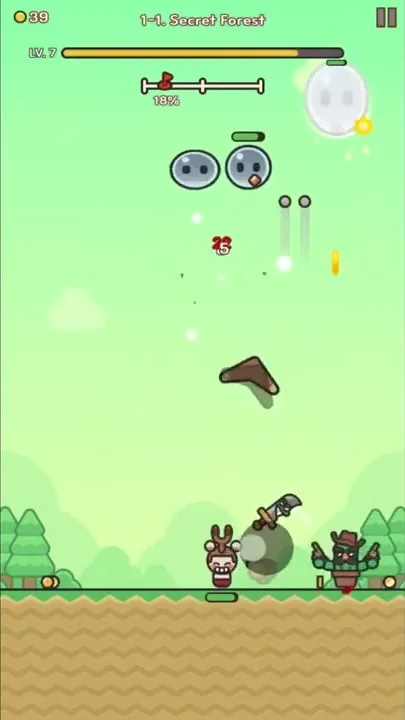
Smaller yellow slimes with two dot eyes and a white outline join the gray ones from LV. 8. At that level one hangs at mid-height between a gray slime near the top and another down on the grass.
The hero’s own volley widens over the run. Its pellets rise in pairs at first; after the LV. 7 screen, which offers Multi Shot (“Increase the number of projectiles”) next to attack-power upgrades for Boomerang and Dancing Sword, the row is three pellets wide, and after the next card screen rows of four appear.
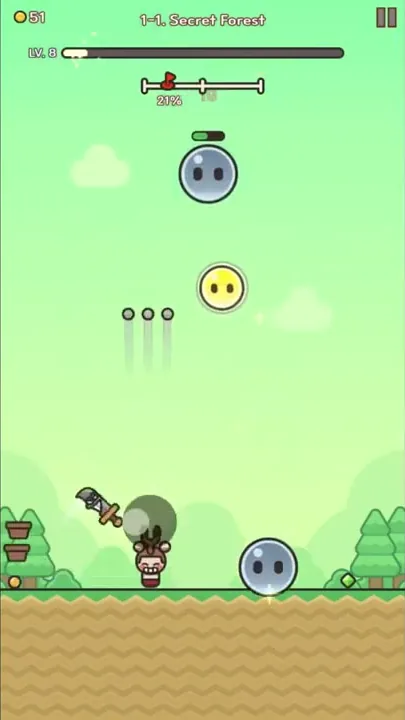
An alarm clock turns up in the second half of the run. First a small glowing clock icon floats in mid-air; moments later a large alarm clock with little yellow jolt marks around it sits in the middle of the screen as a SKILL CARD screen fades in. The big clock appears again late in the run, with slimes crowding the top of the screen.
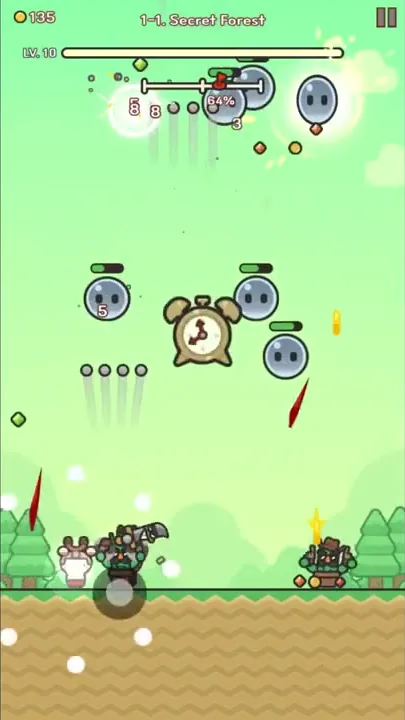
Red hearts lie on the grass from time to time. One glows near the left edge at LV. 6, and another sits right next to the hero at LV. 10.
From a lone hero to a crowded front line
The hero is alone on the grass at the start of the stretch, and helpers gather around it as the card screens pass. The spinning blade appears while the label still reads LV. 2; the clone stands beside the hero at LV. 5; by LV. 7 the boomerang and two cacti have joined them. Late in the run the whole set stands in one row on the grass, with the boomerang and a stream of shots in the air above.
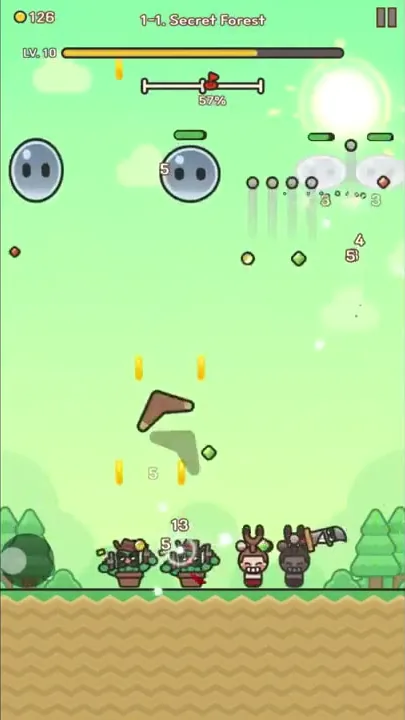
The slimes multiply in the later part of the run. One or two hang in the sky early on; at LV. 10 five slimes of different sizes share the screen, one of them down at ground level, and later a cluster crowds the top with more slimes below it.
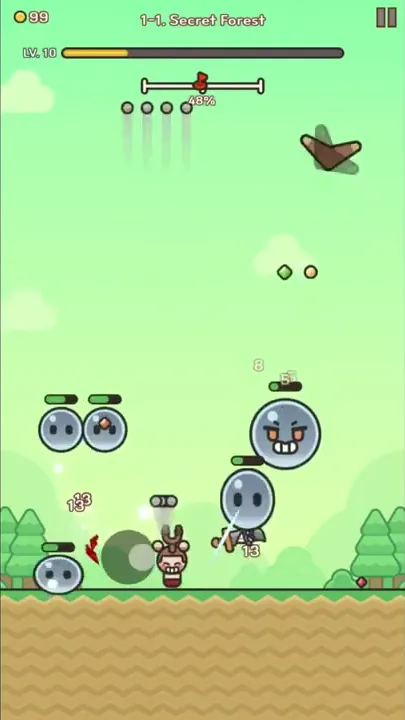
A gold coin counter in the top left corner climbs during the run, and gold coins fall from the fight and lie on the grass. At one point a coin icon with a number pops up next to the hero.
Other drops fall with them. Green diamonds, red-orange diamonds and small gold bars tumble through the sky and land on the grass among the coins.
The yellow LV bar under the stage name fills during play and starts over at the next level after each SKILL CARD screen. On those screens the Refresh button is bright yellow most of the time and paler on the LV. 5 screen, and it carries just the word Refresh.
A proven shooter wrapped in skill cards
Slime Hunter blends two proven pieces. Ball Blast, in our view, is a shooter that already pulls in players and has proven itself in the market, and Slime Hunter keeps that upward shooting at its center while wrapping it in Survivor.io-style card picks. Put together, that makes for an excellent mid-core casual game, and one that could well become a hit.
We are very optimistic about this whole type of game. Build quality is high as well.
The slime visual style is what restyles Ball Blast here. Its round targets become glossy slimes with faces, some with dot eyes and some angry, with orange eyes and teeth, and a slime that takes a hit pulls a “>_<” face.
Ball Blast or a virus shooter underneath
Only one point goes against Slime Hunter, and it is a guess rather than a complaint: built on a virus-blasting shooter instead of Ball Blast, the same blend might have worked even better. Apart from that guess, there is no criticism to report.
Anything outside the run, such as that equipment system, lies beyond the stretch of Secret Forest described here, and so does the end of the stage. Rainbow Bridge and Hamster Cogs are known only from their cards, as is Coin Shot. What the alarm clock and the red hearts do is not shown, nor what the colored gems and the Evol Conditions icons are for.
Sliding under slimes, picking from three cards
The Slime Hunter gameplay comes down to two jobs. Most of the time it means sliding one hero left and right along the grass while its pellets climb straight up toward slimes at every height. Then, each time the LV bar fills, it is a pause to take one card from three: a new skill with one star, or a second star on a skill already in the bar. That mix plays to a taste for arcade shooting along a single strip of ground, paired with a build that grows card by card over a run.
Verdict
Slime Hunter takes a shooting core that has already proven itself and wraps it in slime faces and Survivor.io-style growth. The result is an excellent mid-core casual game with strong potential to become a hit, built to a high standard. It also suggests that the underlying formula of any shooting or enemy-clearing game could take on the same kind of growth.