Maze Sweep Review: A Pac-Man Maze With Archero's Cards
Gold hex nuts, roaming drill monsters and three-card ability picks: our Maze Sweep review of a Pac-Man maze chase rebuilt with Archero's systems.
Game at a glance
Maze Sweep
7.5/ 10
Our score
Pac-Man plus Archero, and the old maze still feels like Pac-Man.
In this article6 sections
Sweep every gold hex nut out of a maze while cyan bullets fly at the monsters in its corridors, then pick one of three ability cards and move on to a larger stage. That loop makes Maze Sweep a top-down mobile maze chase in flat 2D cartoon art. It sets the dot-eating rules of Pac-Man inside the card-picking structure of vampire survivors like mobile games.
The shortest description is Pac-Man plus Archero, Habby’s move-then-shoot dungeon crawler. The hero can fight back and its abilities level up over a run of 10 stages, while the maze half keeps the old arcade feel. It is a twist on the formula that leaves Pac-Man in plain view.
Clearing gold nuts against a 02:10 clock
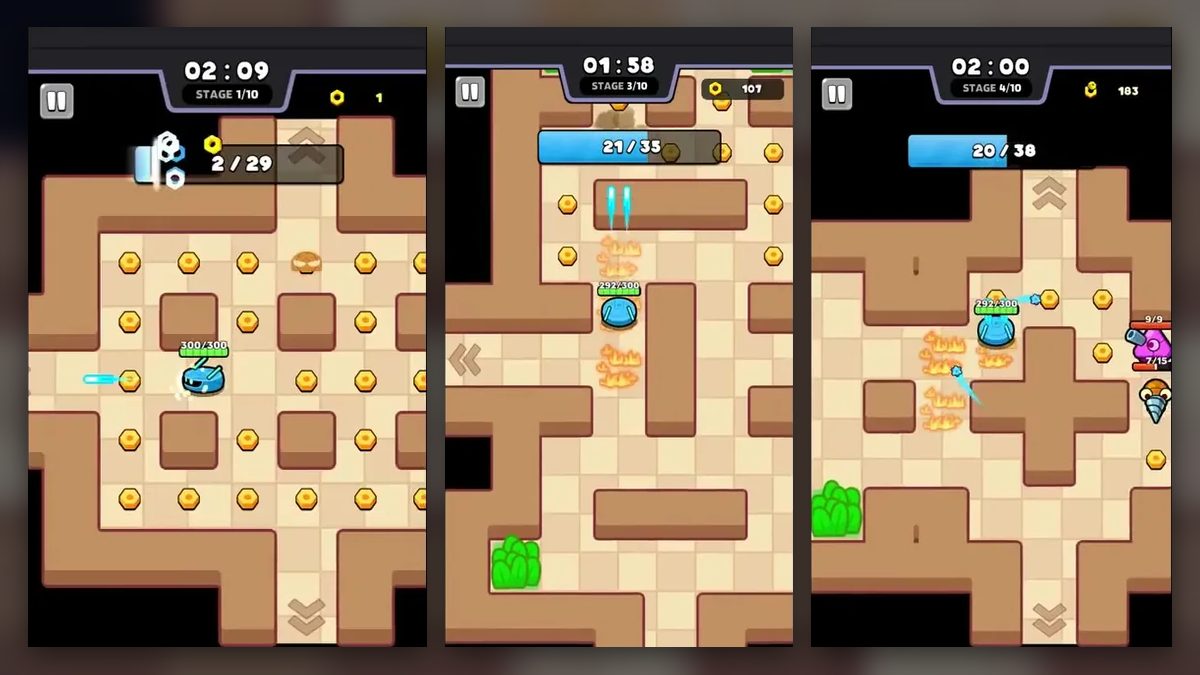
A stage is cleared by collecting all of the gold hex nuts laid out in its maze. A bar near the top of the screen counts them against the stage total, starting from 0 / 29 in Stage 1, and the label under the timer tracks the run from STAGE 1/10 onward. We played the first five of those 10 stages, the fifth left unfinished.
The character is a round blue creature with two antennae, and the camera keeps it near the middle of the screen while the maze scrolls around it. Tan walls with dark red-brown outlines enclose a cream checkered floor, and the nuts sit in rows along the corridors like the dots of a classic arcade maze. Each nut picked up sends a small icon flying to the bar while a second counter in the top-right corner rises. Along the way the character fires cyan bullets down the corridors, and the monsters they hit lose part of their red HP bars as red damage numbers pop up.

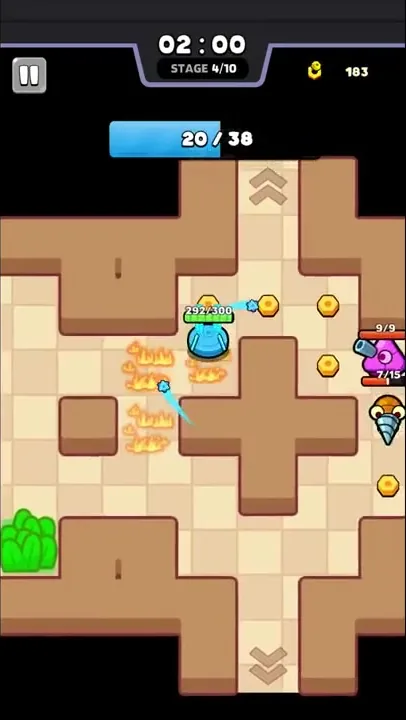
When the counter reaches its total, the bar turns gold and glows. A dark band between two blue lines then crosses the middle of the screen, showing the stage’s place in the run, such as “(1/10)”, above the words “STAGE CLEAR!”. The same banner read “(4/10)” when Stage 4 filled at 38 / 38, that time with confetti around the bar.
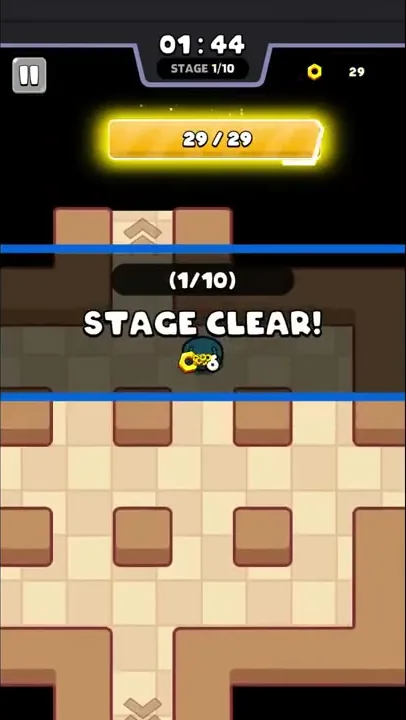
The stages run against a countdown at the top center of the screen. It read 02:10 at the start of Stage 1 and again as the third and fourth stages began. The first stage was cleared with 01:44 still on the clock, and Stages 2 and 4 ended with 01:47 and 01:51 left.
Health is tracked by a green bar with numbers that floats over the character’s head. In Stage 1 a clash with monsters, marked by red damage numbers around the character, knocked a few points off it.
How the character is steered, and whether it fires on its own, are the control details we were unable to pin down. The play screen keeps a gray pause button in the top-left corner and a running nut total on the far right, with the timer and stage label between them and the blue progress bar just below.
A first offer (Dead Shot, Multi Shot, Steal HP) covers the start of Stage 1, with a vertical corridor showing dimly behind the cards. Early in the stage the character is in a room of square pillar blocks set in a grid, with nuts lined up between them and chevron-marked openings at the top and bottom. Orange drill monsters labeled 13/13 roam the corridors there, and a second offer (Multi Shot, Bullet Damage, Explosion) interrupts the stage at 19 / 29 before the bar fills at 29 / 29.
Drill monsters are round orange creatures with a blue drill cone on the front and a red HP bar overhead. Their drills were seen pointing left, right or down as they moved around the maze.

The “CHOOSE YOUR ABILITY” screen dims the maze and lays out three white cards with blue headers. Each card pairs a simple icon and a level label such as LV.1 or LV.2 with a one-line effect, from Back Shot’s “Fire bullet backwards” to Steal HP’s “HP recovery at monster death”. Offers arrived at the start of the run and after stage clears, but also partway through stages: at 13 / 35 in Stage 3, for example, and twice in a row at 25 / 46 in Stage 5.
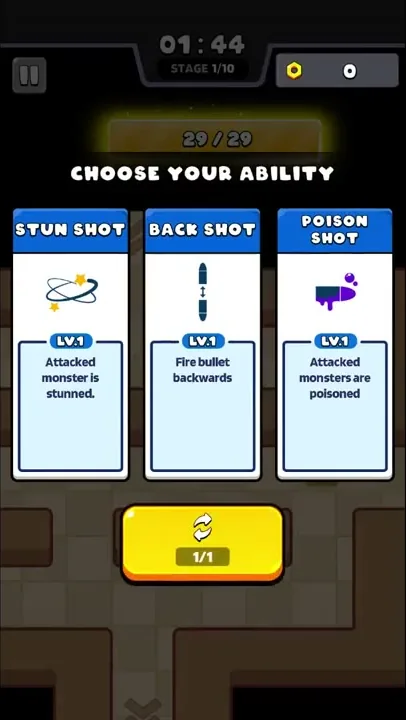
The cards seen over the run sort into a few groups. Bullet upgrades make up one: besides Multi Shot (“Fire more bullets”) and Back Shot there are Bullet Damage and Attack Range Up (“Increased bullet range”), while Corner Shot makes a bullet split after hitting the wall and Penetrate lets bullets pass through a monster. Three cards put a status on the monster that is hit: Stun Shot stuns, Poison Shot poisons, Flame Shot burns. Dead Shot (“Kill monsters instantly by low chance”) and Explosion (“Dead monster explodes.”) both tie into kills, and Move Speed raises movement speed. Blaze and Missile are offered too, while the Satellite card slid past with only its header readable.
A yellow reroll button sat below the cards of the second offer, marked with two circular arrows and “1/1”, and it was there again at every later offer seen in full. The first offer of the run, at the start of Stage 1, showed its three cards without it.
The character’s attacks take several forms. The bullets multiply: at one point two parallel shots fly ahead of the character, and at another two travel upward while a third heads down. Small orange flames are also left on the floor tiles along the character’s path, where they stay for a while and cover stretches of corridor.
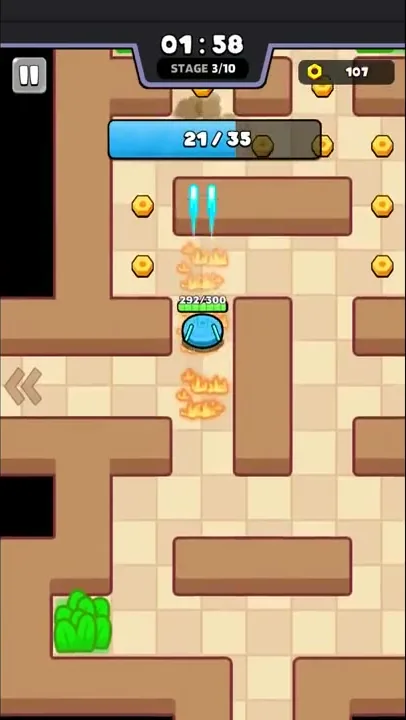
Two small blue star-shaped orbs with cyan trails stay close to the character, sitting at changing points around it. Small blue rockets with red-orange tips appear as well, flying through the corridors near the character.
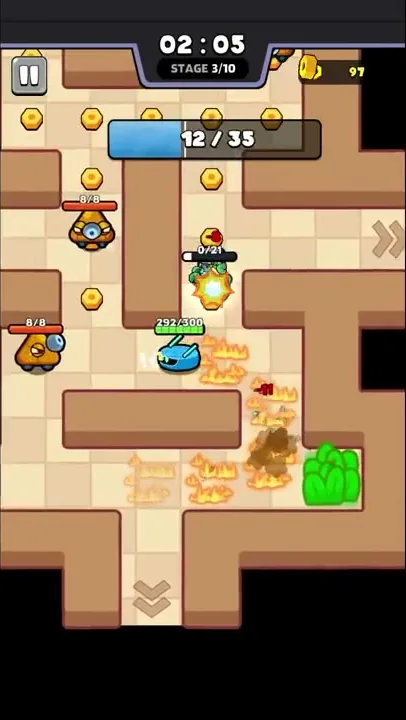
Other monsters share the mazes with the drills. Green monsters turn up from Stage 1, where one sits partly in view at the left edge; in Stage 3 one labeled 0/21 goes up in an orange burst near the character, and mint-green ones roam the right side of the maze in Stage 5. Yellow-orange cone-shaped monsters with a single eye, each labeled 8/8, show up in Stage 3, two of them on screen at once.
Stage 4 brings a new monster: a pink creature carrying a gray cannon, labeled 9/9. It stood at the right edge of the maze, next to a drill monster and close to one of the cross-shaped wall blocks.
Stage 5 has a warning badge at the screen edge. It is a round white disc showing a red ghost in the classic maze-chase style and a red warning triangle with an exclamation mark, with a distance underneath. A red pointer on the rim points toward the edge, and the badge moved from the right side of the screen to the left while its distance went from 4m to 3m to 2m and back to 3m.
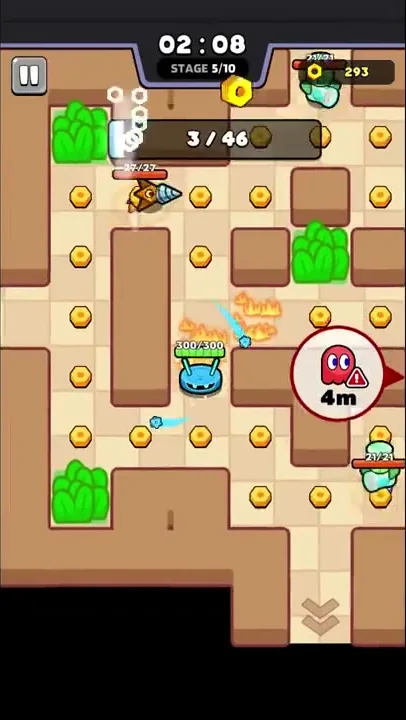
Two more items lie on the floor inside white circles: a green plus sign, seen in a corridor in Stage 3, and a yellow star, seen in Stage 5 near the character and a green monster. A green plus also shows over the character’s head at one point in Stage 4.
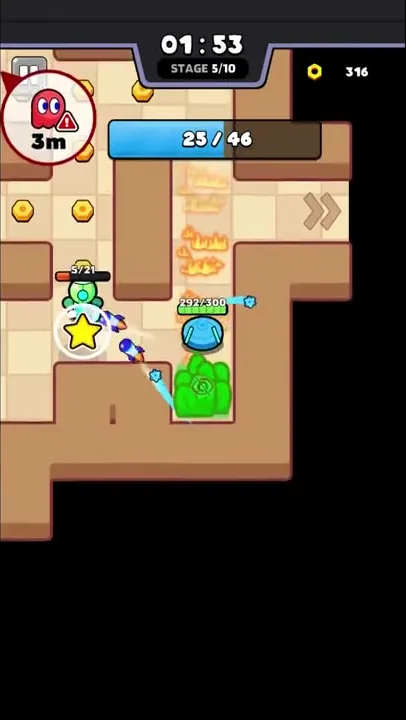
Corridors that run off the edge of the maze are marked with double chevrons on the floor, pointing outward in whichever direction the corridor leaves. Beyond the maze, the screen is solid black.
From 29 nuts to 46, with new monsters
The goal grows from stage to stage. The nut total climbed from 29 in Stage 1 to 33 and then 35; Stage 4 asked for 38 and Stage 5 for 46.
Maze shapes change along with it. Early in Stage 1 the rooms are grids of square pillars with nuts between them, while Stage 2 has narrow corridors and is where green bushes first fill single tiles in recesses along the maze edge. The same stage has the first question-mark bubbles, blue-and-white capsules marked with a question mark inside white bubbles, two of them on screen at one point.

Walls get longer after that. Stage 3 opens with a long vertical wall down the upper center and L-shaped walls framing both sides, plus a horizontal bar just below the character and a bush at each edge near the bottom. Cross-shaped wall blocks follow in Stage 4, one beside the character as the stage begins and another in the middle of the maze later on. Early in Stage 5, tall vertical bars stand among square pillars and bushes fill several recesses, with nuts running down long columns and rows.

The cast of monsters changes too. Drill monster labels went from 13/13 in the first stage to 14/14 in the second, and each of the next three stages had something new: the cone monsters in Stage 3, the pink cannon carrier in Stage 4, the ghost badge in Stage 5. Items arrived one at a time as well, from the question-mark bubbles to the green plus and finally the star.
The character’s attacks pile up over the same span, alongside the ability picks. A single cyan bullet early in Stage 1 was joined by the flame trail partway through Stage 2 and twin bullets in Stage 3. The orbs were circling by the start of Stage 4 and the rockets arrived in Stage 5, when flame trails, orbs and rockets shared the screen. Some cards also return at a higher level. Blaze was offered at LV.2 in the middle of Stage 3 (“Increased blaze damage”) and Dead Shot at LV.2 after the fourth clear (“Increases your chance of dead shot”), while Missile came up at LV.2 in Stage 5 with “Fire more missiles”.
Outside the stage goals, the nuts work as a currency. The gold hex-nut counter in the top-right corner keeps a running total across the run instead of resetting between stages. Clears also pay out. The “(4/10) STAGE CLEAR!” banner shows a nut icon with 90 beside it, and when Stage 2 cleared, a pile of large gold nuts burst out around the character.
Ahead of Stage 1 came an Evolution screen. A blue glowing pop-up on it shows two hexagonal badges, Attack Damage at LV.1 going from 10 to 11 and Attack Speed at LV.1 going from 100 to 101.4. Behind it sits a dimmed screen with “EVOLUTION” at the top and an Evolution tab at the right end of a three-tab bottom bar.

Pac-Man’s maze, rebuilt with Archero’s ability cards
We liked what Maze Sweep layers onto Pac-Man’s rules. The hero gets a way to attack and, as in Archero, where beating monsters earns the experience for each level-up, it levels up as the run goes on. That run is split into stages cleared one after another. In practice that means cyan bullets cutting into drill and green monsters, ability cards stacking up between and during stages, and a “STAGE CLEAR!” banner counting each stage off out of 10.
It also belongs to a trend we enjoy following, in which a classic is reassembled from a newer game’s systems. Another recent game rebuilt the classic Jackal around the systems of Survivor.io, where you move through endless swarms while your weapons fire on their own. Maze Sweep gives Pac-Man the same treatment with Archero in Survivor.io’s place, the shared recipe that links it to games like survivor.io. Studios keep finding fresh things to do with old games, and taking the idea further, plenty of NES classics could be reinvented the same way.
Under all the shooting, the classic Pac-Man feel is still there in finding a path, eating the nuts and weaving around pillars to stay clear of ghosts. Early in Stage 1 the board is a grid of square pillars with nuts in rows between them, laid out like an arcade dot maze. The ghost on the Stage 5 warning badge is drawn in the old red style.
What the items and the red ghost do
We have no complaint to make about Maze Sweep, so the points here are open questions rather than faults. The three kinds of floor item (the question-mark bubble, the green plus and the star) lie in the corridors with their effects out of view. The ghost remains a mystery too, as do the results of the countdown or the health bar running out.
Two smaller questions sit around the cards and upgrades. One is what a reroll from the 1/1 button costs, if anything; the other is what the Evolution upgrades are paid with.
Emptying corridors and choosing ability cards
The maze half of Maze Sweep asks for the old arcade habit of tracing a route and emptying every corridor, with a bar at the top showing how far along the stage is and a clock running above it. It is the same job a Pac-Man board sets, done while shooting at the monsters in the way.
The card half is about picking one ability out of three, between stages and partway through them, while the character’s attacks grow on screen from a single bullet to twin shots and flame trails, with orbs and rockets later on. Anyone who knows Archero’s ability picks will recognize the format, here wrapped around a maze instead of a dungeon.
Verdict
Maze Sweep holds on to the corridors and pillars of Pac-Man, along with its eat-everything routes, and hands its hero the weapons and growing abilities of Archero, one numbered stage at a time. The pairing gives an old classic a new life without losing what it felt like to play. We count it as a good remix, and one that hints at how much room is left in the games of the NES era.