Sorcery School Review: Solitaire Cards That Cast Spells
A solitaire game with wizards and monsters: our Sorcery School review covers crystal and skull cards that hit enemies and potions that heal.
Game at a glance
Sorcery School
7.5/ 10
Our score
Solitaire steps into midcore, fresh from theme to viewpoint to format.
In this article6 sections
Sorcery School is an eye-catching twist on the formula of solitaire games. Its theme, its viewpoint and its format are all new. This mobile card game keeps the familiar rule of playing cards one rank up or down onto a waste pile. Above the board it adds a courtyard of ghosts and mushroom monsters, and cards with pictures on them either attack those monsters or restore the player’s health. Its battles are built on Best Fiends-style level play.
We played the game’s opening stretch: an intro in which the cards free a caged fairy, then three battles in a castle courtyard. The game also opens a new direction for solitaire mixed with other genres. That direction leans toward midcore, the space between light casual games and hardcore ones.
Waste-pile runs and spell cards
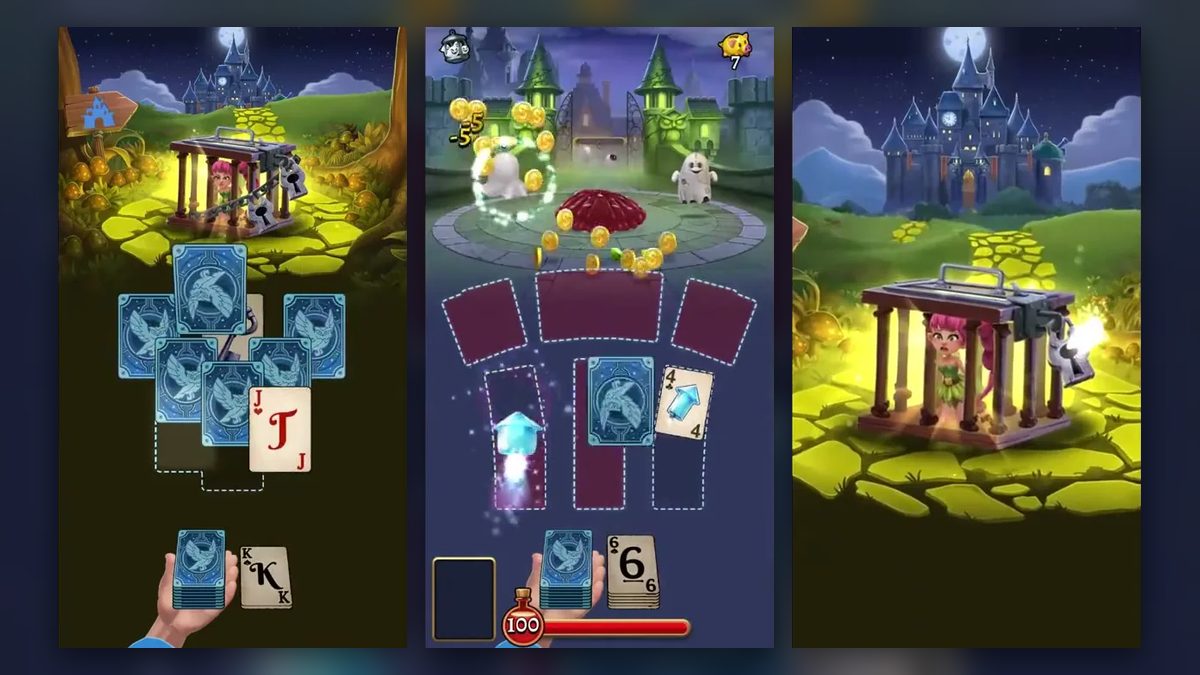
Sorcery School gameplay runs through the waste pile at the bottom of the screen. A face-up card on the board can go onto it when its rank is one above or one below the card on top. When nothing fits, the next card comes off the draw pile, which a cartoon hand holds at the bottom center beside the waste pile. In the opening stretch a gold arrow points out moves. With a 4 on the waste pile it points at a 5. With a 3 there and only a J, 9, 10 and Q face-up, it points at the draw pile instead.
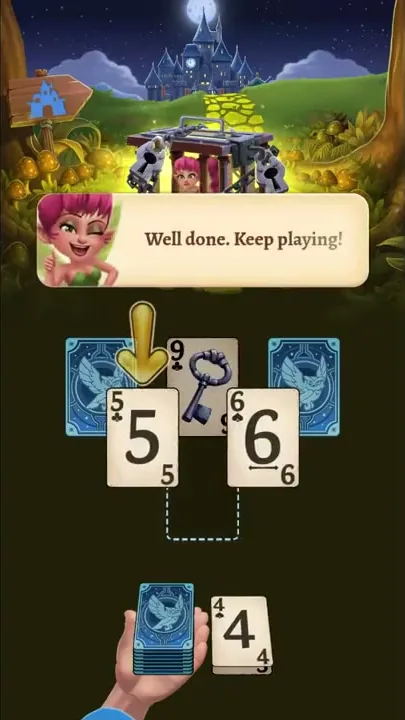
Cards are taken straight from the board or from the draw pile. They sit on a dark lower area of the portrait screen, under a painted scene that fills the top third. Dashed outlines mark the card spots, including empty ones. The card faces are cream, with large rank letters in a storybook typeface, and dialogue appears in parchment boxes with a portrait of the speaker.
Many cards lie face-down under or behind face-up ones, and their blue backs carry a white winged-bird emblem. They turn over once the cards covering them are played. In one intro layout, clearing the front row reveals two aces and a king behind it. Another intro layout is almost entirely face-down, with a single red J fully showing.
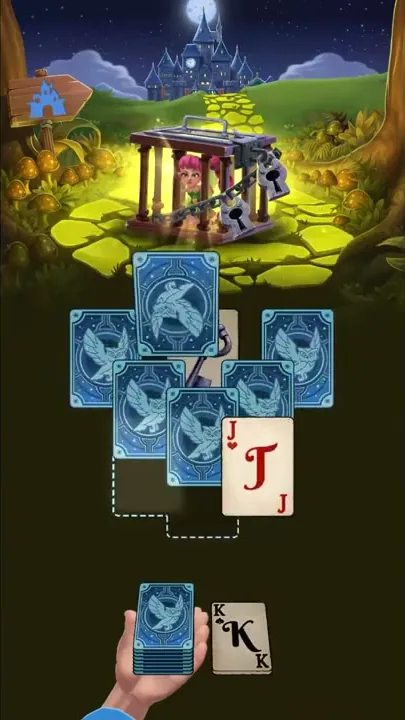
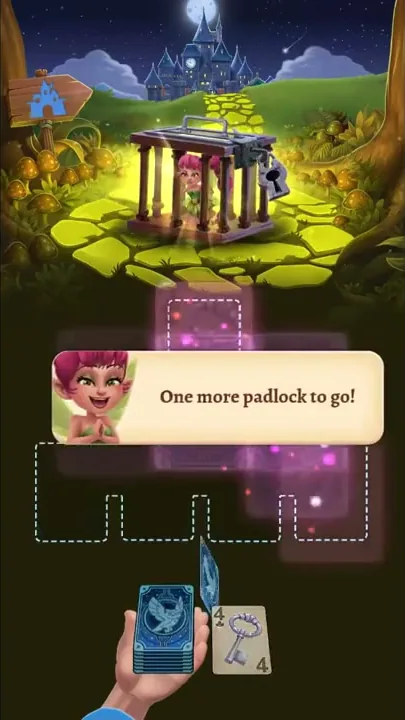
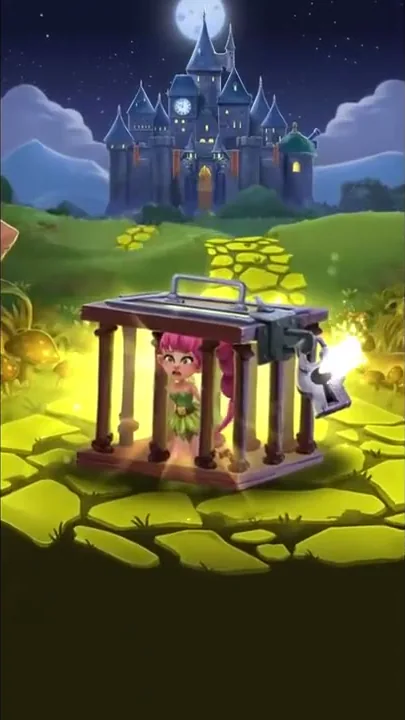
A pink-haired fairy sits locked in a wooden cage hung with padlocks, on a yellow stone path below a moonlit castle. The intro’s cards are there to set her free. They come in small layouts that follow one another, and each emptied layout gives way to a new one.
Each of these layouts held a key card, and key cards break the padlocks. Early on, a key 9 sits under a 5 and a 6. A key 7 and a key 4 come next, and a key 2 comes last. Right after a key card lands on the waste pile, a flash hits the cage. Once the key 4 is down, the fairy says ‘One more padlock to go!’ and a single padlock is left.
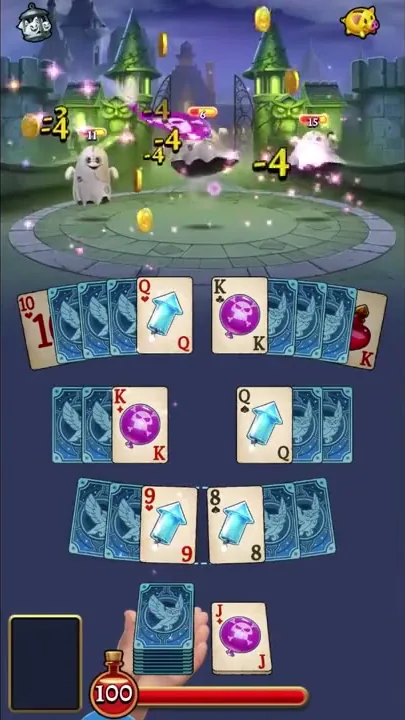
In the battles, cartoon enemies face the player from the top of the screen. Ghosts turn up in each of the three fights. The second and third fights add a red-capped mushroom, and the third also has green blobs. Some enemies carry a small red health bar with a number, and hits show as yellow minus numbers, such as -5 on a ghost. A beaten ghost collapses and vanishes. A beaten mushroom flattens into a red splat as gold coins burst out.
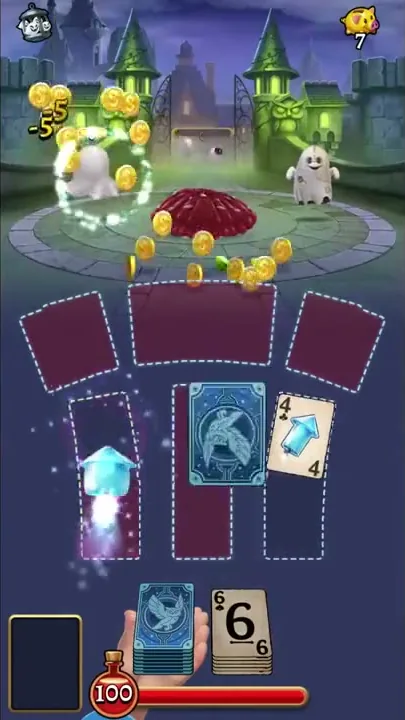
If the board is emptied while enemies are still standing, a new layout is dealt in its place. Once the board was empty and no enemies were left, a new fight followed. During the battles, cleared card spots fill with dark red.
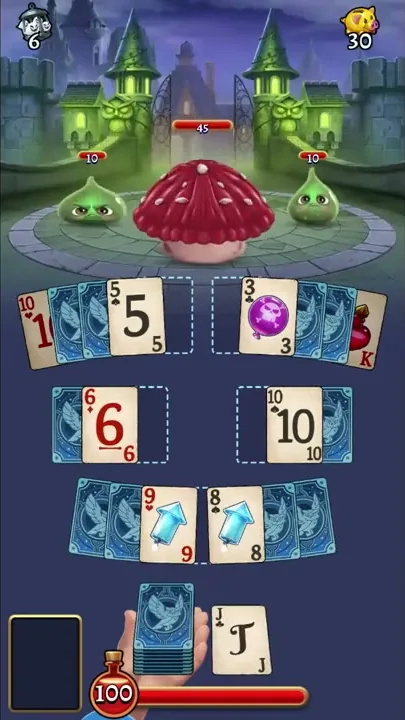
Crystal cards carry a blue crystal picture. Playing one sends a large blue crystal shooting up from the board or across the screen. In the second fight, a crystal 9 leaves the left column for the waste pile, and the crystal rises from that same column. A crystal 4 has turned face-up there in the 9’s place.
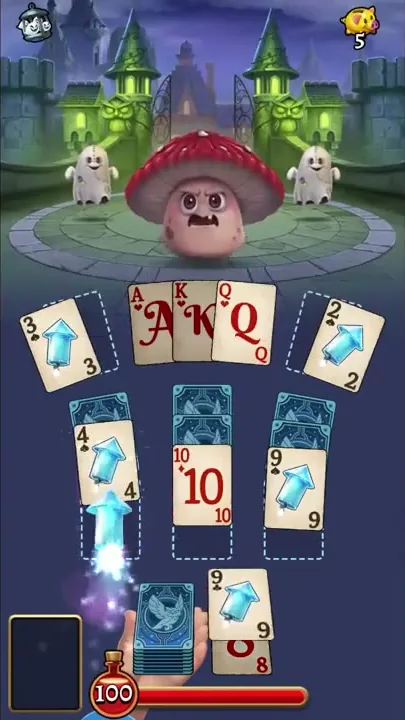
Under the draw pile sits the player’s health meter: a red potion flask with a number inside it, next to a long red bar. In the second fight the meter takes a -30 hit. The flask flashes white and the end of the bar turns yellow.
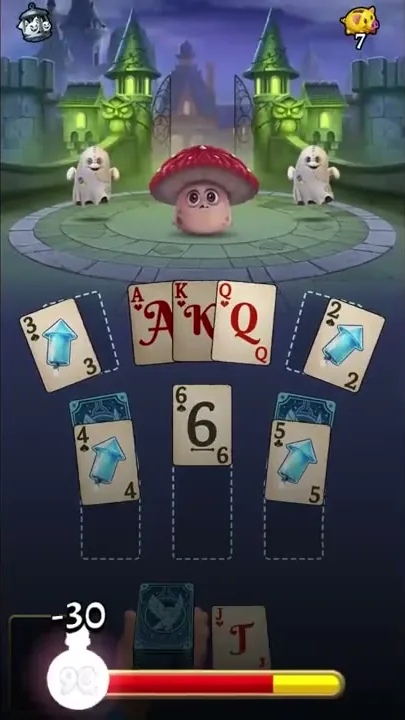
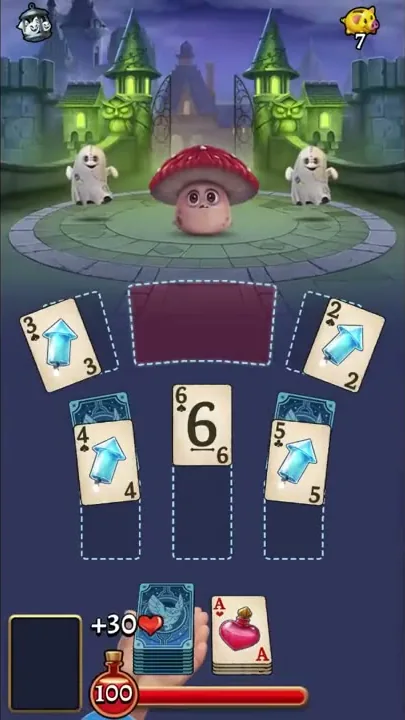
Heart-potion cards carry a red, heart-shaped bottle. In the same fight, the fanned ace, king and queen at the center of the board show plain letters at one moment and the potion picture the next, and a large potion rises from the fan. With a potion A then on the waste pile, ‘+30’ and a heart appear beside the health meter, making up the earlier -30. In the third fight, potion cards also sit at the right end of the top row.
Skull cards show up in the third fight, marked with a purple orb that holds a skull. A wizard named Horatio, whose name sits on a ribbon above his dialogue box, presents a J and two Ks with the new picture. His message begins ‘Try attacking all 3’. With a skull J on the waste pile, purple bursts strike the courtyard and -4 appears over all three enemies at once. Later in the fight, a purple skull flies up from the board.
From a fairy’s cage to monster waves
The cards in the intro work toward the fairy’s cage rather than against enemies. The last padlock breaks in a flash of light. The cage then stands open and empty while a swirling wipe carries the scene from the moonlit path to a castle courtyard.
All three battles take place in that courtyard, among green-spired towers and iron gates, with the enemies on a round stone floor facing the player. In the first battle, two ghosts and a seated, bearded wizard in a blue hat appear above two mirrored groups of overlapping cards. Each group has face-down cards stacked behind its face-up ones. When that board was emptied with enemies still standing, a second, smaller deal replaced it.
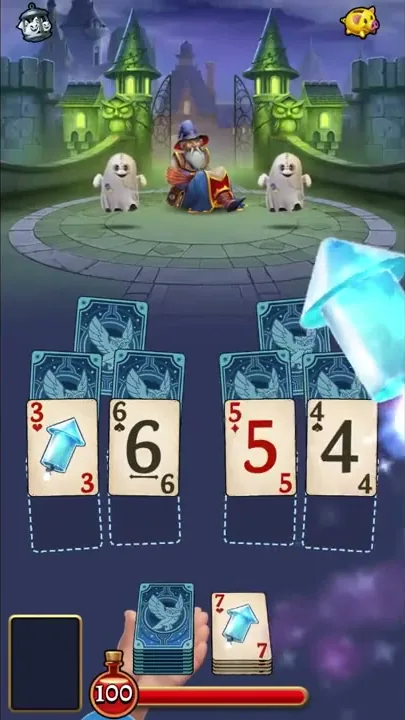
Each fight came with a new card picture. Crystal cards are on the board from the first battle, and heart potions appear on the center fan in the second. Horatio hands over the skull cards as the third begins.
The enemies and layouts change shape as well. For the second fight, two cartoon hands deal the cards in a pink glow. The top row has an angled crystal card at each end with a fanned ace, king and queen between them, above three columns of face-down cards, each topped by a face-up card. Over the board, a red-capped mushroom with a health bar marked 20 stands between two ghosts.
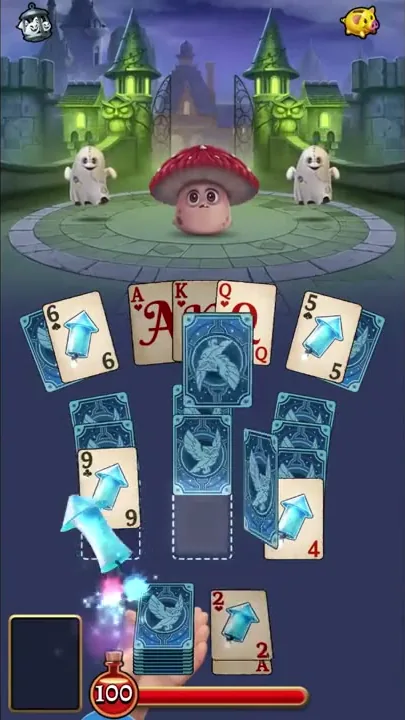
The third fight spreads the cards across three rows of fanned stacks. Each fan holds face-down cards, with face-up cards at its open ends. The first wave is three enemies. Once they fall, a second wave arrives on the same board while the cards stay as they were: a mushroom with 45 on its health bar and two green blobs with 10 each. The player’s health takes another hit along the way. The mushroom ends up as the last enemy standing, then collapses into a red splat.
Gold coins burst out of struck and beaten enemies and fly up the screen. A number beside a yellow pig icon at the top right climbs as they go, and it is low again once the next fight is under way.
At the top left of the battle screens, a small gray creature icon has an unlabeled counter of its own, which rises during a fight.
Solitaire with health bars and monster waves
Block puzzles, solitaire and jigsaw puzzles have lately been edging from light casual play toward midcore. In our view, Sorcery School is the first game to take solitaire there. The game also marks a new direction for solitaire paired with another genre, here wizard battles fought through card plays.
The theme felt fresh: a magic setting where a fairy is freed from a padlocked cage on a moonlit path, and a wizard named Horatio hands over skull cards. The viewpoint did too, with the enemies lined up on a round stone floor facing the player and the solitaire board below them. The format turns card plays into spells, with blue crystals shooting up from the columns and purple skull bursts landing on the enemies. All of it catches the eye.
Open questions after three courtyard fights
There is no criticism of Sorcery School to report.
Whether the intro and the three fights count as separate levels, and how the game groups its stages, is still open. What set off the -30 hit to the health meter, and what the gold-framed, card-sized slot at the bottom left of the battle screen is for, are both unclear.
Rank runs with monsters to aim at
These mechanics suit a taste for rank-by-rank solitaire with a fight attached. The player scans the board for a card one rank away from the top of the waste pile and draws when nothing fits. Clearing the covering cards turns over the face-down ones. Meanwhile, the pictures on certain cards send crystals and skull bursts toward a line of enemies or refill the health meter.
Anyone browsing games like balatro on mobile will find Sorcery School’s ranked playing cards going onto a waste pile one rank at a time, with the pictures on some of them striking enemies or restoring health.
Verdict
Sorcery School carries solitaire into wizard battles, where a run of ranked cards turns into a crystal shot at the enemies or a heal for the player. Its setting, its view of the courtyard and its card-driven format come across as fresh and eye-catching. By our reckoning, it is the first game to bring solitaire into midcore territory, and it marks a new direction for solitaire combined with another genre.