Cascade Match Solitaire Review: Clearing Cards by Rank
A Cascade Match Solitaire review: cards one rank from the corner card light up inside Candy Crush-style levels with color goals.
Game at a glance
Cascade Match Solitaire
7/ 10
Our score
Underneath it's still a clearing game; only the rule for what clears has changed.
In this article6 sections
Clear cards one rank above or below the big card in the top-right corner. That Solitaire rule sits at the center of Cascade Match Solitaire, one of the solitaire games that lays its cards flat across a grid instead of stacking them in piles. The level around it is built like a matching and clearing game, with colored goals, cards that drop in from above, a rocket and star bombs.
We played Levels 1–3. The cross between card ranks and that kind of level struck us as fairly novel, and the build as a bit rough.
One rank up or down from the corner card
Goals sit in a green panel at the top of the screen as colored squares, each with a small counter under it. The counters drop during play and turn into check marks. Once every goal is checked, a translucent banner slides sideways across the board, and a results panel reading “CLEARED!” follows.
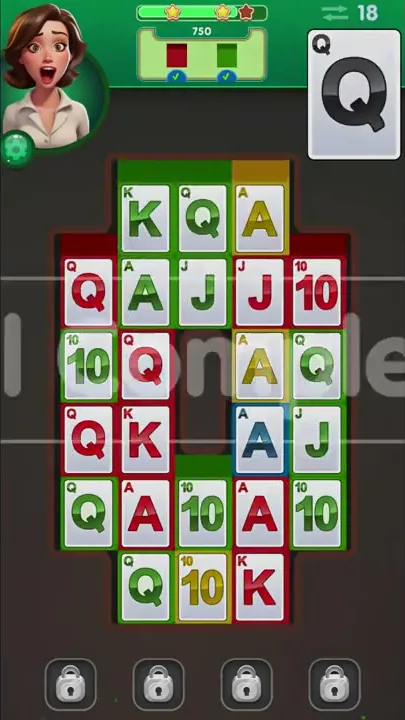
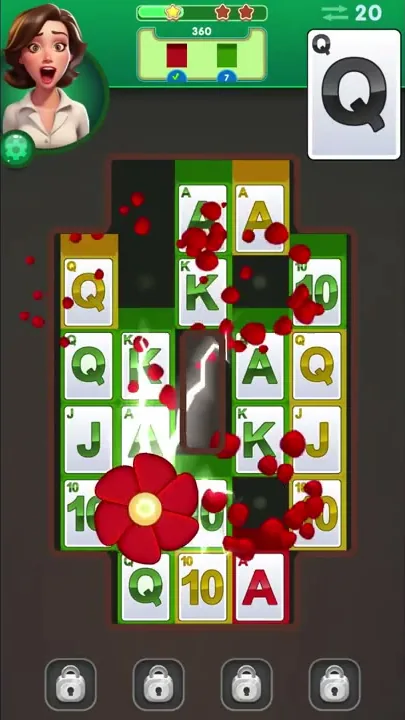
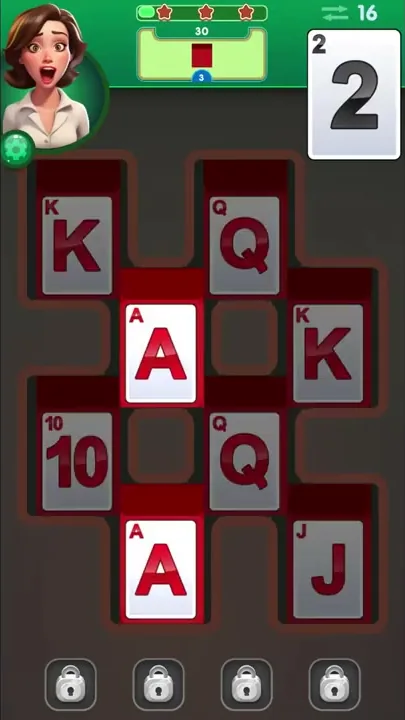
Cascade Match Solitaire gameplay turns on the large card at the top right. Board cards one rank above or below it are lit bright white, and the rest are grayed out. With a 2 up, the Aces light; with a King up, the Queens and Aces light, so King and Ace count as neighbors; with a Jack up, the 10s and Queens do. The corner card changes during play, going from a 2 to a Queen in Level 1.
That lighting is how the board marks playable cards. In Level 2 a tutorial bubble appears beside the rocket, and the visible part of its text reads “touch the” and “how it works!”
Another number sits beside a two-arrow icon at the top right, above the corner card. It carries no label and falls as play goes on; what happens when it runs out, we can’t say.
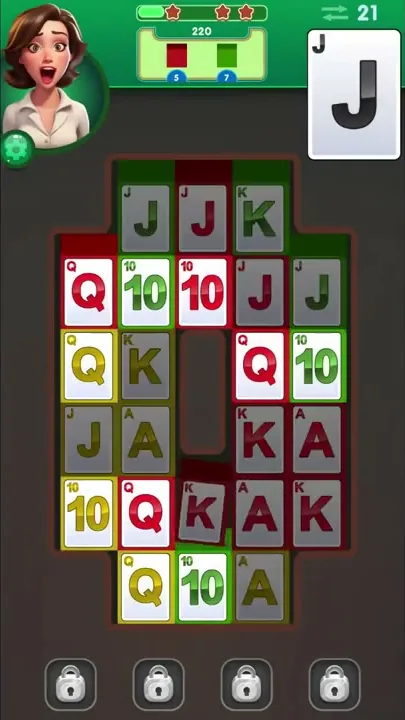
Emptied slots fill again with cards that drop in from above. Partway through Level 2 a red Queen hangs over the board’s top edge with empty slots beneath it, and moments later the top slot of that column holds a red Queen. In Level 3 a King is caught tilted in mid-fall.
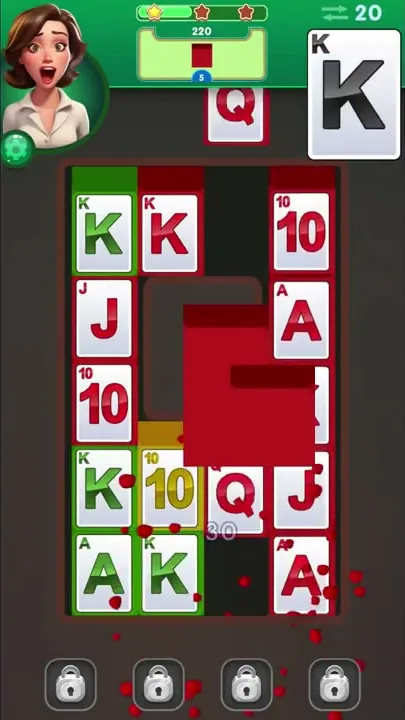
Each card shows a large rank with a small index in its corner and no suit symbol. The ranks seen on the board run from 10 to Ace, each printed in the color of the tile it sits on, and the goal squares use the same red and green as the cards. A single blue Ace turns up late in Level 3. The board itself sits on a dark brown-gray background under a green header.
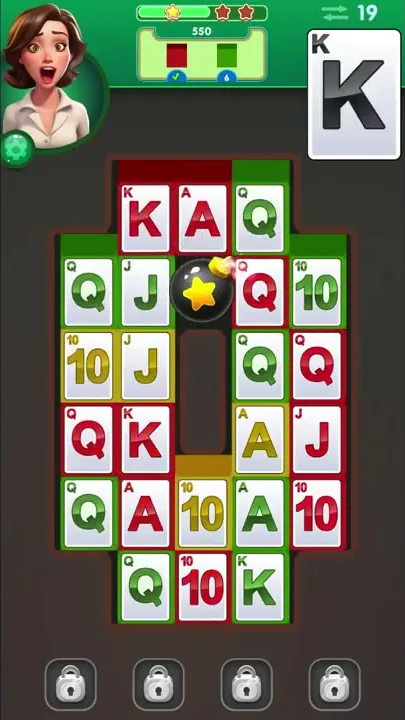
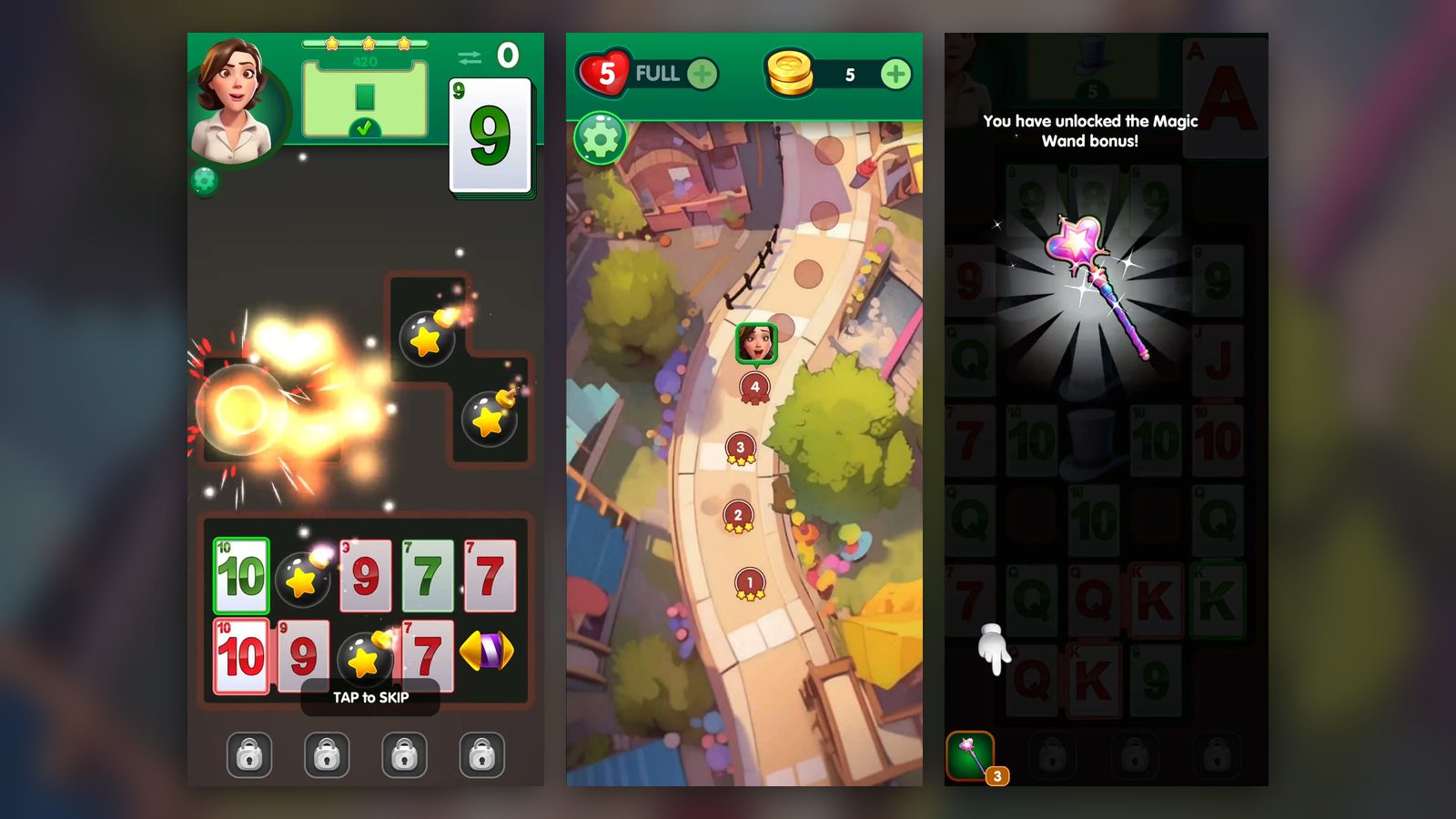
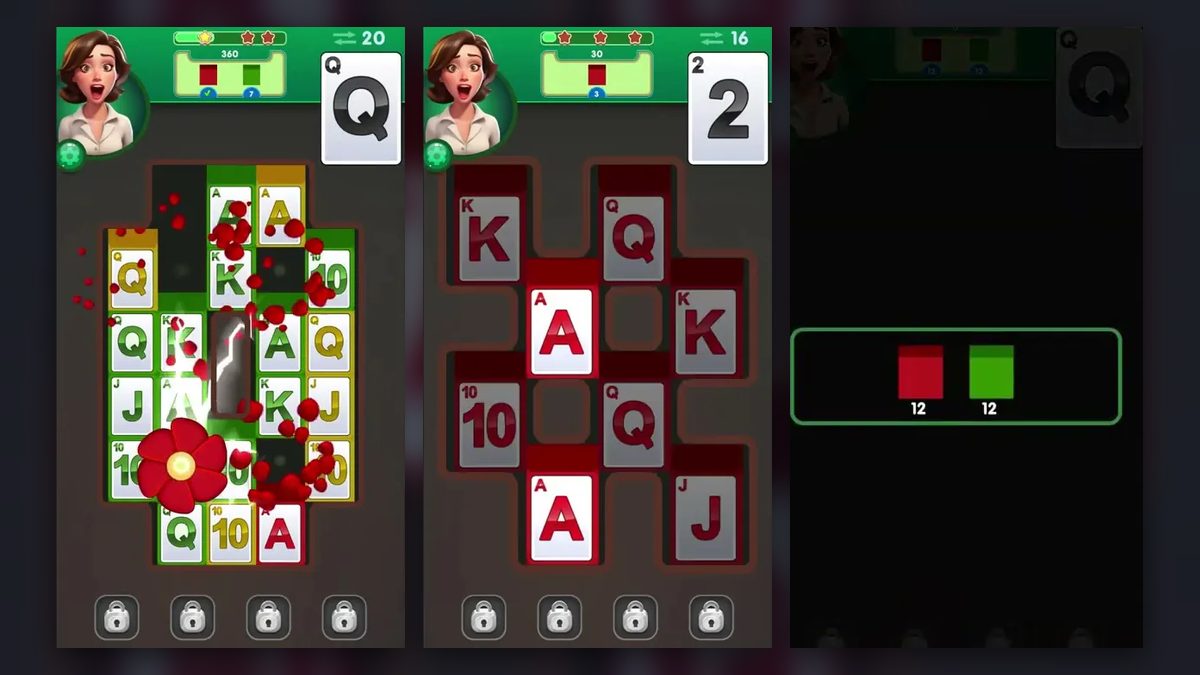
Level 2 is where the rocket shows up. Its purple-and-gold body fires a bright beam straight along the board’s right-hand column, with card fragments flying off around it while the tutorial bubble is still on screen.
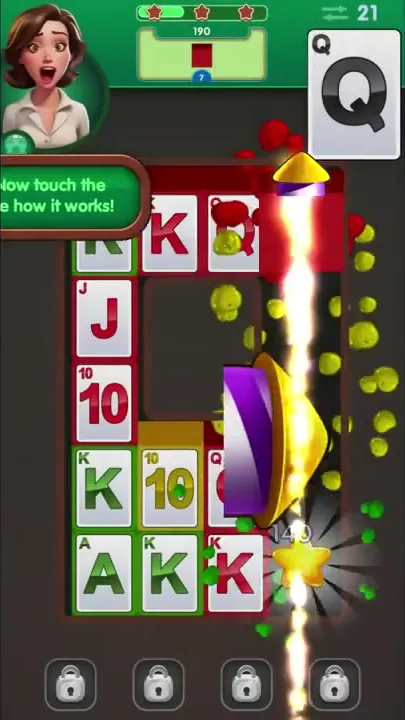
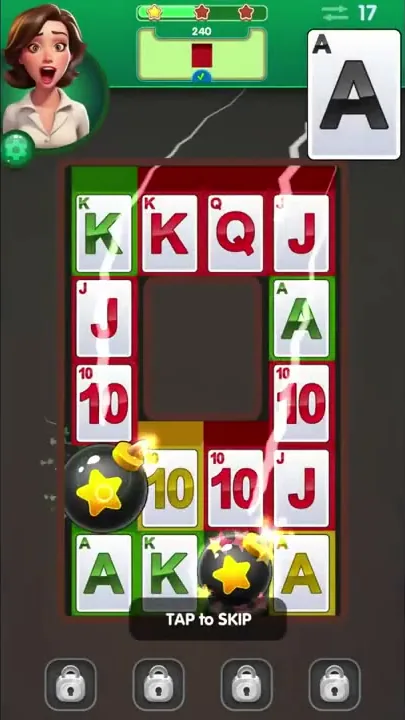
Star bombs are round and black, marked with a gold star and topped by a lit fuse. Each takes up a card slot of its own, as one does early in Level 3 and again later in that level.
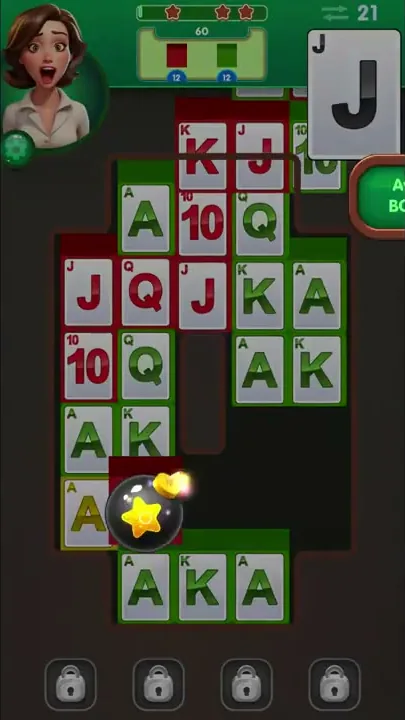
In Level 3 a large red flower with a gold center bursts over the lower left of the board and scatters red petals across it. At the same moment a lightning streak runs down the middle column and the red goal shows its check mark, with several slots standing empty.
An empty board opens Level 2 under one red goal of 12, with a King in the corner and the two-arrow counter at 22. Red cards mixed with green and yellow ones settle into place, and the red goal counts down to a check mark. Two star bombs and streaks of lightning then appear on the board under a “TAP to SKIP” prompt, the same words that show faintly behind the results panels of Levels 1 and 3.
From a red checkerboard to twin color goals
The palette is the first thing to grow. Early in Level 1 the cards on the board are all red, two to a row in a staggered pattern with outlined empty slots between them, and a 2 sits in the corner.
Green and yellow cards join the red in Level 2, and the board takes a new shape. By the middle of that level, its cards form a rectangular ring four columns wide and five rows tall around an empty two-by-two center. By the middle of Level 3 the board is wider: five columns across, against four in Levels 1 and 2, with three cards in its short top and bottom rows and a gap two slots tall in the middle column.
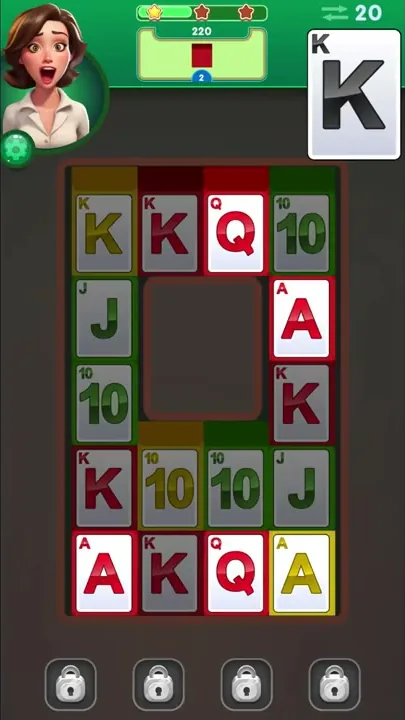
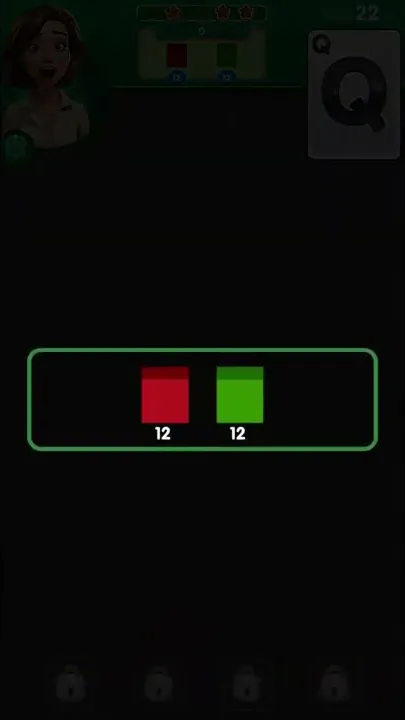
The goals grow in step. A single red square makes up the goal in Level 1, and Level 2 sets the red count at 12. The first two-goal level is Level 3, which shows 12 red and 12 green in a pop-up over a dimmed, empty board before any cards arrive.
Special pieces arrive over the same stretch: the rocket and the end-of-level star bombs in Level 2, then bombs on the board and the red flower burst during Level 3.
Outside the cards, a bar with three stars runs across the top center of the screen with the score beneath it. The bar fills and its stars turn gold as the score climbs, and numbers such as 30 float over the board during play.
A results panel follows a cleared level. A white rabbit in a rainbow top hat and bow tie stands beside “CLEARED!” and the score, with a level tag and up to three stars along the top. Three buttons line the bottom: a large green play button between a round house icon and a round “G”. On the Level 1 panel two stars are gold and the third is pale teal; the Level 3 panel shows all three in gold above a score of 1470.

Four padlocked slots sit in a row under the board during play. A round green button with a chip pattern sits at the lower left of the portrait in the top-left corner, a cartoon woman with an open-mouthed expression.
Solitaire ranks set inside color-goal levels
What we liked is the pairing itself. Cascade Match Solitaire crosses Solitaire’s one-up, one-down card rule with the levels and layouts of matching and clearing games, and the combination feels pretty novel. The new part is the clearing rule: cards light up by rank, whatever their color. In Level 3 a Jack in the corner lights 10s and Queens in all three colors at once, on a board shaped around a gap with red and green goals overhead.
The shell around that rule is Candy Crush’s, which places Cascade Match Solitaire among games like candy crush. Level 3’s two goals are announced in a pop-up before the cards drop in, and a “TAP to SKIP” sequence of star bombs and lightning follows the Level 2 win.
The build around the playing cards
It is a letdown that the build is a bit coarse. The yardstick is the craft of the Scapes games or Royal Match. Made to that standard, swapping card ranks into a matching and clearing game would be an idea with a lot of room to grow.
The idea is already on the board in Level 1, where a 2 in the corner lights the two red Aces under a single red goal. What falls short of that standard is the finish around it.
Rank steps and color targets
The rank rule calls for Solitaire’s kind of attention: watching the corner card and the board cards it lights one step above or below it, with Kings and Aces counting as neighbors. That matches a taste for card play by rank. Around it runs the routine of matching and clearing games, with color goals to check off and special pieces such as the rocket and star bombs. A star rating on the results panel caps a win, which suits a taste for level goals and three-star scores.
Verdict
Beneath the playing cards, the structure belongs to matching and clearing games, and Solitaire’s rank steps are the part swapped in. Pairing that rule with the Candy Crush wrapper gives the game a pretty fresh angle. The build, though, is a touch coarse; with more craft behind it, the concept could go a good deal further.