World Conqueror Review: Live Cards in a Ball Land Grab
Green and orange balls fight over a tile board, and this World Conqueror review covers the Ball, Ball Launcher and Boulder cards played on top.
Game at a glance
World Conqueror - Arena wars
8.5/ 10
Our score
So the key is live card play, and it changes much of the feel these games used to have.
In this article6 sections
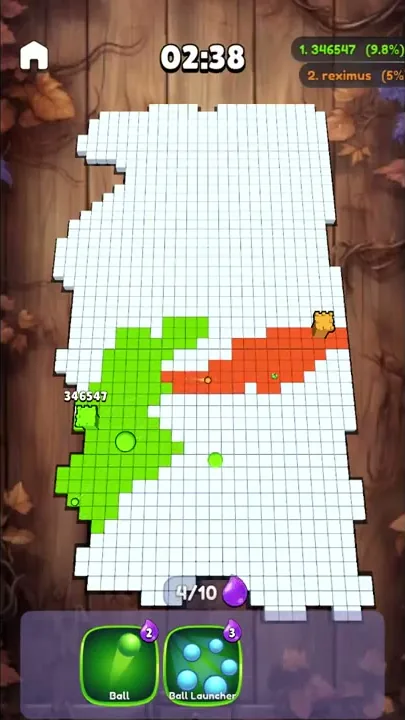
With 02:13 left on the countdown in World Conqueror, a translucent green ring hangs over the orange tiles in the middle of the board. Green holds most of the left side, and orange reaches in from a small figure on the right edge. In the hand below sit three cards, Boulder, Ball Launcher and Ball, each with a purple droplet cost.
This portrait-screen mobile game is a ball bounce game built around territory: small green and orange balls hold patches of a tile grid, and both colors spread across it against the clock. On top of that sits a hand of skill cards, played while the match is live.
Green and orange balls on a white tile board
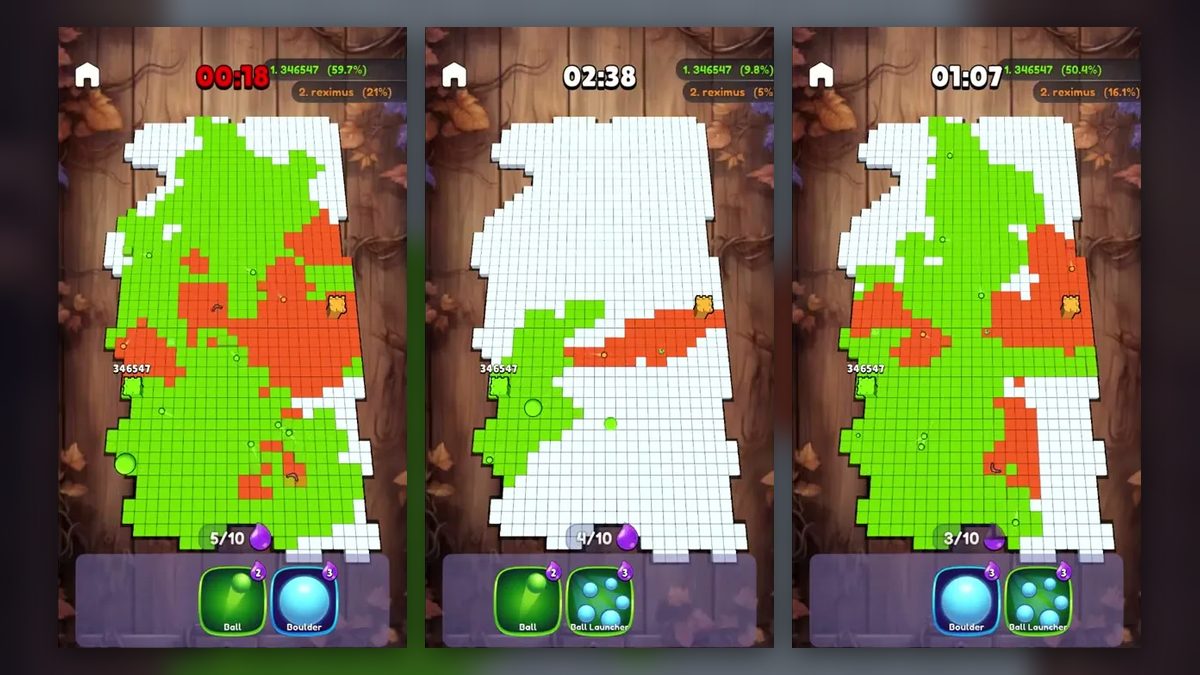
The board is a tall, irregular grid of raised white square tiles on a wooden tabletop. Autumn leaves and vines frame it, and a tilted camera looks down from above. Two colors fight over it, green and orange. No goal text appears during play. Instead, a ranking at the top right lists both sides with their share of the board as a percentage, while a countdown runs in large white digits at the top center.
Each side has a small figure standing on the edge of the board. The green one is on the left edge with the label 346547 above it, the same name that tops the ranking. The orange-yellow one on the right edge carries no label, and the ranking’s second line names that side reximus. Neither figure leaves its spot all match.
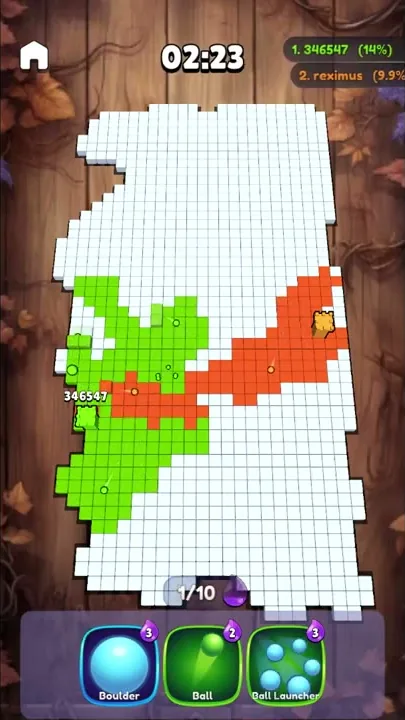
Small balls in each side’s color dot its area and line its edges, and over the match both colored areas push out into the white tiles. Early on, a narrow straight line of green tiles runs from the green area up into the white, and green soon fills in beside it.
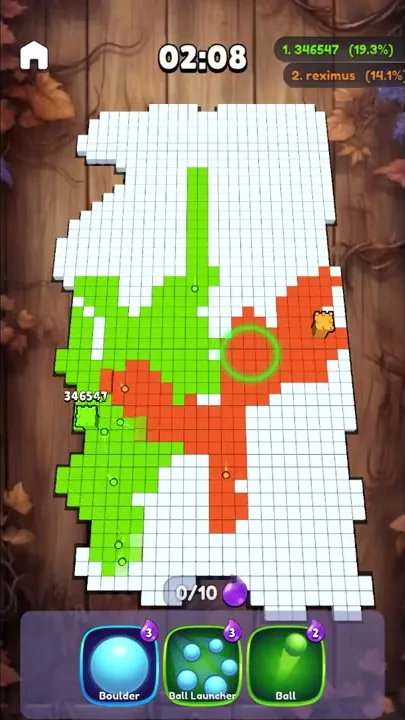
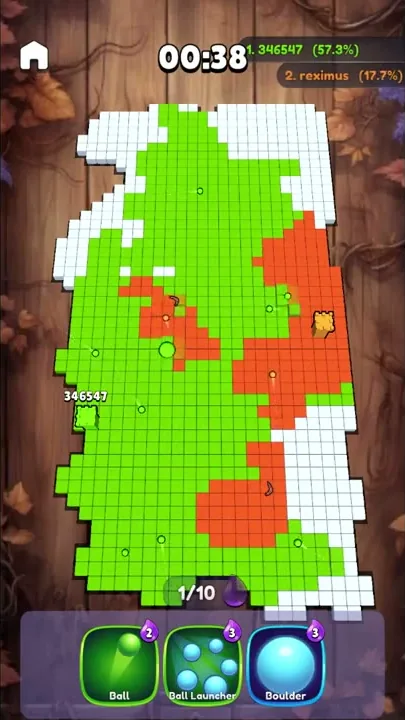
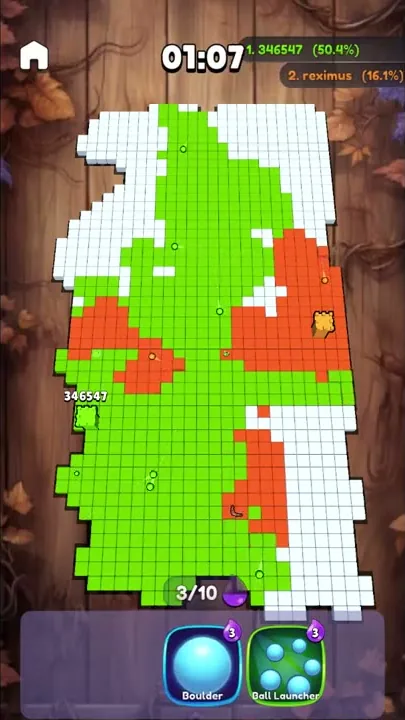
The two colors also cut into each other’s ground. By 01:53 orange has driven a band across the middle of the board that reaches the left edge just above the green figure, while green holds the lower left and spreads upward.
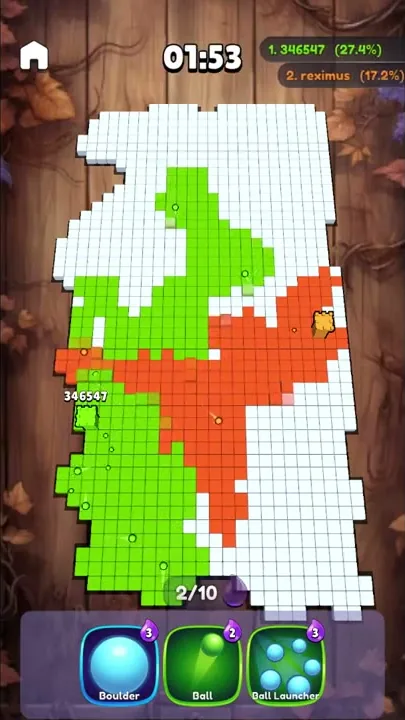
Under the board, a purple-gray bar holds up to three cards, each with its cost in a purple droplet badge. Ball costs 2 and shows a single green ball in a green frame. Ball Launcher costs 3 and shows several light-blue balls on green, also in a green frame, while Boulder costs 3 and shows one large light-blue sphere in a blue frame. These are the only cards that turn up, and their order in the hand keeps changing.
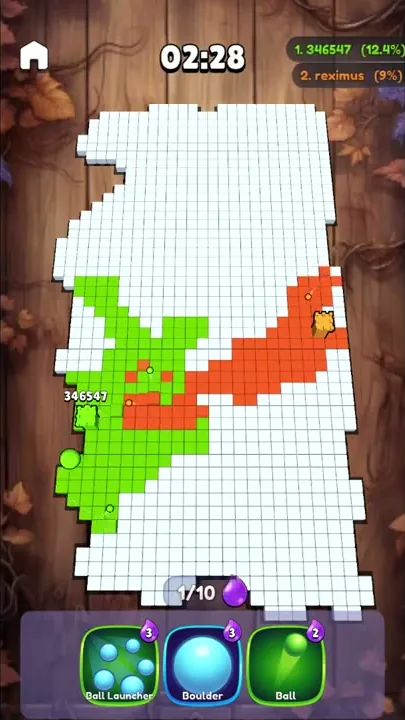
The hand is where the player acts. At times one of its three slots stands empty, and a card fills it again shortly after.
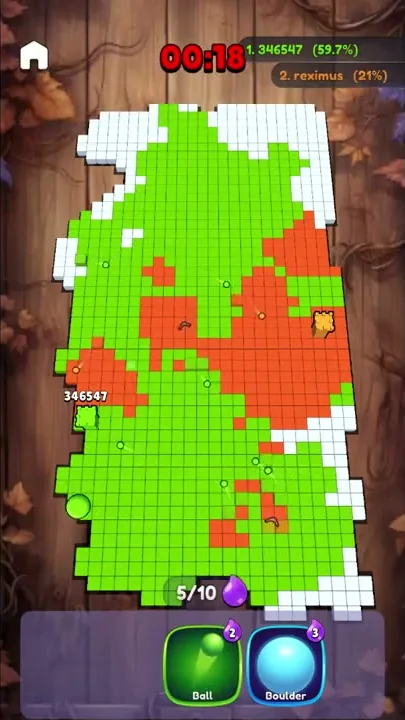
Just above the hand, at the bottom edge of the board, a counter with a purple droplet tracks mana as a number out of 10. The same droplet marks each card’s cost. The counter rises and falls throughout the match, now and then dropping to zero, and once its digits show in red.
A translucent green ring appears several times over orange territory and lingers over the same spot rather than moving. The first one sits in the middle of the board. Later ones settle twice over the lower orange patch.
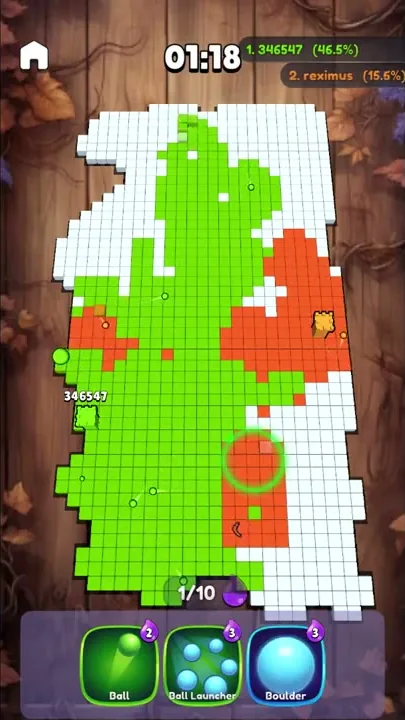
Green balls several times the size of the small ones also show up inside the green area, two at once late in the match. Early on, one green ball sits on white tiles just outside the green patch.
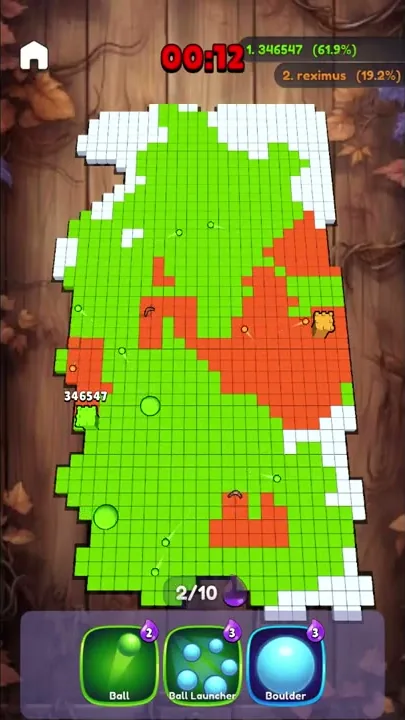
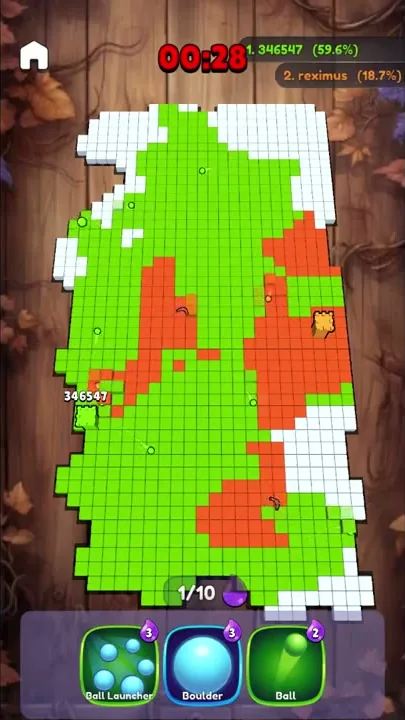
Orange ground holds something of its own. From 01:28 on, a small dark red object shaped like a hook or boomerang sits inside the lower orange patch, shifting position as the match goes on. Later there are two, one in an orange patch left of center and one in the lower patch, and they never appear outside orange territory.
The one timed match we played was already under way at 02:38 on the countdown and ended on a results panel at 00:06. Over that stretch, 346547 at the top of the ranking went from 9.8% of the board to 62.8% with 00:08 left, and reximus went from 5% to 19.7%.
From white tiles to a red countdown
Early in the match most of the board is still white. Green holds a patch around its figure on the left and orange a diagonal strip running in from the right. Both shares are small: 14% against 9.9% with 02:23 left.
The middle of the match is a tug-of-war over the center. After orange’s push across the board, green climbs toward the top edge. With 01:07 left, green covers about half the board and the ranking reads 50.4% for 346547, while orange keeps the right side and a strip lower down.
In the last 30 seconds the timer’s digits switch from white to red. By then little white is left apart from the right edge and the top corners. Orange still takes back patches inside the green area, including tiles just above the green figure, and both hook shapes sit in orange ground.
Outside the board, a house-shaped home button stays at the top left for the whole match.
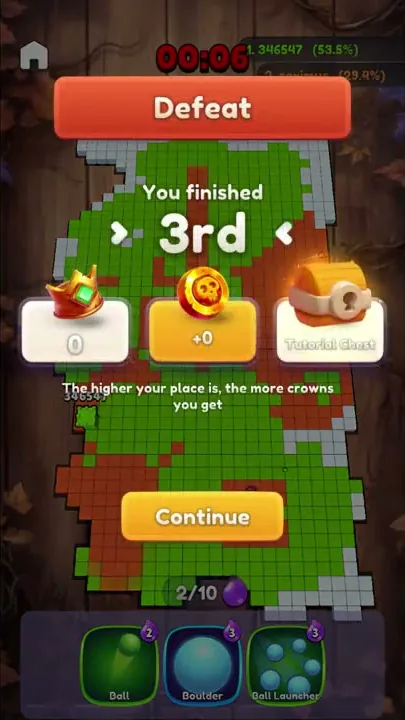
The match closes on a results screen that darkens the board under a red Defeat banner, with “You finished” and a large 3rd between white arrow marks. Three reward cards sit in a row: a crown with a green gem on a white card, a gold skull coin on a yellow card and a chest labeled Tutorial Chest. The line beneath them reads “The higher your place is, the more crowns you get,” and a yellow Continue button waits at the bottom.
Live skill cards on the idle ball formula
The real-time cards are the key to World Conqueror, and they change much of the feel this kind of ball game used to have. We think that makes it an excellent solution for idle ball strategy. The three cards sit under a board that keeps changing color, and they leave the hand and come back while the countdown runs.
Older idle ball games left the player to set things going and watch. Here there is more to do and more strategy behind it, all of it under the board: a mana counter to spend from, cards priced at 2 or 3 droplets and a hand whose slots empty and refill during the match. We also like that the skills are played mid-battle, so they can shape both how the fight goes and its presentation.
Card effects the screen never spells out
We have no complaints about World Conqueror; the points below are things the match leaves open, not faults. No screen explains what each card does, or whether any of them is behind the green ring and the oversized green balls. The dark hook shapes in orange ground come with no label either.
The ending goes unexplained as well. The results panel reads Defeat and You finished 3rd with 00:06 still on the timer, although moments before, the ranking had 346547 on top. Nothing on screen explains the gap.
The panel also never says what crowns and skull coins are for or what the Tutorial Chest contains. No shop or lobby appeared, and the match ends before anything that follows Continue.
Spending droplets against a countdown
Letting two colors spread across a board by themselves, while keeping the option to step in, is the kind of play on offer here. Stepping in happens at the bottom of the screen: picking which card to spend droplets on as the counter climbs, then glancing up at the percentage ranking to see what moved.
A close eye on the standings is easy to keep, since they never leave the screen. The ranking at the top right updates all match, and the clock turns red for the closing stretch.
Verdict
World Conqueror keeps the color-spreading ball battle and lets the player act on it mid-match, which is where its strength lies. That live layer gives the formula a different feel and adds more to do than just watching, and the result is an excellent take on idle ball strategy.