Catch 2 Match Review: Tile Matching by Slingshot
A slingshot knocks animal heads off a sand field into a wooden tray; this Catch 2 Match review weighs bank shots against three-of-a-kind rules.
Game at a glance
Catch 2 Match
6/ 10
Our score
Bank shots and precise picks don't quite mix, so it stays a fun idea.
In this article6 sections
Three matching animals in the wooden tray at the top of the screen clear away, the same rule that drives tap-three-of-a-kind tile matching. Catch 2 Match, a mobile ball bounce game, keeps that rule and changes how pieces reach the tray: a slingshot fires a red projectile across a walled sand field, and each animal head it hits flies up to join the line.
We played Levels 1–7, the last of them only partway. The premise is a farm: cows and pigs share the sand with roosters and ducks, and the field sits in green grass dotted with white daisies, though the cast also runs to pandas and foxes as well as monkeys and hippos. Shooting and matching make a fun pair, yet the two halves don’t quite fit, and the game lands as an interesting idea and not much beyond that.
Slingshot picks for a wooden tray
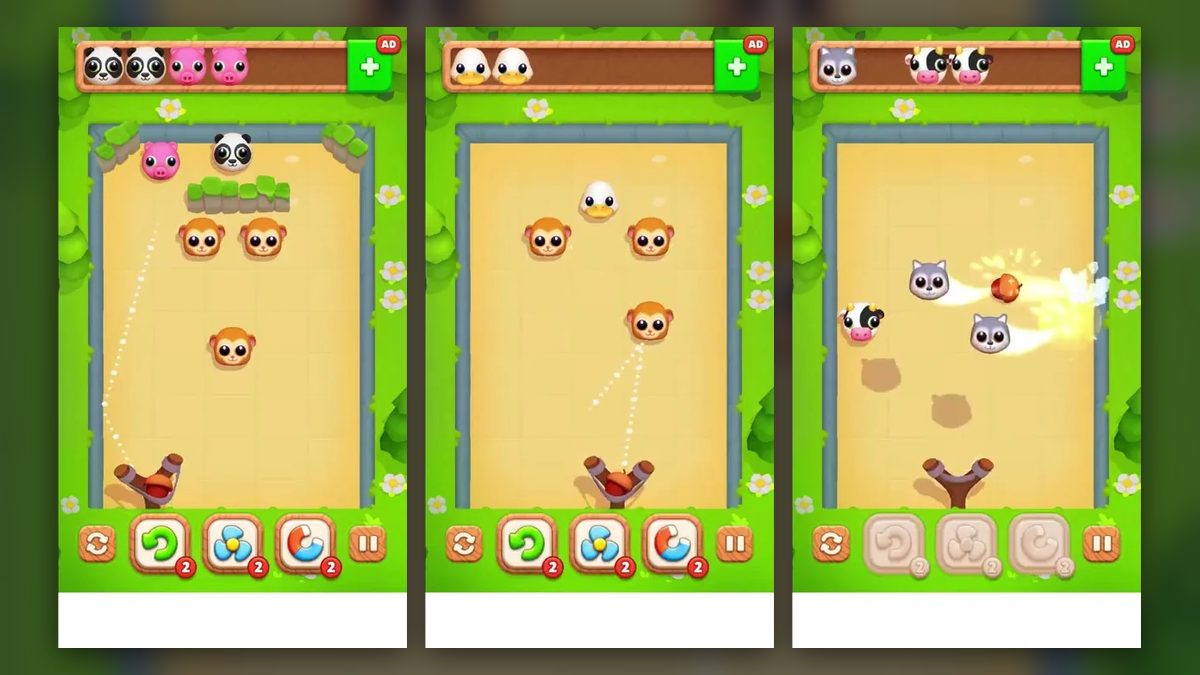
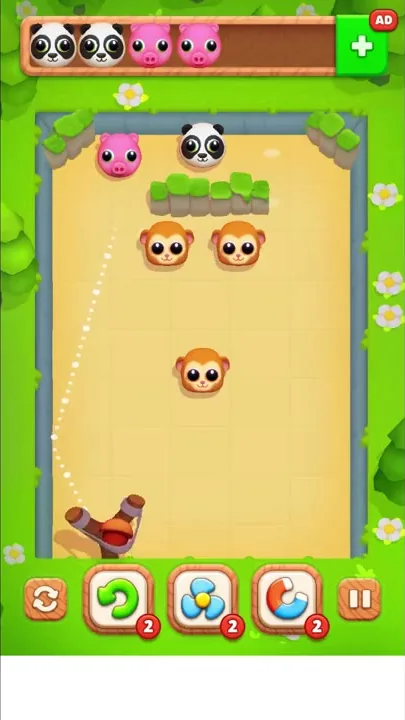
Each level is a rectangle of sand inside a gray stone border, seen from above in portrait, with the tray over it and a bar of buttons below. Animal heads sit on the sand, and the goal is to clear every one of them. A head struck by the projectile leaves the field for the tray, and three of the same animal in the tray disappear together.
That tray works as it does in games like Match Factory, with its pick-three-of-a-kind matching from a pile of 3D objects: three identical pieces in the tray clear. In Catch 2 Match the pile becomes a sand field, and every pick is a shot.
The slingshot stands on the bottom edge of the field with a red projectile loaded. Drawing it back and turning it sets the aim, and a dotted line shows the shot’s path, either straight at an animal or off a side wall and back up toward the heads. Between shots it turns up at different points along the bottom edge, sometimes near the left end and sometimes near the right.
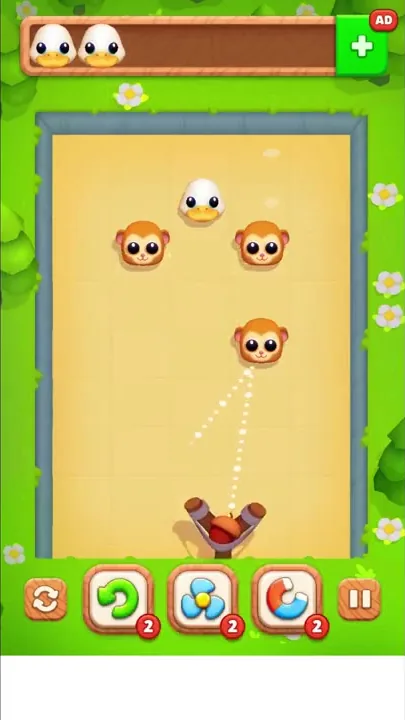
Three white ducks with yellow bills and three orange monkeys make up Level 2, set in a diamond-like zigzag over the upper half of an open field. With two ducks already in the tray, the aim line points at a monkey and splits in two where it meets the head. Shortly after, the ducks have cleared and a single monkey waits in the tray; then two wait there while the last monkey sits alone on the sand.
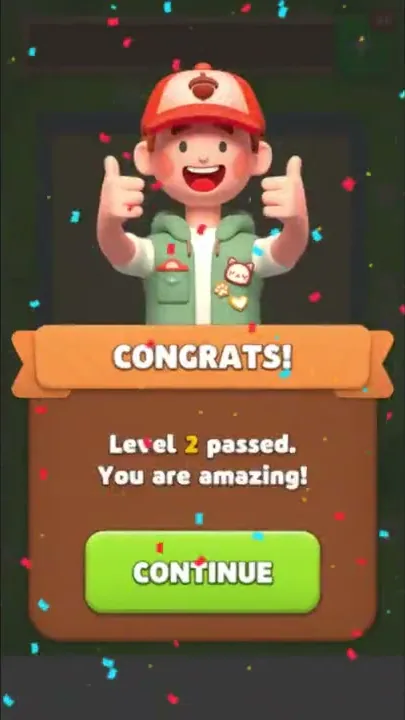
Collecting that final monkey empties the field and wins the level. The board dims behind a “CONGRATS!” banner and a brown panel reading “Level 2 passed. You are amazing!” above a green “CONTINUE” button, while a cartoon boy in a red cap and green vest gives two thumbs up under falling confetti. No coins or other reward appear on the panel.
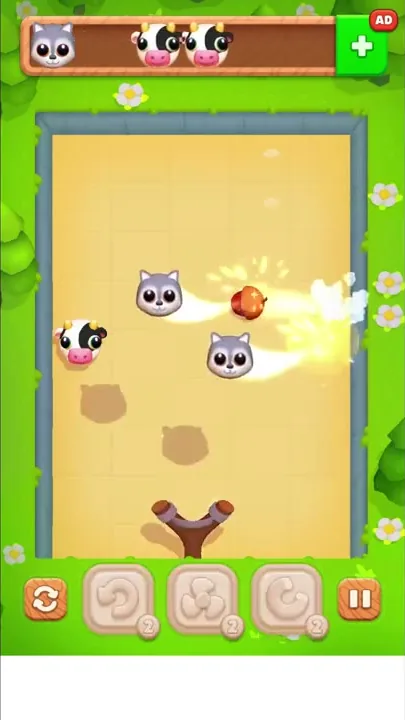
Once fired, the projectile keeps moving around the field and throws up white dust puffs wherever it meets the stone border. Hits leave white streaks and bright flashes, and brown, shadow-like patches show on the sand for a moment after some of them. In Level 1, two gray cat-like heads fly off the field at the same moment while the projectile is still on the move by the right wall.
The pieces are chunky, glossy cartoon animal heads with large eyes, never full bodies, and at the start of a level they appear inside glowing bubbles. Every level through Level 7 places three of each kind on its field. A head that gets hit shoots away with a white streak and reappears in the tray.
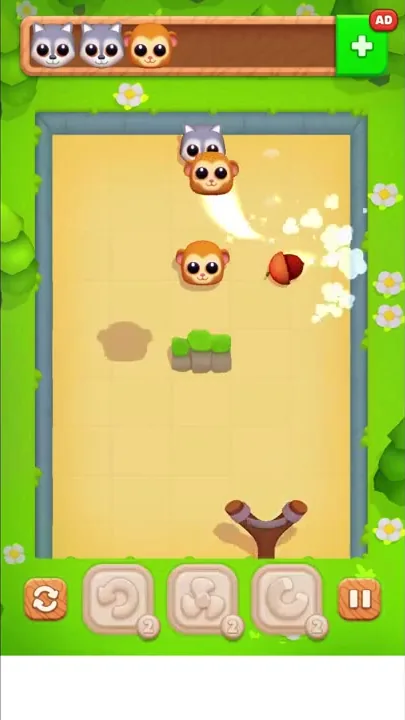
The tray is a long wooden bar without marked slots. Collected animals line up from the left, and matching kinds sit side by side: two pandas followed by two pigs on one board, and on another two striped heads, then a gap, then two pigs. A set of three leaves the bar, and when the foxes go in Level 6 a sparkle flashes in the emptied tray.
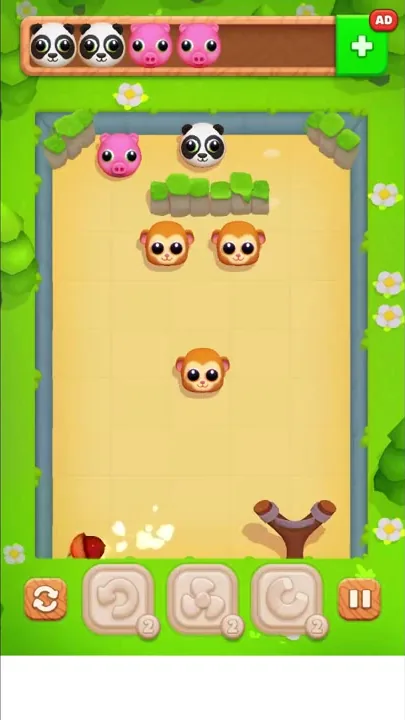
No move counter, shot counter, timer, lives display or fail screen appears on any board. The one visible limit is the length of the tray, which ends at a green “+” button with a red “AD” tag. A full tray never came up.
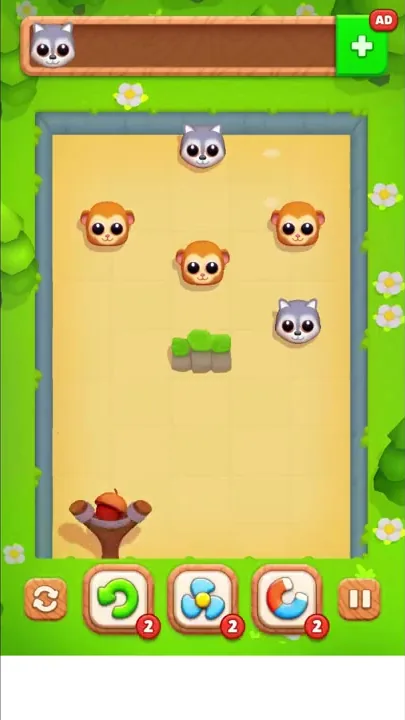
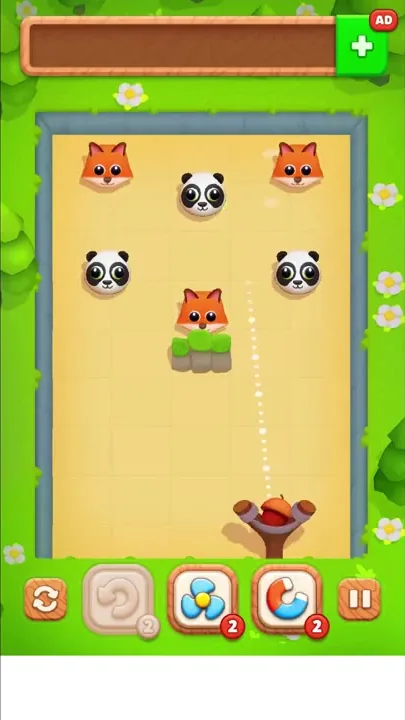
In Levels 5 and 6, a small gray stone block topped with green grass sits in the middle of the field. It stays in place for the whole level and is still standing after the last animal of Level 6 has gone. At one point the aim line runs off the right wall and stops at the block.
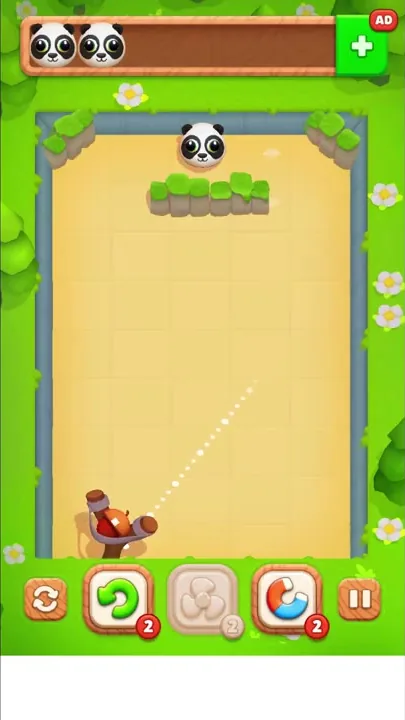
Level 7 sets more stone into the field. Grass-topped stones fill both top corners, and a longer row of them runs just below the top edge, with animals both above and below it. Late in the level the last panda sits in the narrow gap between that row and the top border, and the shots that follow, lined up first from the left and then from the right of the bottom edge, have not reached it by the time our session ends.
New animal pairs, then grass-topped stones
Until the first obstacle appears, the field stays open and each board swaps in a new pair of animals, three of each: cows and gray cat-like animals, then ducks and monkeys, then gray hippos with white roosters, and finally yellow striped heads alongside pink pigs. The arrangement shifts as well, from a loose zigzag across the middle of the first board to two rows packed near the top of the fourth.
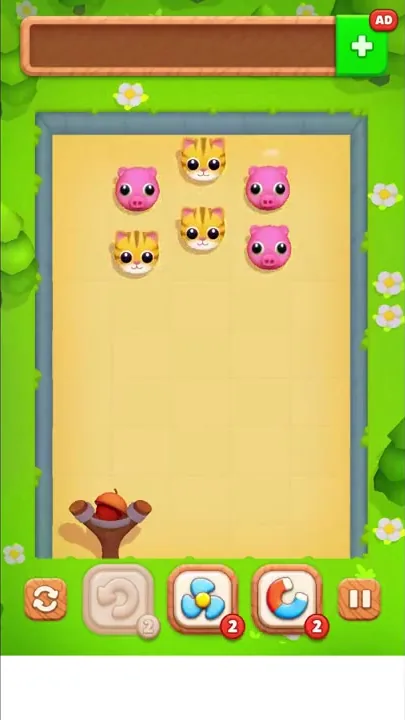
Obstacles come next, while the count stays at two kinds with three of each. The stone block takes the center of the sand for two boards, and in Level 6 one fox starts out perched on it, with the other two in the top corners and the pandas spaced around them.
A third kind and more stone arrive together in Level 7, where pigs and pandas share the sand with monkeys around the corner stones and the long row. Some animals start above the row and others below it, while more of them appear in glowing bubbles as the board fills in.
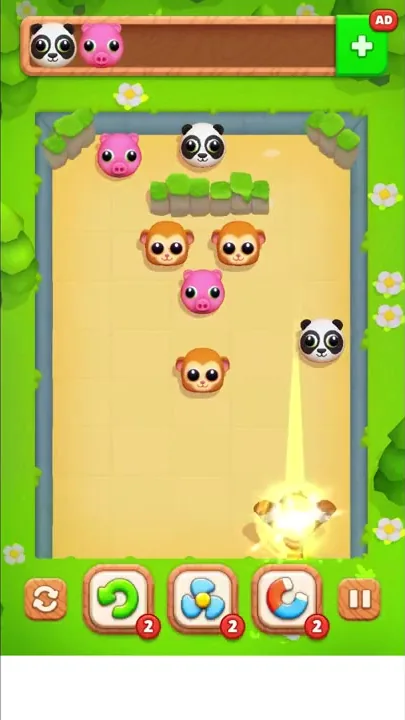
Outside the field, the button bar holds an orange restart-style button with two circular arrows at its left end and an orange pause button at its right; neither one was pressed. Between them sit three boosters: undo as a green curved arrow, a fan drawn as a blue pinwheel and a magnet shaped like a red-and-blue horseshoe.
Each booster carries a small red count badge while it is lit. All three go gray while a shot is in flight, and undo stays gray while the tray is empty, lighting up once animals are in it. The fan also turns gray at times while the other two stay lit. None of them was used, and the badges read the same at the end as at the start.
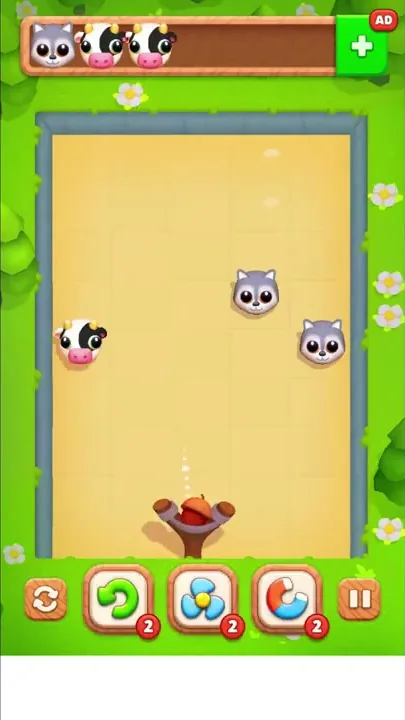
The green “+” button tagged “AD” sits at the end of the tray on every board and was never pressed. It is the only sign of ads or spending that came up: no coin counter, shop, lives, daily feature or offer appeared, and the level-complete panel carries no reward.
Bank shots that feed a matching tray
Catch 2 Match pairs aim-and-ricochet shooting with tile-match rules, and we found the pairing quite fun. Whatever head a shot finds on the sand decides what the tray holds next. In Level 6, once the last fox up in a top corner is knocked in, the foxes leave the tray in a sparkle and the field is bare except for the stone block.
The controls themselves are very interesting. The slingshot is drawn back and turned while the dotted line swings across the sand, and in Level 7 that line runs from the bottom left to the left wall before bending back up toward the animals. A pick becomes a question of angles rather than a tap on the piece.
Rebound shots versus exact picks
Where the design falls short is the fit between its halves. The fun of aim-and-ricochet play lies in the rebound, while tile matching depends on picking exactly the right piece, and here the two don’t quite go together. On the board, the rebound half is the projectile running on around the sand and kicking up dust at the stone border; the picking half is the wooden tray, which clears only three heads of the same animal.
Reading angles off walls and stones
Most of the work on each board is aiming: drawing the slingshot back and turning it until the dotted line meets the head you want, sometimes by way of a side wall. Between shots, a look at the tray shows which kind already has two waiting.
Those actions suit a taste for geometry over quick tapping. The tray keeps tile-matching rules, but each pick is made with an angle, and the projectile carries on around the field after it leaves the slingshot.
Verdict
Shooting into a matching bar makes a fun combination, and the controls are interesting in their own right. Rebounds and exact picks don’t quite fit together, though, and that mismatch leaves Catch 2 Match an interesting idea and no more. A fresh idea has to be weighed for what it adds to the game, beyond the intent behind it, since novelty can easily become an end in itself; here the intent comes through more clearly than the fit.