LiveOps Is Now Google Play Promotional Content
How LiveOps became Google Play Promotional Content, why featured events lifted installs by about 80–120%, and what improves the odds of a feature.
In this article4 sections
Google Play has launched and upgraded a run of features lately, and the most important is the upgrade of LiveOps to Google Play Promotional Content. Many developers have used it to bring in large volumes of organic installs, and their games have seen big gains in active users and revenue. Here is a closer look at the feature.
What Promotional Content is
Promotional Content grew out of Google Play LiveOps. LiveOps got pretty good results, so Google decided to upgrade the module. Here is how the feature compares before and after the upgrade.
| Feature | Placement | Purpose |
|---|---|---|
| LiveOps | Game details page | More active users, win back lapsed players |
| Promotional Content | Games home page, Events page, search page, game details page | Organic installs, more active users, win back lapsed players |
Here is where Promotional Content appears:
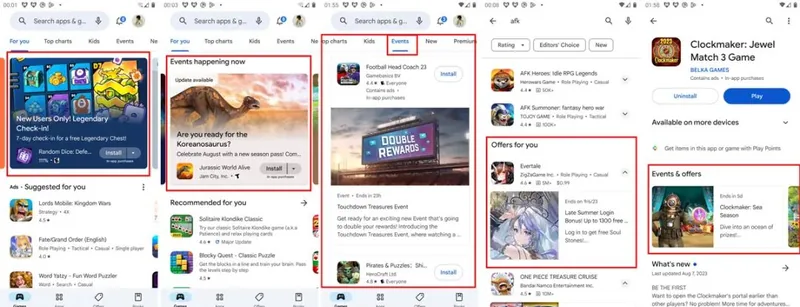
As the diagram shows, the new Promotional Content gets two large featured slots on the home page. Events, which only Promotional Content offers, will now fully replace the “update recommendations” slot, and events also get extra exposure in search. These placements are where the organic installs come from.
How many games use it
We went through the top 100 games on the US Google Play top-grossing chart: 62 games were running events, with events live at all times.
Promotional Content currently supports four types of events:
Offers: mainly in-game sales.
Time-limited events: challenges, regular in-game events and the like.
Major updates: such as new challenge levels, game modes or a new season.
Pre-registration updates: letting pre-registered users know about new content, milestones and so on.
The count also showed that most games rotate through several event types and keep updating and setting up new events. This Google Play feature must have some real advantages and upside.
What it does for revenue
Google’s official figures say it can lift average monthly active users by 2% and revenue by 4%. In practice, developers who have used Promotional Content get one of two results:
- The event is not featured by Google Play, and the numbers barely move.
- The event is featured by Google Play, and new installs rise by around 80–120% (depending on the placement and the app’s weight in Google Play’s ranking). Revenue naturally grows as well, by an amount that depends on how heavily the game monetizes.
So whether the feature is a real windfall or barely worth the effort comes down mainly to getting featured by Google Play. How should events be set up to raise those odds?
How to get featured by Google Play
Promotional Content is still in beta, and its recommendation algorithm and rules are not mature yet. From what we have gathered, these approaches raise the chance of being featured:
- Major in-game updates. Google Play is more likely to read this type of event as a significant content update and feature it. But it must be a real major update, not one set up just to attract a feature, and you can’t post them too often, or a feature becomes hard to get.
- Real, high-quality events that players are happy to join, instead of tricks or click bait made to win a Google feature. A new type of time-limited event in the game, planned and promoted in advance to raise participation, has a better chance of being featured. Once an event is live, Google Play collects and analyzes player data. A fake event shows a clear slump in that data and won’t get featured.
Finally, this is where to set up Promotional Content (Grow > Store presence > Promotional content):
This article won’t go through the detailed rules for creating Promotional Content; the Google Play Academy has tutorials on them. Here’s to doubled installs and revenue for everyone.