Tile Match Zuma: Matching Tiles That Never Stop Coming
A tile match zuma puzzle where new tiles keep coming, each level sets a tile target, and a move limit keeps the difficulty in check.
In this article3 sections
A note on this series: it shares inventive genre mashups as ideas, and none of it is sponsored, so it covers only how each game plays and leaves the name out. This one is a tile match zuma game.
An earlier article, Is Monopoly GO! Only a Reskin? A Close Study of Similar Games Reveals Its Formula for Success, looked at the dice-rolling board game hit and laid out a method for inventing new games: distill what works, break it into parts, then recombine the parts. So every so often we pick out a well-made example of that recombining from the games on the market, to show how the idea works in practice.
This time the mix is Tile Match + Zuma
How the game works
First, a look at the gameplay:
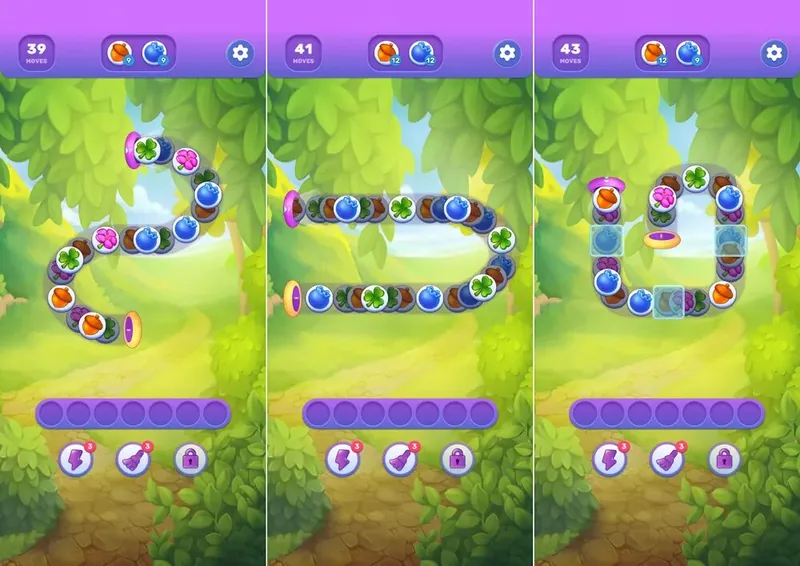
At its core, the game plays like classic tile match games: tiles go into the tray at the bottom, and any three matching tiles clear automatically. There are a few differences, though:
- A different supply of tiles: in a classic tile match, a fixed number of tiles sits stacked on the board and you clear them by the usual rules. This game mixes in Zuma, the classic marble shooter, so new tiles keep appearing.
- A different way to win: a classic tile match ends when every tile is cleared. Here each level sets a target number of tiles to clear, much like the level goals in match-3 games.
- To keep the difficulty in check, the game limits your moves.
In play, new tiles keep feeding onto the board while you fill the tray and work toward the level’s target before your moves run out.
Picking Tiles Off a Winding Track
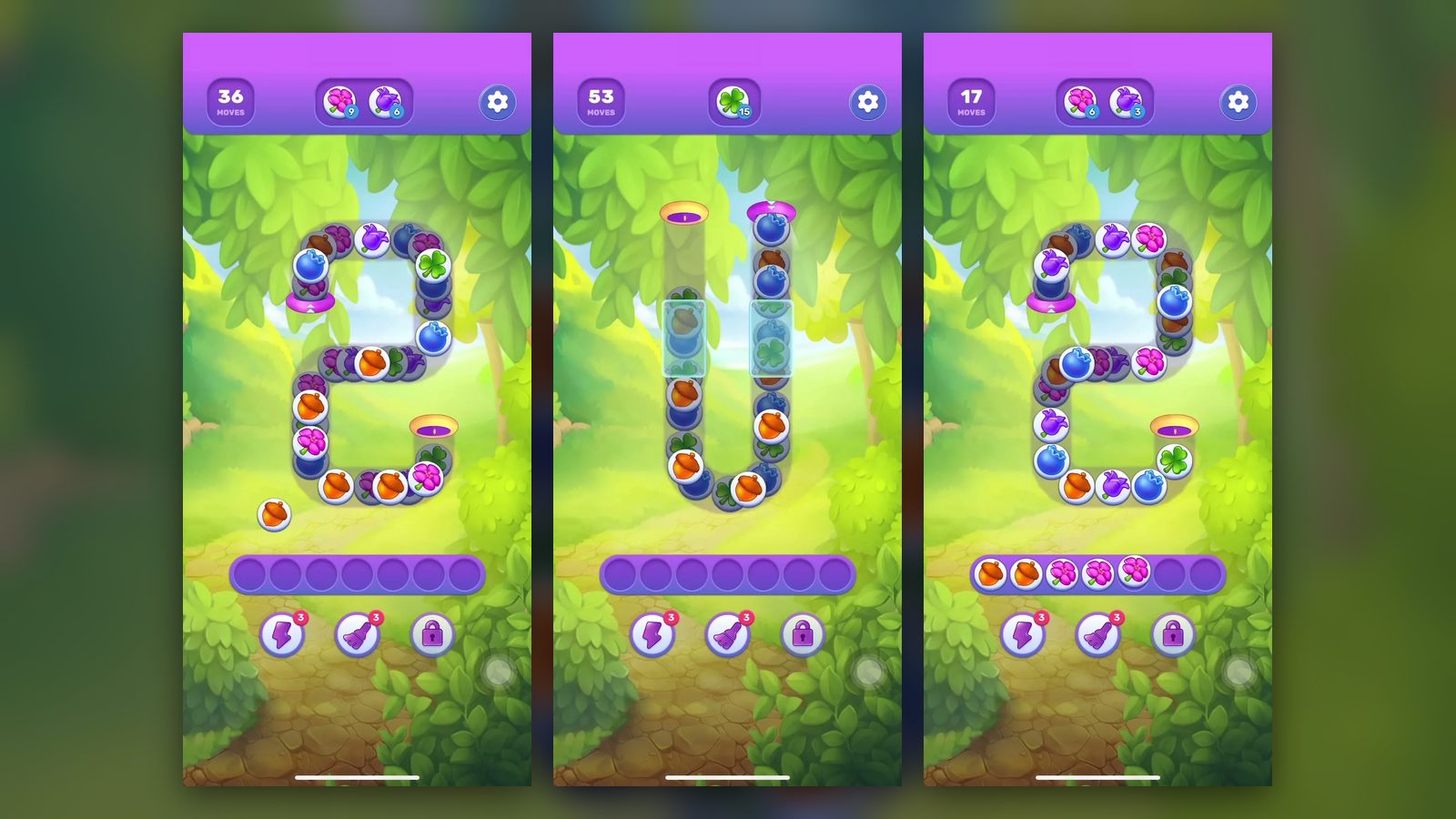
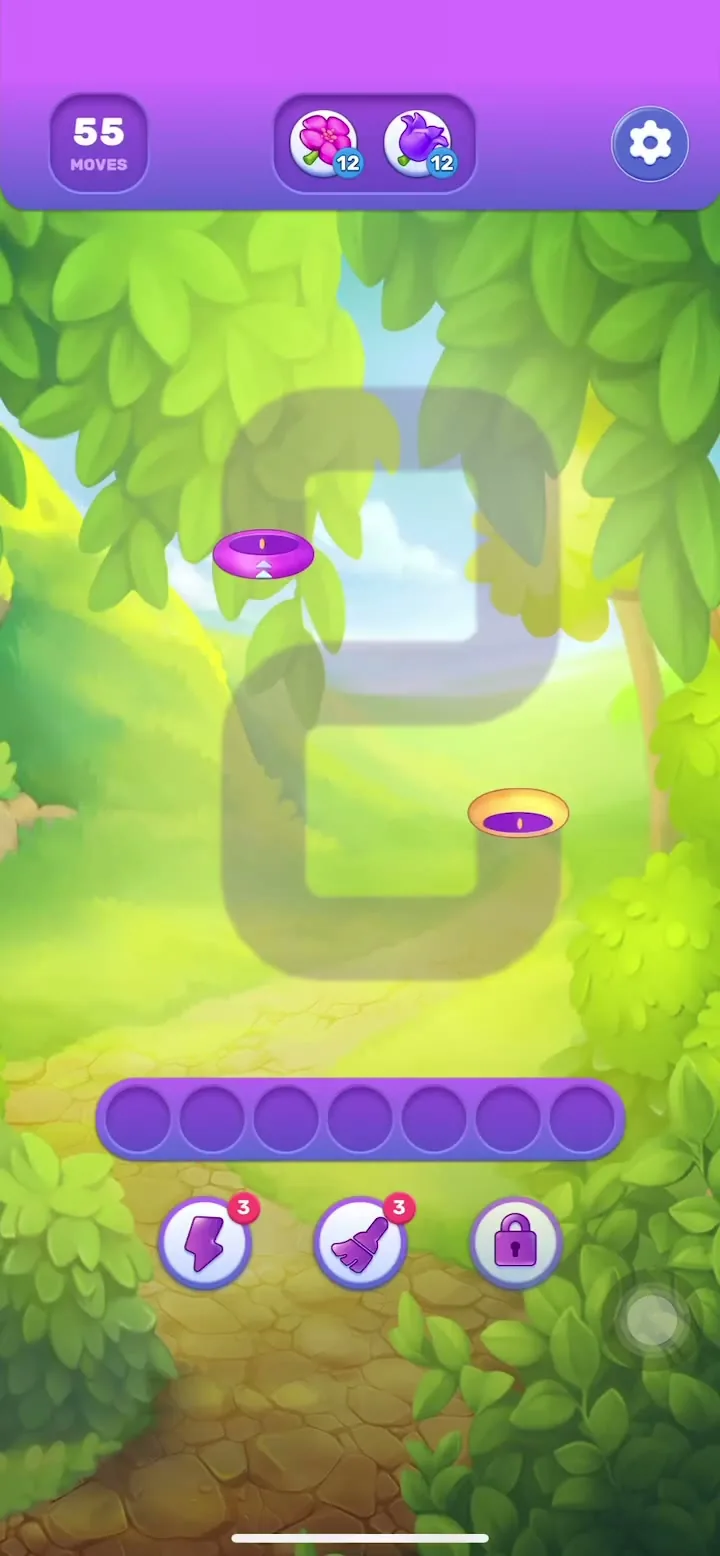
The screen is in portrait and sits over a cartoon forest. Leafy branches frame the edges, blue sky fills the middle and a cobblestone path runs along the bottom. A purple bar across the top holds the MOVES counter on the left, the goal panel in the center and a gear button on the right.
At the very start of the first level, the track is an empty, see-through outline. It is a squared-off path shaped roughly like a blocky number 2. At its upper-left end, a short hook leads down to a pink ring marked with small white chevrons. At its lower-right end, another hook leads up to a yellow ring. The goal panel asks for 12 pink flowers and 12 purple tulips, and the counter starts at 55.
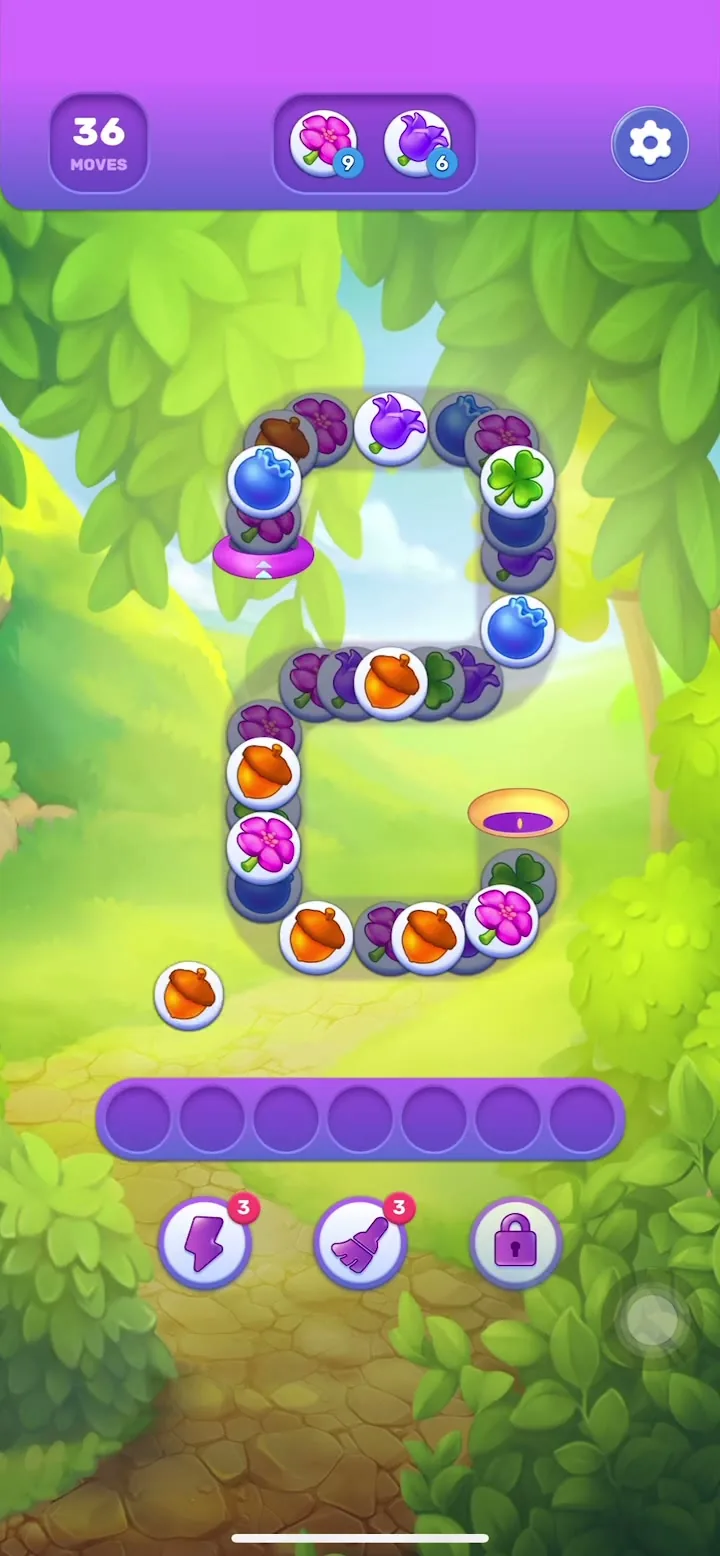
A few seconds later, tiles line the whole track in overlapping layers. Each tile is a round white disc with a glossy icon, and the first level’s tiles come in five kinds: pink flower, purple tulip, orange acorn, blueberry and green four-leaf clover. Brightly lit tiles partly cover darker, gray-shaded ones beneath them, and in many spots two or three tiles overlap along the path. Some tiles sit inside the pink ring itself and just past it.
The player picks tiles off the track one at a time. Each picked tile flies down into the tray, a purple bar of seven round slots below the track.
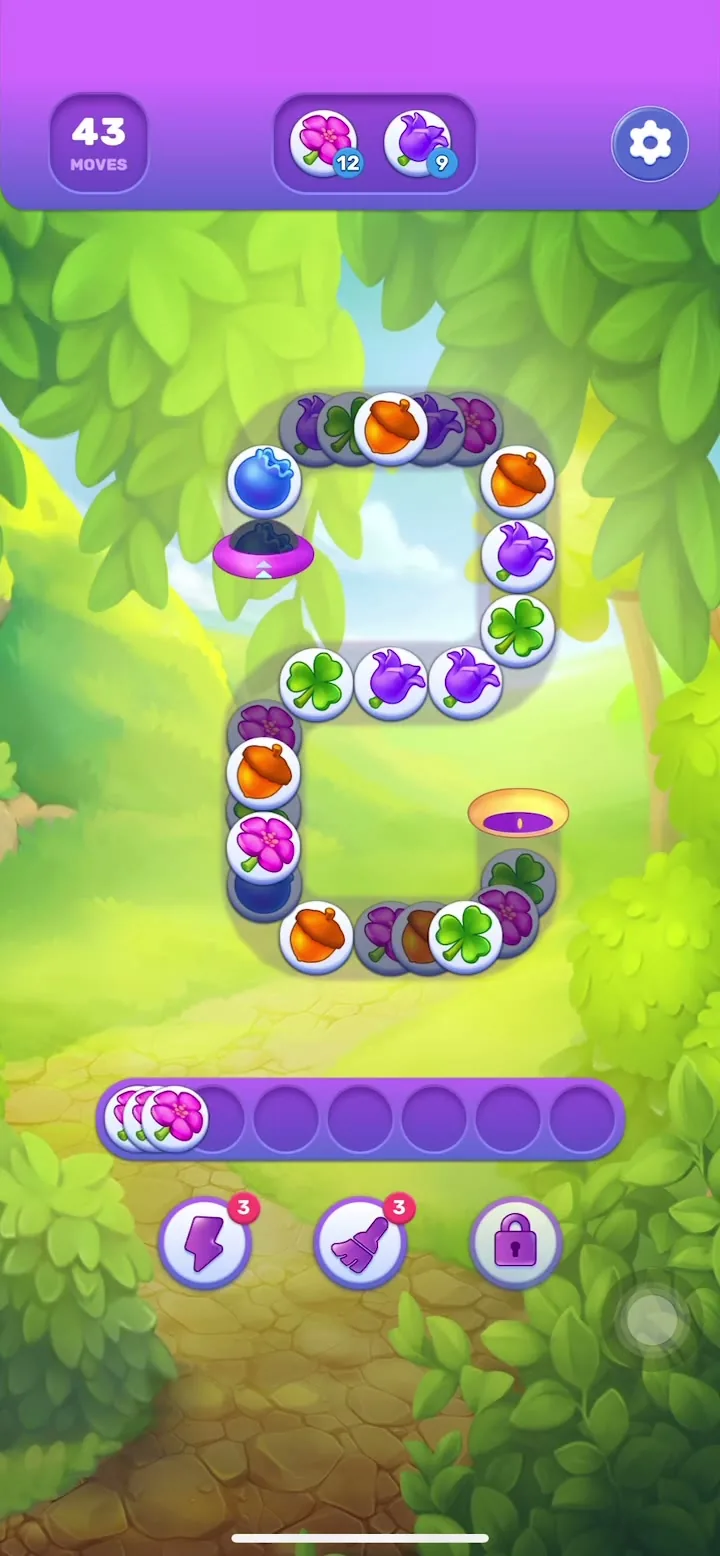
When three tiles of the same kind gather in the tray, they bunch together and clear. A burst of white-and-purple sparkles then fills the slots they leave. Each cleared set of a goal tile takes 3 off that goal’s counter. For example, the pink flowers go from 12 to 9 once three of them clear at the left end of the tray.
A tile with no match stays in the tray. In the first level, two acorns sit unmatched in the tray from partway through until the win. Later, in the second level, six of the seven slots are full while one more blueberry is on its way down.
The MOVES counter falls as tiles are picked: 48 after the first few picks, 17 later on and 8 at the win. Both goal counters drop in steps of 3. Late in the level, with 3 flowers and 3 tulips still to go, the track is still lined with tiles. Once both goal icons show green check marks, “WELL DONE!” appears in large yellow 3D letters over a darkened screen, with tiles still on the track.

After the first level, a full-screen close-up of leafy bushes appears with a purple ribbon banner reading “Loading a brain-training session with colorful tiles.” The next level follows on the same forest backdrop.
Early in the second level, the track bends into a U. The pink ring with its white chevrons sits at the top of the right arm, and the yellow ring sits at the top of the left arm. There is now a single goal, 15 clovers, and the counter reads 53 moves. The tiles here come in three kinds (clover, blueberry and acorn), and bright tiles again sit over dimmed ones, mostly along the right arm.
This level also brings glass panels. They are see-through, light-blue rectangles with a small dot at each corner, one over each arm of the U. Each panel covers a stretch of track that holds about three tiles, and the tiles under the panels look dimmed. Late in the level, the tiles under the left panel are different from the ones there a few seconds before.
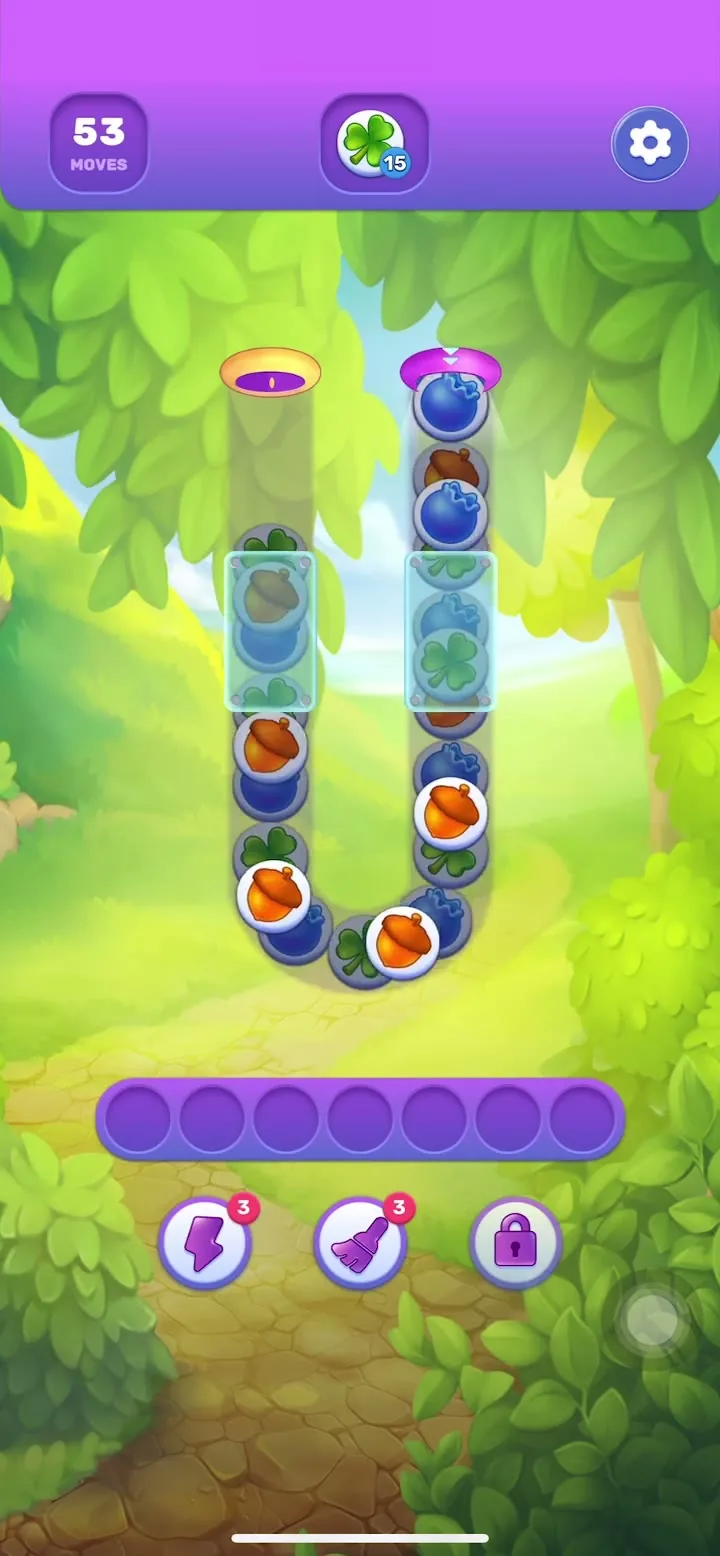
The clover counter steps down from 15 to 12, 9, 6 and then 3. Late in the second level, 3 clovers remain with 11 moves left.
Below the tray are two boosters, a lightning bolt and a broom, each with a red badge reading 3. A third slot beside them shows only a padlock.
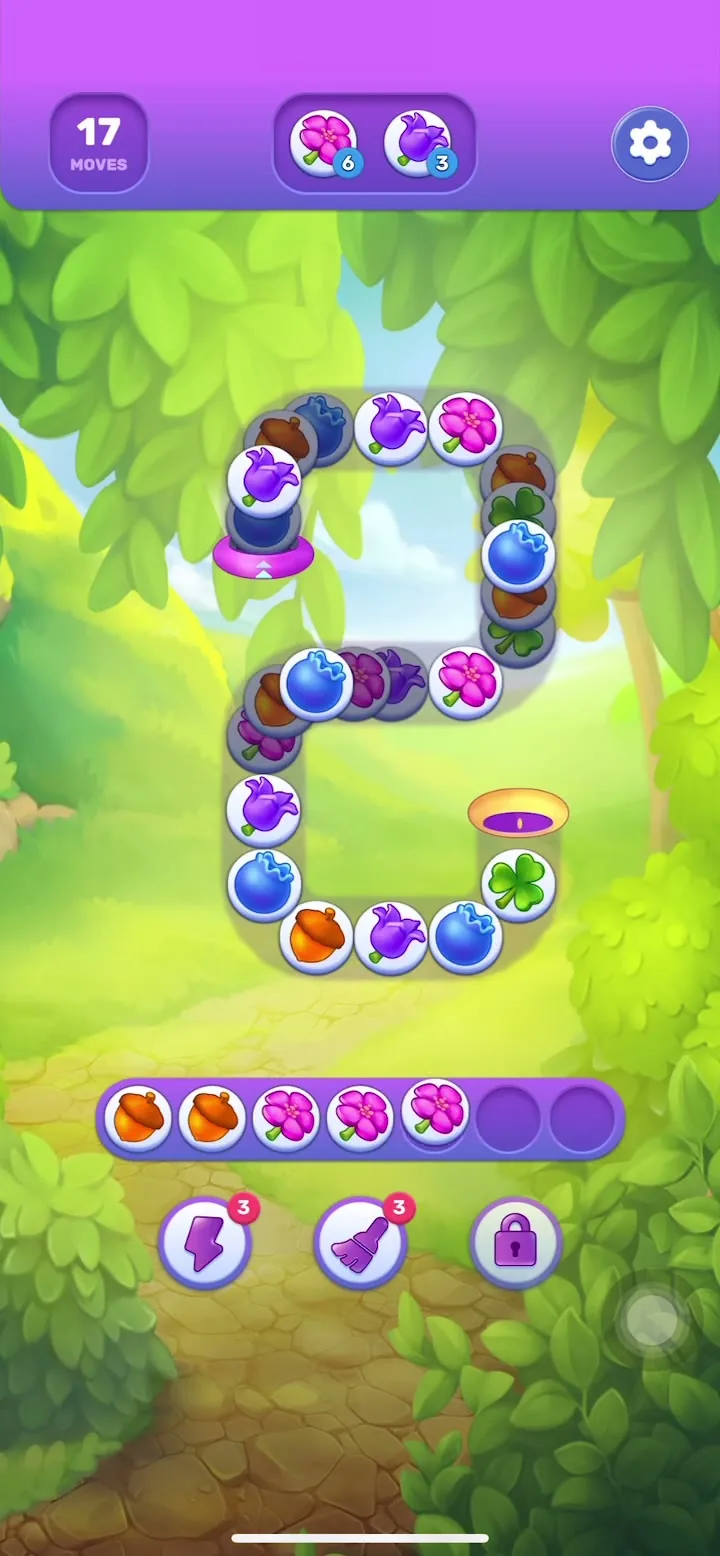
In the second level, the broom badge drops from 3 to 2. A few seconds later, the lightning badge does the same. Both still read 2 when 3 clovers are left to collect.
How it rates
The scores, category by category:
| Category | Score | Notes |
|---|---|---|
| Core fun | 6 | The core play is fairly fun and has staying power, but it grows dull later on |
| Originality | 8 | Tile matching plus Zuma is a very good fresh idea, and the two blend well |
| Art | 8 | Mid-to-high quality for a casual game |
| Overall | 7 | Very good overall. Zuma is a well-loved element in casual games, which helps the game’s ads pull in players to a degree. But after a certain point the core play stops being challenging enough, and with little variety on top of that, it starts to feel dull later on. |
That’s all on this mix. It has some problems, but with gradual fine-tuning it should still do well.