Tile Match 2048: A Really Good Idea for a Puzzle Mashup
Tile match 2048 is a really good idea: tap stacked tiles into a tray, and two of the same color merge, 2 and 2 into 4, toward the goal numbers.
In this article3 sections
Following our approach to game innovation, we regularly pick out some of the better inventive games on the market as real examples, so the method is easier to grasp in practice. This tile match 2048 game is one of them.
The combination it’s built on: Tile Match + 2048
How it plays
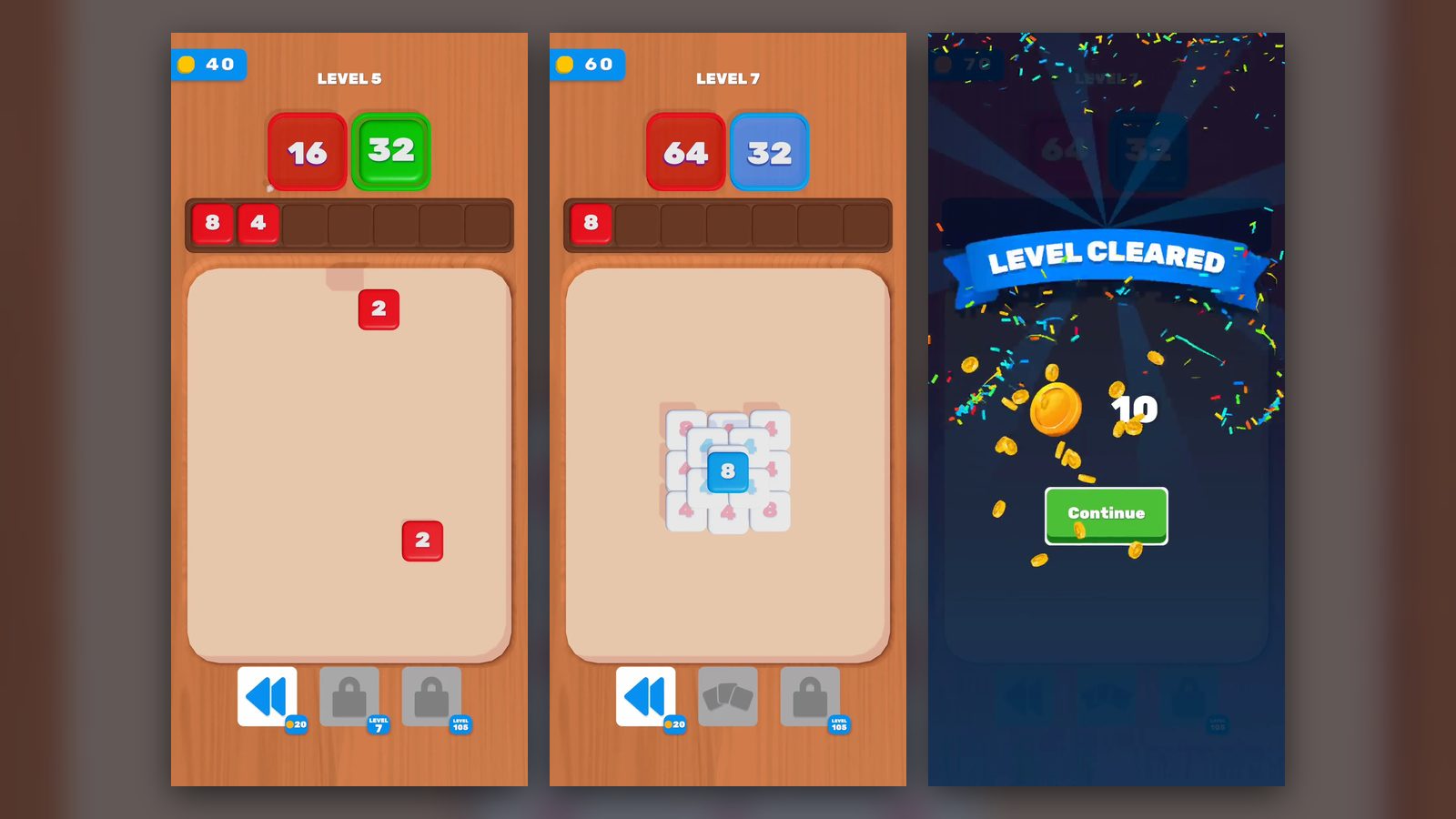
First, a screenshot of the gameplay:
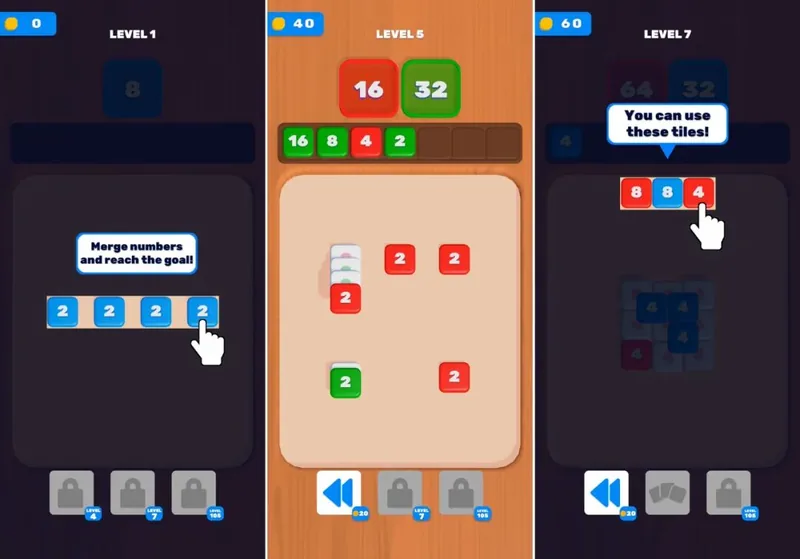
Here’s how it works:
- The layout is close to that of tile match games, where you tap three identical tiles into a small tray to clear them. Small tiles sit in stacks, each level has goals to complete, and the play area is split into three zones: the goal area, the placement area and the stack area.
- Tapping a tile in the stack area moves it to the placement area, where two numbers of the same color merge on their own into a new, bigger number: 2 and 2 become 4, 4 and 4 become 8. Only two tiles are needed for a merge, which is one way the rules differ from tile matching.
- The aim is to merge your way to the colors and numbers shown in the goal area. As the levels go on, the targets get bigger and more numerous and more tile colors show up, and that’s when your skill at arranging the tiles gets tested.
Put simply, each level comes down to tapping tiles into the tray, letting same-color pairs double up, and building toward the numbers in the goal area.
Tap, Merge and Fill the Goal Cards
The game runs in portrait with a fixed, slightly tilted top-down view, and the tutorials show moves made with a single tap. One or two goal cards sit under the level number. Below them is a dark wooden rail with seven evenly spaced slots, and below that is the board, a beige panel on an orange wooden tabletop. When you tap a colored number tile on the board, it moves up into that rail.
Inside the tray, two tiles of the same color and number become one tile worth double, with a small puff of white dust. In Level 4, a second blue 4 drops in beside a blue 4 while a red 8 and a red 2 sit in the other slots. Tiles of different colors stay apart even when their numbers match. Near the end of Level 7, the tray holds red 32, blue 16, red 16, red 8 and blue 8, and the two 16s and the two 8s stay separate.
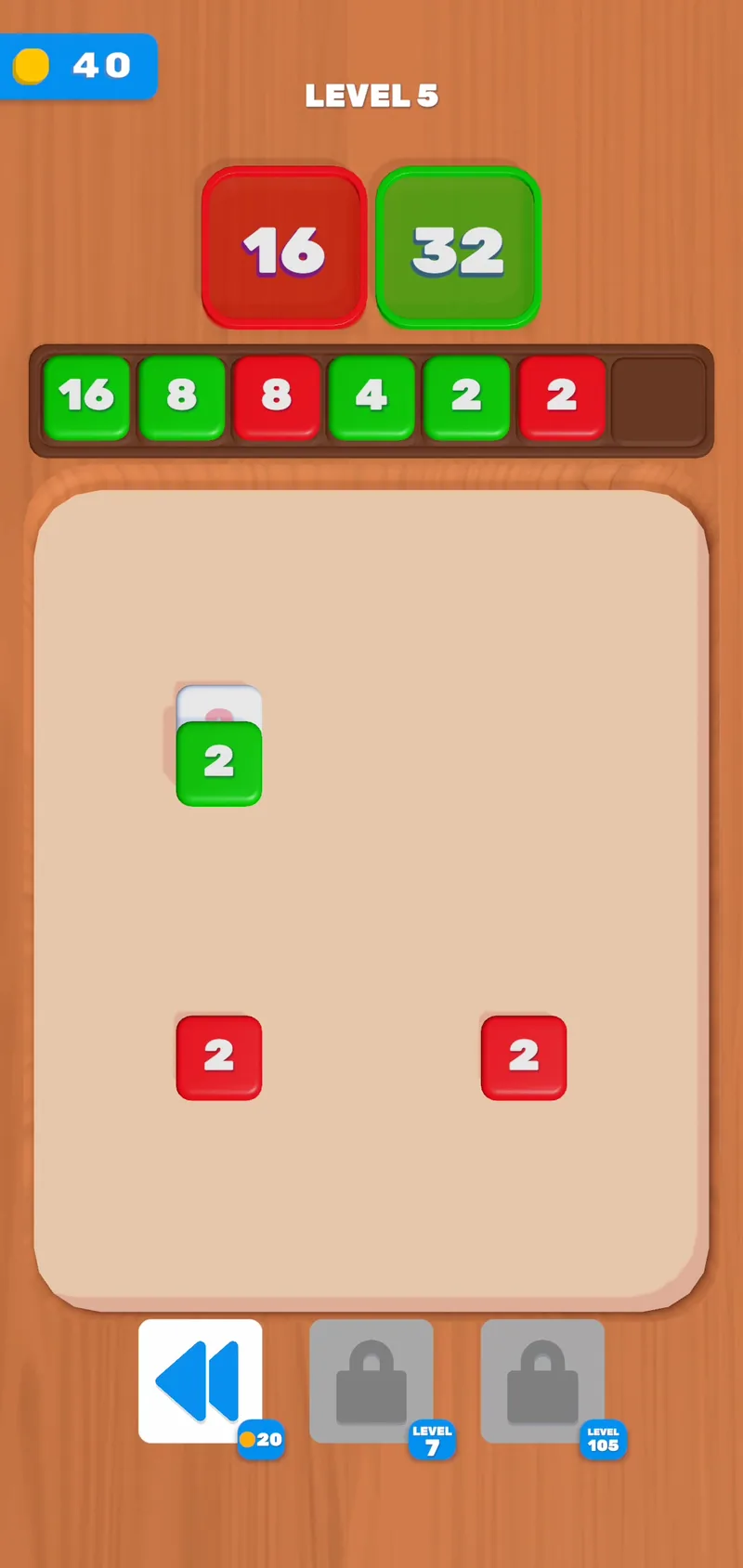
At one point in Level 5, six of the seven slots are full. The tiles run from the highest number on the left to the lowest on the right: green 16, green 8, red 8, green 4, green 2 and red 2.
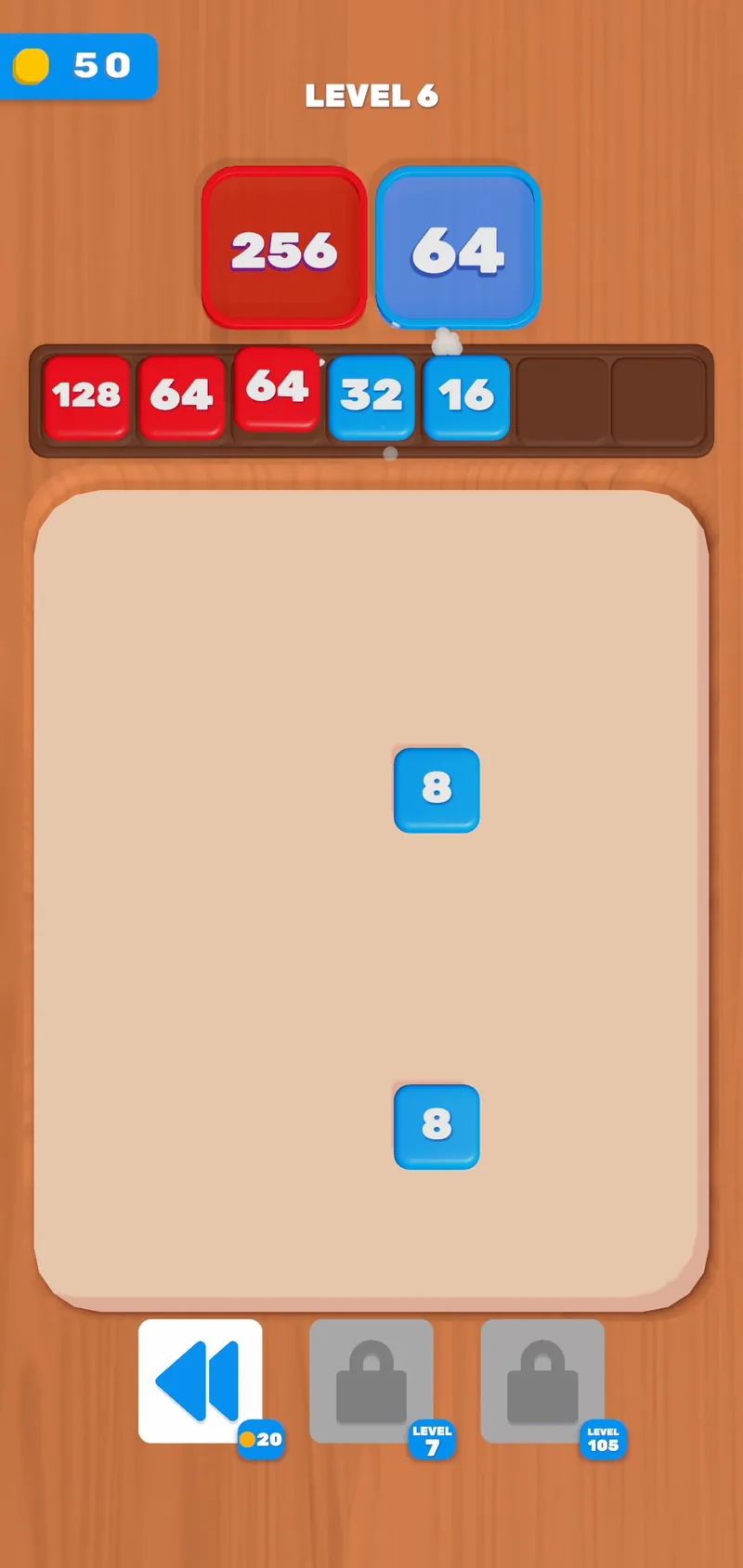
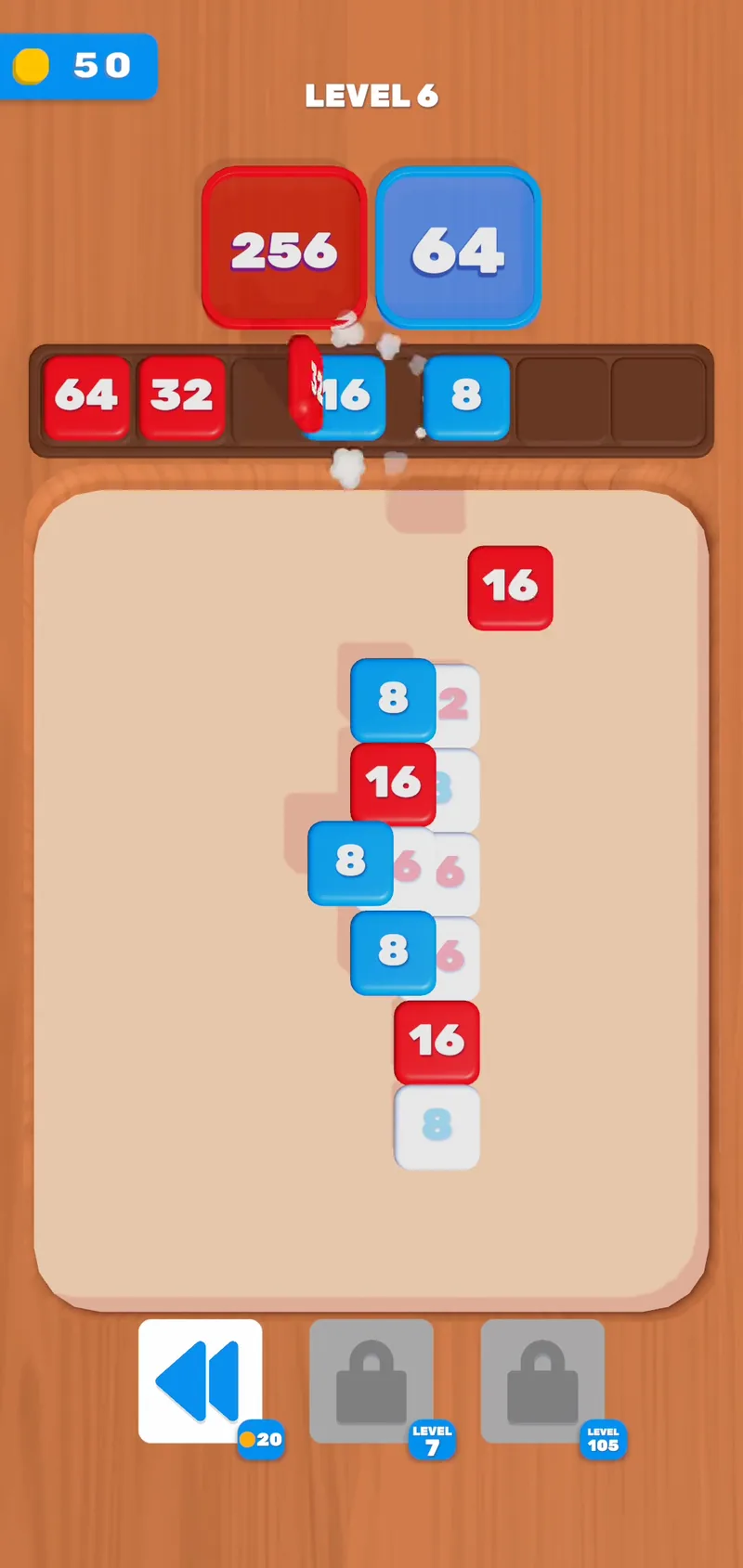
Merges keep chaining upward as more tiles arrive. In Level 6, a second red 64 drops in beside a red 64 and a red 128 as the level builds toward its red 256 goal. Shortly afterward, that card is filled.
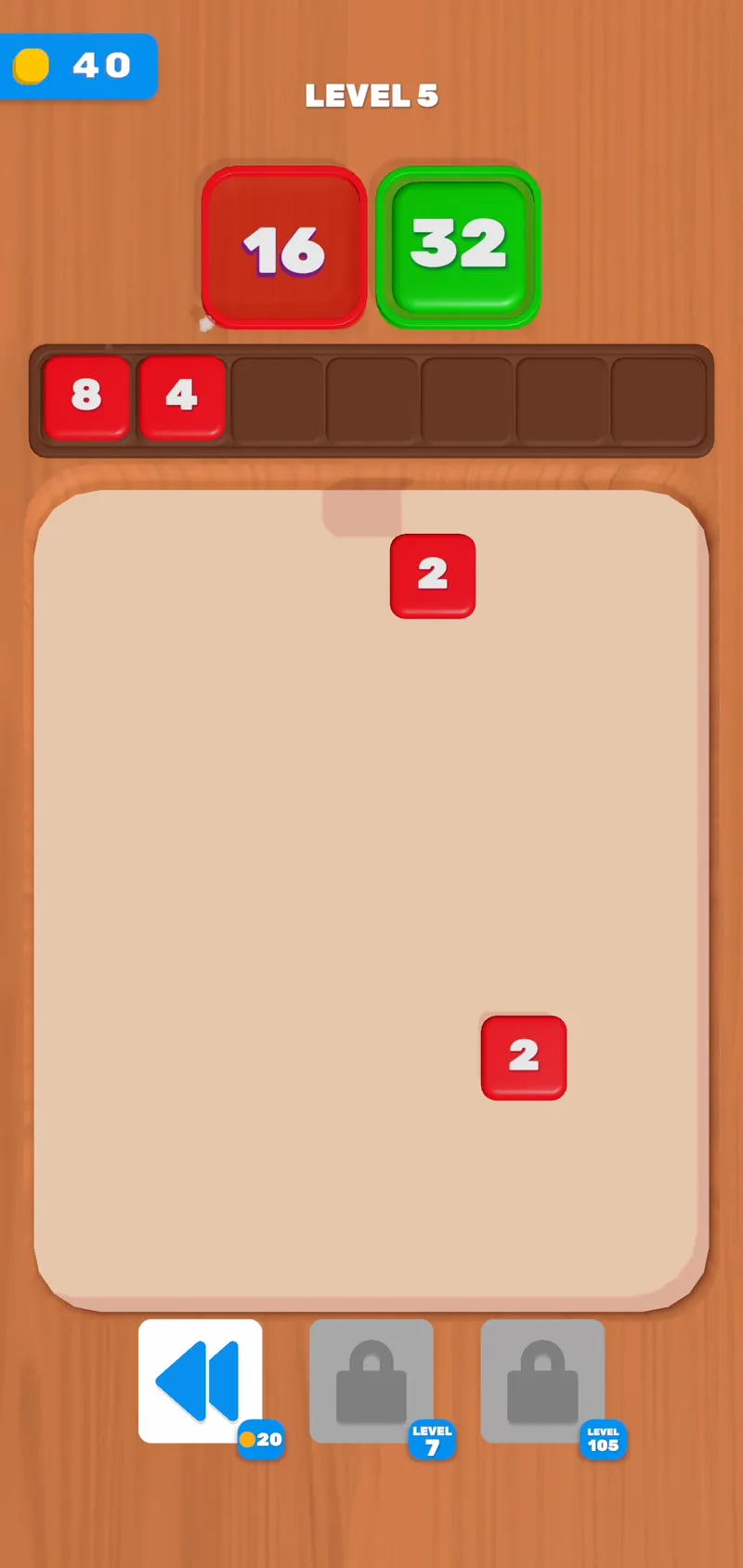
Each goal card shows a color and a number, from 8 in Level 1 up to 256 in Level 6. A card looks translucent until a tile of its color reaches its number; then the card turns solid and that tile leaves the tray. Later in Level 5, the green 32 card is solid and the red 16 card is still translucent. The tray holds a red 8 and a red 4 with no green tiles left in it, and two red 2s remain on the board.
In stacks and overlapping piles, only the uncovered tiles show full color. Tiles under or behind others are white with a faint pale number in their own color, so the pile underneath is partly readable. In the Level 6 block, the white 8 at the bottom becomes a full blue 8 once the red 16 above it is gone. Covered tiles can hold numbers other than 2, such as a white tile with a faint green 4 in Level 5.
Level 1 opens under a dark tutorial overlay. It has one highlighted row of four blue 2 tiles, an empty tray and a single blue 8 goal card, plus a hand pointer on the right-hand tile and the hint “Merge numbers and reach the goal!” Level 2 adds red tiles and a second card, so the goals are blue 8 and red 8. Early in the level, with a red 4 already in the tray, the remaining 2s sit in two rows.
Level 3 brings the first stacks: four in a row, each topped by a 2, with goals of blue 16 and red 8. Level 4 has three stacks, taller than those in Level 3, and goals of red 16 and blue 16. Level 5 adds green as a third color, with stacks in two rows and goals of red 16 and green 32. We played Level 5 twice: right after the six-slot moment above, the board and tray were back at the same early layout, and the second attempt carried on into Level 6.
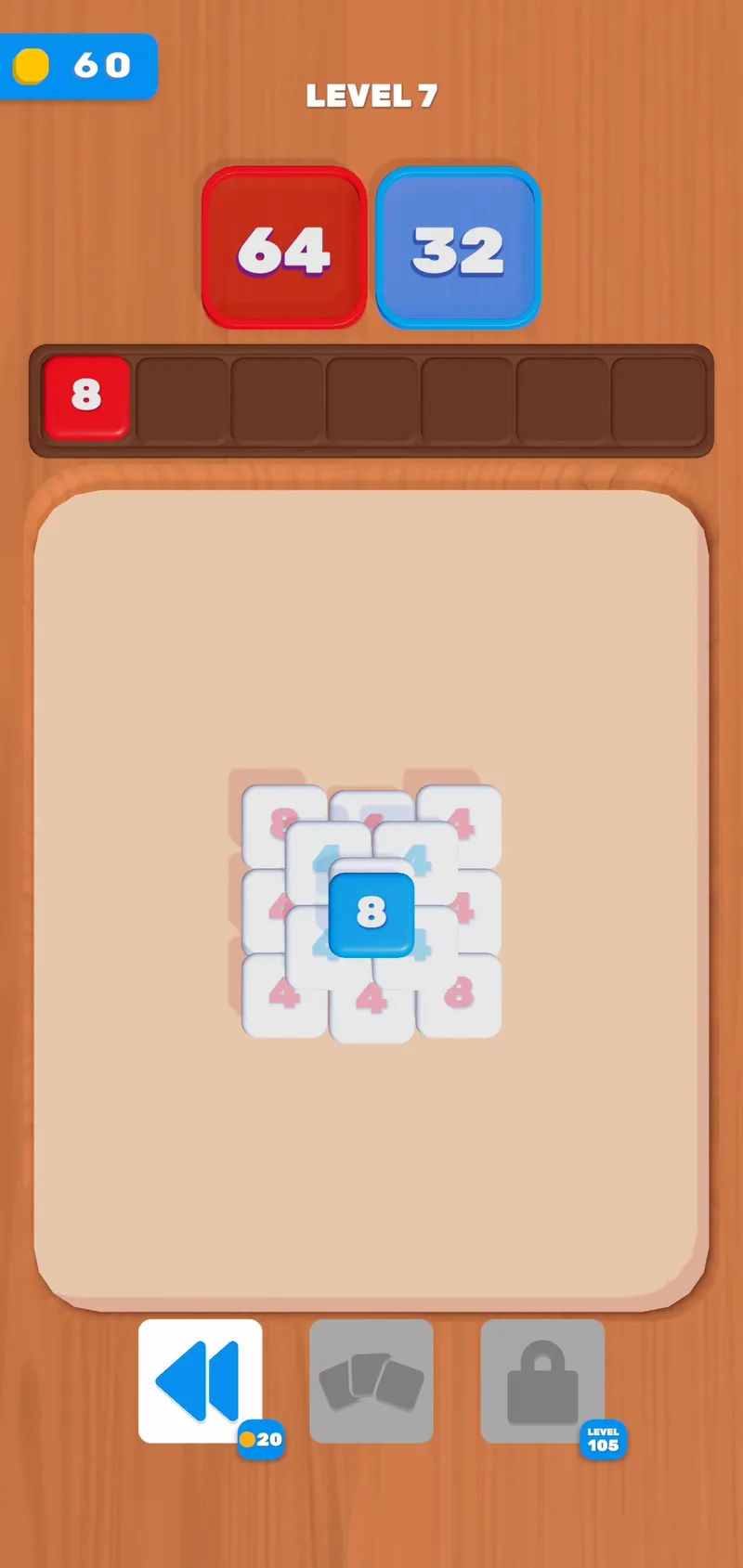
Level 6 starts with an empty tray and higher numbers in place of 2s, with 8s and 16s along the front, packed into one tall, tightly overlapping block. Its front column reads, top to bottom, blue 8, red 16, blue 8, red 16, red 16, and the goals rise to red 256 and blue 64. Early in Level 7, with a red 8 already in the tray, a layered pile sits in the middle of the board: a wide square layer of white tiles with faint pink 4s and 8s, a 2x2 layer with faint blue 4s on top of it, and a single blue 8 in the center at the top. Its goals are red 64 and blue 32.
Three booster slots sit below the board. When Level 1 opens, all three are gray padlocks labeled LEVEL 4, LEVEL 7 and LEVEL 105. In Level 4 the screen dims and a hand points at the first slot, now a white Undo button with two blue left-pointing arrows, with the hint “Tap to UNDO your last move!” After that, the slot carries a badge showing a coin and 20.
The Undo button is gray at the start of Level 6, while the tray is empty. In Level 7 the middle slot’s padlock is replaced by a gray icon of three overlapping cards with no label. The third slot still shows its LEVEL 105 padlock.
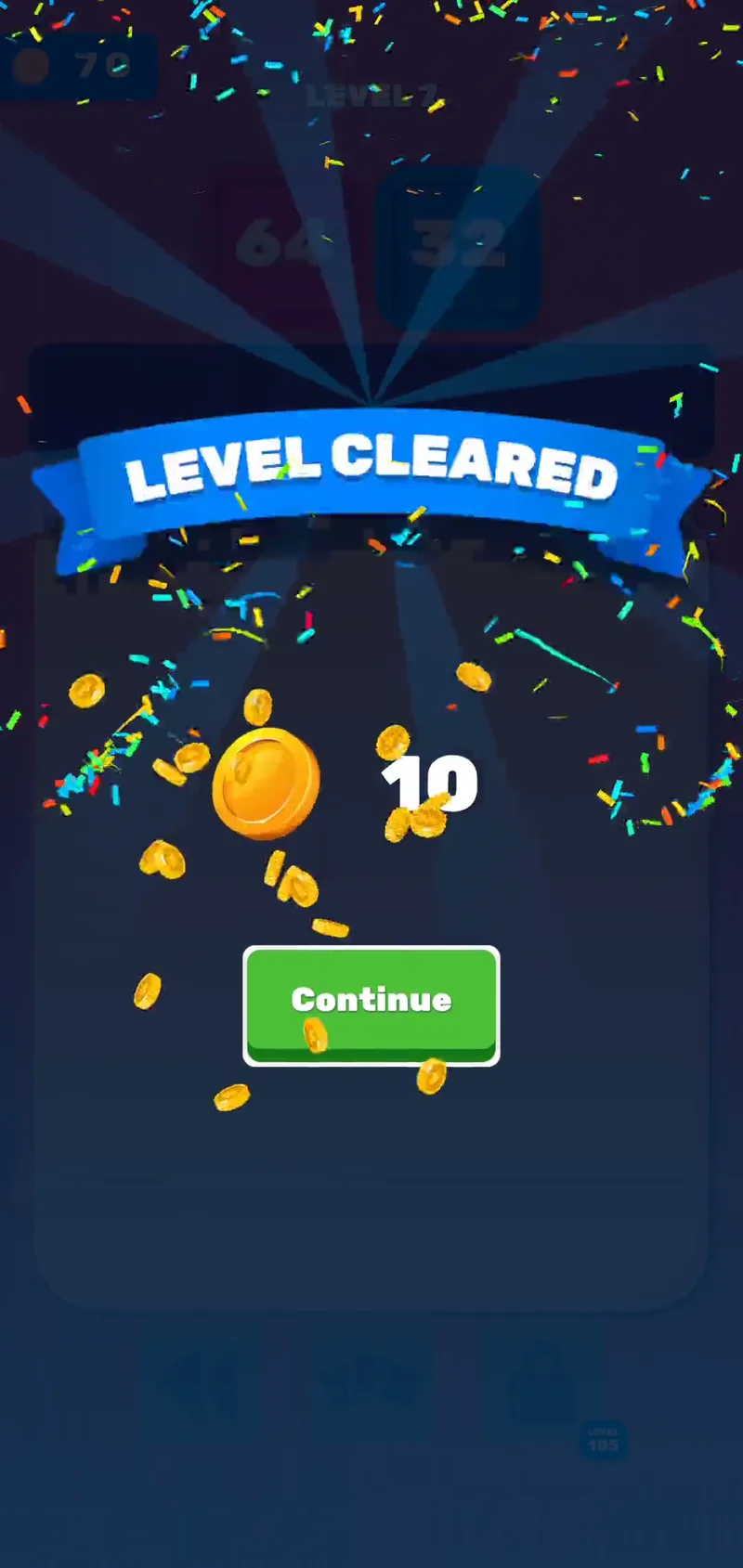
A coin counter at the top left reads 0 in Level 1 and goes up by 10 with each new level, reaching 60 in Level 7. It stays at 40 when Level 5 is played again. When every goal card is solid, the tray and board are empty, and gold coins pop up from the board and fly off with a light trail. After Level 7, the screen dims behind a blue LEVEL CLEARED ribbon with light rays and confetti, a large gold coin with the number 10 and a green Continue button.
How it rates
The scores, area by area:
| Metric | Score | Comment |
|---|---|---|
| Core gameplay fun | 6 | Fun to a point, but lacks depth |
| Originality | 7 | Shows some creativity |
| Art style | 6 | Standard casual-game look |
Overall:
- Overall score: 6.5.
- It cleverly combines 2048 with tile matching, and in both the controls and the gameplay itself, the two fit together very well.
- The format itself is limiting, though: there isn’t much variety, so the levels lack fun on their own, and long sessions get boring easily.
- There is room to refine it further from here by adding more variety to the levels.
More from this series:
Pipe-maze puzzling + clear-the-board matching: an idea with a lot of potential
A Tomb-style maze + RPG monster fights: the fun of puzzle solving and of a roguelite run in one game
Sorting balls into measuring cups + a maze: a good idea, plenty of puzzle and lots of staying power