Ball Fever Review: Idle Cash From Rubber-Band Ropes
A Ball Fever review covering the cyan ball tube, two bendy green ropes that pay $1 each time a white ball hits them, and a STAGE1 bar that counts to 8K.

Game at a glance
Ball Fever
6/ 10
Our score
An old concept found again, with strategy, idle play and payoff balanced very well.
In this article6 sections
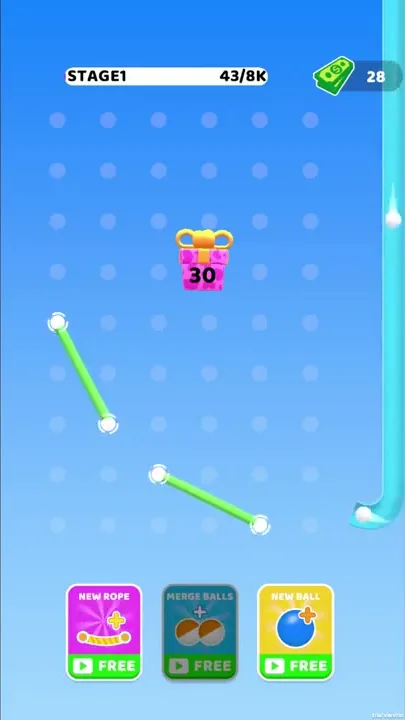
A white ball shoots out of the curled end of a cyan tube on the right edge of the screen and strikes a lime-green rope. The rope bends under the impact and a faint green “$1” drifts up off the band, while the cash counter and a white bar labeled STAGE1 both tick upward.
Ball Fever runs on hits like that one. It’s a mobile ball bounce game with an idle core and a puzzle slant. We played the opening stretch of Stage 1, which was long enough for the board to go from one ball to three and for a new kind of ball to appear. It keeps rope strategy, idle earning and the feedback from every hit in very good balance.
Green ropes on a six-by-nine peg board
The only goal on screen is the STAGE1 bar across the top, which counts toward 8K. Its number climbs with every rope hit, and it matched the cash counter exactly until the first time cash was spent. After that the two parted ways: spending pulled the cash counter down but never set the bar back. Stage 1 shows no timer or move counter, and no lives or fail screen either.
Stage 1 plays out on a single fixed portrait screen that never scrolls. Balls drop down the tube and leave its curved bottom heading for the ropes, then bounce back and forth between the two green bands with white streaks trailing behind them. Each white ball’s hit sends a small green “$1” floating up, and every hit raises both the cash counter and the bar. When two balls strike the lower rope together, each one pays.
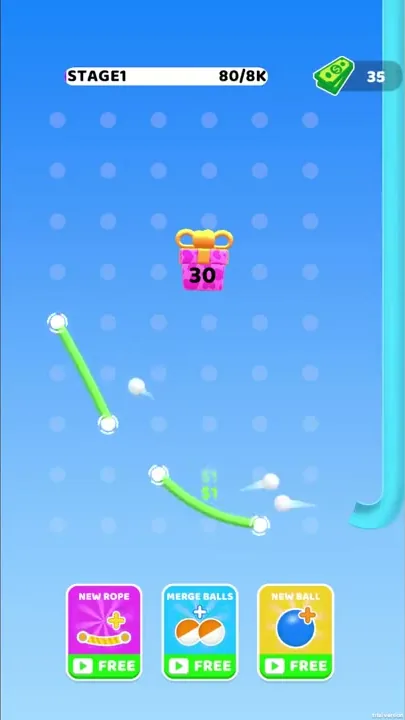
Ball Fever gameplay asks for very little hands-on input. The balls move on their own, and the player’s input shows only in its results: rope ends that sit on different pegs from one moment to the next, and cash that drops at the moments the ball count or the cards under the board change. Those three cards, each a large, brightly colored tile with a green label strip along the bottom, read NEW ROPE, MERGE BALLS and NEW BALL.
The board is a grid of pale dots, six columns by nine rows, laid over a bright blue gradient. The dots work as pegs: each rope is hooked to one at either end, and a white ring marks each anchor.
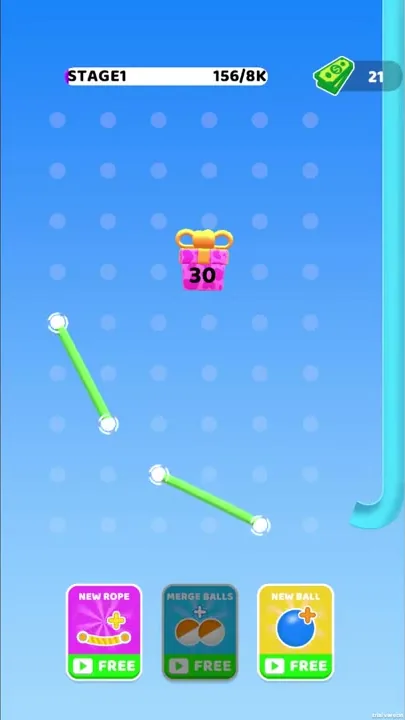
Each rope is a lime-green band stretched between two pegs. Balls rebound off it, and it gives where it is struck: it bends around a ball on impact and sags when two land on it at once.
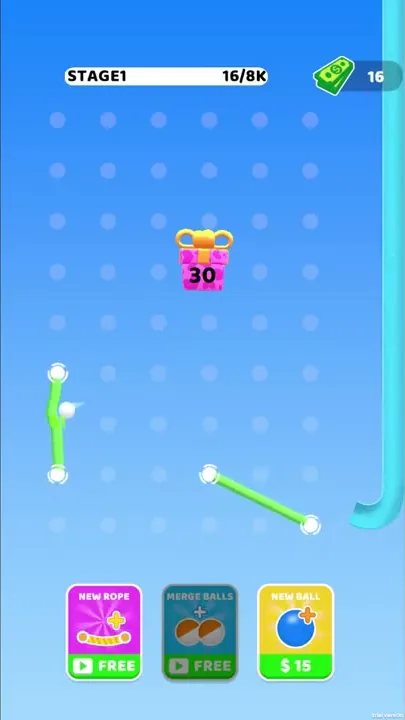
A glossy cyan tube runs down the right edge and curls left at the bottom. Balls slide down inside it with streaks above them, sometimes two at a time, and shoot out of the curl toward the lower rope. Coming off that rope, a ball can also fly back to the right, toward the curl.
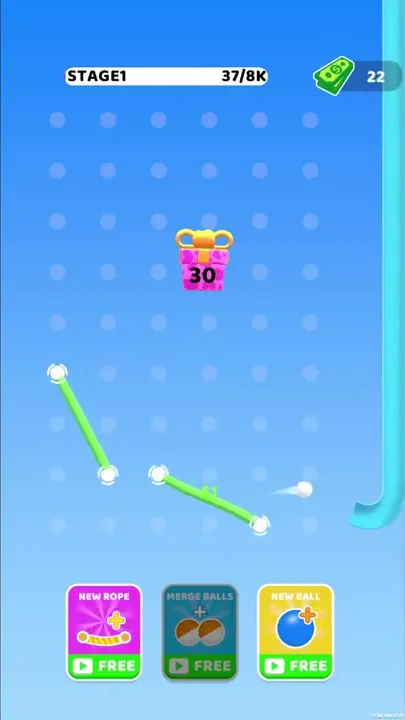
Early in the stage, a pink gift box with a gold bow appears in the upper middle of the grid, marked with the number 30. It stayed in place for as long as play went on, with that number unchanged, and no ball was seen touching it.
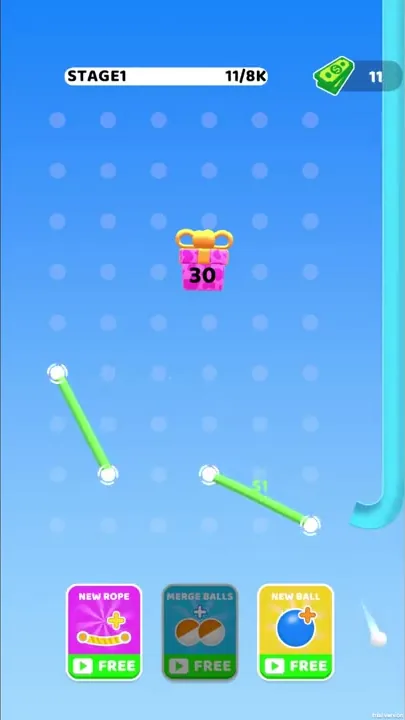
The ropes don’t have to stay where they start. Their ends can shift to other pegs while balls are in flight, and both ropes moved within the first minute: the left one ended up one row higher than in the early layout and the right one a column farther left. That layout then held to the end.
Partway through the stage a different ball shows up, colored part white and part blue. It appears right after three white balls bunch together mid-board, and it rebounds off the ropes just as the white balls do.
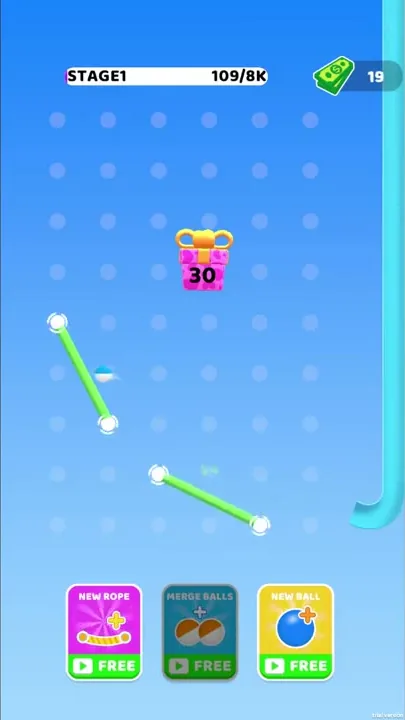
One ball, then three, then a white-and-blue one
Early in the stage the board is sparse. A single white ball waits at the top of the tube above the two ropes, which sit low on the grid, and the three cards line up underneath; the gift box hasn’t appeared yet.
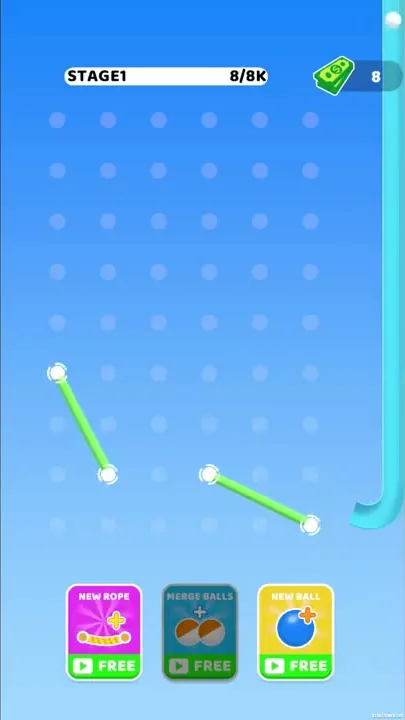
Shortly after the cash counter’s first big drop, two white balls are in the tube at once, and soon both are flying above the left rope.
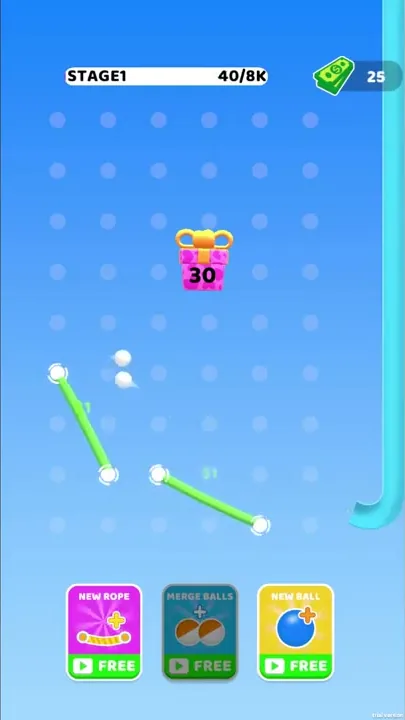
A second drop is followed by a third white ball. With three in play, the MERGE BALLS card switches from gray to full color, the only stretch of our session in which it does.
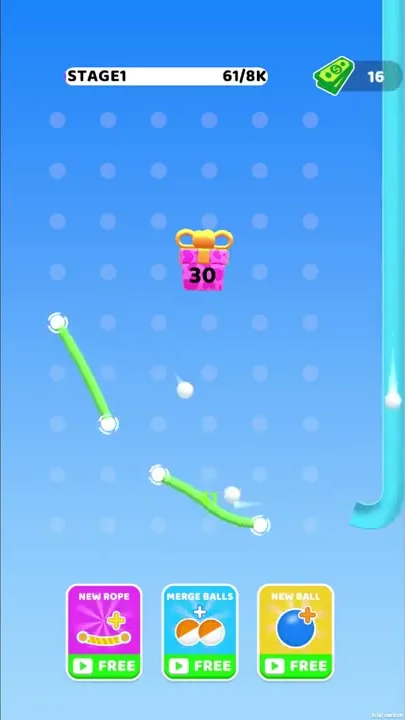
That window closes after the third drop. The three white balls appear bunched together in the middle of the board, drawn larger than before, and the MERGE BALLS card goes gray again. For a while afterward, the only ball in sight is the white-and-blue one.
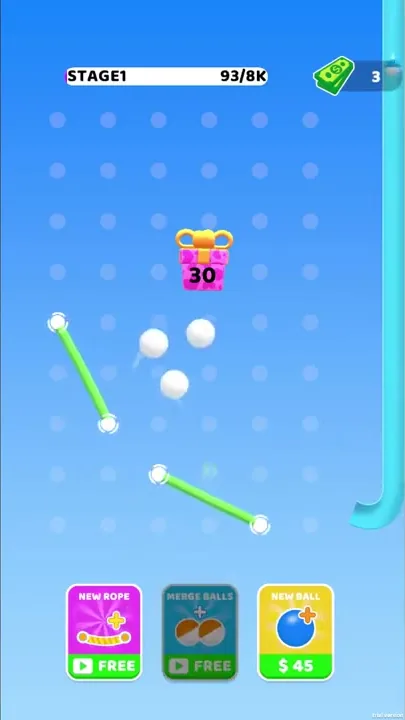
A fourth drop is followed by a fresh white ball. For the last stretch of play the two kinds of ball share the board, bouncing off the same pair of ropes.
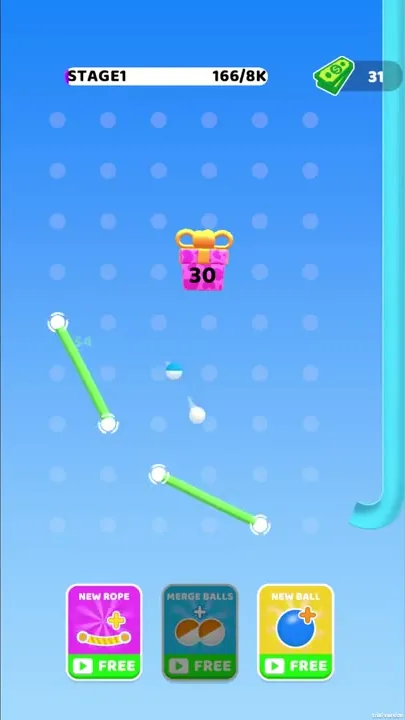
The rest of the board changes little. Once they settle in their new spots, the ropes keep the same pegs and never number more than two, and the gift box keeps its 30 to the end.
Cash is the one currency on screen, shown as a green banknote icon with a counter in the top right corner. It rises with every rope hit and fell sharply four times during the stage, each drop landing at a moment when the ball count or the cards changed.
The NEW BALL card is yellow, with a blue ball and an orange plus. Its label switches between FREE, beside a small play-button icon, and a cash price: $15 early in the stage and $45 later on.
MERGE BALLS shows two orange-and-white balls joined by a plus, with the same FREE label and play-button icon. Outside the three-ball stretch it stays gray.
NEW ROPE is a pink card with a rope icon and a yellow plus, labeled FREE with the play-button icon throughout. No rope was added during the stage, and no ad played at any point, even with that icon on all three cards.
Rope strategy balanced against idle cash
Ball Fever mixes idle growth with rubber-band ricochet and strategy played in real time. We liked how evenly it weighs strategy against idle play and the payoff on each hit. That balance is handled very well, and the game is a model worth learning from for blending them.
The payoff is constant: a small green cash amount lifts off the rope at every hit, $1 for each white ball. The idle side needs no help, since the balls keep dropping and bouncing on their own. Strategy sits on top of both, in moving rope ends to new pegs while balls are in the air and in choosing when to spend, which happened about every 30 to 35 seconds in Stage 1.
It’s also very light: ultra-simple pick-up-and-play on one fixed screen with three cards, yet set up for the long haul. The STAGE1 bar asks for 8K, and after a couple of minutes of steady earning its fill had barely left the left edge.
As a puzzle, Ball Fever is easy to unwind with. The balls keep bouncing without the player doing anything, and the decisions come down to where the ropes hang and when the cash goes out.
A STAGE1 bar that never filled
There are no complaints to report about Ball Fever. The points below are gaps in what Stage 1 showed rather than faults.
The STAGE1 bar stayed far short of 8K, so we never saw what happens when it fills or what a later stage looks like. The gift box marked 30 kept its number unchanged, with no ball seen touching it, and the NEW ROPE card went unused, so what either one does stayed off screen.
Watching balls, moving rope anchors
Most of the time in Ball Fever goes to watching. Balls drop down the tube and ricochet between the ropes on their own, earning as they go, while the player steps in now and then to shift a rope end to another peg or to spend once the counter has built up.
Those mechanics match a taste for tinkering with a system that keeps running: choosing which pegs the ropes hang from, letting cash collect, and watching the ball count climb from one to three. A single screen with three cards is the whole interface.
Verdict
Ball Fever put a concept first seen long ago back on our radar. It stays very light, and the way it weighs moving the ropes, earning on autopilot and the cash that pops up at every bounce is handled very well, well enough to be worth learning from.