Blocks vs Zombies Review: Tetris Pieces Made of Soldiers
A Blocks vs Zombies review: soldiers come in Tetris-shaped squads of four, and full rows flash green instead of clearing.
Game at a glance
Blocks vs Zombies
6.5/ 10
Our score
An interesting mix and very eye-catching, no question. It may not stay fun long-term.
In this article6 sections
Four soldiers make up every piece in Blocks vs Zombies, and each squad takes a shape from Tetris, the falling-blocks classic: a straight line, a square, a T, an S or an L. That puts it among block puzzle games, though nothing here clears away. In this portrait-screen mobile game, the squads hang from a row of posts along the grid’s upper edge and form a barricade while zombies march down at them.
The game crosses that block placement with hands-off zombie defense, where battles play out on their own, and the perk picks of survivor-style games. We played one run of it, through five battles and six rounds of placement. The combination is an interesting one and the game is very eye-catching, though it may not stay much fun over the long run.
Soldier squads hanging from the posts
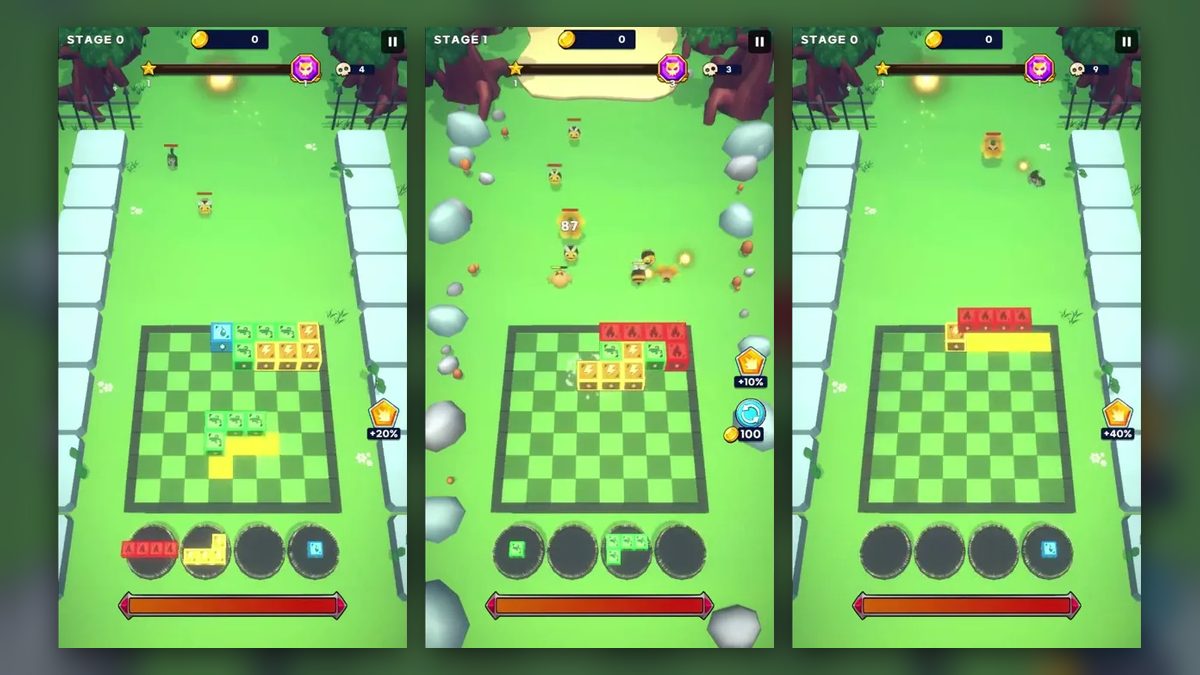
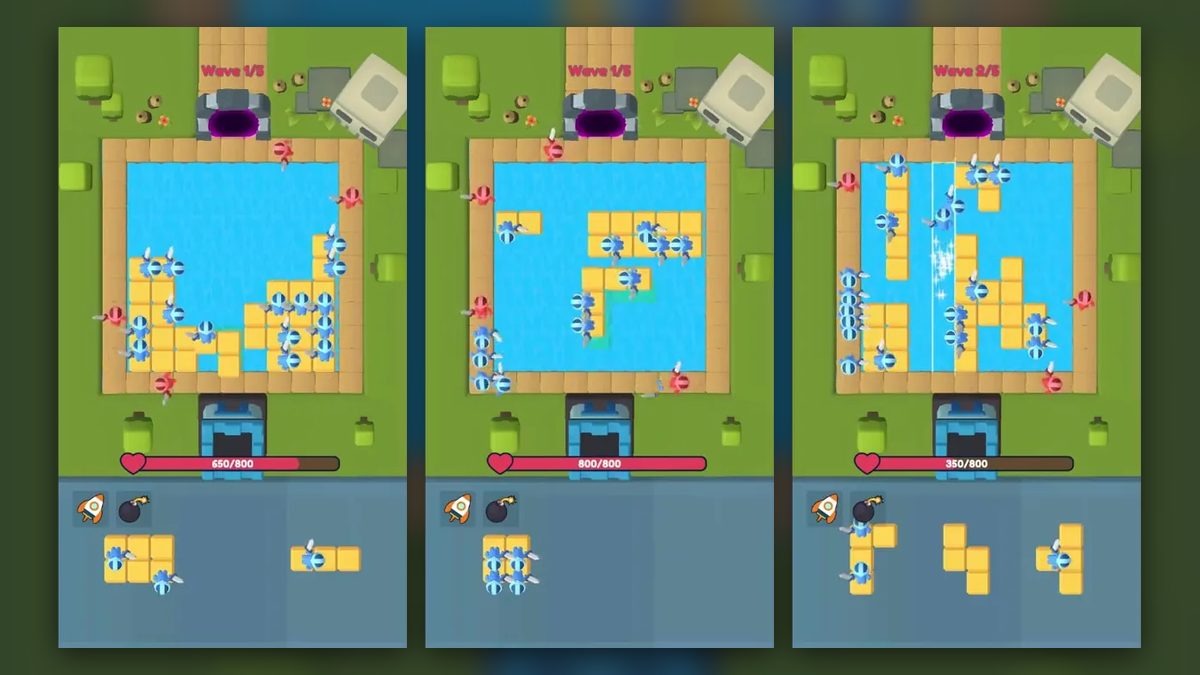
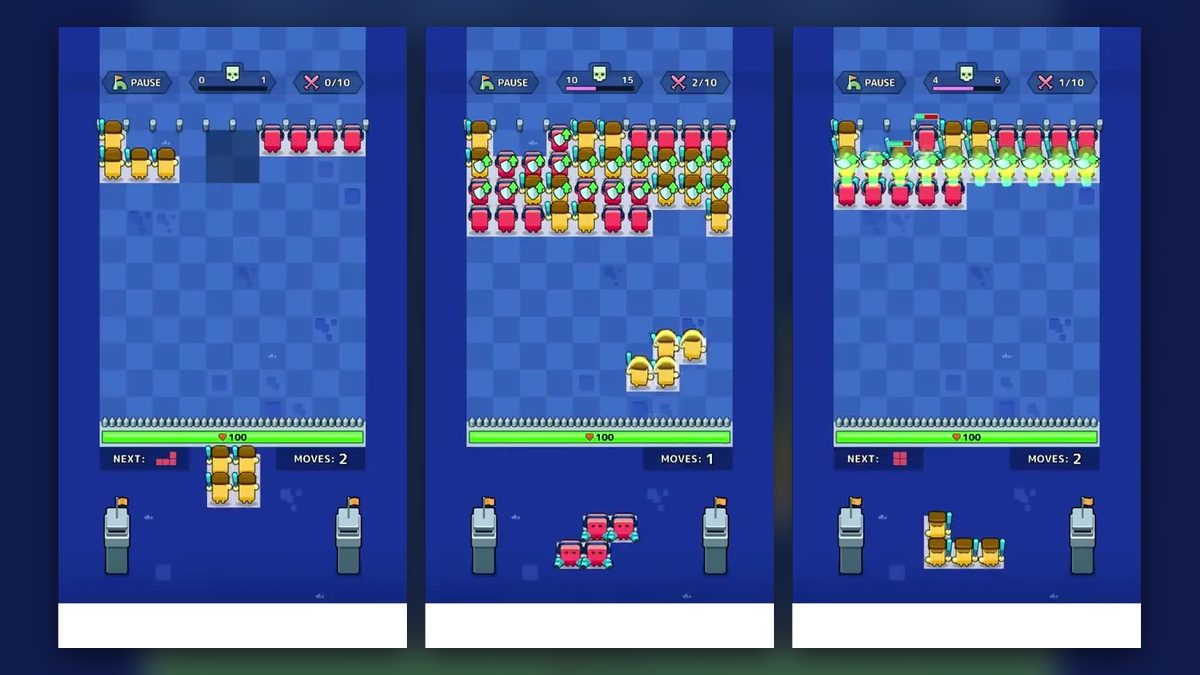
The field is a blue checkered grid ten columns wide, shown whole from above, with posts lining its upper edge. A row of gray spikes with a green health bar crosses the lower part, and under it the piece tray waits between two gray towers flying orange flags.
A PAUSE button occupies the top-left corner and a skull meter the top center. In the opposite corner, a crossed-swords counter climbs toward 10, one step after every battle. No victory or results screen came up, so what reaching 10 does is something we can’t say.
Blocks vs Zombies gameplay comes in two alternating phases. During placement, squads join a formation that hangs from the posts, with no timer on screen. During a battle, a ‘REINFORCEMENTS IN:’ countdown ring takes the tray’s place and zombies attack the formation from above. Perk picks interrupt the fighting, and once a battle ends the counter ticks up and placement begins again.
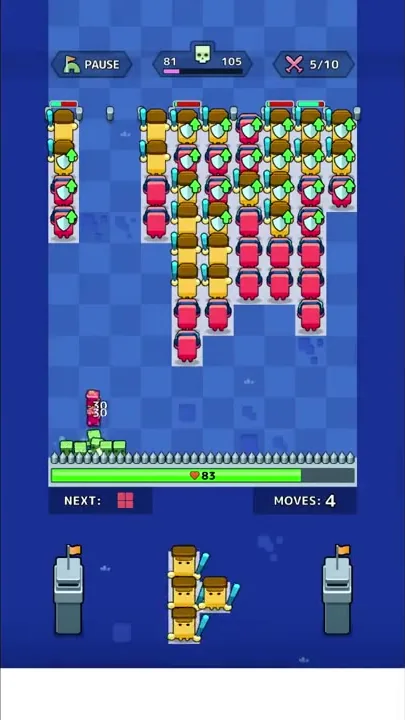
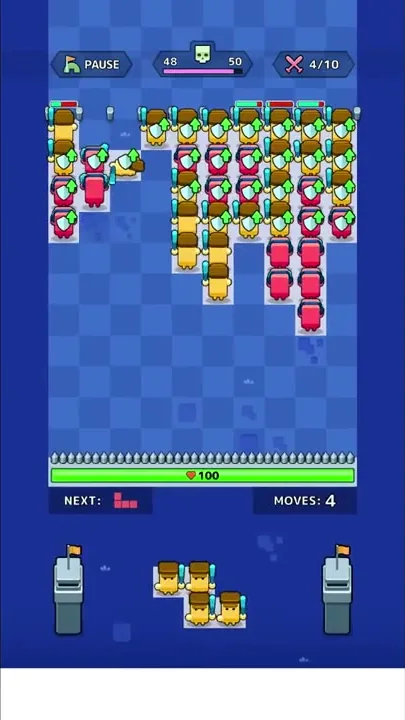
One squad waits in the tray at a time, and ‘NEXT:’ shows a small icon of the following squad in its shape and color. Each squad is a single color, yellow or red, and locks against the posts or against units already in place, so the formation grows downward.
Early in the first placement phase, a yellow L hangs across the three left columns and a red line spans the four on the right. The yellow 2x2 square in the tray casts a dark shadow onto the two middle columns, with ‘MOVES: 2’ beside it, and a few seconds later the square stands exactly there. Then a ‘WAVE 1 IS COMING’ banner crosses the field, the reinforcement ring starts its count at 20, and a few green zombies soon drop in to fight the top row.
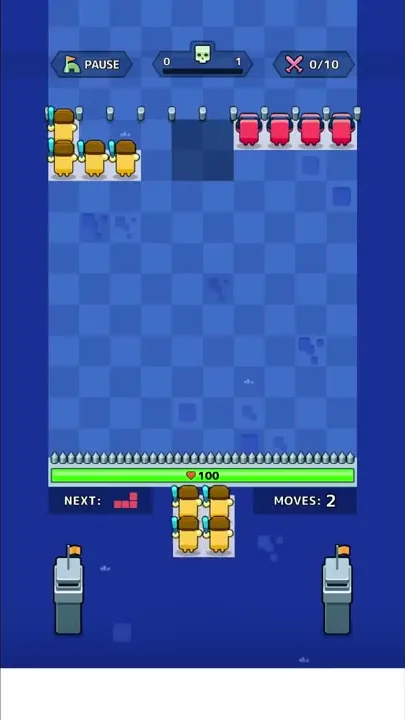
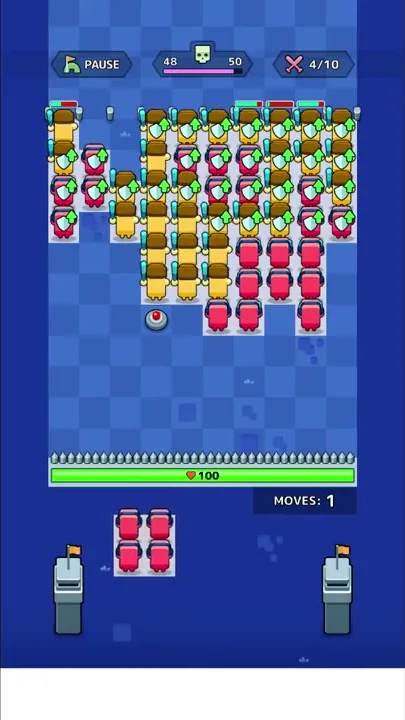
Squads leave the tray between the two towers and cross the open grid to their spot in the formation, glowing on the way. A ‘MOVES:’ count beside the tray limits placements. Early in a placement phase it offers 4, it drops as squads go in, and at ‘MOVES: 0’ the next battle starts.
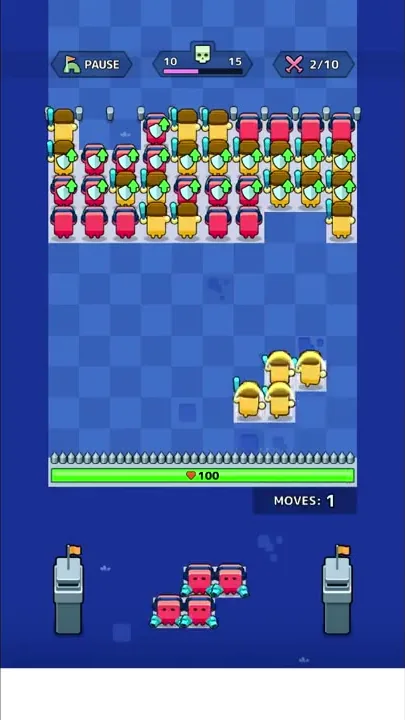
A row filled across all ten columns flashes bright green. Nothing is cleared: the soldiers stay where they are, and each unit in that row now wears a small green badge. Filled rows keep piling up this way, and by the third battle several badge-marked rows crown the formation.
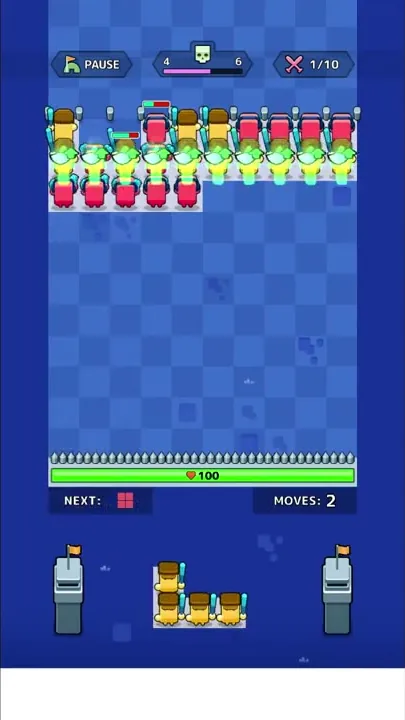
The zombies are small and boxy, mostly green, with pinkish-red ones among them. They come down from beyond the screen’s upper edge and fight the formation’s top row, while damage numbers such as -5.5 and -6 float over each scuffle.
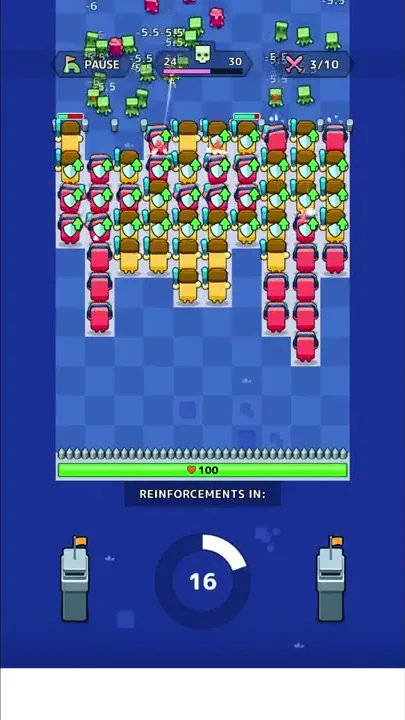
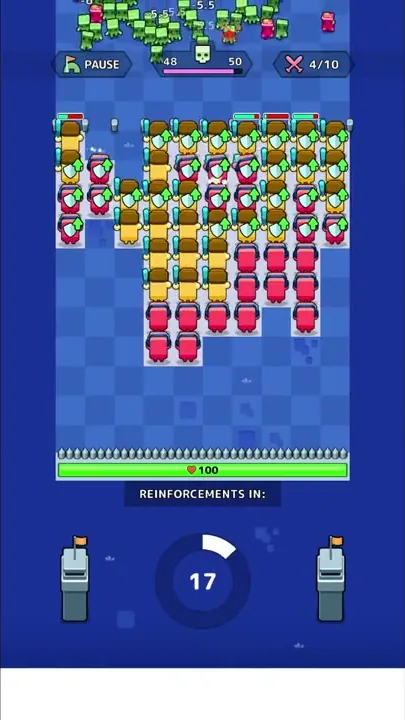
Any open column is a way through. Zombies walk straight down gaps in the formation: in the first battle a green zombie already turns up below the soldiers in the second column from the left, where the top cell is empty. Late in the run a whole stream pours down an opening on the left side. Soldiers take hits too, shown by small health bars over damaged units, and lost units leave new gaps behind.
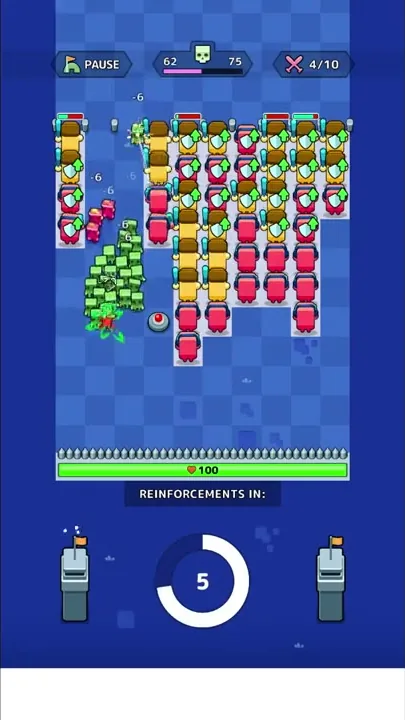
Zombies that slip through head for the spiked wall, which has a health bar of its own. It stays full for most of the run, but once the stream from the left reaches it, the bar drops from 100 to 83 and then to 74. The two towers stand on either side of the tray, and the perk cards treat them as something to upgrade, with bonuses to fire rate and range.
The skull meter holds two numbers. The left one climbs during battles, and when it nears or reaches the right one, the action stops for a ‘Choose one perk card’ screen over the dimmed battlefield. Five of the six screens offer three cards, and one offers only two.
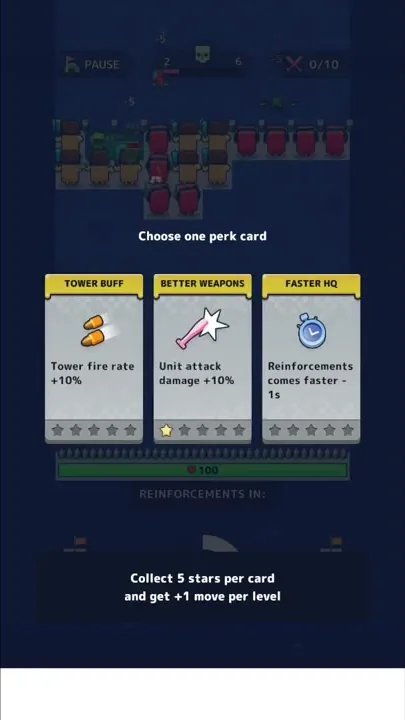
On the tower side, ‘TOWER BUFF’ means ‘Tower fire rate +10%’ and ‘TOWER SEES FAR’ means ‘Tower range +10%’. ‘BETTER WEAPONS’ and ‘UNIT TRAINING’ raise unit attack damage and critical hit chance by 10% each, and ‘FASTER HQ’ makes reinforcements arrive 1s sooner. ‘FIX WALL’ repairs the wall by 25%, while ‘BETTER WALL’ cuts the damage it takes by 15%. ‘LAZY ZOMBIES’ slows the zombies by 5%, and ‘SURPRISE BOYS!’ raises a unit’s chance of dropping a mine by 15%.
A round gray mine with a red top, drawn like the icon on the ‘SURPRISE BOYS!’ card, appears just below the formation in the fifth placement phase. In the next battle the zombie stream from the left gap passes right beside it. Large ‘1000’ numbers then float near that spot behind the following perk screen, and by the next placement phase the mine is gone.
As the sixth placement phase opens, with zombies that broke through still near the wall, a tutorial overlay dims the game. It shows a drawn hand holding a phone, the thumb resting on the lower part of its screen. On that phone, a yellow piece and the words ‘LAUNCH TO SQUASH’ share the upper end of a blue checkered field, with green splats in the middle. Shortly afterward, a yellow squad is out in the middle of the field on the left side.
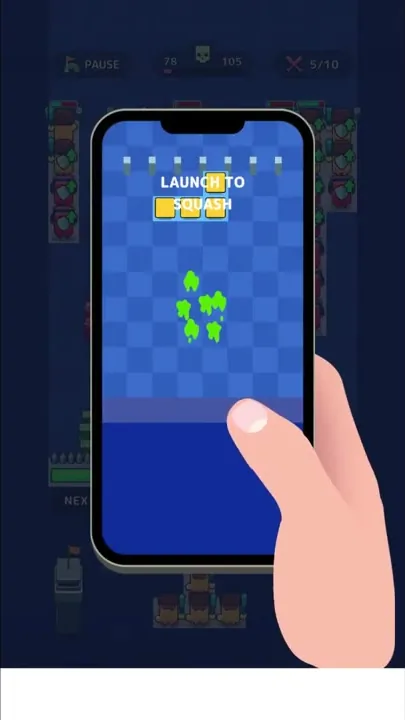
Wave banners and a thickening horde
Pink ribbon banners announce the waves: ‘WAVE 1 IS COMING’ opens the first battle and ‘WAVE 3 IS COMING’ the third. Over those first three battles the formation fills out from a few squads under the posts into several full, badge-marked rows, and the wall’s health bar stays full.
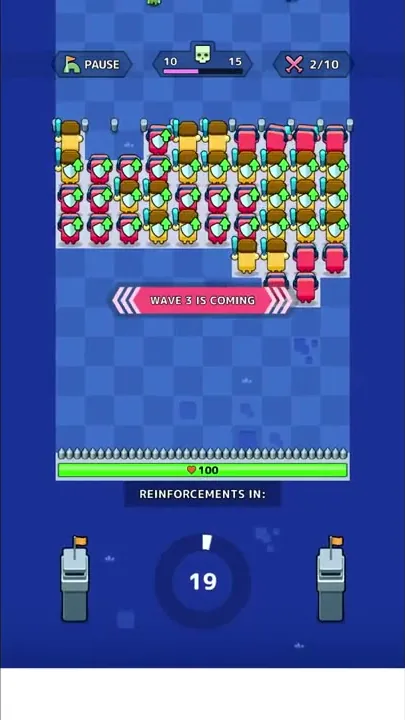
The zombie groups grow over the run. The first battle sends only a few. In the fourth, a larger crowd of green zombies, red ones mixed in, hits the formation’s top row, and by the next placement phase much of its left side is gone.
The fifth battle is the densest yet, a horde packed along the upper screen. It funnels down through the gap on the left and becomes the first group to reach the wall and cut into its health.
The skull meter asks for more with each pick: its mark starts at 1 for the first card, climbs through 6, 15, 30, 50 and 75, and moves to 105 after the sixth.
Each perk card also carries a row of five star slots, and a few show the first star filled in gold: ‘BETTER WEAPONS’ on the very first perk screen, and later ‘FIX WALL’ and ‘BETTER WALL’. Every perk screen repeats the same line at the bottom: ‘Collect 5 stars per card and get +1 move per level.’
Bright squads and a Tetris crossover
Blocks vs Zombies is very eye-catching, without question. On the field, chunky cartoon soldiers fill the grid, the yellow ones in brown helmets with cyan swords and the red ones in dark helmets, and a completed row lights up in a green flash that spans the field. Later battles pack the space above the formation with green and pinkish-red zombies under clouds of floating damage numbers.
The way the game is put together is interesting as well. Splicing Tetris onto other kinds of play is a very interesting line of thinking, and here the parts take turns: squads go in under a NEXT preview, a battle plays out on the reinforcement countdown with no squad to place, and a perk pick cuts in when the skull meter nears or reaches its mark.
Line-clearing logic in a zombie defense
The doubt starts at the core. At heart, Tetris is about clearing lines, and that clearing strategy and logic can easily fail to connect with the genre it is paired with. Whether the new rules agree with the block rules at their core needs careful thought; without that, many hybrids seem interesting at the pitch stage and then fail the real test of the market and its players.
Staying power is the other open question: over the long term, it may not be much fun. The crossed-swords counter never got past its halfway mark, so later waves and the way a run ends remain unknown.
Plugging gaps between zombie waves
Each placement phase is a small spatial puzzle: a few squads fitted into the formation, the NEXT icon showing what follows, and open columns standing as paths for the zombies. Between those turns, the choices come from perk cards, each tuning one part of the fight, from tower range to zombie speed.
The squads are block shapes set into a grid, which sets the game beside games like block blast, while its battles give fans of hold-the-line defense a formation to watch as it soaks up each wave.
Verdict
Soldiers shaped into Tetris pieces, with perk picks breaking into the battles, make an interesting combination and a very eye-catching one. Two doubts weigh against it: Tetris is built on clearing lines, and that logic may not connect with the defense it is paired with, which leaves open whether the two share one core; and the fun may wear thin over long play.