Idle Royal Stories Review: A Pastel Ballroom Tycoon
This Idle Royal Stories review tours a pastel mansion where coin upgrades turn the ballroom's upright piano into a grand one.
Game at a glance
Idle Royal Stories
8/ 10
Our score
The one thing every idle tycoon must have: a look you never tire of.
In this article6 sections
Most idle tycoon games run on the same loop. You spend coins on upgrades so the business earns faster, then put the bigger income into the next upgrade. Idle Royal Stories, a mobile idle tycoon game, keeps that loop but sets it in a pastel aristocratic mansion. The business is a ball, and the upgrades are things in the room, from the drinks to the chairs.
Where it stands out is the setting. Women in long gowns drift onto the dance floor while a pianist and two instrument players perform beside the piano, and several upgrades show up in the room itself. The look and the setting are the main draw, and the interface around them is made with the same care.
Furnishing the ballroom for paying guests
In the short early session we played, everything takes place in one mansion, moving between the Registration hall, the Ballroom and the Office. There is no win screen, and there are no numbered levels. Instead, each room’s panel names a target such as “First build: Ballroom, Level 2” under a warning sign, and a percentage meter at the top of the panel rises as that room’s items are upgraded. The Office panel has a meter but no target line.
No fail screen appears, and there are no lives or move limits. The limits on screen are the coin price on every upgrade and purchase, plus the timers attached to some of them.
Every action shown is a tap. Opening a room’s panel zooms the camera into that room, and the panel fills the lower half of the portrait screen; tapping one of its item slots highlights it in blue and shows the item’s details above the grid. Quest cards open a pop-up with a GO button, and every pop-up closes with a red X. The view also moves across the mansion, from the entrance out to the gardens, though the gesture that moves it never shows.
At its center, Idle Royal Stories gameplay is a spend-and-earn cycle. Coins go into an UPGRADE or BUY button, and the Ballroom fills with guests while the players perform. An “Income: +4” label shows coins arriving, and guests on the dance floor drop bigger bursts on top of that. Quest rewards pay extra along the way, and it all goes into the next upgrade.
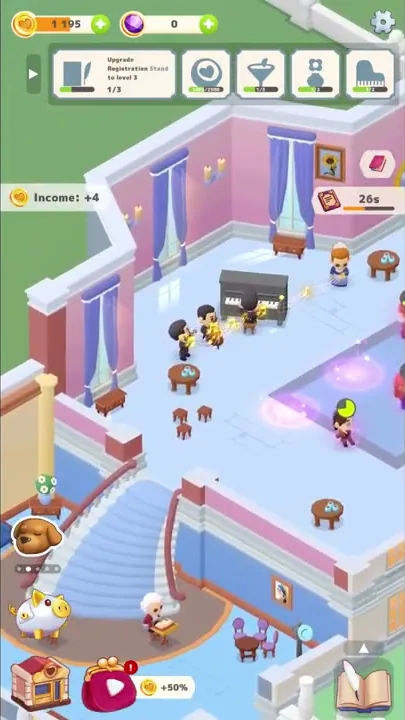
Each room holds a grid of item slots, and each working slot shows its item’s level number. Some slots carry green up arrows or green plus badges, and some are grayed out. Selecting one opens a card where the item’s name and level sit beside a one-line description, usually with a coin rate underneath and an UPGRADE button showing the price.
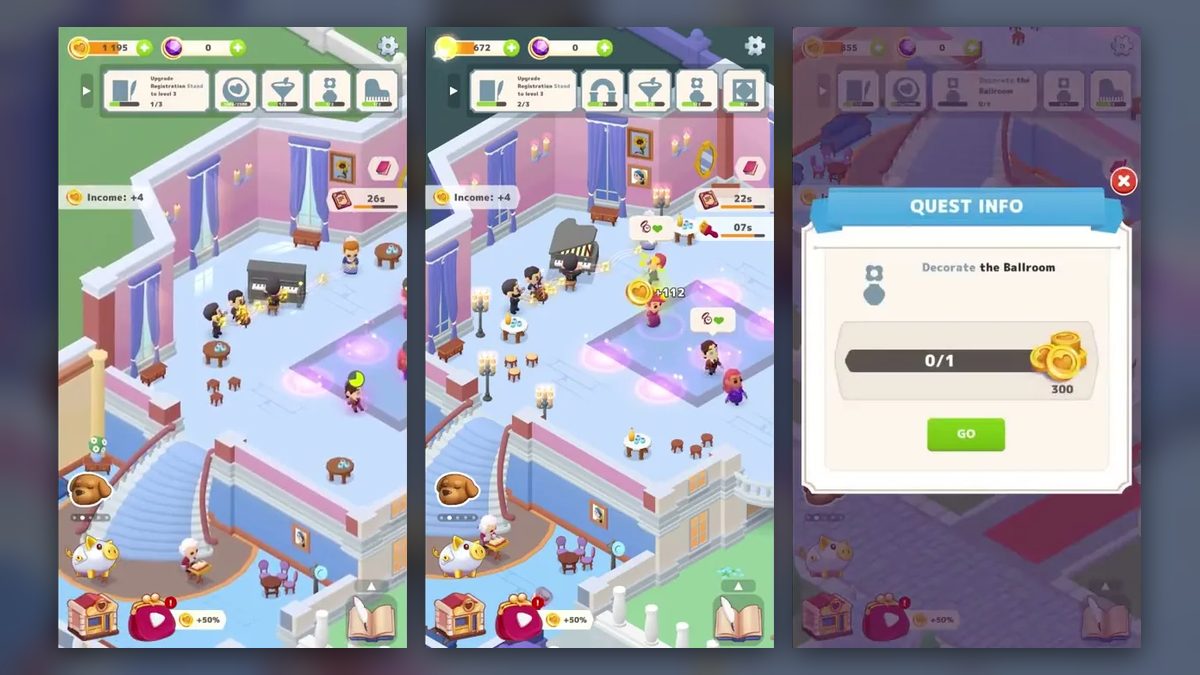
The Ballroom is a hall with pink walls and blue-violet curtained windows, and the piano and its players stand at the back left. To the right lies a square dance floor with glowing pink spots and small round wooden tables and stools spread around it, and a grand staircase leads down to the Registration hall. The Ballroom grid has two rows of four slots with a gold harp slot below. The items named on screen are DRINKS, DANCE FLOOR, BALLROOM DECORATION and CHAIRS, and a quest names the piano.
When the session opens, the DRINKS card is selected with an UPGRADE price of 300 coins, and the decoration slot is still grayed out under a plus badge. By the time DRINKS reaches Level 2, Ballroom Decoration has turned into a working item with a level number of its own, and its next upgrade costs 240 coins. Its card reads “It’s more fun to dance when the room is prettier!”
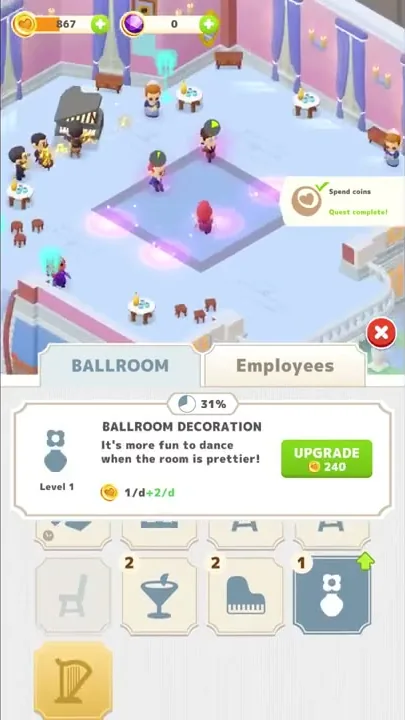
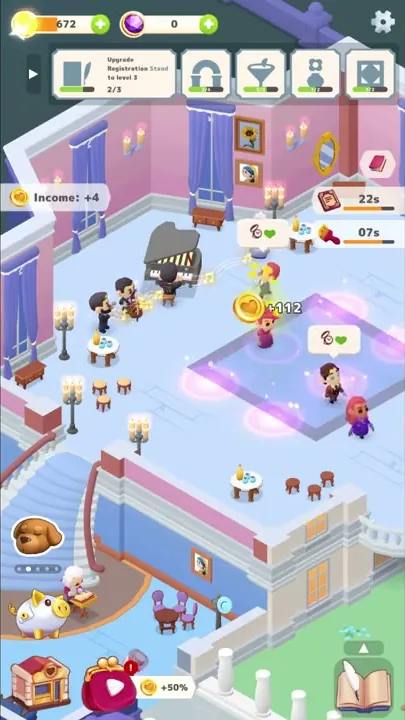
Guests walk between the Registration hall and the Ballroom and gather on the dance floor, while gold sparkles surround the players by the piano. Green circular progress markers hang over some guests’ heads. Guests also drop coin bursts marked +112, and speech bubbles with a small icon and a green heart appear above some of them.
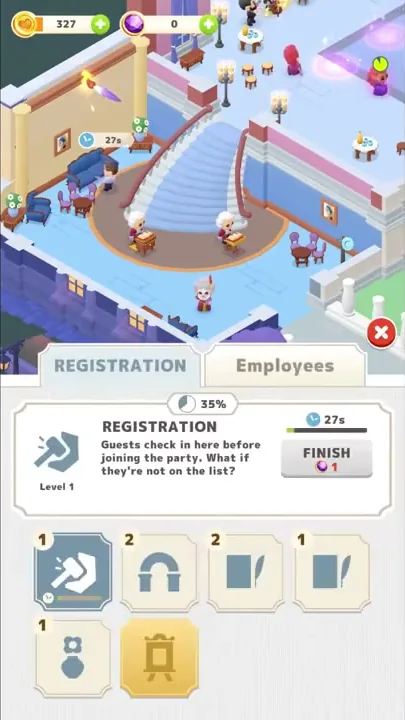
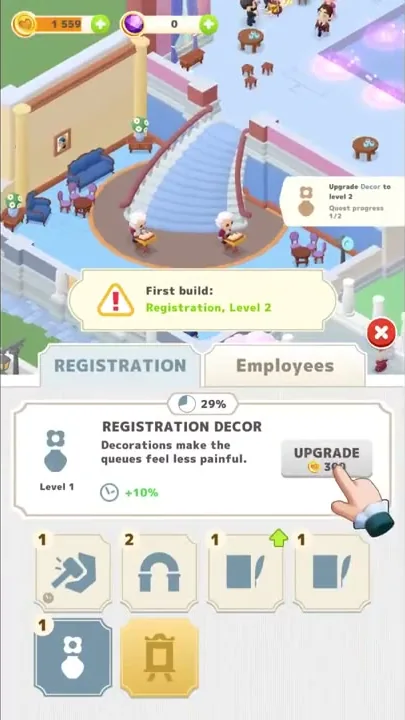
The Registration hall is a semicircular landing at the foot of a blue grand staircase. Two white-haired clerks sit at small desks there, with blue sofas and purple chairs around them. Its grid has six slots: four across the top, then a vase slot next to a gold easel slot. The items named there are REGISTRATION and REGISTRATION DECOR, and quests also mention a Registration Stand and the Entrance.
Some upgrades take time. The REGISTRATION card shows a 30-second timer next to an UPGRADE button priced at 500 coins. Once it is bought, the button is replaced by a countdown bar and a FINISH button that ends the wait for 1 gem. Meanwhile a small timer bubble hangs over the room, and a timer with a red tool icon sits on the right edge of the main screen until the work is done.
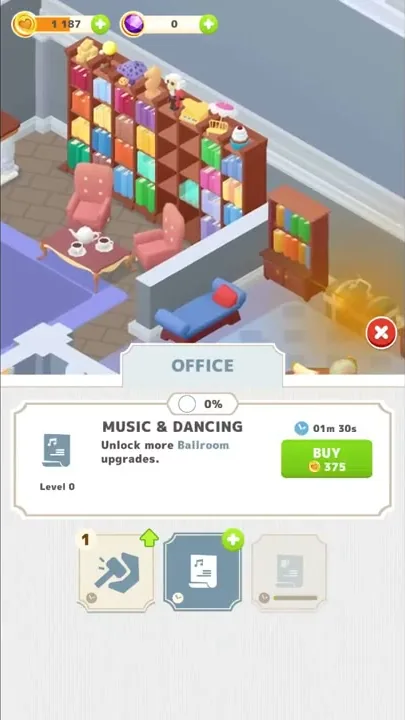
The Office is a study lined with tall bookshelves of colorful books. Pink armchairs face a tea table, and a blue chaise stands nearby. Its grid holds three slots in one row, and the Office card that was opened sells timed research. The card reads “Unlock more Ballroom upgrades.” and offers a BUY button for 375 coins with a timer of 1 minute 30 seconds. While research runs, a red book icon with a countdown sits on the right edge of the main screen.
A CHOOSE NEXT GUEST screen lays out named guest cards. Each card has an oval portrait and a “1” badge, with a small icon in one corner and two hexagon badges under the name, and the highlighted card spells out one perk per hexagon. John Cheers, a mustached man in a dark suit, offers “Increases rewards from after party chest +40%” and “Political Party: Collect 4 Politician: Reduce All Upgrade Cost -25%”. REROLL and INVITE buttons sit below.

A later visit to the screen shows three guests side by side, James Pau Dersman, Bernard Chalet and Charles Bingo, with the INVITE button grayed out. On the main screen, a portrait of a mustached man with a green plus sits on the left edge.
Early on, a white-gloved pointing hand shows which button to press, hovering over UPGRADE and BUY in each of the three room panels. One of its first taps lands on REGISTRATION DECOR, whose card reads “Decorations make the queues feel less painful.”
From upright piano to candlelit ballroom
Progress is tracked room by room. Each upgrade pushes a room’s meter toward its named target, and over the session the Ballroom meter climbed from 13% to 41%.
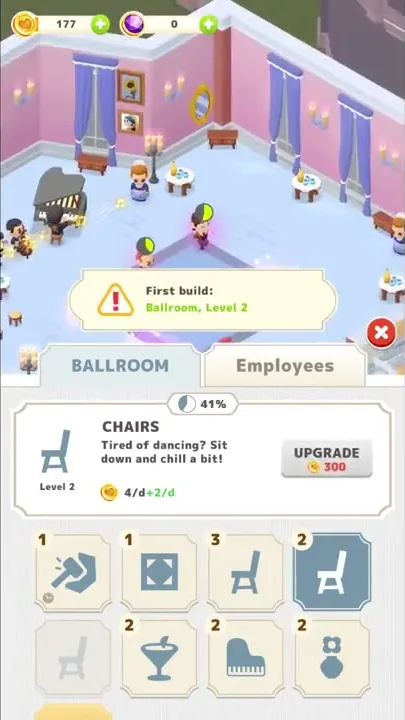
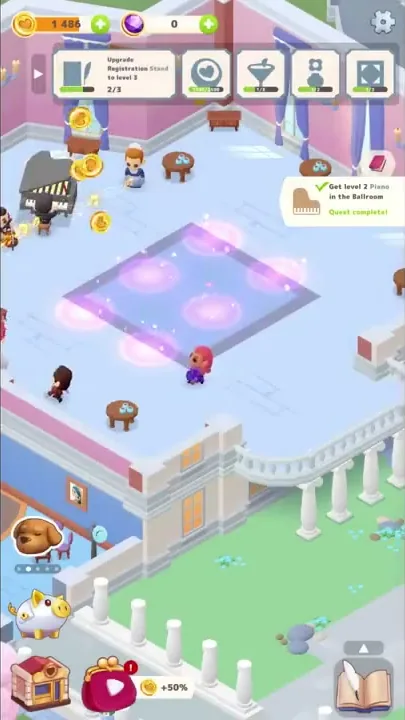
Upgrades also change how the Ballroom looks. The upright piano at the back becomes a grand piano when the quest for a Level 2 piano completes. After DRINKS reaches Level 2, the small tables get white cloths and bottles, and once the decoration slot reaches 2, standing candelabras line the hall.
Some grayed slots carrying a green plus badge turn into working items. The Ballroom decoration slot starts out that way and later carries a level number like the others, and a grayed chair slot with a plus later holds CHAIRS at Level 2. The Office research card says the same, promising more Ballroom upgrades.
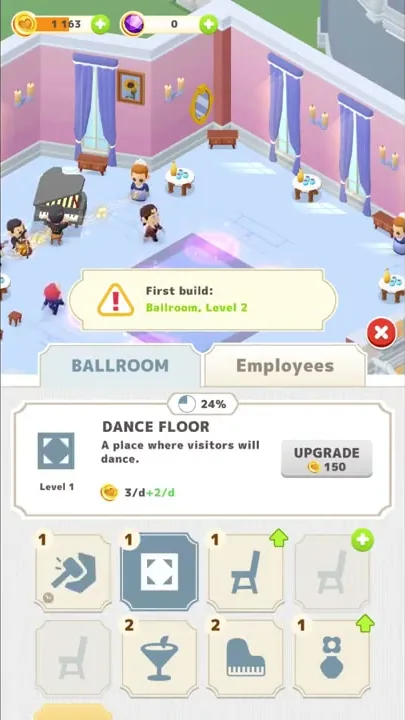
Coins are the main currency, counted at the top left next to a green plus. They pay for every upgrade and every research card, and in our session they came from three sources: the steady “Income: +4” trickle, the +112 bursts that guests drop and quest rewards. Completing “Decorate the Ballroom” sends a stream of coins across the hall under a large +300.
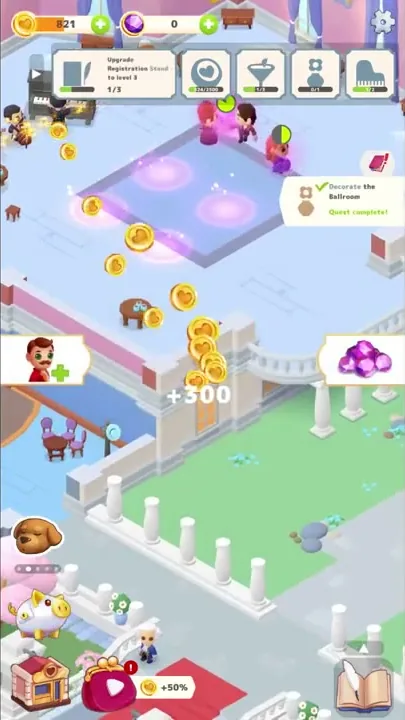
Gems are a second, purple currency with their own counter and green plus at the top. The counter stays empty the whole time, and the only gem price on screen is the 1-gem FINISH button that skips an upgrade timer. A bubble holding a pile of purple gems also floats on the right edge of the main screen, but it is never opened.
A bar of five quest cards runs across the top of the main screen. One card, usually the first, is wide enough to spell out its task and progress, such as upgrading the Entrance to Level 2, at 1/2. Tapping a card opens QUEST INFO, which shows the task and a progress bar next to a coin reward and a GO button. Rewards shown are 300 coins for “Decorate the Ballroom” and 400 each for the piano and Registration Stand quests, and finished quests show a “Quest complete!” tag. The decoration and piano quests were both cleared, along with a “Spend coins” quest.
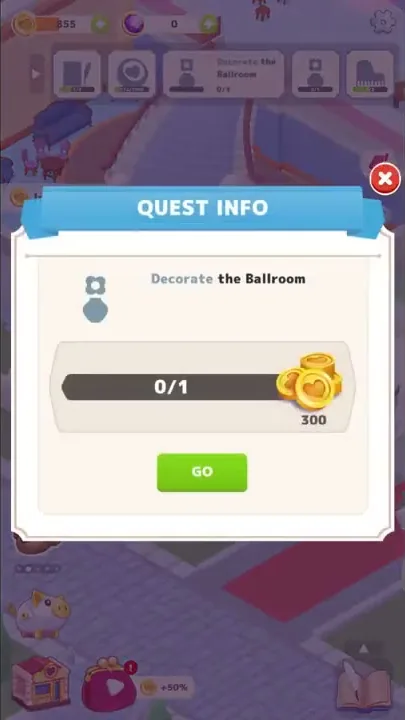
At the bottom of the main screen, a red purse icon with a white play triangle and a red “!” badge sits next to a coin label reading “+50%”. A piggy bank and a small house icon sit at the lower left, with a book-and-quill icon at the lower right and a gear at the top right. A portrait button on the left edge, with a row of dots under it, shows a dog for most of the session and later an old man in a beret. None of these is opened, and no ad of any kind appears.
A pastel mansion made for long looking
Idle Royal Stories is another game that drew us in with its look and its setting. The rooms are isometric 3D cartoon scenes in a pastel palette: the Ballroom has pink walls and blue-violet curtains, and pink blossom trees stand around the mansion outside. The cover art reminded us of Seurat’s painting A Sunday Afternoon on the Island of La Grande Jatte.
The setting is a classical aristocratic house drawn in a Western 3D cartoon style. White-haired clerks staff the registration desks downstairs. Upstairs, men in dark suits gather at the piano while women in long gowns take the dance floor, and every figure is chunky and rounded. The same studio’s other games also have a nicely done look, and anyone drawn to this style can seek them out.
The interface is just as polished, and so are the animations and effects, which suit an idle tycoon well. Panels look like cream parchment with green buttons and round red close buttons, and the highlighted guest card sets its portrait in a gold oval. When a quest finishes, coins stream across the hall, and on the dance floor pink spots glow under a scatter of sparkles.
The whole game keeps an elegant, easygoing tone. In our view, an idle tycoon game has to be something a player can keep looking at for a long time.
Unopened menus and an unreached Level 2 target
There are no complaints to list here. The limits are about what stayed out of view: neither the Ballroom nor the Registration hall reached its Level 2 target, so what a finished first build unlocks remains unknown, and no rooms beyond these three came into play.
The Employees tab in the Ballroom and Registration panels stays closed throughout. The after-party chest named on John Cheers’ card never turns up, and no shop screen or gem offer appears.
Tapping upgrades while the dance floor fills
Each visit follows the same cycle: open a room panel, spend coins on an item, then look at the room again. The cycle fits a taste for furnishing a space one piece at a time, since several upgrades appear in the room itself. There are no puzzles to solve and no fail state. The decisions are which item or research card to buy next, and whether to wait out a timer or skip it with a gem.
The guest cards offer a second goal for collectors. Each card carries perks, and John Cheers’ Political Party bonus cuts all upgrade costs once 4 Politicians are collected.
Verdict
Idle Royal Stories makes its case through presentation. Its look and its classical setting are what pull a player in, and the interface and effects are made to the same standard, all in a graceful, lighthearted tone. A tycoon game of this kind has to hold up to hours of looking, and this one looks the part.