Laundry Mart Review: Every Matched Set Goes in the Wash
A Laundry Mart review: matched sets of clothes drop into three washers, and each finished wash pays cash for capacity and speed upgrades.
Game at a glance
Laundry Mart
7/ 10
Our score
The matching earns the money and the upgrades spend it, a fresh way to run a tile match.
In this article6 sections
In pick-three-of-a-kind matching from a pile of 3D objects, a finished trio clears off the board and is gone. Laundry Mart, a laundromat take on tile match games, gives every trio somewhere to go. The pieces are clothes heaped on a wooden floor, and each matched set drops into one of three washing machines under the tray.
When a wash finishes, the machine pays out cash, and the cash buys upgrades for the washers. That makes it a triple-tile matching puzzle with a very light management sim and some idle washing built in underneath, a twist on the formula that comes off fresh. Its early numbers move a bit slowly, though.
From the clothing heap into the washers
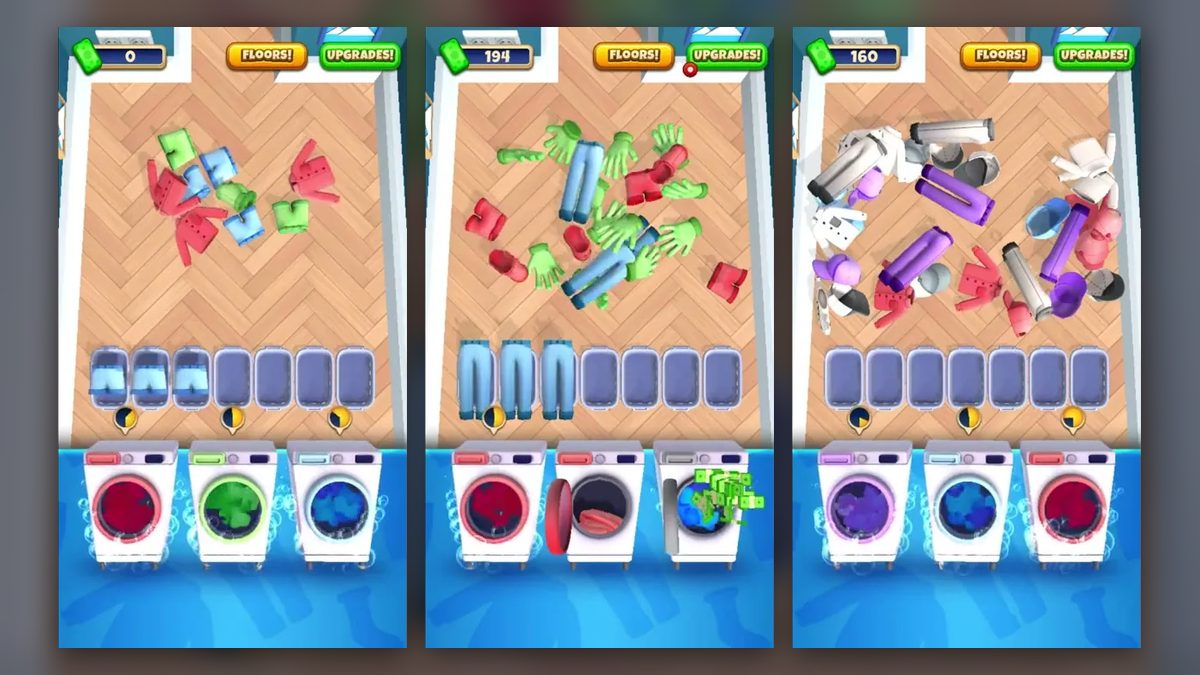
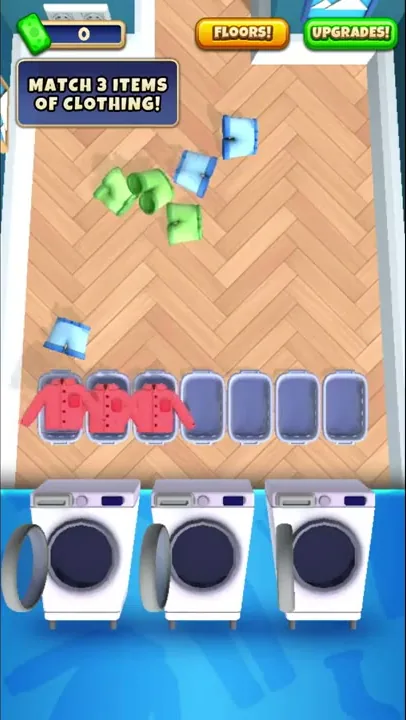
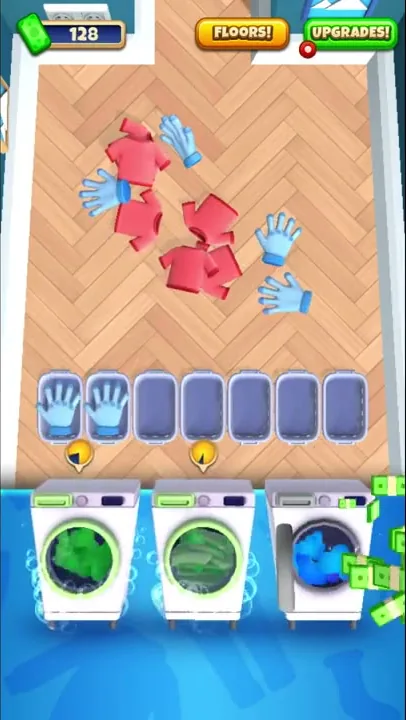
A hint on the first screen sets the goal: “MATCH 3 ITEMS OF CLOTHING!” Garments lie in a heap on a herringbone wood floor, and each one picked goes into a tray of seven slots. Three identical garments leave the tray together and drop into one of the three front-loading washers at the bottom, which takes on their color and starts to spin.
Washing is the second half of Laundry Mart gameplay, and it is where the money comes from. A running machine has a small round marker above it, and cash comes out when its wash ends. Play is split into loads: once the floor is clear, a new batch of clothes falls in. We played five loads, and the fifth was still on the floor at the end.
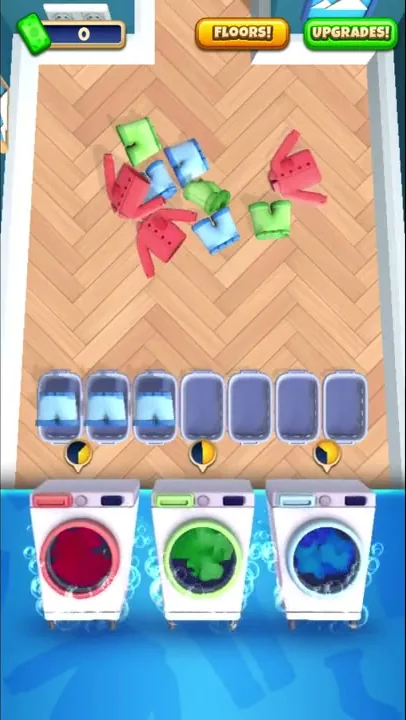
Garments come off the heap one at a time and fly down into the tray. Two pill-shaped buttons share the upper right corner of the screen, a yellow “FLOORS!” and a green “UPGRADES!”, with the cash total facing them from the opposite corner.
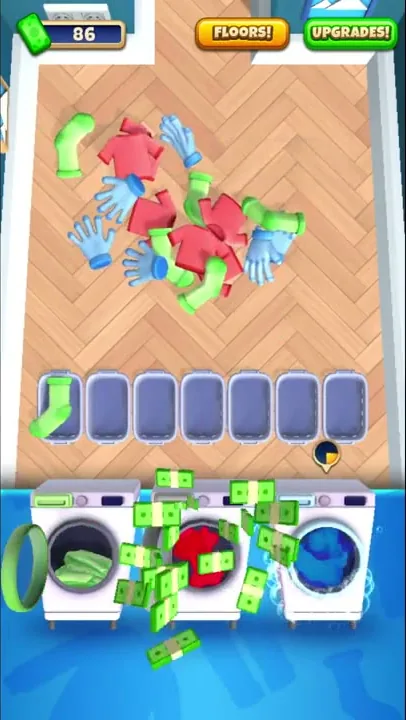
The heap itself is made of chunky, brightly colored 3D garments piled over one another, and each load uses its own garment types. In the fourth load, green gloves are the most common piece, scattered among light blue jeans and small red garments.
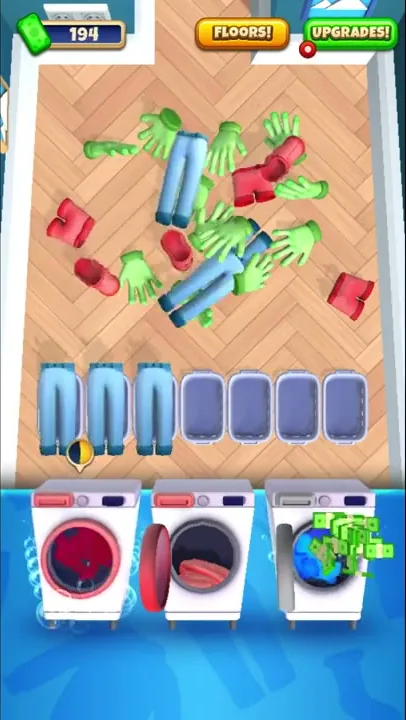
The tray is a row of seven translucent slots between the floor and the machines. A finished set leaves only when a washer can take it, so the tray doubles as a waiting area.
Red button shirts mixed with light blue shorts and green shorts make up the second load, which falls in while the first three sets are still washing. Three light blue shorts reach the tray first and three shirts follow. With every machine busy, both sets stay put, filling six of the seven slots. Once machines free up they move on, and by the time the floor is empty, three green shorts are waiting while all three washers run. What a completely full tray leads to, we can’t say.
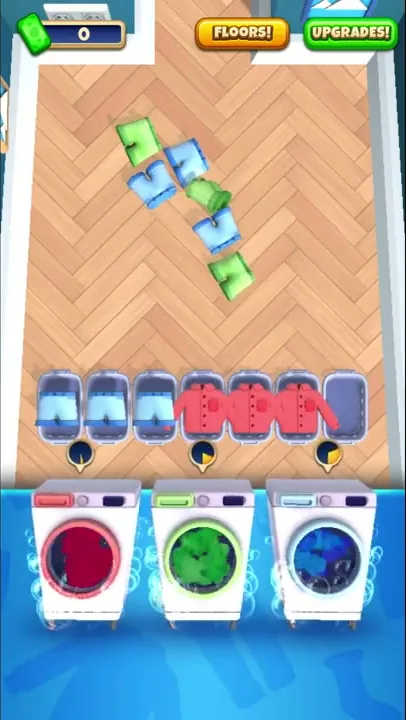
Once a batch is cleared and the floor is bare wood, the next one tumbles in. The second and fourth loads arrive under a large gold “NEW LOAD!” banner.
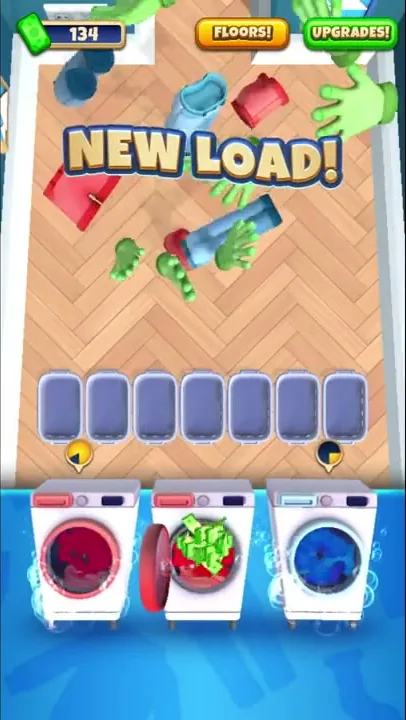
A washer that receives a set takes on the clothes’ color at its door ring and at the indicator strip on its top left, then spins with bubbles around the drum. An empty one has a gray strip and an open door. Two machines can run the same color at once: two blue loads run together as the second load is cleared, and two red ones spin side by side late in the fifth.
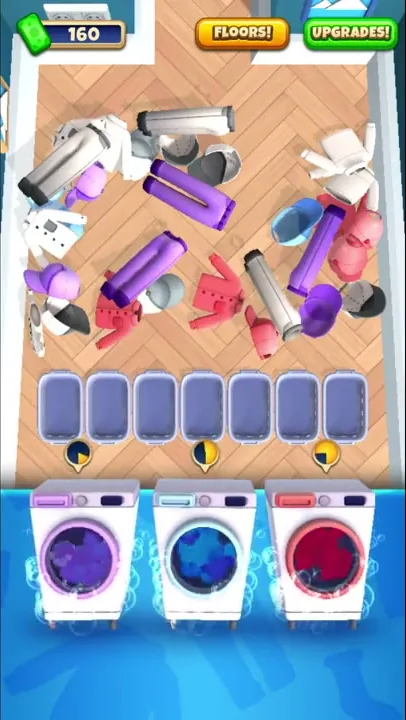
A washer can also stand open with clothes inside and no marker above it, and more sets of its color keep going in. In the fifth load, three light blue jeans leave the tray for the light blue machine, which then holds a bigger pile. For a stretch all three machines wait like this, each with clothes inside, until the purple one starts spinning and the other two follow. The same open state shows up earlier with green socks in the left machine and red clothes in the middle one.
New garment types each load, then a deeper heap
The opening load is small. Three red button shirts already sit in the tray, while three green tops and three light blue shorts lie on the floor. The washers wait empty with their doors open, and the hint hangs at the top of the screen.
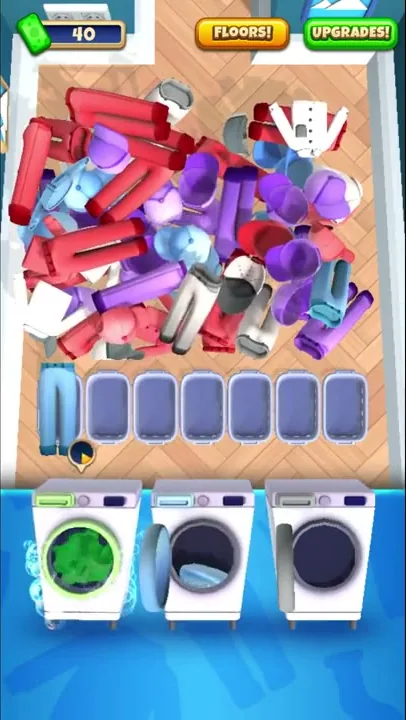
The next three batches each swap in new garment types while sticking to three colors. The shirts and shorts of the second load give way to green socks, red T-shirts and light blue gloves in the third, and the fourth spreads green gloves among light blue jeans and small red garments.
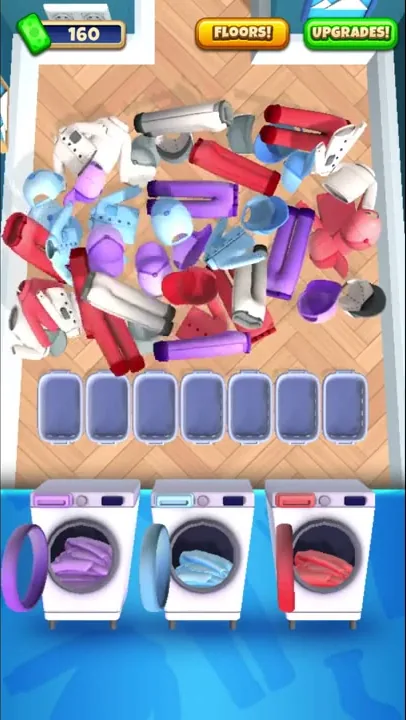
The fifth load changes scale. Early on, a dense heap stacked in layers covers most of the floor, mixing pants, jeans, baseball caps, button shirts and jackets in red, light blue, purple, white and gray. Later it has thinned to white shirts and gray-and-black caps, plus a few light blue caps.
The only currency seen is cash, tracked in a box with a green banknote icon in the screen’s upper left. When a wash finishes, green banknotes burst out of the machine and the total climbs.
The green “UPGRADES!” button opens a panel titled “UPGRADES” over the dimmed board, closed with a red X in its top-right corner. It holds four cards: Washer Capacity marked “+3”, Washer Speed marked “- 12%” with a spinning-drum icon, Income marked “+ 32%” with a banknote icon, and “AUTO,” which shows a washer and a shirt with circular arrows above the word “Locked.” On the visit pictured, Washer Capacity and Washer Speed have gold faces in blue frames, while Income and AUTO are gray.
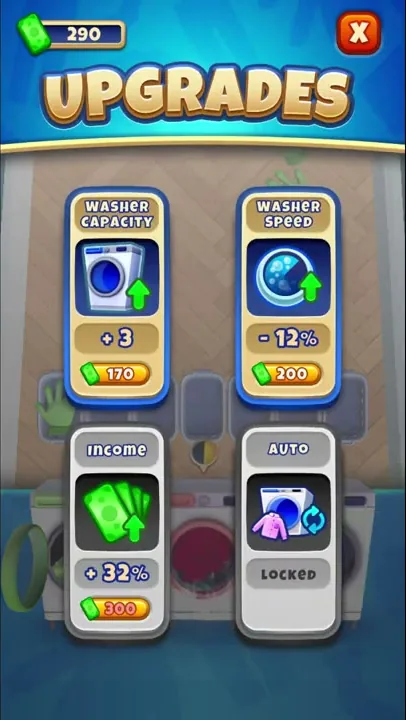
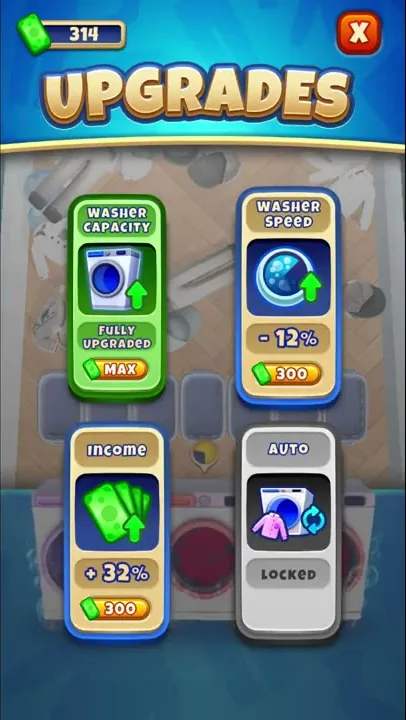
Two of the prices climb over time. Washer Capacity costs 100 at first and 170 after that, and later its card turns green and reads “FULLY UPGRADED” with a “MAX” tag. Washer Speed goes from 200 to 300, and Income is priced at 300 on the first visit and the last, when AUTO still reads “Locked.”
A yellow “FLOORS!” button sits beside “UPGRADES!”, but it was left unopened, so where it leads is unknown. A small red dot shows up now and then on the corner of the “UPGRADES!” button.
Washers under the tray, cash for the upgrades
The washers under the tray are the new idea here, and we found this blend of light management and idle washing on top of triple matching very fresh. In the second load, three light blue shorts are already lined up in the tray while all three machines are still spinning the first load’s sets.
The money follows the same plan. The core loop earns, with banknotes flying out of each finished wash, and the outer system spends that cash on the upgrade panel, where the Washer Capacity price climbs from 100 to 170 before the card hits MAX. One part that makes money and another that uses it is a new way to frame a matching game.
The laundromat premise is in the pieces themselves: socks and caps on a wood floor, machines that wash by color, upgrade cards named after the washers. The management on top is kept light.
An early economy that takes its time
The flow of the early numbers drags a bit. An outer layer, such as decorating the laundromat, could also fit around the loop next to the four upgrade cards. The matching already earns the money, and decorating would be one more place to spend it.
Picking laundry while three machines spin
The hands-on part is the triple-tile routine of scanning a heap and pulling out three of a kind into a seven-slot tray. Here the heap is laundry, from a few shirts and shorts on the first screen to a layered pile of caps and pants in the fifth load.
Running next to it is a second job of watching the washers: which ones are busy, which color each holds, whether a finished set has somewhere to go. Every so often the cash goes to the upgrade panel, where prices rise over time and one card can reach its maximum.
Verdict
Laundry Mart gives the familiar triple-tile tray somewhere to send its trios, and that one change turns a matching puzzle into a small laundromat. Money moves from the floor to the panel, an arrangement that is new for this kind of game. The early economy is slow to get going, and the structure has room for an outer layer such as decorating the shop. It lands as a novel idea with a slow start.